
4 Key Precision Steps in Structural Steel Fabrication
Table of Contents
Introduction
The global infrastructure and construction sectors increasingly rely on complex, high-performance metal components. This escalating demand puts immense pressure on manufacturing processes, making accuracy in the production of these load-bearing elements paramount. The process of Structural Steel Fabrication, which encompasses converting raw steel materials (such as coils or sheets) into standardized or customized structural profiles, is fundamentally shifting from manual methods to highly automated, digital solutions.
Achieving true precision in large-scale metal manufacturing requires more than just skilled labor; it demands integration of advanced machinery and intelligent factory systems. When discussing high-quality steel profile production, precision is measured not just in millimeters, but in fractions thereof. For instance, high-strength alloy formwork produced by modern machine groups boasts an r-angle accuracy of less than 0.5°, a length accuracy of less than 0.2 mm, and a hole-to-hole accuracy of ±0.2 mm. This level of fidelity represents an improvement by a factor of 10 times over previous industry standards, which typically hovered around 1–2 mm.
The industry’s embrace of digital factory solutions is driven by the need for tight dimensional tolerances to ensure fit-up and safety in final assembly, whether the end use is in building structures, rail transit, or high-efficiency automotive components. To meet these rigorous standards, fabricators must focus on four key steps where technology and automation intersect to guarantee superior outcomes in structural steel fabrication.
Step 1: Ultra-Precise Material Forming for Structural Steel Fabrication
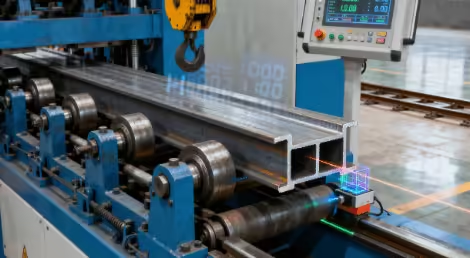
The foundational step in producing high-quality structural elements is material forming. This process dictates the overall geometry and dimensional accuracy of the finished profile. The core technology utilized for large volumes of components, such as C, U, Z, W, and L-shaped profiles, is cold roll forming.
The Role of Cold Roll Forming in Structural Steel Fabrication
Cold roll forming involves continuously passing metal coils—typically galvanized steel, carbon steel, stainless steel, or aluminum—through a series of precision-designed rollers. Each set of rollers gradually bends the material into the final specified shape. This method is chosen for its efficiency and ability to handle materials needed for construction and automotive industries.
Modern roll forming equipment, such as automated C/Z purlin roll forming machines or dedicated W, L, Z-shaped steel forming machines, ensures high production efficiency, with speeds reaching up to 45 meters per minute. High precision is built into the forming machine design to ensure tight dimensional tolerances, often better than ±1mm.
The equipment must maintain consistency across the entire length of the coil, especially when manufacturing specialized high-strength alloy formwork. These components require advanced transmission technology, such as nanometer-level precision transmission, developed through collaborations with institutions like Shandong University, to ensure that the rollers maintain perfect alignment throughout the high-speed process. By optimizing the forming process itself, manufacturers lay the groundwork for high-quality structural steel fabrication, minimizing defects that would require costly rework later in the production line.
Step 2: High-Accuracy Punching and Hole Processing
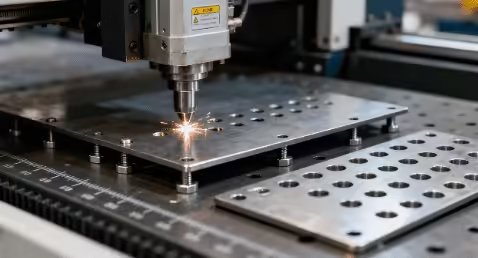
Once the profile is formed, the next critical step for functional structural components is the incorporation of precise holes and slots for connection points. Errors in hole processing—even fractional ones—can render massive sections of a structure unusable or lead to significant time delays during on-site assembly.
Achieving Precise Hole Alignment in Structural Steel Fabrication
High-volume structural steel fabrication requires sophisticated punching equipment integrated directly into the production line. Automated punching systems are essential for guaranteeing both speed and accuracy. For example, automated eight-station punching lines are used primarily for high-efficiency production of profiles like photovoltaic (PV) brackets, delivering precise, flexible, and continuous manufacturing.
These specialized systems, such as the C/U-shaped steel feeding and punching system, ensure that hole processing meets stringent specifications. The required accuracy for hole-to-hole alignment in critical components is often tight, demanding tolerances as fine as ±0.2 mm. The integration of punching and forming functions within a single automated line means minimal manual intervention is required, which drastically enhances manufacturing efficiency and reduces the potential for human error associated with repetitive, high-speed tasks.
The complexity of components, especially for applications like solar mounting systems, often requires equipment that can handle quick switching between different profiles (such as C and Z steel profiles) while maintaining consistent hole placement. This adaptability is crucial in modern structural steel fabrication environments that need to meet diverse design specifications and material requirements.
| Fabrication Step | Precision Target / Performance Metric | Example Equipment / Technology |
| Material Forming | Length accuracy <0.2 mm; R-angle accuracy <0.5° | W, L, Z-shaped Steel Forming Machine; Nanometer-level precision transmission |
| Hole Processing | Hole-to-hole accuracy ±0.2 mm; Precise hole processing | Automated eight-station punching line; C/U-shaped steel feeding and punching system |
| Production Speed | Up to 45 meters/minute | High-Speed Tube Manufacturing Equipment; Forming Machines |
| Quality Improvement | 10 times better than industry standard (1-2 mm) | Machine groups producing high-strength alloy formwork |
| Automation Level | Integrated punching, welding, stacking, and unloading | Automatic C/Z purlin roll forming machine; Tube mill machine production line |
Step 3: Advanced Welding and Assembly Techniques
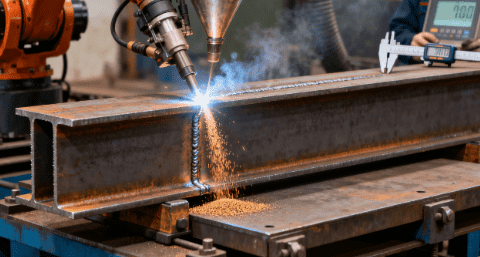
The third key step in structural steel fabrication involves joining the precisely formed and punched components. While high-precision forming and punching ensure that individual parts are accurate, the assembly process must be equally precise to prevent cumulative tolerance stack-up that compromises the integrity of the final structure.
Tube mill machine production lines, for example, demonstrate this integration, continuously processing metal coils into finalized square or round tubes through sequential steps that include roll forming, high-frequency welding, sizing, and straightening. The use of high-frequency welding is critical for achieving strong, consistent seams required for items used in building structures, fluid transportation, and automotive parts.
Ensuring Dimensional Stability in Finished Structural Steel Fabrication
Dimensional stability refers to the component’s ability to retain its intended shape and size throughout the joining process. Heat generated during welding can introduce stress and warp the metal, undermining the precision achieved in the earlier steps. Therefore, integrated production lines often feature specialized sizing and straightening processes immediately following the welding phase to counteract these effects and ensure the final product adheres to the required specifications.
For highly specialized profile processing, such as the production of photovoltaic supports, some advanced forming lines feature integrated welding and loop storage. This sophisticated setup allows for a seamless, continuous flow of material from forming through welding, resulting in high-precision output with reduced labor requirements. Whether producing basic angle steel using an L-shaped Steel Sheet Roll Forming Machine or complex tubular structures, maintaining high precision during assembly is non-negotiable for producing reliable components for construction and automotive manufacturing.
Furthermore, companies that offer integrated production across the entire value chain—from precision parts to complete digital factory solutions—emphasize intelligent production lines equipped with automated assembly lines. This comprehensive approach to manufacturing capability ensures consistent quality with high efficiency throughout the entire process of structural steel fabrication.
Step 4: Digital Monitoring and Quality Control
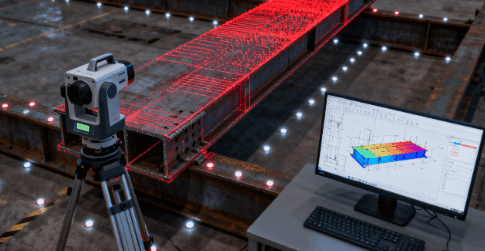
The fourth and perhaps most transformative step in modern structural steel fabrication is the application of digital monitoring and real-time quality control. Precision manufacturing is no longer a static measurement taken at the end of the line; it is a continuous process managed by intelligent systems.
Real-Time Data and Cloud Transmission for Structural Steel Fabrication
Automation reduces dependence on manual labor, leading to high efficiency and low energy consumption. However, to truly master precision at high speeds (such as 45 meters/minute production rates), fabricators must leverage data technology.
Many advanced roll forming machines—including those for W, L, Z, C, and U-shaped steel—are equipped with cloud transmission functionality. This technology allows for the real-time recording of crucial production data, including the quantity of components produced and the equipment’s energy consumption. This data is essential for ongoing quality control, predictive maintenance, and optimizing the production efficiency of the entire line.
A true smart factory solution provider offers integrated production across the entire value chain, enabling real-time feedback loops between the equipment and the supervisory control system. This digital factory solution expert capability ensures that if a machine begins to drift out of its narrow dimensional tolerance—such as the ±0.2 mm hole-to-hole accuracy required for superior formwork—the system can detect the issue immediately. This proactive monitoring minimizes waste and downtime, confirming that every output from the forming machine or punching equipment maintains the necessary high precision standards for demanding applications like infrastructure and power transmission.
Specialized equipment, such as the automatic C/Z purlin roll forming machine with automated stacking, also relies on these intelligent systems to manage the volume and final presentation of the components, ensuring the integrity of the product is maintained even post-production. This level of control is fundamental to delivering components for structural steel fabrication with guaranteed quality and consistency.
Conclusion
The demand for complex, high-strength metal components across sectors like construction, infrastructure, and automotive manufacturing underscores the absolute necessity of high precision in structural steel fabrication. The four key steps—ultra-precise forming, high-accuracy punching, advanced welding and assembly, and digital quality control—are fundamentally interconnected by intelligent machinery and specialized production lines.
Fabricators who utilize integrated and highly automated production lines are able to achieve remarkable levels of accuracy, delivering length tolerances of less than 0.2 mm and improving upon basic industry standards by a factor of 10. Solutions involving dedicated equipment, such as the tube mill machine production line for building structures and automotive parts, or specialized punching equipment for PV connectors, ensure consistent, high-speed, and precise outcomes.
To maintain a competitive edge, manufacturers must look to digital factory solutions that offer customized production line designs and leverage advanced R&D partnerships focused on ultra-precise transmission and smart equipment. By investing in these intelligent production capabilities, fabricators can confidently meet the stringent requirements of global industrial applications, securing a future defined by high efficiency and uncompromising quality in every aspect of structural steel fabrication.
FAQ
Q: What types of materials are compatible with high-speed structural steel fabrication equipment?
A: The automated machinery used in structural steel fabrication is designed to process various coil-based materials crucial for the industry, including galvanized steel, carbon steel, stainless steel, and aluminum. These materials are utilized in forming equipment like the W, L, Z-shaped Steel Forming Machine to create required profiles.
Q: How fast can specialized machinery produce profiles used in Structural Steel Fabrication?
A: Production speeds vary significantly depending on the complexity of the profile and the specific machine type. However, highly efficient roll forming equipment designed for continuous operation can achieve speeds up to 45 meters per minute. This high-speed capability is vital for meeting the demand for quick delivery and high output.
Q: Can production lines for Structural Steel Fabrication be customized to specific dimensions?
A: Yes, intelligent manufacturing experts specialize in digital factory solutions and can provide customized production line design solutions. All machines, including roll forming machines and punching systems, can generally be customized based on specific product dimensions, material types, and required production capacity. This adaptability allows the equipment to manufacture various profiles efficiently, such as C, U, Z, W, and L-shaped sections, for diverse applications.
Q: What role does automation play in ensuring quality in Structural Steel Fabrication?
A: Automation plays a crucial role by integrating functions like feeding, punching, welding, and stacking into seamless operations. This minimizes the need for manual intervention, thereby reducing the chance of human error and ensuring the consistent application of tight dimensional tolerances (e.g., ±1mm or better) necessary for high-quality structural elements. Furthermore, high levels of automation allow for real-time tracking of production data via cloud transmission, enabling immediate quality control measures.
Q: Which major industries rely on high-precision Structural Steel Fabrication?
A: High-precision steel profiles are essential across numerous demanding sectors. Key application industries include construction and steel structure development, automotive components manufacturing, rail transit and infrastructure, and power transmission and electrical equipment. The consistent quality and accuracy provided by advanced fabrication processes are non-negotiable for safety and performance in these critical fields.
If you enjoyed this article on Jinbolida’s smart manufacturing solutions and digital factory expertise, don’t forget to join us on social media for more industry insights, updates, and community discussions.
• 📘 Facebook – Connect with us here for the latest on our smart production lines and global impact: https://www.facebook.com/profile.php?id=61577965371544
• 📱 WhatsApp – Feel free to inquire about our customized production line design solutions and high-efficiency equipment at any time:https://wa.me/8613335170705
• ▶️ YouTube – Watch demonstrations of our automated forming, punching, and assembly lines, and explore our applications in Construction and Steel Structure, Photovoltaic and Solar Energy, and more: https://www.youtube.com/@JINBOLIDA-d3c
Let’s keep exploring the boundless possibilities of smart manufacturing, learning, and growing together. Thanks for reading, and see you in the next post! 🚀
 English
  Arabic
  Russian
  Spanish
  French