
5 Terrible Hydraulic Punching Machines Problems You Must Fix
Table of Contents
Introduction

In the rapidly evolving world of sheet metal fabrication and profile processing equipment, the performance of punching equipment, particularly hydraulic punching machines, is crucial to achieving global manufacturing goals. Modern industrial operations demand speed, consistency, and intelligent manufacturing. While hydraulic punching machines are foundational tools, many operations are hampered by persistent, serious problems that prevent them from operating as efficient, smart production lines. These challenges severely impact output, precision, and overall operational viability.
The shift is clear: achieving maximum efficiency requires integrated production across the entire value chain, moving beyond traditional machinery to intelligent production lines. For companies seeking to optimize their project efficiency and move toward digital factory solutions, identifying and correcting these five terrible problems in their hydraulic punching machines is non-negotiable.
5 Terrible Problems with Hydraulic Punching Machines
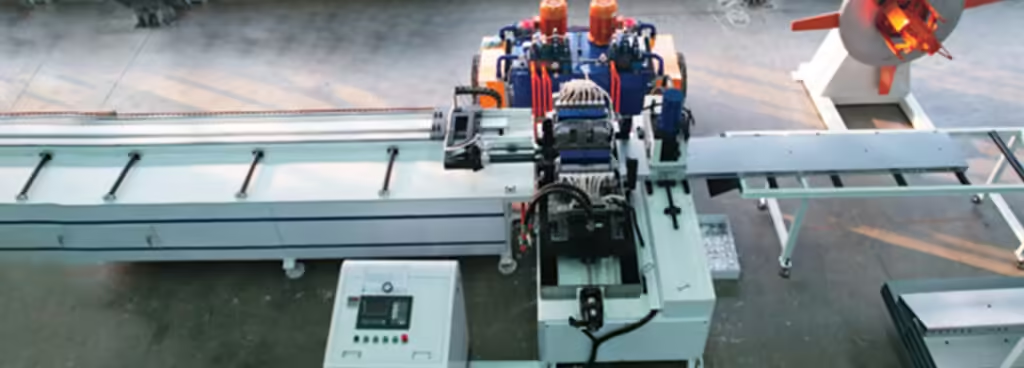
Upgrading from standard hydraulic punching equipment to a smart factory solution often reveals critical shortcomings. These issues prevent manufacturers from achieving the high-efficiency and high-precision standards that modern automated equipment can deliver.
Problem 1: Unacceptable Precision in Hydraulic Punching Machines
Precision is king in modern manufacturing. Unfortunately, many traditional hydraulic punching machines only meet old industry standards, with 1–2 mm of error, which is insufficient for sectors like construction and automotive components.
- Impact: Limits competitiveness in applications requiring exact dimensions.
- Modern Expectation: Hole-to-hole accuracy of ±0.2 mm and length accuracy <0.2 mm—10x better than older machines.
- Solution: Advanced technologies like nanometer-level precision transmission are essential to achieve these ultra-precise tolerances.
Example: In photovoltaic support production, precise hole alignment prevents assembly issues and reduces material waste.
Problem 2: Lack of Automation and High Labor Input in Hydraulic Punching Machines
Outdated machines require significant manual operation, which slows production and increases labor costs.
- Impact: Limits high-speed, continuous processing and prevents intelligent production lines.
- Modern Solution: Fully automated systems such as:
- Eight-station punching lines for PV brackets
- C/U-shaped steel feeding and punching systems
- Benefit: Minimal manual intervention, higher efficiency, and lower labor costs.
Fun Fact: Automation can reduce labor dependency by up to 40% while increasing throughput.
Problem 3: Slow Production Speed and Low Efficiency
Speed is paramount for profitability. A major problem is slow cycle times and resulting low efficiency in hydraulic punching machines. The objective of any forming machine auxiliary equipment is efficiency boosting. If a hydraulic punching machine operates slowly, it fails to deliver the high efficiency and fast delivery promised by smart production lines. For example, modern photovoltaic connector automatic punching, cutting, and forming lines specialize in high-speed processing, something standard, low-efficiency hydraulic punching machines cannot match. The integration of continuous automated processes, such as roll forming, high-frequency welding, and sizing, sets the bar for speed that inefficient hydraulic punching machines must strive to meet.
Problem 4: High Energy Consumption and Maintenance Instability
Inefficient hydraulic punching machines often suffer from unstable operation, leading to frequent downtime and high maintenance costs. Furthermore, running costs soar when the equipment does not prioritize low energy consumption. Modern equipment must be designed for easy maintenance and stable operation. Additionally, smart systems offer cloud transmission capabilities to record production quantity and equipment energy consumption in real time, allowing manufacturers to track and control efficiency. Hydraulic punching machines that lack these features are draining resources needlessly.
Problem 5: Inflexible Processing Capabilities of Hydraulic Punching Machines
Many traditional machines are designed for fixed profiles, creating bottlenecks when production requirements change.
- Impact: Limits production flexibility and adaptability to diverse needs.
- Modern Solution: Integrated systems such as:
- Automatic C/Z purlin roll forming machines
- Machines supporting interchangeable profiles and integrated feeding/punching
- Benefit: Precise, flexible, and continuous manufacturing across multiple profile types.
Example: Solar support production lines now switch between C and Z steel profiles in minutes instead of hours, boosting overall efficiency.
| Problematic Hydraulic Punching Machine Feature | Solution Implemented in Modern Punching Equipment | Key Manufacturing Benefit Achieved |
| Low Precision (1-2 mm error) | Incorporation of nanometer-level precision transmission technology. | Hole-to-hole accuracy of $\pm0.2$ mm, 10 times better than industry standard. |
| High Labor Dependence | Fully automated punching, cutting, and forming production line for clamps. | High efficiency, less labor, and minimal manual intervention. |
| Fixed Profile Processing | Intelligent manufacturing line supporting interchangeable C/Z-shaped steel profiles. | Supports quick switching and flexible, continuous manufacturing. |
| High Energy Use/Instability | Highly automated production with low energy consumption and stable operation. | Cloud transmission available to record equipment energy consumption in real time. |
Upgrading Hydraulic Punching Machines for Smart Manufacturing

Transitioning to a smart factory requires more than just replacing old machines—it demands a holistic approach that integrates automation, precision, and data-driven processes.
Adopting a Smart Factory Mindset
Modern hydraulic punching machines must be part of a larger intelligent production ecosystem. This means rethinking workflows to minimize manual intervention, ensure continuous operation, and capture data that can guide future improvements. Companies specializing in digital factory solutions often collaborate with top research teams and universities to push the boundaries of innovation and develop equipment that meets modern production demands.
Achieving Ultra-Precise Manufacturing
Precision is at the heart of smart production. By incorporating nanometer-level transmission technology and advanced servo systems, modern hydraulic punching machines can deliver hole-to-hole accuracy far beyond traditional standards. This level of precision is essential not only for automotive or construction components but also for high-demand sectors like photovoltaic support structures, where even minor deviations can impact assembly quality.
Seamless Integration with Production Lines
A single hydraulic punching machine is no longer sufficient on its own. Smart manufacturing emphasizes integration across forming, punching, and assembly processes, allowing machines to operate in tandem and maintain consistent output. This integration reduces downtime between steps and ensures that production can run continuously, meeting modern speed and efficiency requirements.
Benefits Beyond Speed
Modernized hydraulic punching machines do more than increase output. They bring stable operation, longer mold life, and reduced maintenance needs. By combining advanced mechanical design with intelligent monitoring systems, these machines provide manufacturers with reliable performance and consistent quality, enabling them to meet the growing expectations of precision-focused industries.
Driving the Next Generation of Manufacturing
Ultimately, upgrading hydraulic punching machines is a step toward transforming traditional production into smart manufacturing. By leveraging precision technologies, intelligent automation, and integrated production lines, companies can ensure high efficiency, adaptability, and quality—forming the foundation for a truly digital factory.
Conclusion
The five terrible problems—lack of precision, reliance on manual labor, slow speeds, high energy consumption, and inflexible processing—pose significant barriers to modern industrial success. Manufacturers must address these shortcomings in their hydraulic punching machines by embracing smart production lines and advanced technology. By implementing solutions centered on high precision, automation, and stable, efficient operation, companies can achieve the necessary digital factory solutions and maintain a competitive edge across crucial sectors like construction, solar energy, and automotive components. Investing in fully integrated and intelligent punching equipment ensures that production moves seamlessly from precision parts to complete digital factory solutions.
FAQ
How do modern hydraulic punching machines contribute to high efficiency?
Modern hydraulic punching machines increase efficiency primarily through automation. Key features include:
- Integrated processes: Feeding, punching, and stacking are combined into one seamless workflow.
- Minimal manual labor: Machines operate continuously with little human intervention.
- Stable operation & easy maintenance: Automated systems reduce downtime and ensure consistent output.
Quick Insight: Automated punching lines can maintain high-speed, precise production 24/7, which is impossible with manually operated machines.
What types of precision standards should I expect from high-end hydraulic punching machines?
High-end machines go far beyond the traditional industry standard of 1–2 mm accuracy. Look for:
- Hole-to-hole accuracy: ±0.2 mm
- R-angle precision: <0.5°
- Advanced transmission technology: Often developed in partnership with global R&D teams for ultra-precise performance
Pro Tip: Superior precision reduces waste, assembly errors, and rework—key factors in industries like automotive and construction.
Are hydraulic punching machines relevant for photovoltaic and solar energy production?
Absolutely! These machines are essential for high-efficiency PV bracket and component production. Key applications include:
- Intelligent PV support production lines
- Automated eight-station punching lines for fast PV bracket manufacturing
- Punching, cutting, and forming lines for photovoltaic connectors
Fun Fact: Modern PV production lines can process multiple components at speeds 5–10x faster than conventional hydraulic machines.
Can new hydraulic punching machines help reduce energy costs?
Yes. Modern machines are designed for both high efficiency and low energy consumption. Features include:
- Energy-efficient automation that minimizes waste
- Cloud monitoring: Real-time tracking of production and energy usage
- Optimized operation: Ensures stable performance while reducing electricity costs
Quick Insight: Manufacturers using intelligent punching systems can save significant energy while maintaining high output—benefiting both the bottom line and the environment.
If you enjoyed this article on Jinbolida’s smart manufacturing solutions and digital factory expertise, don’t forget to join us on social media for more industry insights, updates, and community discussions. Jinbolida specializes in providing smart production lines such as Steel Formwork Production Lines, Photovoltaic Equipment Production Lines, and High-Speed Tube Manufacturing Equipment, leveraging core technologies like nanometer-level precision transmission.
• 📘 Facebook – Connect with us here for the latest on our smart production lines and global impact: https://www.facebook.com/profile.php?id=61577965371544
• 📱 WhatsApp – Feel free to inquire about our customized production line design solutions and high-efficiency equipment at any time: https://wa.me/8613335170705
• ▶️ YouTube – Watch demonstrations of our automated forming, punching, and assembly lines, and explore our applications in Construction and Steel Structure, Photovoltaic and Solar Energy, and more: https://www.youtube.com/@JINBOLIDA-d3c
Let’s keep exploring the boundless possibilities of smart manufacturing, learning, and growing together. With 15 years of experience, over 326 patents, and serving 120+ countries, Jinbolida continues to drive innovation in smart equipment. Thanks for reading, and see you in the next post! 🚀
 English
  Arabic
  Russian
  Spanish
  French