
7 Essential Types of Highway Guardrails
Table of Contents
Introduction
Highway guardrails play a crucial role in ensuring road safety, especially on modern highways where traffic volume, vehicle speed, and road conditions vary widely. As transportation networks expand, the need for scientifically designed barrier systems becomes even more essential. Understanding the main types of highway guardrails helps engineers, procurement teams, construction contractors, and policymakers choose the most effective protective solutions for different environments. This blog explores seven essential types of highway guardrails, their mechanisms, structural characteristics, performance advantages, and typical application scenarios. With accurate data, industry standards, and expert viewpoints, this article serves as a comprehensive reference for anyone involved in road infrastructure planning and maintenance.
The Importance of Highway Guardrails in Road Safety
Highway guardrails play a critical role in reducing the severity of roadway accidents, minimizing fatalities, and enhancing the overall safety of transportation systems. According to global road safety institutions such as the World Health Organization (WHO) and the Federal Highway Administration (FHWA), properly designed and installed highway guardrails can reduce fatal crashes by up to 45%, particularly in high-speed environments. These barriers act as energy-absorbing systems that redirect vehicles away from hazards such as steep slopes, fixed objects, drop-offs, and water bodies.
How Highway Guardrails Reduce Impact Severity
Guardrails work by partially deforming when struck, converting kinetic energy into controlled structural compression. Their performance depends heavily on:
- Material strength
- Coating and corrosion resistance
- Post installation depth
- Road geometry
- Vehicle type and impact angle
Laboratory crash tests following standards such as MASH (Manual for Assessing Safety Hardware) and EN 1317 show that guardrails undergo predictable deformation patterns that can prevent vehicles from overturning or penetrating hazardous areas.
Key Safety Metrics Used to Evaluate Highway Guardrails
Authorities evaluate guardrail performance based on:
- Impact Severity Level (ISL)
- Containment Level (N2, H1, H2, etc.)
- Dynamic Deflection
- Working Width
- Exit Box Trajectory Measurements
These metrics ensure that highway guardrails provide adequate protection for vehicles ranging from passenger cars to heavy trucks.
W-Beam Highway Guardrails
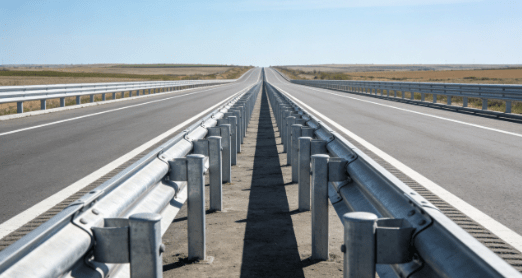
W-beam highway guardrails are one of the world’s most commonly used barrier types, easily recognized by their w-shaped steel profile. Their design provides reliable, predictable impact resistance and energy absorption.
Structural Advantages of W-Beam Guardrails
The W-beam profile allows the guardrail to:
- Deform in a controlled manner
- Spread impact force along the beam
- Prevent vehicle snagging
- Redirect vehicles smoothly back to the roadway
Typical Applications of W-Beam Systems
- Highways with medium to high traffic
- Bridge approaches
- Roadside drop-offs
- Rural highways prone to animal collisions
According to FHWA studies, W-beam systems offer a cost-effective safety ratio, balancing affordability with high performance during crash events.
Material and Coating Options for W-Beam Guardrails
- Hot-dip galvanized steel
- Powder-coated steel for corrosion-intensive climates
- Weathering steel for reduced long-term maintenance
Thrie-Beam Highway Guardrails
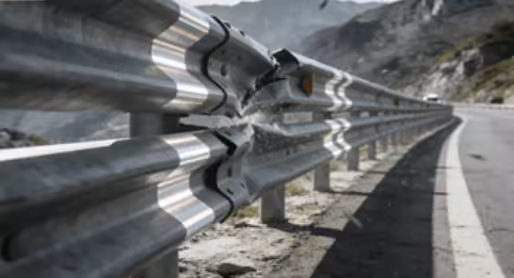
Thrie-beam guardrails incorporate three ridges in their design, providing increased strength and durability compared to W-beam models.
Why Thrie-Beam Guardrails Offer Higher Impact Resistance
- Larger surface area
- Increased moment of inertia
- Higher impact absorption capacity
- Better containment for large trucks
Where Thrie-Beam Systems Are Most Effective
- Mountainous expressways
- Tunnel entrances and exits
- High-speed multi-lane highways
- Areas with steep slopes or cliffs
Crash test data confirms that thrie-beam systems are capable of redirecting heavier vehicles with impact speeds exceeding 100 km/h, meeting stringent roadside safety regulations.
Cable Highway Guardrails

Cable guardrail systems rely on multiple tensioned steel cables mounted along flexible posts.
Key Benefits of Cable Guardrail Systems
- Extremely high flexibility
- Ability to absorb large kinetic energy
- Prevents cross-median crashes
- Reduced vehicle rollover likelihood
Safety Impact of Cable Barriers
Highway authorities note that cable barriers can reduce cross-median crashes by over 80%, making them ideal for wide medians in rural and suburban highways.
Common Use Cases for Cable Systems
- Wide, grassy medians
- Areas with frequent lane-departure crashes
- Roads needing quick, easy installation
- Regions requiring minimal concrete use
While cable guardrails require more regular maintenance, their life-cycle safety performance is extremely high.
Concrete Highway Guardrails
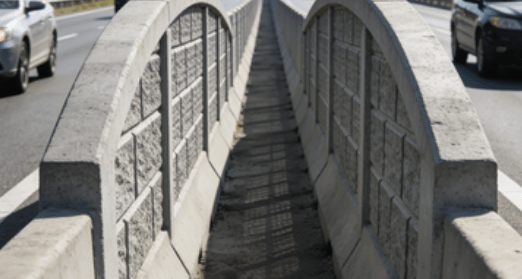
Concrete guardrails—most notably the Jersey barrier—are widely used for high-risk road sections.
Why Concrete Barriers Are Highly Reliable
Unlike flexible guardrails, concrete systems rely on:
- Mass
- Shape geometry
- High compressive strength
This makes them extremely effective for vehicle redirection without excessive deflection.
Where Concrete Barriers Are Most Commonly Installed
- Urban expressways
- Bridge decks
- Narrow medians
- Construction zones
- Areas requiring noise or debris containment
Performance Data for Concrete Guardrails
European safety agencies have found that concrete barriers significantly reduce vehicle rollover rates due to their sloped-face design, ensuring vehicles climb and slide rather than flip.
Box Beam Highway Guardrails
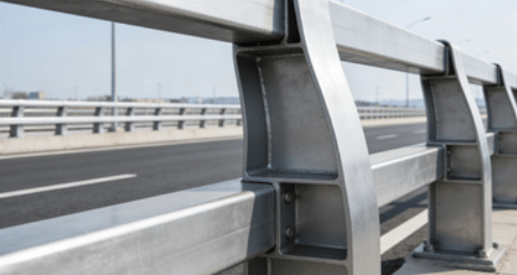
Box beam systems feature rectangular hollow-section steel beams.
Advantages of Box Beam Designs
- Consistent energy absorption
- Enhanced torsional rigidity
- Better corrosion resistance due to closed shape
- Reduced snowplow damage in winter regions
Ideal Applications for Box Beam Guardrails
- Cold, snowy regions
- Mountain highways with ice or debris
- Roads requiring aesthetically clean lines
Box beam barriers provide excellent structural performance with long-term reliability.
Timber Highway Guardrails
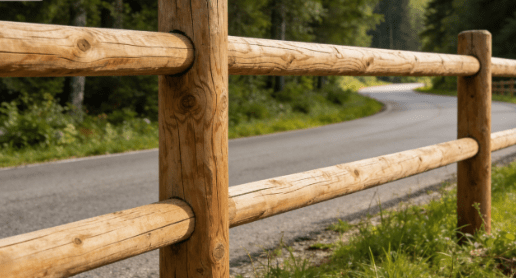
Timber guardrails offer natural aesthetics and environmental compatibility.
Why Timber Guardrails Are Popular in Scenic Areas
- Blend naturally with landscapes
- Made from sustainable materials
- Provide traditional appearance suitable for protected environments
Performance Characteristics of Timber Systems
Although not suited for high-speed crash zones, timber guardrails:
- Are certified for low–moderate speed roadways
- Can incorporate steel reinforcements for better strength
- Perform well in rural and park road applications
They are commonly used in:
- National parks
- Forest highways
- Tourism scenic routes
Timber–Steel Hybrid Designs
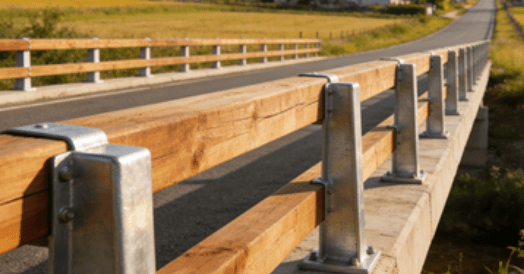
Some regions use timber cladding over steel cores, combining:
- Natural aesthetics
- Modern safety performance
Comparison Table of Highway Guardrails
(Placed in middle of article as required)
| Type of Highway Guardrails | Impact Absorption | Durability | Typical Applications | Cost Level |
|---|---|---|---|---|
| W-Beam | High | High | Highways, rural roads | Medium |
| Thrie-Beam | Very High | High | Mountain roads, tunnels | Medium-High |
| Cable | Very Flexible | Medium | Medians, wide highways | Medium |
| Concrete | Extremely High | Very High | Bridges, urban roads | High |
| Box Beam | High | High | Snow regions, rural areas | Medium |
| Timber | Medium | Medium | Scenic areas, parks | Medium |
Material Selection Considerations
The material choices for highway guardrails significantly affect their long-term performance. Popular materials include high-strength galvanized steel, weathering steel, reinforced concrete, and laminated timber. Steel often undergoes hot-dip galvanization to achieve rust resistance lasting over 25 years. In humid coastal areas, corrosion-resistant coatings and increased thickness specifications are essential. For concrete, admixtures and reinforcement density directly influence compressive strength and impact resistance.
Installation and Maintenance Requirements
Proper installation determines the performance of highway guardrails in real-world conditions. Post spacing, embedment depth, bolt torque, and system alignment must follow regulatory standards. Routine inspections check for corrosion, loose connections, vehicle damage, and structural deformation. Maintenance frequency depends on traffic conditions, climate factors, and roadside hazards.
Expert Insights on Highway Guardrail Performance
Road safety experts emphasize that the effectiveness of highway guardrails depends not only on the type selected but also on the integration of road curvature, slope, traffic statistics, and risk assessment data. Key institutions such as the Transportation Research Board highlight that wrong placement can reduce guardrail effectiveness by up to 60%. Engineers often use simulation tools to evaluate performance under different collision scenarios and optimize designs accordingly.
Emerging Technologies in Highway Guardrails
Modern highway guardrails increasingly incorporate innovations such as composite materials, modular assembly systems, anti-glare panels, and smart monitoring sensors. These sensors can detect impact events, structural weakening, or corrosion levels and send alerts to maintenance teams. The integration of digital monitoring significantly improves long-term safety management.
Conclusion
Understanding the essential types of highway guardrails helps ensure road safety in a wide variety of environments. From W-beam and thrie-beam designs to cable, concrete, box beam, and timber options, each system offers unique advantages suited for specific road conditions. Choosing appropriate materials, adhering to installation standards, and applying expert analysis all contribute to achieving optimal protective performance. The continuous innovation in guardrail technology, combined with automated production equipment, further enhances the reliability and efficiency of modern road safety infrastructure.
FAQ
What is the difference between W-beam and thrie-beam guardrails?
Thrie-beam guardrails have a larger cross-sectional profile, providing higher impact resistance.
Are cable guardrails suitable for high-speed roads?
Yes, especially for medians where preventing cross-lane collisions is critical.
Why choose concrete guardrails?
They provide maximum containment and require minimal maintenance.
Do timber guardrails meet safety standards?
Yes, they meet standards for low to moderate traffic environments.
How long can galvanized steel guardrails last?
Typically over 25 years, depending on environmental conditions.
Additional Section: Highway Guardrail Roll Forming Machine (Cold Roll Forming Automation)

Modern highway guardrails are manufactured using specialized cold roll forming machines. These fully automated systems shape steel coils into W-beam, thrie-beam, or box-beam profiles with high precision. The roll forming process ensures uniform mechanical properties, accurate dimensions, and consistent thickness. Advanced guardrail forming lines integrate feeding systems, punching units, roll stands, cutting mechanisms, and automatic stacking. CNC controllers allow rapid adjustment for different profiles, increasing production efficiency. High-speed lines can reach outputs of 10–15 meters per minute while maintaining strict quality standards. Automated systems reduce labor costs, improve consistency, and enhance the reliability of highway guardrails used in long-term infrastructures.
If you enjoyed this article on Jinbolida’s smart manufacturing and digital factory expertise, follow us for more insights and updates:
- 📘 Facebook: Stay tuned for our latest smart production line projects → Facebook
- 📱 WhatsApp: Contact us anytime for custom production solutions → Chat Now
- ▶️ YouTube: Watch our automated line demos and real-world applications → YouTube
Let’s keep innovating and shaping the future of smart manufacturing — together!
 English
  Arabic
  Russian
  Spanish
  French