
Automatic Punching Machine for PV Bracket Production
Table of Contents
Key Takeaways
- An automatic punching machine can create round holes, elongated slots, notches, and connection features in photovoltaic brackets with less manual positioning.
- The best machine configuration depends on whether the factory processes flat coil, cut blanks, long formed profiles, or short connector components.
- Servo feeding is essential for controlling repeated hole spacing and reducing cumulative positioning errors.
- A standalone automatic punching machine provides flexibility, while an inline system can reduce handling between punching and roll forming.
- Multi-station punching is useful when one bracket contains several hole shapes or requires processing on different surfaces.
- Real production capacity should include feeding, clamping, punching, material movement, die changes, and finished-part handling.
- Buyers should define hole-position tolerance, burr limits, surface requirements, and testing methods before ordering equipment.
- Automatic adjustment and recipe storage create the most value when a factory frequently switches between bracket specifications.
- A complete PV bracket line may combine decoiling, leveling, punching, roll forming, cutting, unloading, and automatic stacking.
- Jinbolida provides automatic punching and forming solutions that can be configured around the customer’s bracket drawings, material, output, and factory layout.
Introduction
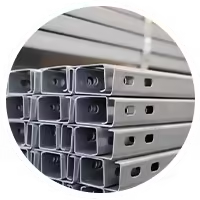
Automatic punching has become an important production process for manufacturers of photovoltaic mounting rails, C channels, U channels, ground posts, purlins, braces, and connecting plates.
These products often require repeated round holes, elongated slots, locating features, notches, and multi-face connection points. When the holes are produced manually, manufacturing speed and consistency depend heavily on operator measurement and positioning. As order volume increases, manual processing can also create bottlenecks between cutting, punching, forming, and assembly.
An automatic punching machine uses programmed feeding and controlled punching cycles to position material and create the required features with less manual intervention. It can operate as a standalone machine or form part of a continuous photovoltaic bracket production line.
The growth of the global photovoltaic market is increasing demand for both mounting structures and their manufacturing equipment. IEA PVPS reported that approximately 698 GW of new PV capacity was installed globally in 2025, taking cumulative installed capacity close to 3 TW. This expansion continues to create manufacturing opportunities for mounting-system producers.
However, purchasing an automatic punching machine requires more than selecting a press force and maximum speed. Buyers must consider:
- Finished bracket geometry
- Raw-material condition
- Steel grade and thickness
- Hole quantity and shape
- Required hole-position tolerance
- Product length
- Number of profile types
- Production volume
- Changeover frequency
- Integration with roll forming
- Available factory space
- Maintenance and service capability
Jinbolida provides solar photovoltaic rack punching equipment and solar photovoltaic bracket forming machines for manufacturers producing solar support profiles and connectors.
This guide explains how an automatic punching machine works, which configurations are available, how it connects to a PV bracket forming line, and what buyers should check before making an investment.
What Is an Automatic Punching Machine?
An automatic punching machine is a metal-processing system that positions material and creates holes or cut features according to a programmed production sequence.
Unlike a basic manual press, an automatic system can control several operations without requiring the operator to measure and reposition every part.
Automatic Material Feeding
The feeding system moves the strip, sheet, blank, or profile to the next punching location.
Servo-driven rollers or grippers are commonly used when precise distances and multiple product recipes are required.
Programmable Punching
The control system determines which punching station operates and when it should activate.
The operator can enter or select information such as:
- Product length
- Hole spacing
- Hole quantity
- Punching sequence
- Finished quantity
- Product model
Automatic Counting
The machine records the number of completed parts or punching cycles.
This helps the operator monitor order progress and reduce overproduction.
Automatic Fault Detection
Sensors can detect conditions such as missing material, feed errors, hydraulic pressure problems, guard opening, or incomplete punching cycles.
Concept: Automation Means Coordinated Control
A machine is not truly automatic simply because the punch moves by itself.
Automation requires material positioning, punching, counting, safety, and production instructions to work as one coordinated system.
Why PV Bracket Manufacturers Use Automatic Punching
PV mounting structures commonly use repeated and standardized connections.
Automatic punching helps manufacturers produce these features efficiently and consistently.
Faster Hole Positioning
The servo feeder moves material according to programmed distances.
This removes repeated tape measurement and manual marking from the normal production cycle.
Consistent Hole Spacing
Solar support profiles can contain long sequences of equally spaced or differently spaced holes.
A programmed feeding system can repeat the same pattern across multiple products and production batches.
Lower Operator Dependence
Manual positioning accuracy can vary between operators and shifts.
Automatic feeding makes the process less dependent on individual measuring technique.
Easier Product Recipe Changes
The control system can store several punching patterns.
This allows the operator to select a product program rather than manually resetting every dimension.
Better Integration with Roll Forming
An automatic punching unit can be connected to a roll forming machine so that punched strip moves directly into profile production.
Concept: Punching Accuracy Supports Installation Efficiency
The final bracket must connect with bolts, clamps, rails, posts, braces, and other structural components.
Accurate holes reduce the need for drilling, reworking, and forced alignment during installation.
Which PV Brackets Need Automatic Punching?
Automatic punching equipment can process a wide range of photovoltaic support products.
C-Channel Brackets
C-channel profiles may require holes in the web, flanges, or return lips.
The punching arrangement depends on whether the features are created before or after forming.
U-Channel Rails
U-shaped rails frequently contain base holes or elongated slots.
Pre-punching is often practical when all required openings are located on the flat strip area that becomes the profile base.
Ground-Mounting Posts
Ground posts may use thicker, higher-strength steel.
Their punching equipment must provide sufficient force and stable material support.
Slotted Strut Channels
Slotted channels contain frequent repeated openings.
For these products, punching capacity may determine total production speed.
Roof-Mounting Rails
Roof-system rails may use lighter steel or aluminum and several customized hole patterns.
Surface protection and quick recipe changes can be especially important.
Connector Plates
Short connector plates may contain round holes, slots, notches, and several bends.
A standalone automatic punching or punching-and-forming machine may be more suitable than a continuous roll forming line.
Triangular Support Components
Triangular solar structures use several profiles and connecting parts.
Different components may require separate punching stations or tooling sets.
How an Automatic Punching Machine Works
The exact process depends on whether the machine receives coil, blanks, or formed profiles.
Coil-Fed Automatic Punching Process
A coil-fed system is commonly used in continuous PV bracket production.
Step 1: Coil Loading
The metal coil is placed on a decoiler.
The decoiler must match the coil weight, inner diameter, outer diameter, and strip-width range.
Step 2: Material Leveling
The strip passes through a leveling unit.
Leveling reduces coil curvature and creates a more stable condition for accurate feeding.
Step 3: Servo Feeding
The feeder advances the strip according to the programmed hole position.
The feeding distance may change several times within one component.
Step 4: Material Positioning
Guides and clamping devices hold the strip in the correct location.
Stable positioning reduces sideways movement during punching.
Step 5: Punching
A hydraulic or mechanical system drives the punch through the material.
The removed scrap passes through the lower die.
Step 6: Repeated Feeding
The punch retracts and the servo feeder moves the strip to the next location.
The cycle continues until the complete hole pattern has been produced.
Step 7: Forming or Cutting
The punched strip can move into a roll forming machine or be cut into flat components.
Blank-Fed Automatic Punching Process
A blank-fed system processes individual sheets or precut components.
Part Loading
The operator or automatic handling system places the component in the machine.
Positioning
Stops, clamps, robots, or servo tables position the part.
Punching Sequence
The machine creates one or several features according to the selected program.
Part Unloading
The finished component is collected manually or automatically.
When Blank Feeding Is More Suitable
Blank-fed machines are often useful for short connectors, plates, brackets, and lower-volume products that do not require continuous coil processing.
Standalone vs Inline Automatic Punching Machines
One of the main purchasing decisions is whether punching should operate independently or connect directly to the forming line.
| Comparison Factor | Standalone Punching Machine | Inline Punching Machine |
|---|---|---|
| Production layout | Independent workstation | Connected to forming line |
| Material type | Blanks, profiles or coil | Usually continuous coil |
| Flexibility | High for varied components | Optimized for related profiles |
| Material handling | More transfers | Fewer transfers |
| Work-in-process inventory | Higher | Lower |
| Production coordination | Separate scheduling | Central control |
| Changeover | Independent from forming | Must coordinate all line tooling |
| Initial investment | Usually lower | Usually higher |
| Factory footprint | Flexible placement | Long continuous layout |
| Best application | Connectors and varied parts | High-volume bracket profiles |
Advantages of Standalone Punching
A standalone automatic punching machine can process different components independently of the roll forming line.
It is useful when:
- Several production lines share one punching system.
- The factory produces many short connectors.
- Punching and forming operate on different schedules.
- Products require post-forming holes.
- Production volume does not justify a complete integrated line.
Limitations of Standalone Punching
Material must be moved between workstations.
This can increase handling, work-in-process stock, positioning time, and the risk of product damage.
Advantages of Inline Punching
An inline system connects decoiling, leveling, servo feeding, punching, forming, and cutting.
Material can move from coil to finished bracket with fewer manual transfers.
Limitations of Inline Punching
The complete line must be designed around a related profile family.
A punching fault can stop downstream forming and cutting operations.
Which Configuration Is Better?
A standalone machine is often better for varied connectors and lower-volume parts.
An inline system is generally better for continuous production of standardized or adjustable long profiles.
Hydraulic vs Mechanical Automatic Punching
The punching drive system affects speed, force control, maintenance, and application.
Hydraulic Automatic Punching
A hydraulic system uses pressurized oil to move the punching cylinder.
It offers flexible force and stroke control and can be integrated easily with servo feeding.
Mechanical Automatic Punching
A mechanical press uses a crank, flywheel, eccentric mechanism, or similar drive.
It is commonly selected for high-frequency repetitive production.
| Evaluation Factor | Hydraulic System | Mechanical System |
| Force control | Adjustable | Mechanically determined |
| Stroke adjustment | Flexible | More limited |
| Cycle rate | Moderate | Often faster |
| Noise | Generally lower | Generally higher |
| Integration | Suitable for varied recipes | Strong for repeated patterns |
| Maintenance | Oil, filters, seals and valves | Clutch, bearings and drive parts |
| Overload protection | Hydraulic pressure relief | Mechanical protection required |
| Best application | Flexible bracket production | Stable high-speed production |
When to Choose Hydraulic Punching
Hydraulic punching is suitable when the factory needs:
- Adjustable force
- Several hole shapes
- Multiple production recipes
- Controlled stroke
- Multi-station operation
- Moderate-to-high output
- Easy PLC integration
When to Choose Mechanical Punching
Mechanical equipment may be appropriate for:
- One repeated hole pattern
- Very high cycle frequency
- Stable long-term orders
- Dedicated mass production
- Factories with mechanical press experience
Single-Station vs Multi-Station Automatic Punching
The number of stations should match the actual hole requirements.
Single-Station Machine
A single-station system contains one primary die set.
It can be economical for one repeated round hole or slot.
Multi-Station Machine
A multi-station system contains several dies that operate independently or in sequence.
Possible stations include:
- Round-hole punching
- Long-slot punching
- Square-hole punching
- Side-hole punching
- Notching
- Cutting
- Marking
- Connector forming
Benefits of Multi-Station Automatic Punching
- Several hole types without repeated die replacement
- Faster switching between product recipes
- Reduced material handling
- Easier integration with continuous production
- Potential processing of several profile faces
Limitations of Multi-Station Equipment
- Higher purchase cost
- Larger machine footprint
- More tooling to maintain
- More complicated programming
- Longer commissioning and testing
How Many Stations Do You Need?
The station count should follow the actual hole drawings.
A higher number of stations does not automatically create a better production line.
Pre-Punching vs Post-Punching
Automatic punching can take place before or after profile forming.
| Factor | Pre-Punching | Post-Punching |
| Material condition | Flat strip | Formed profile |
| Die accessibility | Easier | More restricted |
| Material support | Simple | Profile-specific |
| Side holes | Difficult | More practical |
| Scrap removal | Easier | More complex |
| Tooling cost | Often lower | Often higher |
| Position reference | Flat-strip dimensions | Final profile geometry |
| Integration | Common in coil lines | Additional downstream station |
Pre-Punching Advantages
The flat strip can be supported easily.
The upper and lower die components have clear access to the material.
Pre-Punching Limitations
The holes pass through the roll forming process.
A hole near a bend may shift, stretch, or deform during forming.
Post-Punching Advantages
The final profile can be used as the dimensional reference.
This is useful for flange holes and side-wall features.
Post-Punching Limitations
The profile may need internal support to prevent crushing or distortion.
Tooling access and scrap removal can also become more difficult.
Combined Punching
Some production lines use both methods.
Repeated web slots may be created before forming, while special side holes are produced afterward.
Stop Punching vs Flying Punching
The line can stop during punching or continue moving.
Stop-to-Punch System
The feeder stops the strip at each hole location.
The punching cycle is completed before the material moves again.
Main Advantages
- Simpler control
- Easier positioning
- Lower investment
- Straightforward maintenance
- Suitable for moderate production rates
Main Limitations
Frequent stopping can reduce effective line speed.
This is especially important when one component contains many holes.
Flying Punching System
A flying punching carriage moves with the strip.
The punch operates while the material continues moving.
Main Advantages
- Less production interruption
- Higher potential line speed
- Better continuous-flow capability
- Useful for dense repeated patterns
Main Limitations
- Higher investment
- More complicated synchronization
- More moving components
- Greater maintenance requirements
- More demanding commissioning
Does Every Factory Need Flying Punching?
No.
Flying punching is worthwhile when stop punching has been confirmed as the main production bottleneck and the expected order volume supports the additional investment.
Servo Feeding and Hole-Position Accuracy
The servo feeding system is one of the most important components of an automatic punching machine.
Feed Distance Control
The control system commands the servo motor to move the strip by a specified distance.
Recipe Storage
Different hole spacings can be saved as production recipes.
Accumulated Error Management
Long solar rails may contain many repeated openings.
If each movement contains a small error, the final hole can deviate significantly from the required location.
Encoder Feedback
An encoder measures actual material movement.
The control system can use this signal to improve positioning control.
Causes of Feeding Error
- Material slipping
- Dirty feed rollers
- Incorrect roller pressure
- Encoder installation problems
- Poor leveling
- Material curvature
- Incorrect program data
- Mechanical backlash
Automatic Punching Machine vs CNC Punch Press
Both systems can create programmed holes, but their production models differ.
| Factor | Automatic Punching Machine | CNC Punch Press |
| Typical material | Coil, strip or profiles | Sheet blanks |
| Main movement | Material feeds through fixed stations | Sheet moves in X and Y |
| Best product | Long brackets and repeated patterns | Flat sheets with varied features |
| Roll forming integration | Strong | Limited |
| Continuous production | Suitable | Usually batch-based |
| Profile processing | Possible with special tooling | Mainly flat sheet |
| Tooling arrangement | Dedicated or multi-station | Turret or tool library |
| Best application | PV rails, posts and channels | Panels and flat components |
When a CNC Punch Press Is Better
A CNC punch press is suitable for large flat sheets with many feature positions and product variations.
When an Automatic Coil Punching Line Is Better
A coil-fed automatic punching machine is more suitable for long profiles manufactured continuously from strip.
Automatic Punching vs Laser Cutting
Laser cutting can also create holes and profiles.
Laser Cutting Advantages
- Flexible geometry
- No dedicated punch for each hole
- Suitable for prototypes and varied patterns
- Can cut complex contours
Laser Cutting Limitations
- Higher energy use for some repetitive products
- Potential heat-affected edges
- Different maintenance requirements
- Slower than dedicated punching for some high-volume holes
- Less natural integration with certain roll forming lines
Automatic Punching Advantages
- Fast repeated holes
- Stable dimensions with dedicated tooling
- Lower processing cost at high volume
- Easy coil-line integration
- No thermal cutting zone
Automatic Punching Limitations
- Dedicated tooling required
- Tool wear must be monitored
- Product changes may require die replacement
- Highly complex shapes can increase tooling cost
Which Process Is More Economical?
Laser cutting can be economical for prototypes and frequently changing low-volume products.
Automatic punching is often more economical for repeated bracket features produced at scale.
How to Calculate Required Punching Force
Required force depends on the total amount of material being sheared.
The supplier should consider:
- Total hole perimeter
- Material thickness
- Material shear strength
- Number of simultaneous holes
- Tool condition
- Required safety margin
Hole Perimeter
A long slot has a greater cutting perimeter than a small round hole.
Material Thickness
Thicker material requires more force.
Material Strength
High-strength steel may require substantially more force than low-carbon steel of the same thickness.
Simultaneous Hole Quantity
When several holes are punched in one stroke, their total cutting perimeter must be included.
Safety Factor
The machine should have a reasonable reserve for material variation and tooling wear.
Do Not Select a Machine by Thickness Alone
“Suitable for 3 mm steel” is not a complete specification.
The calculation must also include steel grade, hole size, slot perimeter, and simultaneous punching quantity.
Die Design and Clearance
The punch and die must be designed according to the material.
Insufficient Clearance
Clearance that is too small can cause:
- Excessive force
- Rapid wear
- Punch breakage
- Material sticking
- High temperature
Excessive Clearance
Clearance that is too large can cause:
- Heavy burrs
- Distorted holes
- Poor dimensions
- Rolled edges
- Unstable fracture surfaces
Tool Material
The punch and die material should be selected according to:
- Steel strength
- Thickness
- Production volume
- Hole shape
- Coating
- Tooling-life target
Heat Treatment
Correct hardness improves wear resistance.
Excessive hardness without adequate toughness can increase the risk of cracking.
Material Considerations
PV brackets are manufactured from several metals and coatings.
Galvanized Steel
Galvanized steel is widely used for outdoor support profiles.
Guides, clamps, and dies should minimize coating damage.
High-Strength Steel
High-strength steel can support efficient structural designs.
It requires greater punching force and can increase tool wear.
Zinc-Aluminum-Magnesium-Coated Steel
This coated material is used in demanding corrosion environments.
The supplier should test surface behavior and punched-edge quality.
Stainless Steel
Stainless steel may require greater force and wear-resistant tooling.
Some grades can harden during processing.
Aluminum
Aluminum is lightweight but can scratch or deform under excessive clamping pressure.
Material Information Buyers Must Provide
- Material grade
- Yield strength
- Tensile or shear strength
- Thickness range
- Strip width
- Coil weight
- Surface coating
- Surface-quality requirements
Automatic Punching Machine Production Capacity
Maximum cycle speed does not equal finished output.
Punching Cycle
This is the time required for the punch to descend, complete the cut, and retract.
Feeding Time
The strip must move to the next position.
Long feed distances increase cycle time.
Hole Quantity
A product containing many holes requires more operations.
Product Length
Short products may increase cutting and handling frequency.
Changeover Time
Changing dies, guides, recipes, and forming settings reduces available production time.
Coil Replacement
The line stops while the next coil is loaded and threaded.
Qualification Rate
Rejected parts should not be counted as usable output.
Practical Capacity Question
Ask the supplier:
How many qualified finished brackets can the complete line produce per hour using our real material and hole pattern?
This is more meaningful than asking only for punching cycles per minute.
How Automation Reduces Production Cost
Automation should produce measurable operational value.
Lower Manual Positioning
Operators do not need to measure each hole location.
Reduced Handling
An inline system moves material directly between punching and forming.
Faster Recipe Changes
Stored programs reduce repeated data entry.
Lower Rework
Stable feeding and defined tooling can reduce incorrect hole positions.
Better Production Records
The control system can record finished quantities and alarm information.
Reduced Work-in-Process Inventory
Connected production reduces the number of semi-finished components waiting between machines.
Automation Does Not Eliminate Operators
Operators are still required for:
- Coil loading
- Setup
- Tool inspection
- Quality control
- Maintenance
- Finished-product handling
- Production supervision
Smart Functions Buyers May Need
HMI Recipe Management
The operator selects a profile model and order quantity through the interface.
Automatic Quantity Control
The machine stops or alerts the operator when the required quantity is reached.
Alarm History
Alarm records help maintenance personnel identify repeated problems.
Tool-Life Reminders
The system can remind operators to inspect punches and dies after a defined number of cycles.
Remote Diagnostics
Authorized technical personnel can review selected alarms, parameters, and input signals.
Production Data Export
Some lines can export order quantities, operating time, or production records.
Energy Monitoring
Power meters can record equipment electricity consumption.
Smart Features Should Solve Factory Problems
Buyers should not purchase unnecessary functions simply because they sound advanced.
Each feature should support quality, maintenance, production planning, energy control, or faster changeovers.
Safety Requirements
Automatic punching creates significant force and requires proper guarding.
Fixed Guards
Fixed covers prevent access to moving and punching areas during normal operation.
Interlocked Doors
Opening an interlocked door stops hazardous machine movement.
Emergency Stops
Emergency-stop buttons should be accessible from relevant operating positions.
Light Curtains
Light curtains can detect entry into a protected area.
Pressure Protection
Hydraulic systems should include appropriate pressure-control and relief components.
Safe Setup Mode
Maintenance and die adjustment may require controlled low-speed or manual operation.
Safety Must Be Included in the Machine Design
Adding warning labels alone is not sufficient.
The machine layout, guards, controls, access points, and operating procedures should be reviewed together.
How to Choose an Automatic Punching Machine
Start with the Finished Product
Provide complete drawings of the bracket and every required hole.
Confirm Raw-Material Condition
Explain whether the machine will receive:
- Continuous coil
- Flat strip
- Cut blanks
- Formed C channels
- Formed U channels
- Short connector components
Define Product Variety
List all required profile sizes and hole patterns.
Calculate Required Output
Estimate qualified products per hour or shift.
Determine Punching Stations
Count the different hole shapes and punching surfaces.
Select the Feeding Method
Servo feeding is normally preferred for programmable continuous production.
Decide Between Standalone and Inline
Consider product variety, factory layout, material handling, and production volume.
Review Future Requirements
Include realistic future products, but avoid designing one machine for unrelated components.
Important Specifications to Compare
| Specification | Why It Matters |
| Nominal punching force | Must support the maximum cutting requirement |
| Supported material | Defines grade, thickness and strength range |
| Feeding accuracy | Influences longitudinal hole position |
| Station quantity | Determines available hole types |
| Punching cycle | Affects potential output |
| Changeover time | Influences small-order efficiency |
| Die material | Affects tooling life |
| Hydraulic or mechanical drive | Affects speed and flexibility |
| PLC and servo brand | Influences control and service |
| Safety configuration | Protects operators |
| Scrap-removal system | Supports continuous operation |
| Integration capability | Determines connection with forming and cutting |
| Qualified output | Shows practical production capacity |
Factory Acceptance Test Checklist
The automatic punching machine should be tested with the agreed material and drawings.
| Test Item | What to Verify | Suggested Evidence |
| Material feeding | Stable and centered movement | Continuous video |
| Feed accuracy | Repeated positioning | Measurement report |
| Round holes | Diameter and location | Sample inspection |
| Slots | Length, width and orientation | Inspection sheet |
| Multi-station sequence | Correct station activation | Program demonstration |
| Burr level | Acceptable edge condition | Visual and measured check |
| Scrap removal | No blockage | Continuous operation |
| Surface quality | No excessive scratches | Visual inspection |
| Recipe change | Correct product change | Live demonstration |
| Output | Qualified parts per hour | Timed test |
| Safety | Guards and emergency stops | Safety checklist |
| Stability | Agreed continuous test | Test report |
Test the Most Difficult Product
The test should include:
- Maximum material thickness
- Highest material strength
- Largest hole perimeter
- Most complex hole pattern
- Longest required product
- Maximum practical production speed
Measure Several Samples
One correct component does not prove stable production.
Samples should be taken throughout the continuous test.
Common Purchasing Mistakes
Comparing Only Machine Prices
One quotation may include servo feeding, several dies, scrap removal, and safety guards, while another may not.
Selecting by Tonnage Alone
Force does not guarantee feed accuracy, tooling life, or acceptable burrs.
Believing Maximum Cycle Speed
The actual output includes feeding and handling time.
Ignoring Product Changeovers
A machine can be productive during long runs but inefficient for frequent small orders.
Providing Incomplete Drawings
Missing hole references or material information can lead to unsuitable tooling.
Ignoring Scrap Removal
Blocked punching scrap can damage tools and stop production.
Failing to Define Acceptance Standards
Terms such as “high precision” should be replaced with measurable requirements.
Overlooking After-Sales Support
Punches, dies, seals, sensors, encoders, and control components require continued support.
RFQ Checklist for an Automatic Punching Machine
Provide the following information:
- Finished bracket drawings
- Flat-strip drawings
- Profile cross-sections
- Material grade
- Yield strength
- Tensile or shear strength
- Thickness range
- Strip-width range
- Coil size and weight
- Hole drawings
- Slot dimensions
- Number of hole types
- Hole-position tolerances
- Burr requirements
- Product lengths
- Required output
- Number of shifts
- Product-change frequency
- Pre- or post-punching requirement
- Standalone or inline preference
- Required station quantity
- Factory voltage and frequency
- Installation space
- Installation country
- Required safety standards
- Preferred PLC and servo brands
- Required technical documents
Why Choose Jinbolida?
Jinbolida supplies metal forming, punching, and integrated production-line equipment for photovoltaic support manufacturers.
Photovoltaic Rack Punching Equipment
The company’s solar photovoltaic rack punching equipment can be considered for brackets containing repeated holes, slots, and multiple feature types.
Photovoltaic Bracket Forming Machines
Jinbolida also provides solar photovoltaic bracket forming machines for C-channel, U-channel, and related support profiles.
Integrated Production Solutions
A customized line may combine:
- Decoiling
- Leveling
- Servo feeding
- Automatic punching
- Roll forming
- Cutting
- Receiving
- Stacking
- Production counting
Drawing-Based Machine Configuration
The machine should be designed around the finished bracket rather than selected only from a standard catalog.
Buyers can submit profile drawings, hole patterns, materials, production targets, and factory information through the Jinbolida contact page.
FAQ About Automatic Punching Machines
What is an automatic punching machine?
It is a metal-processing machine that automatically positions material and creates programmed holes, slots, or notches.
Can an automatic punching machine process PV brackets?
Yes. It can process flat strip, coil, connector blanks, and formed profiles used in photovoltaic support systems.
What holes can the machine make?
Depending on the tooling, it can produce round holes, elongated slots, square holes, keyholes, notches, and customized features.
Is servo feeding necessary?
Servo feeding is recommended when the product requires programmable hole spacing, multiple recipes, or continuous automatic production.
Can one machine make several hole types?
Yes. A multi-station machine can contain several separate dies.
What is the difference between standalone and inline punching?
A standalone machine operates independently, while an inline unit connects directly to decoiling, forming, and cutting equipment.
Should PV brackets be punched before forming?
Many repeated web holes are suitable for pre-punching. Side holes and final-position features may require post-punching.
Can the machine punch a formed C channel?
Yes, but profile-specific support and tooling may be required to prevent deformation.
What is flying punching?
Flying punching processes the material while it continues moving through the production line.
Is flying punching faster?
It can increase output when stop punching is the main bottleneck, but it also requires more complex controls.
How much force does the machine need?
Required force depends on hole perimeter, material thickness, material strength, and the number of holes punched simultaneously.
Can it process high-strength steel?
Yes, when the machine, frame, hydraulic or mechanical drive, and tooling are designed for the specified material.
How accurate is automatic punching?
Accuracy depends on servo feeding, material support, tooling, control, and measurement methods.
What causes hole-position errors?
Possible causes include feeding slip, encoder errors, poor leveling, incorrect programs, material movement, and mechanical backlash.
What causes heavy burrs?
Heavy burrs may result from worn tooling, excessive die clearance, incorrect alignment, or unsuitable material settings.
How fast can the machine work?
The actual speed depends on feeding distance, hole count, punching cycle, material, and handling. Buyers should compare qualified output.
Can the machine store different products?
A PLC-controlled system can store several product recipes when this function is included.
Does the machine require manual operators?
Operators are still required for loading, setup, inspection, maintenance, and production supervision.
How should buyers test the machine?
Use the agreed material and inspect feeding, hole size, position, burrs, surface quality, output, safety, and continuous stability.
What information is needed for a quotation?
Provide bracket drawings, material specifications, thickness, hole patterns, tolerances, output, automation, voltage, and factory-layout information.
Conclusion
An automatic punching machine can improve the speed, repeatability, and production control of photovoltaic bracket manufacturing.
Its value comes not only from faster punching but from reducing manual measurement, controlling repeated hole spacing, storing product recipes, and connecting punching with forming and cutting operations.
A standalone machine may be the best solution for short connectors, varied brackets, and lower-volume orders. An inline automatic punching system is more suitable for continuous production of rails, C channels, U channels, posts, and slotted profiles.
Before purchasing equipment, manufacturers should define the finished drawings, raw material, hole types, required tolerances, annual output, product-change frequency, and desired automation level.
They should also evaluate real qualified output rather than relying on maximum punching cycles or press force alone.
Jinbolida supplies photovoltaic rack punching equipment, solar photovoltaic bracket forming machines, and customized production-line solutions.
Manufacturers can submit bracket drawings, material data, hole patterns, and production targets to Jinbolida to receive an equipment proposal based on their actual processing requirements.
If you enjoyed this article on Jinbolida’s smart manufacturing and digital factory expertise, follow us for more insights and updates:
- 📘 Facebook: Stay tuned for our latest smart production line projects → Facebook
- 📱 WhatsApp: Contact us anytime for custom production solutions → Chat Now
- ▶️ YouTube: Watch our automated line demos and real-world applications → YouTube
Let’s keep innovating and shaping the future of smart manufacturing — together!
 English
  Arabic
  Russian
  Spanish
  French