
Butt Welders vs. Fillet Welders: Which Fits Your Needs?
Key Takeaways
- Understand the primary differences between butt welders and fillet welders.
- Learn which welding type is ideal for different materials and joint applications.
- Explore the technical specifications and operational advantages of butt welders.
- Discover how automation and precision improve weld quality and efficiency.
- Compare costs, productivity, and labor requirements for both welding methods.
- Review practical case studies and industry standards for industrial welding.
- Find answers to common questions through an FAQ section.
Introduction
Selecting the right welding equipment can significantly impact production quality, operational efficiency, and safety standards. In industries such as steel manufacturing, automotive production, and pipeline fabrication, the decision between butt welders and fillet welders can define the overall workflow, cost efficiency, and product durability.
This comprehensive guide explores technical, operational, and economic factors to help manufacturers and engineers choose the right welding solution for their specific application. You will gain insights into welding standards, cutting-edge technology, labor optimization, and real-world performance benchmarks.
Table of Contents
What Are Butt Welders?

Concept Overview
Butt welders join two pieces of metal end-to-end, creating a continuous seam. This technique is crucial for applications that require high tensile strength and uniformity in the welded joint.
Key Features of Butt Welders
- Seam Strength: Welds often exceed the parent material’s strength.
- Automation Options: PLC control, touchscreens, and hydraulic alignment are increasingly standard.
- Precision: Nanometer-level alignment in modern equipment ensures minimal deformation.
Standards and Guidelines
- ASME Section IX governs qualification of welding procedures and operators.
- ISO 15614-1 defines requirements for welding procedure specification testing.
- AWS D1.1 focuses on structural steel welding, widely adopted for butt joints.
Applications
- Steel pipelines in energy projects
- Structural steel frameworks
- Automated steel strip welding in industrial lines
Understanding Fillet Welders
Concept Overview
Fillet welders are designed to join two surfaces at an angle, typically 90°, forming L-shaped or T-shaped joints. These welders are essential for sheet metal fabrication, automotive components, and structural frameworks.
Key Features of Fillet Welders
- Corner or T-joint welding: Essential for angled connections.
- Flexibility: Can handle various thicknesses and joint configurations.
- Accessibility: Easier to apply in complex assemblies where butt welding may not be feasible.
Industry Standards
- AWS D1.3: Provides structural welding guidelines for sheet metal.
- ISO 2553: Specifies weld symbols for fillet and other joint types.
- EN 1011-2: European standard providing guidance on welding quality and inspection.
Applications
- Fabrication of cabinets, panels, and enclosures
- Automotive frame construction
- Small to medium-sized structural components
Butt Welders vs. Fillet Welders: Technical Comparison
| Feature | Butt Welders | Fillet Welders |
|---|---|---|
| Joint Type | End-to-end | Angle (L-shaped or T-shaped) |
| Weld Strength | Often stronger than base metal | Moderate, suitable for structural support |
| Automation | High, PLC & touchscreen options available | Moderate, manual or semi-automatic |
| Material Thickness | 0.5–30 mm or more | 1–20 mm typical |
| Labor Intensity | Low with automated machines | Higher with manual operation |
| Waste & Finish | Minimal, burr-free | May require grinding or finishing |
| Productivity | Up to 1200 meters/day (industrial case) | Typically lower due to manual alignment |
| Typical Cost | $50,000–$150,000 per unit | $10,000–$50,000 per unit |
Advantages of Using Butt Welders
High-Strength Joints
Butt welding creates seamless joints that often match or exceed the tensile strength of the parent material. This is crucial in pressure pipelines, energy infrastructure, and steel manufacturing.
Smooth, Burr-Free Finish
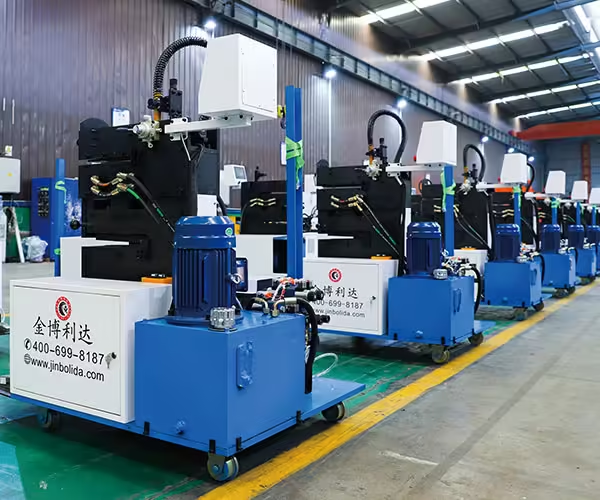
Automated butt welders, like the Strip Shearing and End Welding Machine from Jinbolida, produce burr-free welds with minimal finishing required, enhancing efficiency and reducing material waste.
Automation and Precision
PLC-controlled systems with hydraulic alignment ensure consistent weld quality, reduce human error, and allow integration into fully automated production lines.
Case Study: Steel Strip Production
A Jinbolida client increased daily welded steel output from 500 meters to 1,200 meters after implementing automated butt welders. Labor requirements dropped by 35%, and weld quality metrics improved according to ISO 15614-1 standards.
Industry News and Innovations
Recent industry white papers highlight the adoption of AI-assisted butt welding systems that monitor seam temperature, detect microcracks, and adjust power in real time, increasing both safety and production efficiency.
When Fillet Welders Are Preferable
Flexible Joint Configurations
Fillet welders excel at corner joints, T-joints, and lap joints. They are ideal when material orientation or assembly geometry makes butt welding impractical.
Simpler Equipment for Small Workshops
Fillet welding machines require lower upfront investment and are easier to operate manually, making them suitable for smaller fabrication shops.
Quick Adaptation for Mixed Thickness
Fillet welders can adapt to variable thicknesses and angles without complex alignment, suitable for repairs, maintenance, or custom projects.
Practical Example
In automotive body fabrication, fillet welders are used to join sheet panels at angles, enabling quick assembly without the need for specialized butt welding setups.
Choosing Between Butt Welders and Fillet Welders
Material Type and Thickness Considerations
- Butt Welders: Ideal for end-to-end steel strips, pipes, and thick plates.
- Fillet Welders: Best for angle joints, thin sheets, and flexible configurations.
Automation and Productivity Needs
Automated butt welders save labor and reduce errors in high-volume production. Fillet welders are better suited for low-volume or repair work.
Cost-Benefit Analysis
Although initial investment in a butt welder may be higher, long-term savings in labor, material, and production quality often outweigh the upfront cost.
Industry Benchmark Data
- Average ROI for automated butt welders: 18–24 months
- Average increase in production efficiency: 40–60% in steel strip manufacturing
- Reduction in material waste: 15–25% compared to manual welding
Advanced Technologies in Butt Welders

PLC Centralized Control
Touchscreen interfaces and programmable logic control allow operators to monitor welding parameters, automate sequences, and maintain consistent quality.
Hydraulic Alignment and Clamping
Automatic double-sided alignment ensures precise positioning, critical for high-strength welds and minimal burrs.
AI-Assisted Monitoring
Emerging AI systems can detect defects such as microcracks, overheating, or misalignment during the welding process, providing real-time adjustments for maximum efficiency.
Integration with Factory Automation
Butt welders can be fully integrated into digital factory lines, coordinating with shearing, stacking, and inspection equipment for continuous production.
Real-World Applications of Butt Welders
Steel Strip Industry
- Seamless end-to-end welding for steel coils
- High-speed automated lines reduce downtime and manual handling
Pipeline Manufacturing
- Continuous welds for high-pressure gas, oil, and water pipelines
- Weld quality validated through non-destructive testing (NDT) methods
Automotive and Heavy Machinery
- Chassis and frame fabrication
- Consistent, high-strength welds critical for structural safety
Case Example: Energy Infrastructure
A pipeline project in China employed Jinbolida butt welders, increasing welded joint throughput by 2x, while reducing labor costs by 30%. Welds passed ISO 15614-1 and ASME Section IX inspections without rework.
Safety and Operational Best Practices

Proper Training and Certification
Operators should be certified under AWS or ISO welding standards to ensure high-quality, safe operations.
Regular Equipment Maintenance
Routine checks of hydraulic systems, alignment clamps, and PLC software ensure consistent welding performance.
Protective Measures
Use of welding shields, ventilation systems, and automated barriers minimizes operator exposure to heat, sparks, and fumes.
FAQ
What is the main difference between butt welders and fillet welders?
Butt welders join metals end-to-end, forming a continuous seam, while fillet welders join metals at angles, creating L-shaped or T-shaped joints.
Are butt welds stronger than fillet welds?
Yes, properly executed butt welds often match or exceed the tensile strength of the base metal, ideal for high-stress industrial applications.
Can fillet welders be automated like butt welders?
Fillet welders can be automated, but full PLC-controlled automation is more common in butt welding due to alignment precision requirements.
Which welding type is more labor-efficient?
Automated butt welders reduce labor significantly, whereas fillet welders usually require more manual input and operator skill.
Is a butt welder suitable for small workshops?
Yes, though initial cost is higher. Small workshops often opt for fillet welders for flexibility and lower upfront investment.
What industry standards apply to butt welding?
Key standards include ASME Section IX, ISO 15614-1, and AWS D1.1, ensuring safety and structural integrity.
How can AI improve butt welding?
AI systems monitor welding temperature, detect defects, and adjust parameters in real time, improving quality and reducing rework.
What are the typical material thicknesses for butt welders?
Modern machines can handle 0.5 mm to 30 mm, depending on model and application.
Can butt welders weld non-ferrous metals?
Yes, specialized machines with TIG or MIG capability can weld stainless steel, aluminum, and other alloys.
How does automated butt welding reduce waste?
Precise alignment and controlled welding energy minimize burrs and excess material, reducing scrap by up to 25%.
Conclusion
The choice between butt welders and fillet welders hinges on joint type, production volume, material thickness, and automation needs. For industrial-scale, high-strength, end-to-end welding, butt welders deliver superior efficiency, consistent quality, and labor savings. Fillet welders are indispensable for angle joints, small-batch fabrication, and flexible assembly.
Investing in modern automated butt welding systems with PLC control, hydraulic alignment, and AI-assisted monitoring ensures maximum productivity, minimal waste, and long-term operational excellence.
If you enjoyed this article on Jinbolida’s smart manufacturing and digital factory expertise, follow us for more insights and updates:
- 📘 Facebook: Stay tuned for our latest smart production line projects → Facebook
- 📱 WhatsApp: Contact us anytime for custom production solutions → Chat Now
- ▶️ YouTube: Watch our automated line demos and real-world applications → YouTube
Let’s keep innovating and shaping the future of smart manufacturing — together!
 English
  Arabic
  Russian
  Spanish
  French