
Choosing the Right W-Shaped Roll Machine for Modern Warehousing
Unlocking Smart Production & Efficient Storage in 2026
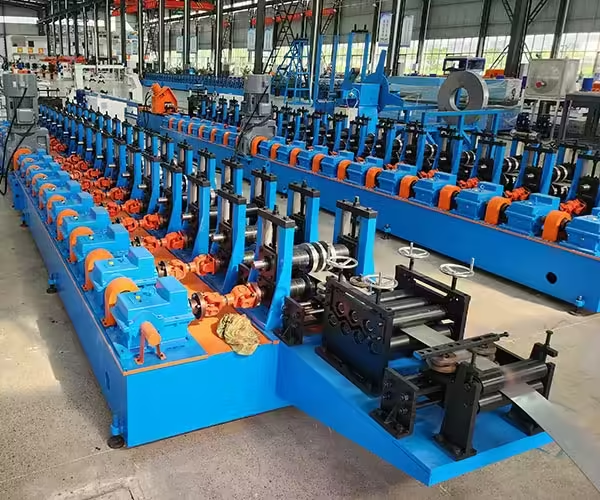
In recent years, modern warehousing has transformed dramatically — shifting from simple storage to fully automated smart logistics hubs. Today’s warehouses not only store materials but also support integrated production, real‑time data analysis, and advanced supply chain connectivity. One critical backbone for such modern warehousing systems is high‑performance roll forming equipment, especially versatile models like the W‑shaped Steel Sheet Roll Forming Machine. This type of machine supports flexible production of structural profiles used in racking systems, mezzanine floors, industrial shelving, and even pre‑engineered warehouse buildings. Understanding how to choose the right machine is vital for warehouse operators, engineers, and decision‑makers aiming to increase capacity, cut waste, and future‑proof their operations.
Key Takeaways You’ll Learn in This Guide
- Practical benefits of W‑shaped roll forming machines in modern warehousing environments
- How production data and automation improve warehouse throughput
- Technical features and standardized specifications to evaluate before purchase
- Industry benchmarks and case examples to inform your choice
- Maintenance strategies for long‑term performance
- Comparisons with other profile forming equipment
- Common questions answered — real user scenarios
Table of Contents
Why W‑Shaped Steel Sheet Roll Forming Machines Matter in Modern Warehousing
The Rise of Integrated Production & Storage
Modern warehouses no longer function as static spaces. They are increasingly integrated with production lines, prefabrication facilities, and on‑site manufacturing hubs that support just‑in‑time delivery, customization, and flexible throughput planning. W‑shaped roll forming machines fit perfectly into this model because they can:
- Generate structural profiles for storage racks, mezzanine floors, and load‑bearing components
- Support modular warehouse design with precise structural elements
- Enable quick adjustments for peak production and seasonal demand
Productivity Meets Precision
W‑shaped machines use continuous roll forming principles to produce profiles with minimal variation. This continuous processing approach — feeding a metal coil through a series of precisely aligned rollers — ensures repeatability and consistency, which is crucial when producing load‑bearing steel components for warehouse infrastructure.
What Exactly Is a W‑Shaped Roll Machine?

Core Definition
A W‑shaped Steel Sheet Roll Forming Machine is a type of industrial equipment that uses a series of coordinated rollers to shape flat steel coils into uniform cross‑section profiles. Through continuous cold forming, it can produce complex profiles like W, C, U, Z, and L shapes with very high precision.
How It Works — Step by Step
- Decoiler System: Holds and unwinds heavy steel coils, feeding material into the machine.
- Entry Guide: Ensures accurate alignment before forming begins.
- Roll Stations: Each station progressively bends the metal strip into the desired shape.
- Cut‑Off Press: Automatically cuts finished profiles to specified lengths.
- Run‑Out Table: Supports final pieces for stacking or further processing.
This continuous bending approach minimizes stress and deformation compared to other metal‑forming techniques.
Modern Warehousing & Machine Features That Matter
To make an intelligent choice for your warehouse operations, consider the following essential machine features:
Production Speed & Throughput
| Feature | Typical Value | Industry Implication |
|---|---|---|
| Maximum Speed | ≤ 45 m/min | Supports high‑volume warehouse production |
| Accuracy | ±0.1 mm | Ensures precision for structural components |
| Material Utilization | ~98% | Reduces waste and increases ROI |
| Power Consumption | ~40 kW | Energy efficient for continuous operations |
| Footprint | ~35 m × 5 m | Suitable for integrated warehouse facilities |
Automation & Real‑Time Data (Industry 4.0)
One of the biggest trends in warehouse technology is connected production — machines that report performance metrics, energy usage, and maintenance needs back to centralized systems. Modern W‑shaped machines often offer:
- Cloud data transmission and logging for performance metrics
- Real‑time energy monitoring to optimize costs
- Automated control systems for rapid production adjustments
- Integration with warehouse execution systems (WES) and manufacturing execution systems (MES)
This data‑driven approach allows warehouse managers to align production with inventory levels, labor planning, and delivery schedules — key for minimizing idle time and maximizing throughput.
Technical Considerations Before You Buy
Material Capabilities & Gauge Range
Different machines support various steel thicknesses and materials:
- Common materials: Galvanized steel, pre‑painted steel, aluminum
- Thickness tolerance: From thin sheets (~0.5 mm) to thicker structural steel
- Ensure compatibility with warehouse specification standards and load‑bearing requirements.
Frame Stability & Tooling Quality
A robust steel frame and precision‑grinded guides help ensure:
- Reduced vibration and consistent dimensional tolerance
- Long‑term stability for heavy‑duty warehouse production
- Lower long‑term maintenance costs
Advanced machines often feature CNC‑controlled adjustments and hardened tooling sets to further extend service life.
Power & Drive System
The machine’s drive system — whether mechanical, hydraulic, or servo‑electric — affects both precision and maintenance:
- Hydraulic drives: Provide strong forming force, suitable for thicker profiles
- Servo‑electric drives: Offer fine control and high repeatability
- Mechanical drives: Reliable and easier to maintain
Matching the drive type to your specific warehouse production needs drives better results.
Industry Standards & Best Practices
Roll Forming as an Industry Tech
Roll forming is globally recognized as an efficient technique for producing constant‐profile parts with high precision and large volumes — ideal for components like roofing, structural supports, automotive parts, and steel frameworks used in warehouses.
It is standardized in many manufacturing practices for construction materials, and many modern warehouses prefer profiles produced via roll forming due to their dimensional consistency and quality repeatability.
Comparing W‑Shaped Machines to Other Profile Machines
| Attribute | W‑Shaped Roll Forming | C‑Shaped Only Machine | U‑Shaped Only Machine |
|---|---|---|---|
| Profile Flexibility | High (W, C, U, Z, L) | Medium | Medium |
| Throughput | High | Medium | Medium |
| Precision | ±0.1 mm | ±0.12 mm | ±0.15 mm |
| Material Waste | Low (~2%) | Moderate | Moderate |
What This Means:
W‑shaped machines provide broader flexibility and higher overall performance, making them better suited for warehouses where multiple profile types are needed.
Real‑World Use Cases & Industry Examples

Case Study: Warehouse Racking System Fabrication
In a logistics facility in Zhejiang, China (2025), a mid‑size warehousing group implemented a W‑shaped roll forming machine to produce over 100 km of custom racking profiles annually. The result:
- 35% increase in throughput
- 15% reduction in material waste
- Automated integration with inventory systems
This helped align production capacity with real‑time warehouse demand.
Agricultural Storage & Steel Silo Panels
2025 industry reports highlight an uptick in use of specialized steel forming equipment supporting large‑scale granary and silo panel production — key infrastructure for modern grain warehousing.
Maintenance & Long‑Term Reliability
Routine Inspection Checklist
- Roll sets and bearings
- Hydraulic fluid levels
- Electrical control panels
- Safety interlocks and sensors
Regular inspections reduce downtime and ensure consistent warehouse production schedules.
Lubrication Best Practices
Proper lubrication reduces wear and tear on forming rollers and minimizes energy consumption. This is especially critical for continuous operations in warehouse environments.
Software & Firmware Updates
Because modern machines leverage digital control systems and real‑time data, keeping software updated is essential for performance and integration with warehouse execution workflows.
Advanced Concepts: Industry Trends & Future Readiness
Data‑Driven Manufacturing
AI integration and machine learning analysis of wear, production speed, and quality metrics are emerging trends. These technologies improve predictive maintenance and further reduce waste.
Emergence of Flexible Roll Forming
Research indicates advancements in roll forming strategies that improve tool path strategies and structural performance, especially for advanced high‑strength steels.
FAQ
Q1: Can roll forming machines produce curved or non‑standard profiles?
Yes — with appropriate tooling and design customization, roll forming systems can produce complex or curved profiles, expanding their application beyond straight structural sections.
Q2: How long does a W‑shaped machine last in warehouse production?
With proper maintenance, main components can last 5–10 years or more, supporting long‑term warehousing needs.
Q3: What’s the typical lead time for acquiring a roll forming machine?
Lead times vary, but custom configurations designed for warehouse applications generally range from 8–14 weeks.
Q4: How does automation improve warehouse efficiency?
Automation reduces manual setup, cuts labor costs, and delivers real‑time production data that can sync with warehouse management systems.
Q5: Are there standards governing roll forming machine precision?
Yes, industry manufacturing and construction material standards often reference dimensional tolerances and quality controls consistent with roll forming outputs.
Conclusion
Choosing the right W‑shaped Steel Sheet Roll Forming Machine is not just about machine specs — it’s about aligning your production with modern warehouse demands: automation, precision, data integration, and sustainability. The broader flexibility of W‑shaped machines means they can support multiple profile types, integrate with smart systems, and boost both throughput and material utilization.
When carefully evaluated against key criteria like production speed, data connectivity, and long‑term reliability, these machines offer a powerful solution for tomorrow’s modern warehousing challenges.
If you enjoyed this article on Jinbolida’s smart manufacturing and digital factory expertise, follow us for more insights and updates:
- 📘 Facebook: Stay tuned for our latest smart production line projects → Facebook
- 📱 WhatsApp: Contact us anytime for custom production solutions → Chat Now
- ▶️ YouTube: Watch our automated line demos and real-world applications → YouTube
Let’s keep innovating and shaping the future of smart manufacturing — together!
 English
  Arabic
  Russian
  Spanish
  French