
Cold Rolled vs Hot Rolled Steel in Manufacturing: Expert Insights & Data-Driven Guide
/ Cold Rolled vs Hot Rolled Steel in Manufacturing: Expert Insights & Data-Driven Guide
Key Points You Will Learn in This Article
- What distinguishes cold rolled vs hot rolled steel in terms of process and physics
- How manufacturing temperature influences microstructure, mechanical behavior, and performance
- Performance comparison backed by engineering data and industry specifications
- Practical considerations for choosing materials in real manufacturing settings
- Where cold rolled steel delivers superior value, and when hot rolled still dominates
- The role of surface quality, tolerances, and finishing in modern automated production
- FAQs that match real buyer and engineer search intent
Table of Contents
Introduction
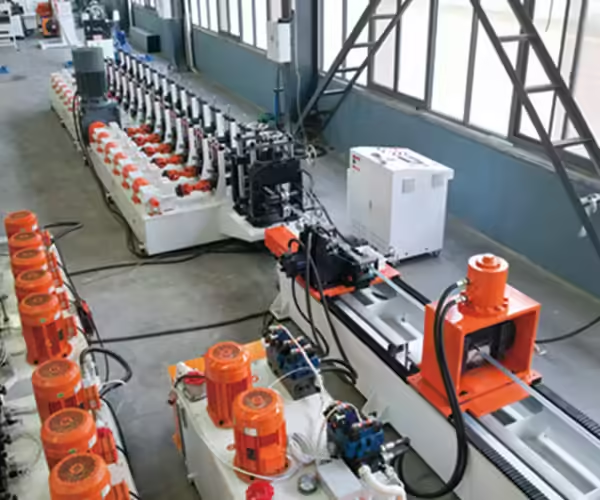
Carbon steel underpins infrastructure, automotive, appliances, precision machines, and industrial equipment across the globe. Yet a single basic choice — cold rolled vs hot rolled steel — can significantly influence production cost, precision, strength, surface finish, and manufacturing efficiency.
From structural beams in construction to pressed automotive parts and high-precision profiles, engineers and procurement teams make material decisions daily that hinge on this seemingly simple distinction. With industrial automation, laser cutting, and robotic assembly now mainstream, the subtleties between cold rolled and hot rolled steel have concrete downstream impacts.
Section 1 — How Steel Is Made: Hot Rolling vs Cold Rolling
Hot Rolling: Overview of High-Temperature Processing
Hot rolled steel is formed by heating steel above its recrystallization temperature — often ~1700°F+ (925°C+) — and rolling it into desired shapes. This high heat allows heavy deformation without cracking, facilitating large structural shapes and coarse profiles. Hot rolled steel typically cools in air after rolling, retaining mill scale and characteristic surface texture unique to this process.
Cold Rolling: Precision at Room Temperature
Cold rolled steel starts from hot rolled coils, then undergoes additional reduction at or near room temperature. This cold deformation increases strength and hardness through work hardening and enables very tight dimensional control and surface finish not achievable with hot rolling alone.
Temperature’s Role in Material Behavior
In manufacturing science, the temperature at which steel is mechanically worked influences grain structure, internal stress, and defect distribution. Hot rolling produces a coarser grain structure with higher ductility, while cold rolling aligns crystalline grains and increases structural uniformity, enhancing precision but limiting formability without subsequent heat treatment.
Section 2 — Mechanical Properties: Cold Rolled vs Hot Rolled Steel in Numbers
Strength and Hardness
Cold rolled steel generally exhibits significantly higher mechanical strength than hot rolled steel due to strain hardening. For similar grades:
| Property | Hot Rolled Steel | Cold Rolled Steel | Engineering Impact |
|---|---|---|---|
| Yield Strength | ~310 MPa (45,000 psi) | ~480–500+ MPa (70,000 psi+) | Cold rolled resists deformation longer |
| Tensile Strength | ~460 MPa (67,000 psi) | ~580 MPa (85,000 psi+) | Better load capacity |
| Hardness | ~120–160 HB | ~95+ (or higher when not annealed) | Cold rolled often harder |
| Ductility (Elongation) | ~20–35% | ~5–25% | Hot rolled is more deformable before fracture |
(Representative data for typical mild steel grades at similar chemistry.)
Interpretation: Cold rolled steel can sustain higher stress before permanent deformation, making it more suitable for precision parts that must maintain shape under load. Hot rolled remains advantageous where the ability to bend, shape, and absorb deformation is prioritized.
Surface Finish and Dimensional Accuracy
Cold rolled steel has a smooth, bright surface with tight, predictable tolerances. Hot rolled steel, by contrast, carries mill scale and dimensional variability due to thermal contraction and expansion during cooling.
In many precision manufacturing contexts — such as automotive body panels or fine-tolerance hardware — the cold rolled finish can eliminate secondary surface processing steps like grinding or polishing.
Section 3 — Microstructure & Residual Stresses: Science Behind the Differences


Microstructure Dynamics
Hot rolling occurs above recrystallization temperature, allowing dynamic growth and refinement of grains. Cold rolling, performed at lower temperatures, forces dislocations and strain into the microstructure, resulting in work hardened steel with elevated strength but greater internal stresses.
Advanced materials science recognizes that cold rolling’s grain alignment also enhances uniformity, which can improve machinability and consistency in automated processing.
Residual Stress Considerations
Cold rolled steel’s internal stresses can cause warping or distortion if not annealed after rolling, something engineers must account for in precision assemblies. Hot rolled materials have their residual stresses largely relieved by the high-temperature process itself.
Section 4 — Cost and Production Efficiency: Practical Industry View
Price Considerations
Hot rolled steel is generally 20%–40% cheaper per ton compared to cold rolled due to fewer production stages and lower energy requirements. This makes hot rolled steel popular for structural members, heavy plates, and infrastructure components where tight tolerances are unnecessary.
Production Speed & Automation
Although cold rolling adds steps (pickling, cold reduction, annealing, leveling), modern mills use automation and tandem rolling lines to maintain throughput while achieving fine tolerances. For high-volume precision parts, this often results in fewer downstream corrections, offsetting some of the cost premium.
Lifecycle Manufacturing Cost
While cold rolled steel costs more up front, it may reduce total manufacturing cost by minimizing scrap, rework, and secondary finishing. In automated CNC and robotic assembly lines, the consistency of cold rolled coils supports predictable process control.
Section 5 — Real World Applications: Where Each Material Excels
Typical Uses of Hot Rolled Steel
Hot rolled steel is dominant in robust, large-scale, and general structural contexts:
- Structural beams, columns, and plate
- Rails and heavy load-bearing members
- Construction infrastructure (bridges, frames)
- Agricultural and industrial equipment
Its high ductility and toughness make it favorable where shock resistance, fatigue tolerance, and weldability are important.
Typical Uses of Cold Rolled Steel
Cold rolled steel is preferred where precision, surface quality, and strength matter:
- Automotive panels and chassis parts
- Household appliance housings
- Precision mechanical components
- Surface-critical consumer products
- Profiling and stamping parts for industrial machines
Because cold rolling yields a clean surface free of scale, it often requires less surface preparation before coating, painting, or plating.
Section 6 — Manufacturing Considerations in Automated Lines
Role of Surface Quality in Automation
Automated assembly systems — such as vision-guided welding or laser cutting — perform best with precise, clean surfaces. Cold rolled steel’s uniform surface leads to more reliable sensor readings and tighter fit assembly.
Hot rolled steel may require additional smoothing or preparation, adding time and cost when surface finish matters.
Impact on CNC Machining
Cold rolled steel’s uniform microstructure and tighter tolerances generally facilitate more predictable CNC cutting and fabrication paths. While hot rolled steel may be easier to deform manually, its variability can reduce machining efficiency and lead to tool wear.
Section 7 — Advanced Manufacturing Scenarios: Engineers’ Perspectives

Expert Insights on Material Selection
Industry engineers often recommend cold rolled steel where tolerance and aesthetics are necessary. As one materials specialist noted in engineering discussions, cold rolling’s work hardening and surface control produce components with much more predictable behavior in stress testing and dynamic loading — crucial for automotive and precision parts.
However, hot rolled steel remains attractive in projects prioritizing cost savings and formability, such as in heavy fabrication and large structural assemblies.
Section 8 — Comparative Summary Table
| Feature | Hot Rolled Steel | Cold Rolled Steel |
|---|---|---|
| Processing Temperature | High (>925°C) | Room temperature |
| Surface Finish | Rough, scaled | Smooth, bright |
| Dimensional Accuracy | Lower | High precision |
| Yield Strength | Lower | Higher (work hardened) |
| Ductility | High | Lower without annealing |
| Cost | Lower | Higher |
| Typical Use | Structural | Precision parts |
| Machinability | Moderate | Good |
Conclusion
The debate between cold rolled vs hot rolled steel is more nuanced than a simple “better or worse.” Each type has its place:
- Choose hot rolled steel for heavy structural applications, cost-sensitive fabrication, and high ductility requirements.
- Choose cold rolled steel when precision, strength, surface aesthetics, and tight tolerances matter — particularly in automotive, appliance, and precision machining industries.
By weighing mechanical properties, surface finish, cost, and production requirements, manufacturers can optimize material selection for both performance and economics.
FAQ
What is the main difference between cold rolled vs hot rolled steel?
The key distinction lies in processing temperature: hot rolled steel is formed at high temperature, while cold rolled steel achieves final shaping at or near room temperature, yielding different mechanical and surface properties.
Is cold rolled steel stronger than hot rolled steel?
Yes — cold rolled steel generally exhibits higher yield and tensile strength due to strain hardening imparted during cold processing.
Why does cold rolled steel cost more?
Additional processing steps (pickling, cold reduction, leveling, potential annealing) raise production cost compared to the simpler hot rolling process.
Which is better for machining and precision parts?
Cold rolled steel — with its tight tolerances and smooth surface — offers better predictability for precision machining and automated assembly.
Can hot rolled steel be used where cold rolled steel is recommended?
In some cases, yes. Hot rolled steel may be acceptable if tolerances are forgiving and surface finish is secondary. But for high-precision or aesthetic components, cold rolled is often preferred.
If you enjoyed this article on Jinbolida’s smart manufacturing and digital factory expertise, follow us for more insights and updates:
- 📘 Facebook: Stay tuned for our latest smart production line projects → Facebook
- 📱 WhatsApp: Contact us anytime for custom production solutions → Chat Now
- ▶️ YouTube: Watch our automated line demos and real-world applications → YouTube
Let’s keep innovating and shaping the future of smart manufacturing — together! 🚀
 English
  Arabic
  Russian
  Spanish
  French