
Cost Analysis: W Beam Guardrail Cold Bending Machine
As the global highway construction market expands, contractors and manufacturers face mounting pressure to produce high-quality guardrails quickly, efficiently, and cost-effectively. W beam guardrails are a critical safety component, protecting lives on roads worldwide. Selecting the right W beam guardrail cold bending machine is not just a technical decision—it’s a financial one.
In this blog, we will explore every aspect of cost analysis for these machines, including initial investment, operational expenses, maintenance, energy usage, ROI strategies, and expert insights. Whether you are planning a single machine purchase or a large-scale production line, this guide will help you make informed decisions.
Table of Contents
Key Points Covered:
- Understanding W beam guardrail cold bending machines
- Cost breakdown: purchase, operation, maintenance, and energy
- Automation level comparison: semi-automatic vs fully automatic
- Efficiency optimization and ROI strategies
- Material waste reduction and production speed considerations
- Expert insights and industry benchmarks
- Procurement tips and risk management
- Frequently Asked Questions (FAQ)
Understanding the W Beam Guardrail Cold Bending Machine
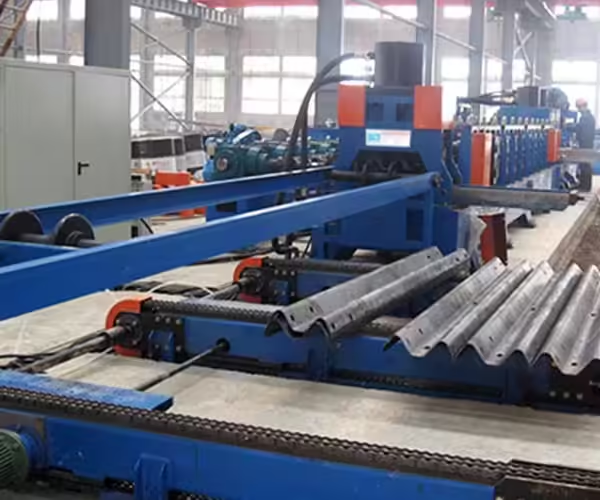
What is a W Beam Guardrail Cold Bending Machine?
A W beam guardrail cold bending machine is an automated system designed for producing steel W-shaped highway guardrails at room temperature. Cold bending preserves material properties while enabling precise wave shapes, tight tolerances, and minimal scrap.
Core Functions:
- Continuous high-speed production of W beam guardrail panels
- Precision forming with flying shear cutting
- Adjustable for different wave shapes (single, double, or triple wave)
- Low material waste due to accurate head and tail processing
Key Technical Specifications
| Parameter | Typical Range |
|---|---|
| Material Thickness | 2.0–4.5 mm |
| Material Width | Customized per project |
| Forming Speed | 25–55 m/min |
| Cutting Precision | ±0.5 mm |
| Roller Life | 5–8 years depending on use |
Cost Breakdown of a W Beam Guardrail Cold Bending Machine

1. Initial Purchase Cost
The upfront investment varies based on automation, capacity, and additional features:
- Semi-automatic machines: $50,000–$90,000
- Fully automatic machines: $120,000–$200,000
- Factors affecting cost: production speed, number of rollers, control system sophistication, feeding mechanism type
Industry Insight: According to the 2023 Highway Equipment Report, fully automatic machines have a 25–40% higher initial cost than semi-automatic units, but yield 30–50% higher efficiency and lower labor costs.
2. Operational Cost
Labor Expenses
- Semi-automatic machines require 2–3 operators per shift
- Fully automatic machines may operate with only 1 operator
- Labor accounts for approximately 20–35% of annual operational costs
Energy Consumption
- Average power consumption: 25–35 kW for a fully automatic machine operating at 50 m/min
- Optimizing motor usage and employing variable frequency drives (VFDs) can reduce electricity costs by 15–20% annually
Material Costs
- Material wastage during start-up and profile changes
- Fully automatic machines minimize scrap through continuous and precise production
- Using high-quality steel reduces post-processing costs and rework
3. Maintenance and Spare Parts
- Annual maintenance: 3–5% of initial investment
- Key components: rollers, shear blades, feeding system, hydraulic or electric motors
- Preventive maintenance can extend machine lifespan by 5–8 years
Automation Level Comparison
Semi-Automatic vs Fully Automatic
| Feature | Semi-Automatic | Fully Automatic |
|---|---|---|
| Initial Cost | Lower | Higher |
| Labor Requirement | Moderate | Minimal |
| Production Speed | 25–35 m/min | 45–55 m/min |
| Cutting Precision | ±1.0 mm | ±0.5 mm |
| Material Waste | Higher | Minimal |
| ROI Timeframe | 2–3 years | 1–2 years |
Expert Tip: For large-scale highway projects, fully automatic machines often provide faster payback due to labor savings and higher throughput.
Advanced Cost Considerations
Energy Efficiency Optimization
- Implement VFDs for motors to match production demand
- Schedule production runs to avoid peak electricity costs
- Utilize energy-efficient lighting and auxiliary equipment
Material Savings Strategies
- Use precision rollers for minimal head/tail scrap
- Optimize machine settings for different steel thicknesses
- Consider recycling or repurposing offcuts
Risk Management in Procurement
- Assess supplier reliability and after-sales support
- Ensure availability of spare parts and technical support
- Evaluate machine adaptability for future guardrail design changes
Maintenance and Longevity

Regular Inspections
- Roller alignment, lubrication, and wear checks
- Hydraulic system pressure monitoring
- Electrical system inspection and control panel calibration
Prolonging Machine Life
- Implement a preventive maintenance schedule
- Train operators on proper handling and emergency procedures
- Maintain proper storage and environmental conditions
Industry Benchmarks and Expert Opinions
Dr. Michael Lee, Highway Infrastructure Specialist:
“Investing in a fully automated W beam cold bending machine can significantly reduce production downtime and material waste, making it highly cost-effective for large highway projects. Selecting the correct specifications for each application is crucial to optimize ROI.”
Global Highway Construction Report 2024:
- Average ROI for fully automatic machines: 1.5–2 years
- Labor cost savings: up to 50% compared to semi-automatic machines
- Reduction in material scrap: 10–20%
Case Studies
Large-Scale Highway Project
- Project: 50 km of new highway guardrail
- Equipment: Fully automatic W beam cold bending line
- Outcome: Production rate 55 m/min, labor reduced from 12 to 4 workers per shift, material waste reduced by 15%
Medium-Scale Regional Project
- Equipment: Semi-automatic machine
- Production rate: 30 m/min
- Labor: 6 workers per shift
- ROI achieved in 2.5 years
Comparative Concepts
Cold Bending vs Hot Rolling
| Feature | Cold Bending | Hot Rolling |
|---|---|---|
| Production Speed | Moderate | High |
| Material Properties | Maintained | Slightly altered |
| Precision | High | Lower |
| Initial Investment | Lower | Higher |
| Waste | Minimal | Higher |
W Beam vs U Beam Guardrails
| Feature | W Beam | U Beam |
|---|---|---|
| Safety Performance | Higher lateral stability | Moderate |
| Production Complexity | Moderate | Simple |
| Cost | Higher per unit | Lower |
| Suitable Road Type | Highways | Local roads |
Conclusion
Investing in a W beam guardrail cold bending machine requires a careful balance of upfront costs, operational efficiency, labor savings, and long-term maintenance. By understanding automation levels, production speeds, energy usage, and material savings, manufacturers can make informed decisions that optimize ROI. Fully automatic machines offer superior throughput and precision, while semi-automatic lines may suit smaller-scale operations. Strategic procurement, preventive maintenance, and proper workflow optimization ensure sustainable, high-quality guardrail production for years to come.
FAQ
Q: How much does a W beam guardrail cold bending machine cost?
A: Prices range from $50,000 to $200,000 depending on automation and production capacity. Fully automatic machines cost more but save labor and improve ROI.
Q: What is the expected lifespan of the W beam guardrail cold bending machine?
A: 15–20 years with proper maintenance, with key components like rollers replaced every 5–8 years.
Q: Can I switch wave shapes easily?
A: Yes, most machines allow adjustments for single, double, or triple wave shapes, but some complex profiles may require roller replacements.
Q: How can I minimize energy and material costs?
A: Use VFDs, schedule production runs efficiently, implement preventive maintenance, and recycle scrap materials.
Q: Is a fully automatic machine worth it for medium-sized projects?
A: It depends on production requirements and labor costs. For moderate output, semi-automatic machines may suffice, while fully automatic lines maximize efficiency for large-scale projects.
If you enjoyed this article on Jinbolida’s smart manufacturing and digital factory expertise, follow us for more insights and updates:
- 📘 Facebook: Stay tuned for our latest smart production line projects → Facebook
- 📱 WhatsApp: Contact us anytime for custom production solutions → Chat Now
- ▶️ YouTube: Watch our automated line demos and real-world applications → YouTube
Let’s keep innovating and shaping the future of smart manufacturing — together! 🚀
 English
  Arabic
  Russian
  Spanish
  French