
H-beam Production Line Explained: From Raw Steel to Finished Beams
Table of Contents
Introduction
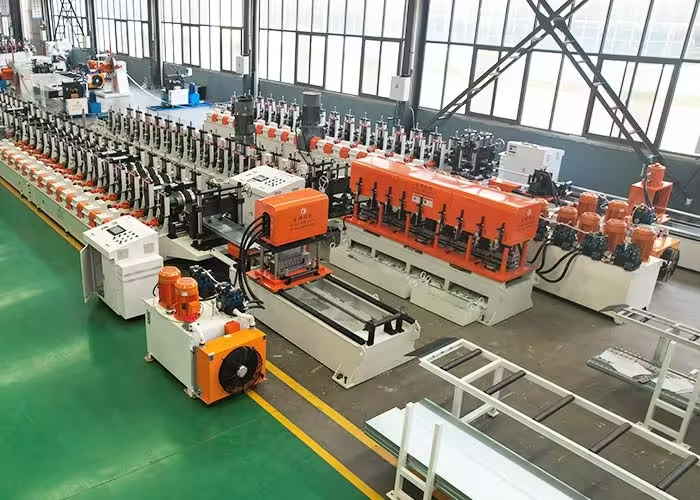
H-beam production lines are essential in modern steel manufacturing. They enable the efficient fabrication of H-shaped beams used in construction, bridges, industrial frameworks, and large-scale projects. By integrating cutting, forming, welding, and inspection processes, these production lines ensure consistent quality and high output. Understanding how H-beam production lines operate helps manufacturers optimize production and select the right line for their needs.
Key Components of an H-beam Production Line
Main Equipment in H-beam Manufacturing
A standard H-beam production line consists of cutting machines, forming machines, welding units, straightening machines, and automated conveyors. Each piece of equipment plays a vital role in transforming raw steel plates or coils into finished beams with precise dimensions and strong structural integrity.
Optional Equipment for Enhanced Automation
Some modern lines include automatic stacking systems, hydraulic shears, and computer-controlled monitoring units. These enhancements reduce manual labor, improve safety, and maintain consistent production quality. Choosing between a fully automated or semi-automated setup depends on production scale and budget.
H-beam Production Process

Step 1: Raw Material Selection
Before production begins, high-quality steel plates or coils are carefully inspected for grade, thickness, and surface defects. Selecting the right steel ensures that the finished H-beams meet structural and safety standards.
Practical Tip: Use ultrasonic or visual testing to detect internal defects and ensure the steel’s chemical composition matches design requirements. Proper handling during storage prevents scratches, rust, or deformation, which can affect final beam quality.
Step 2: Cutting and Forming
Steel plates are cut into appropriate lengths using precision cutting machines such as plasma cutters or hydraulic shears. The cut sections are then shaped into flanges and web components using rolling or forming machines. Accurate forming is crucial for maintaining beam geometry and load-bearing capacity.
Practical Tip: Regularly calibrate forming rolls to maintain uniform thickness and ensure proper alignment between web and flange sections.
Step 3: Welding and Assembly
The web and flange sections are assembled and welded together, usually using automated or semi-automated welding machines. Consistent weld penetration and alignment are essential to maintain structural integrity and reduce weak points.
Practical Tip: Implement real-time welding monitoring systems to check heat input and prevent excessive warping or weak welds. Post-weld stress-relief treatment can further improve beam durability.
Step 4: Straightening and Shaping
After welding, beams may experience slight deformation or warping. Straightening machines correct these deviations, ensuring that H-beams are dimensionally accurate and perfectly aligned. This step is critical for meeting tolerances required in construction and industrial applications.
Practical Tip: Use laser measurement or mechanical gauges to check straightness during the process, ensuring minimal rework and consistent quality.
Step 5: Quality Inspection and Packaging
Each H-beam undergoes thorough inspection for dimensions, weld quality, surface defects, and alignment. Only beams that meet the required standards are approved for packaging. Beams are then carefully stacked, labeled, and prepared for transport.
Practical Tip: Maintain a digital record of inspection results for traceability. Apply protective coatings or anti-rust treatments if beams will be stored or transported in humid environments.
Types of H-beam Production Lines
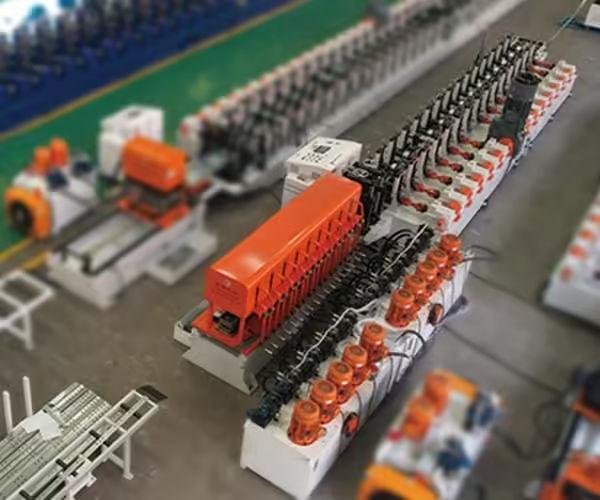
Fully Automated H-beam Production Line
These lines employ robotics and computer control for material handling, cutting, welding, and stacking. They maximize output, reduce errors, and are ideal for large-scale steel beam production.
Semi-Automated H-beam Production Line
Semi-automated lines combine manual oversight with automated processes. They allow operators to handle some functions while machines perform welding, forming, and cutting, offering flexibility for mid-sized operations.
Customized Small-Scale Lines
Tailored for specific beam sizes or low-volume production, small-scale lines are suitable for niche markets or localized construction projects.
Parameter Comparison Table: Selecting the Right H-beam Line
| Specification | Small-Scale Line | Semi-Automatic Line | Fully Automated Line |
|---|---|---|---|
| Production Capacity | 20–50 tons/day | 50–100 tons/day | 100–200+ tons/day |
| Automation Level | Low | Medium | High |
| Labor Requirement | High | Moderate | Low |
| Suitable Beam Size | Standard small beams | Medium beams | All sizes, customizable |
| Investment Cost | Low | Medium | High |
| Maintenance Complexity | Moderate | Moderate | Low to Medium |
| Ideal Users | Small workshops | Mid-sized plants | Large commercial/industrial producers |
This table helps users quickly compare production line types and determine the best fit for their facility based on capacity, automation, and investment level.
Advantages of Modern H-beam Production Lines
Improved Production Efficiency
Modern H-beam production lines integrate cutting, forming, welding, and straightening into a continuous workflow, drastically reducing production time compared to traditional manual methods. With real-time monitoring and automated scheduling, manufacturers can optimize production sequences, minimize idle time, and achieve higher daily output, enabling faster delivery for large-scale projects.
Consistent Beam Quality
Automation ensures that H-beams maintain uniform dimensions, precise flange-web alignment, and high-quality welds. In-line measurement systems and immediate defect detection help maintain strict compliance with industry standards, reducing rework and minimizing structural defects. This consistency is crucial for construction projects, bridges, and industrial frameworks where safety and reliability are paramount.
Labor Savings and Safety
Automated lines significantly reduce manual labor, allowing staff to focus on oversight, maintenance, and quality assurance. Built-in safety features such as protective barriers, emergency stops, and automated welding systems minimize the risk of accidents during hazardous operations. By reducing reliance on manual handling, manufacturers can achieve higher productivity with fewer operators while maintaining a safer working environment.
Flexibility for Diverse Beam Specifications
Advanced H-beam production lines can handle a wide range of steel grades, thicknesses, and custom beam dimensions. Modular line designs allow quick adjustments between production runs, enabling manufacturers to respond efficiently to varied client specifications without downtime. This flexibility is particularly valuable for companies supplying beams for both standard construction projects and specialized industrial applications.
Comparison: Traditional vs Modern Lines
Traditional H-beam production relies heavily on manual welding and forming. While requiring lower initial investment, it delivers slower output, higher defect rates, and greater labor intensity. Modern automated lines, despite higher upfront costs, provide significantly higher efficiency, consistent quality, and long-term cost savings. Companies that adopt modern lines often see a rapid return on investment through reduced labor costs, lower scrap rates, and faster project completion.
Applications and Case Studies
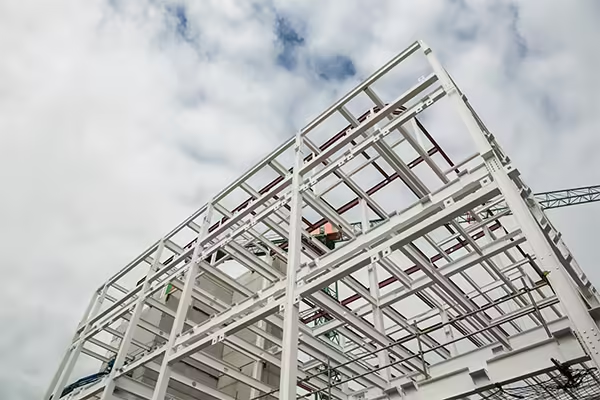
Construction and Infrastructure
H-beams produced on modern lines are extensively used in high-rise buildings, bridges, and industrial facilities. Their precision and strength ensure structural stability, and automated production allows for beams with custom dimensions to meet architectural and engineering requirements.
Industrial Projects
Factories, warehouses, and heavy machinery platforms benefit from H-beams produced with consistent quality. Automated production ensures beams are strong enough to withstand heavy loads while maintaining dimensional accuracy, supporting industrial operations without compromising safety.
Real-World Case Study
A steel manufacturer upgraded from a semi-automatic line to a fully automated H-beam production line with a daily capacity of 150 tons. Within six months, production efficiency increased by 40%, welding defects decreased by 60%, and labor costs were reduced by 30%. The company could also produce a broader variety of beam sizes, fulfilling diverse client demands and improving market competitiveness. This case demonstrates how modern H-beam production lines enhance output, quality, and operational flexibility simultaneously.
Maintenance and Operational Tips
Regular Equipment Inspection
Check rollers, welding units, and cutting tools frequently to prevent unexpected downtime and ensure consistent beam quality.
Cleaning and Lubrication
Keeping machinery clean and lubricated improves performance and extends equipment lifespan.
Operator Training
Well-trained staff can operate the line efficiently, reduce mistakes, and maintain safe working conditions.
Conclusion
Modern H-beam production lines offer unmatched efficiency, quality, and safety compared to traditional methods. Selecting the right line depends on production capacity, desired automation, material versatility, and budget. Investing in a well-designed H-beam production line ensures long-term operational efficiency, reduced labor costs, and reliable product quality.
Need specific guidance for selecting the right H-beam production line for your facility? Contact our engineers today for personalized advice and tailored solutions.
FAQ
How much does an H-beam production line cost?
Costs vary depending on automation, capacity, and equipment quality. Small lines may cost tens of thousands, while fully automated lines can reach hundreds of thousands.
What is the typical production capacity of a standard line?
Small-scale lines produce 20–50 tons/day, semi-automated 50–100 tons/day, and fully automated lines can exceed 150 tons/day.
Can an H-beam production line handle different steel grades?
Yes, modern lines are designed for multiple steel grades and beam thicknesses, offering flexibility for various projects.
How long does it take to install a full production line?
Installation may take several weeks for small lines or 2–3 months for large automated systems, depending on complexity.
What maintenance is required?
Regular inspection, cleaning, and lubrication are essential. Critical equipment like welding machines and rollers should be checked frequently.
Is training required to operate the production line?
Yes, proper training ensures safety, consistent quality, and efficient operation.
Can I customize an H-beam production line?
Yes. Suppliers offer customization for beam size, production capacity, automation level, and optional equipment.
How does automation improve production quality?
Automation ensures consistent welds, uniform beam dimensions, and minimizes human error, leading to higher-quality H-beams.
If you enjoyed this article on Jinbolida’s smart manufacturing and digital factory expertise, follow us for more insights and updates:
- 📘 Facebook: Stay tuned for our latest smart production line projects → Facebook
- 📱 WhatsApp: Contact us anytime for custom production solutions → Chat Now
- ▶️ YouTube: Watch our automated line demos and real-world applications → YouTube
Let’s keep innovating and shaping the future of smart manufacturing — together! 🚀
 English
  Arabic
  Russian
  Spanish
  French