
Highway Guardrail Manufacturing: Quality Standards Explained
Introduction
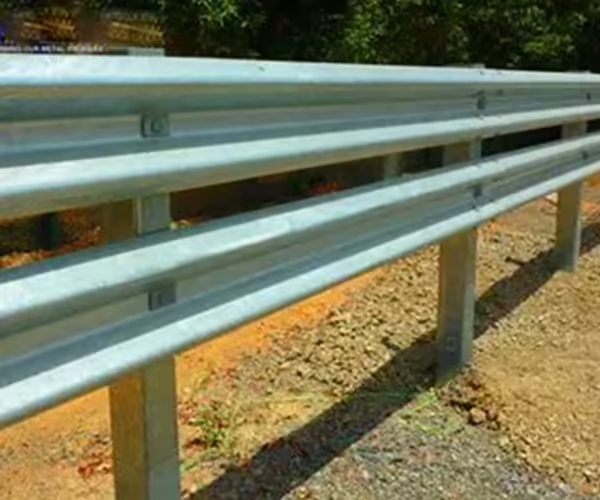
Highway guardrails are more than just roadside metal barriers—they are life‑saving safety devices that prevent vehicles from leaving roadways, colliding with hazards, or rolling over embankments. As global traffic volumes rise and infrastructure standards tighten, the quality of highway guardrail manufacturing plays a direct role in road safety outcomes and regulatory compliance.
In 2024 alone, the World Road Statistics Report noted a significant increase in demand for guardrail infrastructure across North America, Europe, and Asia Pacific, driven by rising road construction budgets and stricter crash safety regulations. Manufacturers must therefore ensure consistent product quality, material integrity, and compliance with national and international standards such as AASHTO M180 (USA), EN 1317 (Europe), and GB/T 31439 (China).
This article offers an in‑depth examination of guardrail production, explaining key manufacturing concepts, quality benchmarks, material selection, production technologies, safety standards, real‑world case studies, and the latest innovations shaping the industry.
Table of Contents
What Is Highway Guardrail Manufacturing?
Highway Guardrails Defined
Highway guardrails are engineered safety systems installed along road edges, medians, bridges, and roadside obstacles. Their purpose is to:
- Prevent vehicle rollover or run‑off
- Redirect errant vehicles safely
- Absorb and dissipate crash energy
The most common type today is the W‑beam guardrail, named for its distinctive “W” cross‑section that efficiently balances strength and flexibility during impact.
Core Concept: W‑Beam Profiles
W‑beam guardrails provide structured deformation under force, allowing controlled vehicle deceleration. A properly manufactured W‑beam meets precise curvature, thickness, and material strength requirements, crucial for crash performance.
Core Materials and Specifications
Selecting the right materials is foundational in highway guardrail manufacturing. Poor material quality leads to structural weakness, reduced durability, and non‑compliant products.
Steel Material Standards
European, American, and Chinese standards mandate high‑strength, low‑ductility steel for guardrails:
| Region | Standard | Typical Thickness (mm) | Typical Tensile (MPa) | Yield (MPa) |
|---|---|---|---|---|
| USA | AASHTO M180 | 2.67–4.0 | 350–550 | ≥ 230 |
| Europe | EN 1317 | ≥ 3.0 | 380–600 | ≥ 240 |
| China | GB/T 31439 | 2.0–4.5 | 350–550 | ≥ 235 |
Protective coatings—such as hot‑dip galvanization per ASTM A123 or EN ISO 1461—are essential to prevent corrosion and extend service life, especially in coastal or high‑humidity environments.
Concept: Coating and Corrosion Resistance
Guardrails exposed to road salt or moisture require coatings with ≥ 600 g/m² zinc equivalent to maintain corrosion resistance over decades. Industry white papers, such as from the International Zinc Association, show that enhanced coatings reduce maintenance costs by up to 35% over 10 years.
Guardrail Production Processes and Automation
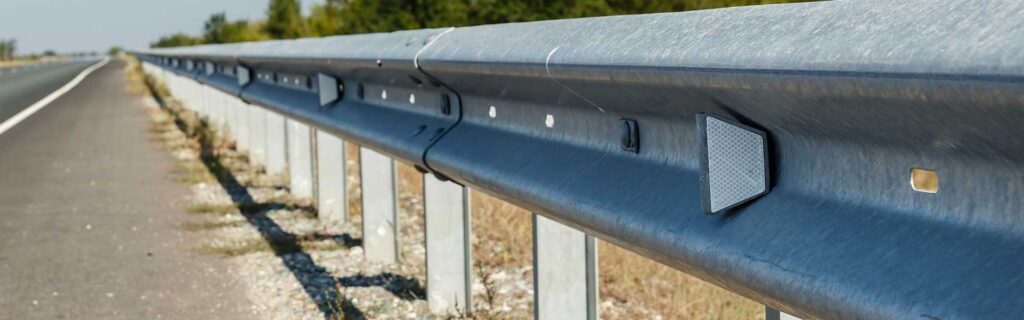
Material Feeding and Forming
Modern manufacturing lines start with raw steel coils fed into a forming machine that shapes the W‑beam profile through cold bending.
Standard Process Steps:
- Coil Feeding – Automatic material feed ensures consistent supply.
- Cold Bending Roll Forming – Series of progressive rollers shape the profile.
- Flying Shear Cutting – Cuts panels precisely at high speed, maintaining ±0.5 mm accuracy.
- Inspection & Quality Verification – Automated sensors check dimensions and surface quality.
Table: Production Line Performance Comparison
| Feature | Manual Press | Semi‑Auto Line | Automated Forming Machine |
|---|---|---|---|
| Forming Speed | 5–15 m/min | 15–30 m/min | 25–55 m/min |
| Cutting Precision | ±2.0 mm | ±1.0 mm | ±0.5 mm |
| Labor Required | High | Medium | Low |
| Waste Rate | High | Medium | Low |
| Standard Compliance Level | Moderate | High | Very High |
Concept: Automation Benefits
Automated forming lines yield more consistent products with less material waste, fewer human errors, and faster throughput—directly improving compliance with dimensional and performance standards.
Quality Standards and Testing Requirements
International & National Guardrail Standards
Official safety standards ensure guardrails perform reliably during crashes. Key frameworks include:
- AASHTO M180 (USA) — Material, dimension, strength requirements for steel guardrails
- EN 1317 (Europe) — Crash test classifications (e.g., N2, H2, H3 performance levels)
- GB/T 31439 (China) — Technical specifications covering guardrail material, production, and testing
These standards cover:
- Material grade and tensile properties
- Profile dimensions and thickness tolerances
- Surface treatment and corrosion resistance
- Energy absorption and impact performance
Concept: Crash Test Classifications
Crash testing assigns ratings such as TL‑2 or H2, indicating guardrail capability to safely redirect vehicles at specific speeds and impact angles. Guardrail segments must be manufactured precisely to pass these evaluations.
Comparisons of Manufacturing Methods
Understanding the advantages and limitations of different production approaches helps manufacturers optimize output and compliance.
Comparison Table: Manufacturing Methods
| Method | Cost | Precision | Automation | Compliance Risk |
|---|---|---|---|---|
| Manual Press | Low | Medium | Low | Higher |
| Semi‑Automated Line | Medium | High | Medium | Medium |
| Fully Automated Forming | High | Very High | High | Low |
Fully automated systems require higher upfront investment but deliver the most consistent quality and lower compliance risk, especially for large‑scale highways and export markets.
Industry Trends and Market Data
Global Guardrail Infrastructure Growth
According to Global Infrastructure Report 2025–2030, highway guardrail installations are expected to grow by 5.8% CAGR, driven by safety policy updates and new expressway projects across Asia Pacific, North America, and the Middle East.
Impact of Smart Manufacturing
Industry 4.0 technologies—such as IoT sensors, predictive maintenance, and automated quality scoring—are becoming mainstream in top‑tier guardrail manufacturing plants. A Manufacturing Journal white paper reports that facilities with integrated real‑time monitoring systems cut defect rates by up to 22%.
Case Studies: Manufacturing and Deployment
Case Study 1: Automated Line Deployment in China
A leading Chinese supplier installed a highway guardrail forming machine with automated control and flying shear cutting. Results after 12 months:
- Output increased by 38%
- Material waste reduced by 27%
- Rework rates decreased by 15%
Strict quality control ensured compliance with GB/T 31439 and export standards for Southeast Asian markets.
Case Study 2: Crash‑Test Validation in Europe
A European manufacturer upgraded to higher‑precision forming rollers to meet EN 1317 H3 standards. Extensive crash testing showed improved energy absorption and consistent deformation performance across multiple batches—earning certification for high‑speed motorway contracts.
Innovations Transforming Guardrail Production

Smart Manufacturing and IoT Integration
Modern plants use sensors to measure:
- Roll forming alignment
- Material thickness real‑time
- Temperature and vibration
Cloud‑based dashboards provide insights into machine health and product quality, enabling remote alerts and predictive maintenance.
Concept: Digital Twin & Simulation
Digital twin models simulate forming processes, allowing engineers to optimize roller configurations before physical production. This technology reduces trial‑and‑error downtime and accelerates setup changes for new profiles or thickness ranges.
Common Challenges and Best Practices
Challenge: Material Variability
Solution: Implement incoming material testing protocols using tensile testers, thickness gauges, and coating adhesion tests to reject substandard steel before production.
Challenge: Maintaining Precision Over Time
Solution: Perform scheduled calibrations on forming rollers and cutting tools, and track machine wear with automated measurement data.
Best Practice: Continuous Documentation
Maintaining traceable production logs helps prove compliance during audits and crash test validations.
FAQ
Q1: What makes a guardrail compliant with safety standards?
A1: Compliance requires proper material grade, precise dimensions, correct coating thickness, and successful performance in crash tests per AASHTO, EN 1317, or GB/T 31439.
Q2: How can manufacturers reduce waste while maintaining quality?
A2: Using automated forming lines with precision control, flying shear cutting, and real‑time sensors dramatically reduces material waste.
Q3: Are coated guardrails better than uncoated ones?
A3: Yes—coated products (e.g., hot‑dip galvanized) significantly outperform uncoated guardrails in corrosion resistance and long‑term durability.
Q4: What is the role of automation in modern guardrail manufacturing?
A4: Automation improves consistency, reduces labor costs, enhances precision, and lowers compliance risk in large‑scale production.
Q5: How often should guardrails be tested after installation?
A5: While manufacturing quality standards ensure initial compliance, periodic field inspections (every 1–3 years) are recommended to check for damage, corrosion, or deformation.
Conclusion
Highway guardrail manufacturing is both a technical discipline and a safety imperative. Manufacturers must balance material choices, production technology, precision standards, and global compliance requirements to produce products that protect lives and meet regulatory demands.
By embracing automation, smart manufacturing, robust quality standards (AASHTO, EN 1317, GB/T 31439), and proactive best practices, producers can ensure high‑performance guardrails that consistently meet or exceed safety expectations for highways worldwide.
Investing in advanced forming machinery, rigorous testing protocols, and data‑driven control systems positions suppliers for success in an increasingly competitive and safety‑focused market.
If you enjoyed this article on Jinbolida’s smart manufacturing and digital factory expertise, follow us for more insights and updates:
- 📘 Facebook: Stay tuned for our latest smart production line projects → Facebook
- 📱 WhatsApp: Contact us anytime for custom production solutions → Chat Now
- ▶️ YouTube: Watch our automated line demos and real-world applications → YouTube
Let’s keep innovating and shaping the future of smart manufacturing — together!
 English
  Arabic
  Russian
  Spanish
  French