
How to Form Solar PV Mounting Brackets
Key Takeaways
- Solar PV Mounting Bracket forming relies on precision roll forming and cold forming technologies
- High-speed forming machines can reach up to 45 m/min with ±1 mm accuracy
- Material selection and profile design directly impact structural strength and durability
- Intelligent automation improves efficiency, reduces labor, and ensures consistent quality
- U-channel and C-channel forming are the most common structural solutions
- Choosing the right forming process depends on project scale, cost, and application scenario
- Global PV demand is driving higher standards for bracket accuracy, corrosion resistance, and strength
- Smart manufacturing and data-driven production are becoming industry benchmarks
Introduction
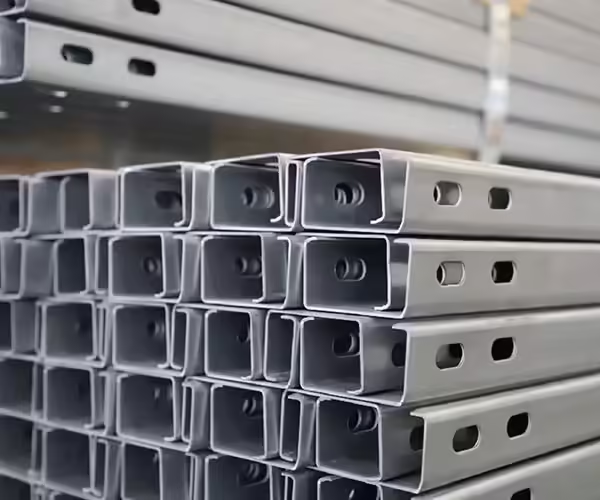
As global solar capacity continues to surge—exceeding 1 terawatt of installed photovoltaic capacity worldwide—the demand for reliable structural systems has never been higher. While solar panels often receive the most attention, the true backbone of every installation is the Solar PV Mounting Bracket.
A poorly formed bracket can lead to structural instability, reduced lifespan, and costly maintenance. In contrast, precision-formed brackets ensure long-term durability, faster installation, and optimal load distribution. This makes forming technology not just a manufacturing step, but a strategic advantage.
Modern Solar PV Mounting Bracket production has evolved into a highly engineered process that integrates high-speed roll forming, intelligent automation, and strict quality control standards. For manufacturers and buyers alike, understanding this process is essential to making informed decisions.
Table of Contents
What Is Solar PV Mounting Bracket Forming?

Definition of Solar PV Mounting Bracket Forming
Solar PV Mounting Bracket forming refers to the process of shaping metal materials—typically galvanized steel, stainless steel, or aluminum—into standardized structural profiles used in photovoltaic systems.
This process ensures consistent geometry, structural strength, and compatibility with installation systems.
Purpose of Forming in PV Bracket Production
The primary goal of forming is to create high-performance structural components.
Accurate forming improves installation efficiency, enhances load-bearing capacity, and ensures long-term reliability in outdoor environments.
Industry Background: Growth of Solar PV Mounting Bracket Demand
Global Market Expansion
The solar energy market is expanding rapidly.
According to industry reports, global solar installations are growing at an annual rate of 15%–25%, directly increasing demand for Solar PV Mounting Bracket systems.
Shift Toward Standardization
Standardized bracket systems are becoming the norm.
This trend simplifies installation and reduces costs, making precision forming even more critical.
Demand for High Durability
Solar installations are expected to last 25–30 years.
This requires brackets with excellent corrosion resistance and mechanical strength, which depend heavily on forming quality.
Core Forming Methods for Solar PV Mounting Bracket
Roll Forming Process for Solar PV Mounting Bracket
Roll forming is the most widely used method in the industry.
It allows continuous shaping of metal strips into precise profiles, making it ideal for large-scale production.
Cold Forming Technology
Cold forming enhances material strength without heating.
This process ensures high dimensional accuracy and improved mechanical properties.
Punching and Cutting Integration
Integrated systems streamline production.
They allow punching, slotting, and cutting to occur within the same production line, reducing time and cost.
Key Equipment for Solar PV Mounting Bracket Forming
U-Channel Steel Forming Machine

This machine is designed for producing U-shaped profiles commonly used in mounting systems.
Production Speed: ≤45 m/min
Precision: ±1 mm
Equipment Power: ~40KW
Product Range: 41×21 – 41×82
Advanced features include servo tracking cutting, intelligent mold switching, and real-time data monitoring.
C-Channel Roll Forming Machine

C-channel machines are essential for structural support components.
Production Speed: ≤45 m/min
Precision: ±1 mm
Web Height: 30–60 mm
Base Width: 50–160 mm
Cloud-based systems track production data and energy consumption, enabling smart factory integration.
Technical Comparison: U-Channel vs C-Channel Forming
| Feature | U-Channel Forming | C-Channel Forming |
|---|---|---|
| Structural Shape | U-shaped | C-shaped |
| Load Capacity | Moderate | Higher |
| Application | Light to medium systems | Medium to heavy systems |
| Flexibility | High | Moderate |
| Production Efficiency | High | High |
| Installation Complexity | Lower | Slightly higher |
Key Parameters in Solar PV Mounting Bracket Forming
Forming Speed
High-speed production is essential for large-scale projects.
Machines operating at 45 m/min can produce thousands of meters of profiles daily.
Precision and Tolerance
Precision ensures compatibility across components.
A tolerance of ±1 mm is considered industry standard for high-quality Solar PV Mounting Bracket production.
Material Thickness and Coating
Material selection impacts durability.
Galvanized coatings such as Z275 or higher are commonly used to ensure corrosion resistance.
Industry Standards and Certifications
International Standards
Compliance with global standards ensures quality and reliability.
ISO 9001 ensures quality management, ISO 1461 governs galvanization, and ASTM A653 defines steel specifications.
Structural Design Standards
Engineering standards define performance requirements.
Codes like Eurocode 3 and AS/NZS 1170 ensure brackets can withstand wind, snow, and seismic loads.
Advantages of Advanced Solar PV Mounting Bracket Forming
High Production Efficiency
Continuous forming systems maximize output.
They reduce downtime and increase manufacturing capacity.
Reduced Labor Costs
Automation lowers workforce requirements.
This improves cost efficiency and operational safety.
Consistent Product Quality
Precision equipment ensures uniformity.
This reduces defects and improves installation performance.
Conceptual Insights into Forming Technology
Continuous Forming Concept
Continuous forming eliminates interruptions.
It ensures smooth production flow and higher efficiency.
Intelligent Manufacturing Concept
Smart factories use data-driven systems.
They optimize performance and reduce waste.
Modular Design Concept
Modular systems allow flexibility.
Manufacturers can quickly adapt to different product requirements.
Process Flow of Solar PV Mounting Bracket Forming

Step 1: Material Preparation
Raw materials are inspected and prepared.
This ensures consistent quality before entering the production line.
Step 2: Roll Forming
The material passes through multiple rollers.
Each stage gradually shapes the profile with high precision.
Step 3: Punching and Cutting
Integrated systems process holes and final dimensions.
Servo tracking ensures accuracy without interrupting production.
Step 4: Surface Treatment
Protective coatings are applied.
This enhances corrosion resistance and extends service life.
Step 5: Quality Inspection
Finished products are tested.
This ensures compliance with design and industry standards.
Case Study: High-Speed PV Bracket Production Line
A manufacturer implemented a fully automated Solar PV Mounting Bracket production line and achieved measurable improvements.
Production efficiency increased by 40%, labor costs were reduced by 35%, and product defect rates decreased by 25%.
This case highlights how intelligent forming systems can significantly improve operational performance and profitability.
Industry Trends in Solar PV Mounting Bracket Forming
Automation and Digitalization
Manufacturers are adopting smart factory systems.
Real-time monitoring and cloud-based data improve production efficiency and traceability.
High-Strength Lightweight Materials
Advanced materials are becoming more common.
They reduce structural weight while maintaining strength and durability.
Sustainability and Green Manufacturing
Energy-efficient equipment is gaining importance.
Modern forming machines reduce energy consumption and environmental impact.
Cost Analysis of Solar PV Mounting Bracket Forming
| Cost Factor | Traditional Method | Modern Forming Solution |
|---|---|---|
| Labor Cost | High | Low |
| Energy Consumption | Moderate | Low |
| Production Efficiency | Low | High |
| Maintenance Cost | High | Moderate |
| ROI | Slow | Fast |
How to Choose the Right Forming Solution
Evaluate Production Volume
Large-scale production requires high-speed forming systems.
Smaller operations may benefit from flexible and modular setups.
Consider Material Requirements
Different materials require different forming approaches.
High-strength steel demands precise control during forming.
Analyze Long-Term ROI
Investment decisions should focus on long-term efficiency.
Advanced systems provide faster returns and lower operating costs.
FAQ
What is the best method to form Solar PV Mounting Bracket?
Roll forming is widely considered the most efficient method due to its speed, precision, and scalability.
How accurate is modern forming equipment?
Most advanced machines achieve a precision level of ±1 mm, ensuring consistent quality.
Can one machine produce multiple bracket types?
Yes, modern forming machines support quick mold changes and flexible configurations.
How long do forming machines last?
With proper maintenance, forming equipment can operate efficiently for more than 10–15 years.
Is automation necessary for PV bracket production?
Automation is highly recommended for improving efficiency, consistency, and cost control.
What coating is best for PV brackets?
Hot-dip galvanization with Z275 or higher is commonly used to ensure long-term corrosion resistance.
Conclusion
Solar PV Mounting Bracket forming is a critical process that directly impacts the performance, durability, and cost-effectiveness of photovoltaic systems. As the solar industry continues to expand, manufacturers must adopt advanced forming technologies to remain competitive.
By leveraging high-speed roll forming, intelligent automation, and strict quality standards, companies can produce high-performance brackets that meet the demands of modern solar installations. Investing in the right forming solutions is not just a production decision but a strategic step toward long-term success in the renewable energy industry.
If you enjoyed this article on Jinbolida’s smart manufacturing and digital factory expertise, follow us for more insights and updates:
- 📘 Facebook: Stay tuned for our latest smart production line projects → Facebook
- 📱 WhatsApp: Contact us anytime for custom production solutions → Chat Now
- ▶️ YouTube: Watch our automated line demos and real-world applications → YouTube
Let’s keep innovating and shaping the future of smart manufacturing — together!
 English
  Arabic
  Russian
  Spanish
  French