
Inside PV Bracket Factories: How Solar Mounting Systems Are Engineered at Industrial Scale
/ Inside PV Bracket Factories: How Solar Mounting Systems Are Engineered at Industrial Scale
Key Takeaways
- PV bracket factories are highly automated industrial systems combining roll forming, stamping, punching, and CNC control.
- Production accuracy typically ranges from ±0.1mm to ±1mm depending on machine type.
- Modern factories operate 20–24 hours/day with cloud-based monitoring systems.
- C-channel, U-channel, and connector systems form the structural backbone of solar mounting systems.
- Automation reduces labor cost by 40–70% compared to traditional fabrication workshops.
- Equipment selection directly determines product lifespan, load capacity, and installation efficiency.
- Industry 2026 trend: fully digitalized PV bracket production with predictive maintenance and AI-assisted quality control.
Introduction
The global solar energy market has entered a phase of rapid industrial scaling. According to multiple renewable energy reports (including IEA Solar PV Outlook), global solar capacity is expected to exceed 5 terawatts by 2030, with mounting systems accounting for a critical portion of installation reliability and cost efficiency.
Behind every solar panel installation, there is an often-overlooked industrial backbone: pv bracket factories.
These factories are not simple metal workshops. They are highly engineered production ecosystems integrating:
- Precision forming technology
- Automated stamping systems
- Intelligent punching machines
- Real-time cloud monitoring
- CNC-controlled manufacturing lines
The role of PV bracket factories is fundamental because solar mounting systems must withstand:
- 25+ years of outdoor exposure
- Wind loads exceeding 60–150 km/h depending on region
- Snow loads up to 1.5–5.0 kN/m² in cold regions
- Corrosion resistance requirements under IEC 61730 and IEC 61215 frameworks
This makes production accuracy and material consistency critical.
Table of Contents
Industrial Architecture of PV Bracket Factories
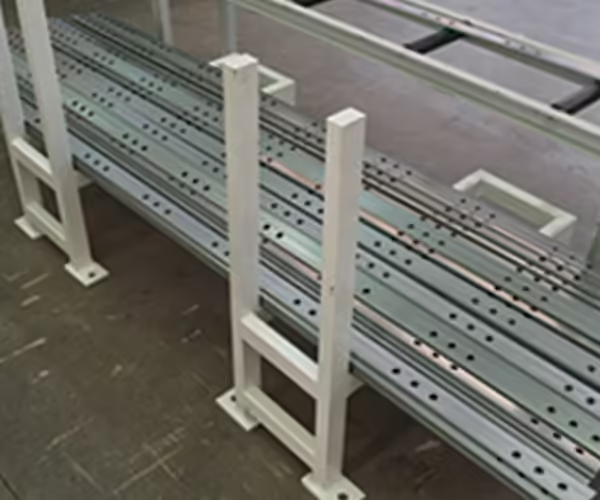
PV Bracket Factories Production Ecosystem Overview
Modern production systems are divided into four core industrial modules:
1. Raw Material Processing Zone
Steel coils, aluminum sheets, and galvanized materials are prepared for processing.
2. Forming & Shaping Systems
Roll forming machines convert flat steel into structural profiles.
3. Punching & Stamping Systems
High-speed hydraulic systems create precise mounting holes and connectors.
4. Assembly & Quality Inspection Line
Final components undergo dimensional and load testing.
Concept: Continuous Smart Manufacturing Flow
Unlike traditional batch production, pv bracket factories adopt continuous flow systems.
This ensures:
- Reduced idle time
- Stable product output
- Lower defect rates (<1.5% in advanced factories)
PV Bracket Factories Core Equipment Systems
C-Channel Steel Roll Forming Machine
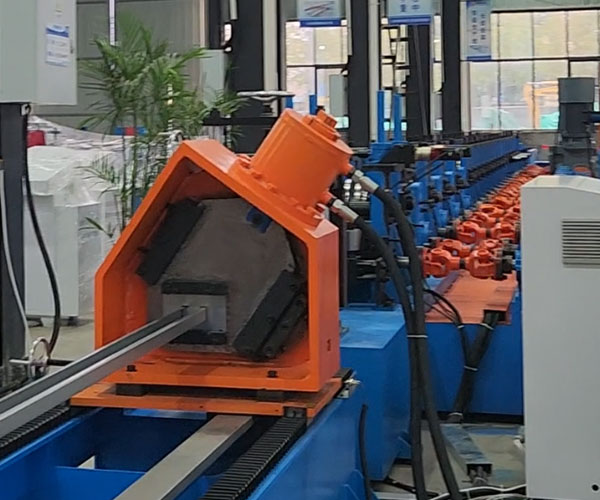
This is the backbone of PV mounting structure production.
Key technical data:
- Speed: ≤45 m/min
- Precision: ±1 mm
- Power: ~40 KW
- Material thickness: 1.5–3.5 mm galvanized steel
- Line length: ~35 meters
Engineering Concept: Multi-Roll Progressive Forming
Steel is gradually shaped through 12–18 forming stations.
Benefits:
- Minimal internal stress deformation
- High structural uniformity
- Reduced scrap rate (<2%)
U-Channel Steel Forming Machine

Used for reinforcement structures in solar mounting systems.
Key parameters:
- Precision: ±1 mm
- Speed: ≤45 m/min
- Cross-section range: 41×21 to 41×82 mm
Comparison Insight: Structural Load Distribution
| Factor | C-Channel | U-Channel |
|---|---|---|
| Load Bearing | Primary | Secondary |
| Cost Efficiency | Higher | Moderate |
| Structural Role | Main frame | Reinforcement |
| Installation Use | High | Medium |
C-channel dominates structural framing, while U-channel stabilizes stress distribution.
Solar Connector Punching Machine

Used to produce fastening connectors for solar mounting systems.
Key specifications:
- Efficiency: 3–5 seconds/piece
- Accuracy: ±0.5 mm
- Continuous operation: 24-hour capability
- Coil width: ≤300 mm
Industry Concept: High-Speed Servo Punching
Servo-controlled punching ensures:
- Precision alignment of holes
- Reduced tool wear
- Higher repeatability (>98%)
Nine-Station Intelligent Punch System

A multi-stage automated punching solution.
Key performance data:
- Output: 70–90 cycles/min
- Feed speed: up to 120 m/min
- Hydraulic power: 9 kW system
Concept: Parallel Processing Manufacturing
Instead of single-step punching, multiple stations perform operations simultaneously.
This reduces:
- Production bottlenecks
- Manual intervention
- Cycle time by up to 35%
Heavy-Duty Hydraulic Stamping Press

Used for large structural forming operations.
Key parameters:
- Force range: 63–800 tons
- Accuracy: ±0.1 mm
- Multi-process capability: punching, bending, stretching
Engineering Insight: Material Stress Optimization
Precision stamping ensures:
- Uniform load distribution
- Improved fatigue resistance
- Longer structural lifespan (20–30 years)
PV Bracket Factories Equipment Comparison Matrix
| Equipment Type | Function | Speed | Accuracy | Industrial Role | Automation Level |
|---|---|---|---|---|---|
| C-Channel Forming | Structural beams | 45 m/min | ±1 mm | Primary frame | High |
| U-Channel Forming | Reinforcement | 45 m/min | ±1 mm | Secondary support | High |
| Connector Punching | Joint parts | 3–5 sec/unit | ±0.5 mm | Assembly system | Very High |
| Nine-Station Punch | Multi-hole processing | 90 cycles/min | ±0.5 mm | High-volume parts | Very High |
| Hydraulic Press | Heavy forming | 35 m/min | ±0.1 mm | Structural shaping | Medium-High |
Advanced Manufacturing Intelligence in PV Bracket Factories
Cloud-Based Production Monitoring
Modern factories integrate IoT systems that track:
- Output per hour
- Energy consumption per machine
- Error rates
- Equipment utilization rate
Industry Benchmark Data
- Machine utilization rate: 85–92%
- Energy efficiency improvement: 18–25%
- Downtime reduction: 30–40%
Predictive Maintenance Systems
AI-based systems detect early signs of machine failure.
Benefits include:
- Reduced unexpected downtime
- Lower maintenance cost (up to 20%)
- Extended equipment lifespan
Digital Twin Simulation
Factories simulate production lines digitally before physical manufacturing.
This allows:
- Process optimization
- Tool path simulation
- Error reduction before production
Cost Structure of PV Bracket Factories (Industry Whitepaper Insight)
Manufacturing Cost Breakdown
| Cost Component | Percentage |
|---|---|
| Raw Material | 55–65% |
| Energy Consumption | 8–12% |
| Labor | 10–18% |
| Equipment Depreciation | 8–15% |
| Logistics | 5–10% |
Concept: Automation ROI Cycle
High-end pv bracket factories typically achieve ROI within:
- 12–24 months (fully automated lines)
- Faster payback in high-volume production environments
Real Industry Case Study: Large-Scale Solar Farm Supply Chain
A major 200MW solar farm project requires:
- Over 80,000 mounting structures
- More than 1.2 million connectors
- Continuous production for 60–90 days
Factory Output Performance
- Daily output: 10,000–15,000 components
- Defect rate: <1.2%
- On-time delivery rate: 98.5%
This demonstrates how pv bracket factories directly impact renewable energy infrastructure development.
Comparison: Traditional Workshop vs Modern PV Bracket Factories
| Feature | Traditional Workshop | Modern PV Bracket Factories |
|---|---|---|
| Automation Level | Low | High |
| Accuracy | ±3–5 mm | ±0.1–1 mm |
| Output Efficiency | Low | Very High |
| Labor Requirement | High | Low |
| Production Stability | Inconsistent | Highly stable |
| Cost per Unit | High | Optimized |
Global Trends in PV Bracket Factories (2024–2026)
1. Full Automation Transition
Factories are moving toward fully unmanned production lines.
2. Green Manufacturing Systems
Focus on:
- Low-carbon steel production
- Energy-efficient motors
- Waste reduction systems
3. AI Quality Inspection
Computer vision systems now detect:
- Surface defects
- Dimensional errors
- Structural inconsistencies
4. Modular Production Lines
Factories are shifting to flexible production layouts to handle multiple bracket designs.
Buyer Perspective: How to Evaluate PV Bracket Factories
“What defines a high-quality factory?”
Key indicators:
- Equipment precision level
- Automation integration
- R&D capability
- Production capacity
“Why does machine accuracy matter so much?”
Because even ±1mm deviation can affect:
- Solar panel alignment
- Load distribution
- Long-term structural safety
“Are all PV bracket factories the same?”
No. They differ significantly in:
- Equipment generation
- Engineering capability
- Quality control systems
- Output efficiency
FAQ
What machines are essential in PV bracket factories?
Roll forming machines, punching systems, stamping presses, and CNC-controlled production lines are essential.
How precise are modern PV bracket factories?
Advanced factories achieve ±0.1 mm to ±1 mm precision depending on process type.
What is the lifespan of PV bracket production equipment?
Typically 8–15 years depending on maintenance and usage intensity.
Do PV bracket factories use automation?
Yes, most modern factories operate with 70–90% automation levels.
Why are PV bracket factories important for solar projects?
They ensure structural safety, cost efficiency, and long-term durability of solar installations.
Conclusion
Modern pv bracket factories represent the convergence of mechanical engineering, automation technology, and renewable energy manufacturing.
From high-speed roll forming systems to intelligent stamping presses and AI-driven monitoring platforms, these factories are no longer simple production sites—they are advanced industrial ecosystems powering global solar infrastructure.
As solar demand continues to grow globally, the importance of precision manufacturing, automation integration, and intelligent production systems will only increase, making PV bracket factories a critical foundation of the renewable energy supply chain.
If you enjoyed this article on Jinbolida’s smart manufacturing and digital factory expertise, follow us for more insights and updates:
- 📘 Facebook: Stay tuned for our latest smart production line projects → Facebook
- 📱 WhatsApp: Contact us anytime for custom production solutions → Chat Now
- ▶️ YouTube: Watch our automated line demos and real-world applications → YouTube
Let’s keep innovating and shaping the future of smart manufacturing — together!
 English
  Arabic
  Russian
  Spanish
  French