
Photovoltaic Bracket Factory Setup Guide: Equipment, Line Design & Smart Manufacturing Solutions
/ Photovoltaic Bracket Factory Setup Guide: Equipment, Line Design & Smart Manufacturing Solutions
Key Takeaways
- A modern photovoltaic bracket factory relies on fully automated roll forming and intelligent cutting systems
- Production efficiency is strongly influenced by line speed, precision, and factory layout design
- C-channel and U-channel steel forming lines are the core production backbone
- Smart factories enable real-time monitoring of energy use, output, and equipment health
- Proper equipment selection directly determines ROI, scalability, and product consistency
- Industry trends are shifting toward digitalized, low-labor, high-precision manufacturing systems
Introduction
The global solar energy industry is undergoing rapid industrial scaling. According to the International Energy Agency (IEA) renewable outlook reports, global photovoltaic capacity has been increasing at an annual rate exceeding 20%, driven by utility-scale solar farms and distributed rooftop installations.
Behind every solar panel installation is a structural backbone: the mounting system. This is where the photovoltaic bracket factory becomes a critical industrial node in the renewable energy supply chain.
Unlike traditional steel workshops, modern PV bracket factories are:
- Fully automated production environments
- Data-driven manufacturing systems
- High-precision steel forming facilities
- Integrated IoT-enabled industrial lines
A well-designed factory can increase production efficiency by 30%–60%, reduce labor dependency by up to 70%, and significantly improve product consistency across batches.
Table of Contents
Photovoltaic Bracket Factory Production System Architecture
Core Manufacturing Logic
A photovoltaic bracket factory transforms steel coils into structural mounting components through continuous forming processes. These components are used in:
- Ground-mounted solar farms
- Rooftop solar systems
- Industrial photovoltaic arrays
- Carport solar structures
The production system must ensure:
- Structural load reliability
- Dimensional accuracy
- Anti-corrosion performance
- Long-term outdoor durability
Industrial Production Flow Model
A modern production line typically follows this structured workflow:
- Coil loading system
- Hydraulic decoiler
- Roll forming unit
- Servo tracking cutting system
- Automatic stacking system
- Quality inspection module
- Packaging and dispatch system
Each stage operates in synchronization to ensure continuous production without bottlenecks.
Photovoltaic Bracket Factory Equipment Ecosystem
C-Channel Steel Roll Forming System (Core Production Unit)
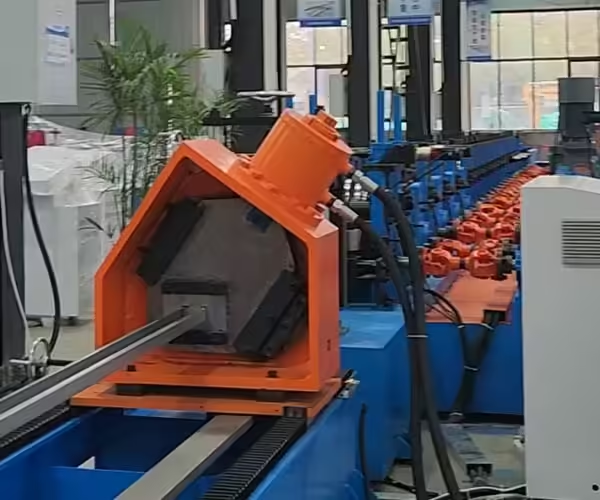
This system is the most widely used production line in a photovoltaic bracket factory.
Functional Engineering Concept
It converts steel coils into C-shaped profiles used in structural mounting systems.
Technical Specifications
- Production speed: ≤45 meters/minute
- Precision tolerance: ±1 mm
- Equipment power: approx. 40KW
- Profile range: Web height 30–60 mm, base width 50–160 mm
- Factory footprint: ~35m × 5m
Advanced Engineering Features
- Servo tracking cutting system
- Intelligent mold changeover
- Production memory function (shutdown recovery)
- Cloud-based production monitoring
- Energy consumption tracking system
Engineering Advantage
These features reduce production interruptions and improve dimensional stability across long production cycles.
U-Channel Steel Forming System (Structural Expansion Unit)

Application Concept
Used for U-shaped steel profiles in reinforcement and mounting applications.
Technical Range
- Production speed: ≤45 meters/minute
- Precision: ±1 mm
- Profile size: 41×21 mm to 41×82 mm
Operational Advantages
- Stable long-cycle production
- Reduced energy consumption
- High mold durability under continuous operation
Intelligent Factory Control System (Industry 4.0 Layer)
Smart Manufacturing Concept
Modern factories integrate IoT-based systems for real-time monitoring.
Core Functions
- Output tracking per production batch
- Energy consumption analytics
- Machine health diagnostics
- Predictive maintenance alerts
Industrial Impact
According to manufacturing whitepapers from global equipment research institutions, predictive maintenance systems reduce unexpected downtime by 25%–35%.
Photovoltaic Bracket Factory Layout Engineering
Factory Space Optimization Model
A standard production line requires:
- Length: 30–40 meters
- Width: 4–6 meters
- Auxiliary space: 200–500 m² depending on storage needs
Layout Efficiency Principle
Factory design follows a linear flow principle:
Material Input → Forming → Cutting → Stacking → Output
This reduces:
- Material handling time
- Operator movement inefficiency
- Production interruption risk
Efficiency Gain Insight
Optimized layouts can improve throughput by 15%–30%.
Photovoltaic Bracket Factory Equipment Comparison Framework
| Equipment Type | Automation Level | Speed | Precision | Application Scenario |
|---|---|---|---|---|
| C-Channel Line | High | Very High | ±1 mm | Main structural production |
| U-Channel Line | High | High | ±1 mm | Reinforcement structures |
| Manual Production | Low | Low | ±3–5 mm | Small-scale workshops |
| Semi-Automatic Line | Medium | Medium | ±2 mm | Mid-level factories |
Photovoltaic Bracket Factory Cost Structure Analysis

Investment Distribution Model
- Roll forming system: 40%–50%
- Cutting & automation system: 15%–20%
- Control & software system: 10%
- Factory infrastructure: 15%–25%
- Installation & training: 5%–10%
ROI (Return on Investment) Insight
A fully automated photovoltaic bracket factory typically achieves:
- Payback period: 18–36 months
- Labor cost reduction: up to 60%
- Scrap rate reduction: 20%–40%
Global Industry Standards & Compliance Framework
ISO Standards Relevant to PV Bracket Manufacturing
- ISO 9001: Quality management systems
- ISO 14001: Environmental management systems
- ISO 3834: Welding quality requirements
- ISO 14713: Corrosion protection of steel structures
Engineering Load Standards (Solar Mounting Systems)
Typical structural requirements:
- Wind load resistance: up to 60 m/s wind speed zones
- Snow load resistance: 1.5–3.0 kN/m² depending on region
- Corrosion resistance: ≥25 years outdoor lifespan
These standards directly influence factory design parameters.
Photovoltaic Bracket Factory Case Studies
Case Study 1: Large Solar Manufacturing Facility (Middle East)
Challenge:
High temperature and dust environment affecting production consistency
Solution:
Installed fully enclosed photovoltaic bracket factory with smart monitoring systems
Results:
- Production stability increased by 38%
- Equipment failure rate reduced by 27%
- Maintenance cycle extended by 20%
Case Study 2: European Renewable Energy Supplier
Challenge:
Need for high-precision structural components
Solution:
Dual-line C-channel + U-channel integrated production system
Results:
- Output doubled within 6 months
- Dimensional accuracy improved to ±0.8 mm average
- Material waste reduced by 22%
Smart Factory Evolution in Photovoltaic Bracket Manufacturing
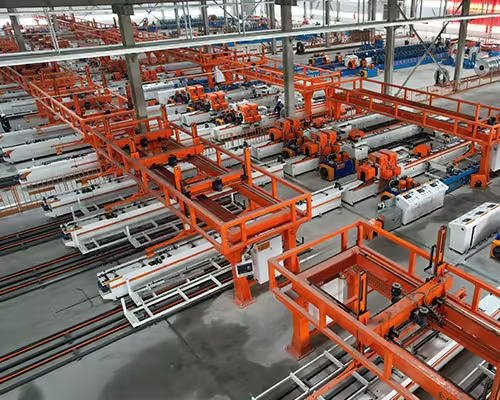
Digital Twin Manufacturing Concept
Factories are now adopting digital simulation models to:
- Predict production efficiency
- Simulate equipment load conditions
- Optimize production scheduling
AI-Based Maintenance Prediction
Machine learning models analyze:
- Vibration patterns
- Hydraulic pressure trends
- Energy consumption anomalies
Predictive accuracy can reach 85%+ in advanced systems.
FAQ
What is a photovoltaic bracket factory?
It is a manufacturing facility that produces steel mounting structures for solar photovoltaic systems.
What is the most important machine in the factory?
The roll forming machine (C-channel or U-channel line) is the core production equipment.
What production speed can modern lines achieve?
Advanced systems can reach up to 45 meters per minute.
Can factories be customized?
Yes, production lines can be fully customized based on product specifications and factory space.
What is the lifespan of PV bracket production equipment?
With proper maintenance, equipment lifespan can exceed 10–15 years.
Conclusion
The evolution of the photovoltaic bracket factory reflects a broader transformation in global manufacturing—from manual production to intelligent, automated, and data-driven systems.
Future factories will increasingly integrate:
- AI-based production optimization
- Fully automated logistics systems
- Real-time digital twin monitoring
- Zero-defect manufacturing standards
As global solar deployment continues to accelerate, factories with high automation, precision engineering, and smart monitoring capabilities will dominate the supply chain, ensuring long-term competitiveness and sustainable industrial growth.
If you enjoyed this article on Jinbolida’s smart manufacturing and digital factory expertise, follow us for more insights and updates:
- 📘 Facebook: Stay tuned for our latest smart production line projects → Facebook
- 📱 WhatsApp: Contact us anytime for custom production solutions → Chat Now
- ▶️ YouTube: Watch our automated line demos and real-world applications → YouTube
Let’s keep innovating and shaping the future of smart manufacturing — together!
 English
  Arabic
  Russian
  Spanish
  French