
Photovoltaic Support: The Complete Guide to Manufacturing and Equipment
Table of Contents
Why Photovoltaic Support Structures Are Essential
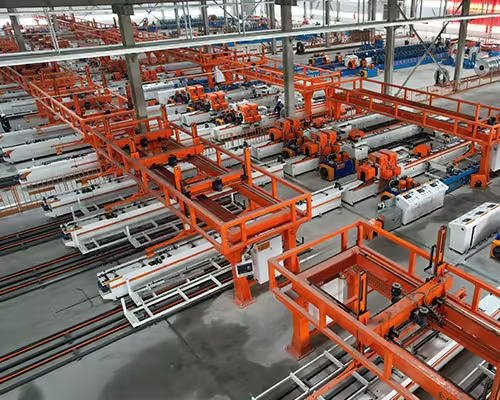
Photovoltaic support structures are the backbone of solar energy systems. They provide stability, maintain optimal panel angles for sunlight capture, and withstand environmental stress like wind, snow, and UV exposure. High-quality supports ensure efficient energy production and safety across installations.
Key Functions of PV Support
- Structural Stability: Securely holds solar panels in place.
- Optimal Performance: Maintains precise tilt and orientation for maximum sunlight exposure.
- Durability: Resists environmental forces and prolongs system lifespan.
Understanding the Photovoltaic Support Manufacturing Process
Modern photovoltaic support manufacturing integrates precision machinery, automated processes, and quality control measures. A typical PV support production line includes several key stages: material preparation, punching, forming, welding, surface treatment, and inspection. Each stage is critical for producing durable, high-performance solar mounting structures.
Material Preparation: Laying the Foundation for PV Supports
Material selection is the first step in PV support manufacturing. Galvanized steel and aluminum alloys are commonly chosen for their strength and corrosion resistance. Raw materials are cut to size and checked for quality before entering production.
Proper material handling ensures:
- Structural strength for heavy-duty applications.
- Long-term durability against environmental exposure.
- Compatibility with automated forming and punching machinery.
High-quality materials reduce maintenance needs and improve energy system reliability, especially for large solar farms or rooftop installations.
Punching and Forming: Core Steps in PV Support Production
Two machines play a pivotal role in transforming raw materials into functional PV supports: the U-Channel Steel Forming Machine and the Photovoltaic Bracket Connector Punching Machine. Together, they form the backbone of modern PV support production lines.
U-Channel Steel Forming Machine for Photovoltaic Supports
The U-Channel Steel Forming Machine converts steel strips into U-shaped rails, which serve as the structural backbone of ground-mounted and roof-mounted PV supports. This machine ensures consistent quality and precision at high production speeds.
Key Highlights:
- Production Speed: ≤ 45 meters/minute
- Precision: ±1 mm, ensuring exact dimensions for assembly
- Equipment Power: Approx. 40KW
- Product Specification: U-shaped steel from 41×21 mm to 41×82 mm
- Floor Area: 35 m × 5 m (customizable)
- After-Sales Support: Five-year warranty for essential components
Advantages and Insights:
The machine uses patented molds and processes, intelligent mold changeover, and servo tracking cutting. This combination results in high efficiency, low energy consumption, minimal labor requirements, and a small operational footprint. Additionally, cloud-based monitoring allows real-time tracking of production data and energy consumption, helping manufacturers optimize their PV support production line.
Photovoltaic Bracket Connector Punching Machine
The PV Bracket Connector Punching Machine automates punching, cutting, and forming of PV connection components, such as C-shaped, U-shaped, and triangular brackets. Developed in partnership with Shandong University, it merges speed with high precision.
Key Highlights:
- Processing Efficiency: 3–5 seconds per part
- Positioning Accuracy: ±0.5 mm with no cumulative error
- Equipment Power: 20KW
- Floor Area: 6 m × 2 m (customizable)
- Raw Material: Coiled steel strips, width < 300 mm, thickness < 5 mm
- After-Sales Support: Five-year warranty for key components
Advantages and Insights:
This machine dramatically reduces manual labor while delivering precise forming. CNC-based programming allows quick adjustment for different specifications, and continuous 24-hour operation ensures high-volume production. Cloud-enabled monitoring records real-time production data, improving efficiency and resource management in the PV support production process.
Comparing U-Channel Forming and Punching Machines


| Machine | Primary Function | Speed | Precision | Footprint | Key Advantage |
|---|---|---|---|---|---|
| U-Channel Steel Forming Machine | Shapes raw steel into U-rails | ≤ 45 m/min | ±1 mm | 35 m × 5 m | High-volume, precise rail production with long mold life |
| PV Bracket Connector Punching Machine | Punches and forms bracket components | 3–5 sec/piece | ±0.5 mm | 6 m × 2 m | Fast, automated, minimal labor, continuous operation |
Production Insight: The U-Channel forming machine excels at producing structural rails, whereas the punching machine specializes in precise bracket components. Both machines combined create a highly automated PV support production line, capable of meeting the demands of large-scale solar farms and commercial projects.
Welding and Assembly: Creating Strong PV Supports
After forming and punching, rails and brackets are assembled and welded. Robotic welding systems offer consistency and high throughput, while manual welding can be used for small batches or specialized designs. Proper welding ensures that PV supports maintain structural integrity and withstand environmental loads like wind, snow, and vibration.
Key Considerations:
- Accurate alignment of rails and connectors is essential.
- Welding quality directly impacts durability and safety.
- Automated monitoring ensures uniformity across multiple units.
Surface Treatment: Ensuring Longevity
Surface treatments such as powder coating, galvanization, and anodization protect PV supports from corrosion and UV degradation.
Key Benefits:
- Extends service life in harsh environments.
- Maintains aesthetic consistency for rooftop installations.
- Enhances adhesion and performance of brackets and rails.
Quality Inspection: Maintaining High Standards
Every PV support undergoes rigorous inspection:
- Dimensional Checks: Ensure compatibility with solar panels.
- Load Testing: Confirms structural strength under environmental stresses.
- Coating Inspections: Verifies corrosion resistance.
Automated cameras and sensors further enhance accuracy, minimizing production errors and improving PV support reliability.
Optimizing Production Lines with Data and Automation
Modern PV support manufacturing integrates cloud-based monitoring and data collection. Manufacturers can track:
- Production volumes
- Energy consumption
- Maintenance alerts
- Equipment utilization
This data-driven approach helps optimize the PV support production process, reduce downtime, and improve overall operational efficiency.eras further enhance accuracy and consistency.
Applications and Real-World Use Cases


Ground-Mounted Solar Farms
Automated U-Channel forming and punching machines enable consistent, high-volume production of rails and brackets, ensuring reliability across hundreds of units.
Commercial Rooftops
Lightweight aluminum supports produced via CNC forming and punching provide safe, efficient solutions with minimal roof load.
Tracking Systems
Dual-axis trackers require precise connectors and rails. Robotic welding and CNC-controlled forming ensure repeatability and structural stability.
Conclusion
Efficient PV support production depends on precise forming, automated punching, and high-quality material handling. The U-Channel Steel Forming Machine and PV Bracket Connector Punching Machine are central to achieving high-volume, precise, and durable photovoltaic supports. Combined with proper welding, surface treatment, and inspection, these machines ensure reliable solar mounting solutions for all applications—from rooftops to large-scale solar farms.
Ready to enhance your photovoltaic support production? Our team can help you select the right U-Channel forming and punching machines to meet your manufacturing needs. Contact us today to discuss custom solutions, request a quote, or schedule a consultation. Let’s build efficient, high-quality solar mounting systems together!
FAQ
What machines are essential for PV support production?
CNC cutters, U-Channel forming machines, punching machines, welding robots, and surface treatment lines are critical for high-volume production
How fast can these machines produce components?
U-Channel forming: up to 45 m/min; Punching machine: 3–5 seconds per piece, enabling rapid assembly of support structures.
How accurate are the machines?
U-Channel forming: ±1 mm; Punching machine: ±0.5 mm. Automation ensures minimal cumulative error.
How do these machines improve efficiency?
Automation reduces labor, ensures repeatable precision, supports 24-hour production, and tracks data via cloud systems.
Can PV support production be scaled for large solar farms?
Yes, automated forming and punching lines allow manufacturers to produce thousands of units consistently and efficien
How fast can these machines produce components?
U-Channel forming: up to 45 meters/min
Punching machine: 3–5 seconds per part
High-speed automation allows large-scale production suitable for solar farms and commercial projects.
What is the precision of these machines?
U-Channel forming: ±1 mm
PV bracket punching: ±0.5 mm (no cumulative error)
This level of precision ensures components fit together seamlessly, reducing installation errors.
Can production lines be adjusted for different PV support designs?
Yes. CNC programming and adjustable molds allow rapid specification changes, enabling manufacturers to produce custom or standard components efficiently.
How do these machines improve efficiency and reduce labor?
Automation reduces manual intervention, allows 24-hour operation, minimizes energy consumption, and enables cloud-based production monitoring, improving overall efficiency.
Are these machines suitable for small-scale production?
While designed for high-volume production, both U-Channel forming and punching machines can be adapted for smaller batches, with adjustable floor area and production speed.
If you enjoyed this article on Jinbolida’s smart manufacturing and digital factory expertise, follow us for more insights and updates:
- 📘 Facebook: Stay tuned for our latest smart production line projects → Facebook
- 📱 WhatsApp: Contact us anytime for custom production solutions → Chat Now
- ▶️ YouTube: Watch our automated line demos and real-world applications → YouTube
Let’s keep innovating and shaping the future of smart manufacturing — together! 🚀
 English
  Arabic
  Russian
  Spanish
  French