
PV Panel Brackets Production Line: A Complete Guide to Modern Manufacturing Processes
/ PV Panel Brackets Production Line: A Complete Guide to Modern Manufacturing Processes
Key Takeaways
- Learn how a modern PV panel brackets production line transforms steel coils into precision solar mounting components.
- Discover the complete manufacturing workflow, from raw material feeding to finished product inspection.
- Understand the role of C-channel and U-channel roll forming machines in photovoltaic bracket production.
- Compare different production equipment and identify the best solution for your manufacturing needs.
- Explore how servo automation, intelligent control systems, and cloud monitoring improve production efficiency.
- Find out why automated production lines are becoming the standard for the global solar mounting industry.
The Future of Solar Manufacturing Starts with an Efficient PV Panel Brackets Production Line
As the global photovoltaic industry continues to expand, manufacturers are under increasing pressure to deliver high-quality PV panel brackets faster, more accurately, and at lower production costs. Whether the brackets are designed for rooftop systems, ground-mounted solar farms, or tracking systems, their structural reliability begins with an advanced production line.
Unlike conventional metal fabrication, a modern PV panel brackets production line integrates intelligent roll forming, CNC punching, servo tracking cutting, automatic stacking, and digital production management into one continuous manufacturing process. This integrated approach minimizes labor requirements while improving dimensional accuracy, production consistency, and material utilization.
Today’s manufacturers are no longer looking for individual machines. Instead, they seek complete automated production solutions capable of operating continuously, adapting to multiple product specifications, and supporting Industry 4.0 manufacturing strategies.
This guide explains every major stage of a photovoltaic bracket production line, introduces the key equipment involved, and highlights the technologies that help manufacturers remain competitive in today’s rapidly growing solar industry.
Table of Contents
What Is a PV Panel Brackets Production Line?
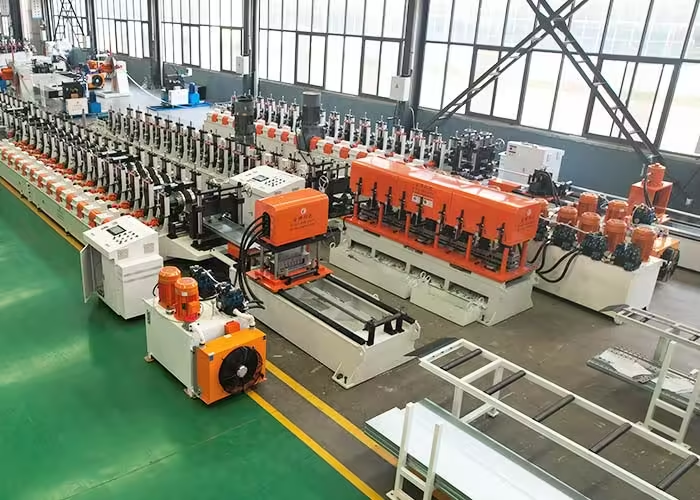
A PV panel brackets production line is an automated manufacturing system designed specifically for producing structural components used in photovoltaic mounting systems. These components include C-channel steel, U-channel steel, connector plates, support beams, reinforcement brackets, and various customized accessories.
Unlike general-purpose metal fabrication lines, photovoltaic bracket production requires exceptional dimensional consistency because every component must fit precisely during field installation.
Modern production lines combine several manufacturing technologies into one coordinated process, allowing continuous production from steel coil to finished product.
Core Functions
A complete production line typically performs the following operations:
- Coil feeding
- Material leveling
- Servo feeding
- Roll forming
- Hydraulic or servo punching
- Profile cutting
- Automatic stacking
- Product inspection
Each operation is synchronized through PLC control systems to maximize productivity while maintaining high precision.
Why Production Line Automation Matters
Higher Production Efficiency
Automation significantly increases output while reducing manual intervention. Continuous production minimizes downtime and improves machine utilization.
Modern photovoltaic bracket production lines can operate continuously for more than 20 hours per day while maintaining stable product quality.
Better Dimensional Accuracy
Precision directly affects installation quality.
Servo-controlled systems maintain dimensional tolerances throughout the entire manufacturing process, ensuring every bracket meets engineering requirements.
Lower Manufacturing Cost
Although automated production requires higher initial investment, manufacturers benefit from lower labor costs, reduced material waste, and higher production capacity over the long term.
Main Components of a PV Panel Brackets Production Line
Raw Material Feeding System
The production process begins with galvanized or hot-dip galvanized steel coils.
Common material characteristics include:
- High tensile strength
- Excellent corrosion resistance
- Stable thickness tolerance
- Good cold-forming properties
Steel coils are prepared before entering the forming process to ensure continuous production.
Decoiler
The decoiler safely unwinds heavy steel coils.
Why It Matters
A stable decoiling system prevents material deformation and ensures constant feeding speed.
Smooth feeding also reduces stress on downstream equipment, improving product consistency.
Leveling Machine
Before forming, the steel strip passes through a leveling machine.
Purpose of Leveling
Steel coils naturally contain residual stress after rolling and transportation.
The leveling machine removes these internal stresses and produces a flat material surface, which improves forming accuracy.
Servo Feeding System
Servo feeding precisely controls the movement of steel into the production line.
Key Advantages
Servo motors provide extremely accurate feeding distances.
This improves punching accuracy while reducing positioning errors during continuous production.
Roll Forming: The Core of PV Panel Brackets Manufacturing
Among all manufacturing processes, roll forming is the most important stage because it determines the final profile geometry.
Instead of shaping metal through a single operation, roll forming gradually bends the steel through multiple roller stations.
This method minimizes internal stress while producing highly consistent profiles.
Solar Photovoltaic Bracket C-Channel Roll Forming Machine
The C-channel roll forming machine is specifically designed to manufacture structural C-profile brackets used in photovoltaic mounting systems.
Typical Technical Specifications
| Item | Specification |
|---|---|
| Production Speed | ≤45 m/min |
| Forming Accuracy | ±1 mm |
| Equipment Power | Approx. 40 KW |
| Product Size | Web Height 30–60 mm |
| Base Width | 50–160 mm |
| Installation Area | 35 m × 5 m (Customizable) |
| Warranty | Five years for major components |
Manufacturing Advantages
The equipment incorporates patented forming technology, allowing continuous production with exceptional dimensional consistency.
Its intelligent mold change system significantly reduces production downtime when switching between product specifications.
Servo tracking cutting maintains cutting accuracy within ±1 mm, ensuring every bracket matches design requirements.
Cloud-based production management continuously records production quantity, operating status, and equipment energy consumption for real-time factory monitoring.
Solar Photovoltaic Bracket U-Channel Forming Machine
The U-channel forming machine produces another common structural profile widely used in solar mounting systems.
Compared with C-channel profiles, U-channel brackets provide different structural characteristics depending on project requirements.
Typical Production Parameters
| Item | Specification |
| Production Speed | ≤45 m/min |
| Accuracy | ±1 mm |
| Equipment Power | Approx. 40 KW |
| Product Size | 41×21 mm – 41×82 mm |
| Floor Space | 35 m × 5 m |
| Warranty | Five years |
Production Features
The machine supports intelligent mold replacement, allowing manufacturers to switch specifications quickly without lengthy setup procedures.
Servo-controlled cutting improves production precision while reducing material waste.
The built-in shutdown memory function automatically restores previous production parameters after restarting, minimizing adjustment time and increasing production efficiency.
C-Channel vs U-Channel PV Panel Brackets


Different photovoltaic projects require different structural profiles.
| Feature | C-Channel | U-Channel |
| Structural Strength | Excellent | Very Good |
| Installation Flexibility | High | High |
| Typical Applications | Ground Mount | Roof Mount |
| Material Usage | Moderate | Slightly Lower |
| Load Capacity | Higher | Medium |
Selecting the correct profile depends on wind load, installation environment, structural design, and project budget.
Why Roll Forming Is Preferred Over Traditional Fabrication
Continuous Production
Unlike press brake forming, roll forming allows uninterrupted production from steel coil to finished profile.
Higher Consistency
Every roller station gradually shapes the material, reducing deformation and maintaining profile uniformity.
Lower Labor Requirements
One automated production line can replace several conventional manufacturing stations while requiring fewer operators.
Better Material Utilization
Optimized forming sequences reduce scrap rates and improve raw material utilization.
Intelligent Manufacturing Concepts
Servo Tracking Cutting
Servo tracking cutting synchronizes cutting speed with material movement.
Instead of stopping the production line during cutting, the cutting unit moves together with the material, maintaining production speed while ensuring cutting precision.
Intelligent Mold Change
Automatic mold adjustment minimizes setup time between different bracket specifications.
Manufacturers can quickly switch production without replacing the entire production line.
Cloud-Based Manufacturing
Modern photovoltaic bracket production lines increasingly support cloud monitoring.
Managers can remotely view:
- Production quantity
- Equipment status
- Energy consumption
- Production efficiency
- Maintenance reminders
These digital capabilities improve factory management and support predictive maintenance.
Production Workflow Overview
A complete PV panel brackets production line generally follows this sequence:
- Steel Coil Loading
- Decoiling
- Material Leveling
- Servo Feeding
- Roll Forming
- Hole Punching
- Servo Tracking Cutting
- Automatic Stacking
- Quality Inspection
- Packaging
This streamlined workflow ensures continuous manufacturing while minimizing manual handling.
Solar Photovoltaic Bracket Connector Punching Machine
Connector components are critical in any PV panel brackets production line, as they determine how structural elements are joined together on-site. The punching process must therefore ensure high precision, repeatability, and material integrity.
Technical Overview
| Item | Specification |
|---|---|
| Processing Efficiency | 3–5 seconds/piece |
| Positioning Accuracy | ±0.5 mm |
| Equipment Power | 20 KW (actual operation) |
| Material Width | ≤300 mm |
| Material Thickness | ≤5 mm coil steel |
| Floor Area | 6 m × 2 m (customizable) |
| Operation Mode | Fully automatic CNC |
Key Manufacturing Advantages
The punching machine replaces manual drilling and stamping processes with automated CNC control. This significantly improves production speed while maintaining consistent hole positioning.
A major advantage is its flexible programming system. Changing product specifications requires only CNC program adjustment and mold replacement, allowing manufacturers to quickly respond to different project requirements.
Cloud data integration records production volume and energy consumption in real time, helping factories optimize efficiency and maintenance schedules.
Hose Clamp Forming and Punching Machine in PV Panel Brackets Production Line
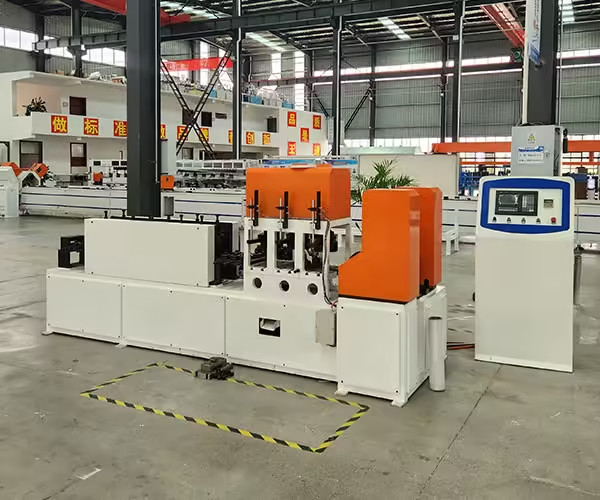
Although originally designed for clamp manufacturing, this machine is often integrated into photovoltaic production environments for auxiliary components and fastening systems.
Core Specifications
| Item | Specification |
| Processing Efficiency | 3–5 pcs/min |
| Accuracy | ±0.5 mm |
| Power | Approx. 18 KW |
| Material Range | 3–8 mm thickness |
| Working Width | ≤100 mm |
| Production Length | 9 m × 3 m |
Industrial Value in Solar Manufacturing
This machine ensures consistent production of fastening components used in PV mounting systems. Its continuous operation capability allows more than 20 hours of daily production under stable conditions.
Due to its high automation level, labor requirements are significantly reduced, making it suitable for large-scale manufacturing facilities.
Solar Support Direct Connector Stamping Machine
This machine plays a vital role in producing structural connectors used in photovoltaic systems. It is engineered for high-speed stamping and shaping of C-type and U-type steel connectors.
Functional Characteristics
The stamping machine performs precise forming operations, ensuring each connector matches exact installation requirements.
Its automated process reduces material waste while improving structural consistency across large production batches.
Key Benefits
- High-speed stamping for mass production
- Stable dimensional accuracy
- Reduced manual labor dependency
- Improved connector structural reliability
- Suitable for continuous 24-hour operation
PV Panel Brackets Production Line Efficiency Comparison
Manual vs Automated Production
| Factor | Manual Production | Automated Production Line |
| Output Efficiency | Low | High (continuous 24h) |
| Labor Requirement | High | Low |
| Accuracy | ±2–3 mm | ±1 mm or better |
| Material Waste | High | Low |
| Consistency | Variable | Stable |
Traditional Fabrication vs Roll Forming Line
| Feature | Traditional Method | Roll Forming Production Line |
| Production Mode | Batch-based | Continuous |
| Setup Time | Long | Short (intelligent switching) |
| Automation Level | Low | High |
| Scalability | Limited | Excellent |
Quality Control in PV Panel Brackets Production Line
Dimensional Inspection
Each bracket undergoes strict dimensional verification to ensure compliance with design tolerances.
Precision control within ±1 mm is standard for modern photovoltaic mounting systems.
Surface Treatment Inspection
Surface quality directly affects corrosion resistance and service life.
Common checks include:
- Zinc coating thickness consistency
- Surface smoothness
- Anti-corrosion layer integrity
Structural Strength Testing
Brackets are tested under simulated wind and load conditions.
This ensures stability in real-world installation environments such as deserts, coastal regions, and high-wind zones.
Concept: What Makes a “Smart PV Panel Brackets Production Line”?
Intelligent Control System
A smart production line integrates PLC control with cloud-based monitoring systems.
This enables real-time tracking of production status, machine health, and output efficiency.
Predictive Maintenance
Instead of waiting for breakdowns, the system predicts maintenance needs based on operational data.
This reduces downtime and increases machine lifespan.
Data-Driven Manufacturing
Production data is continuously collected and analyzed.
Manufacturers can optimize speed, energy consumption, and material usage based on real operational insights.
Factory Layout Planning for PV Panel Brackets Production Line
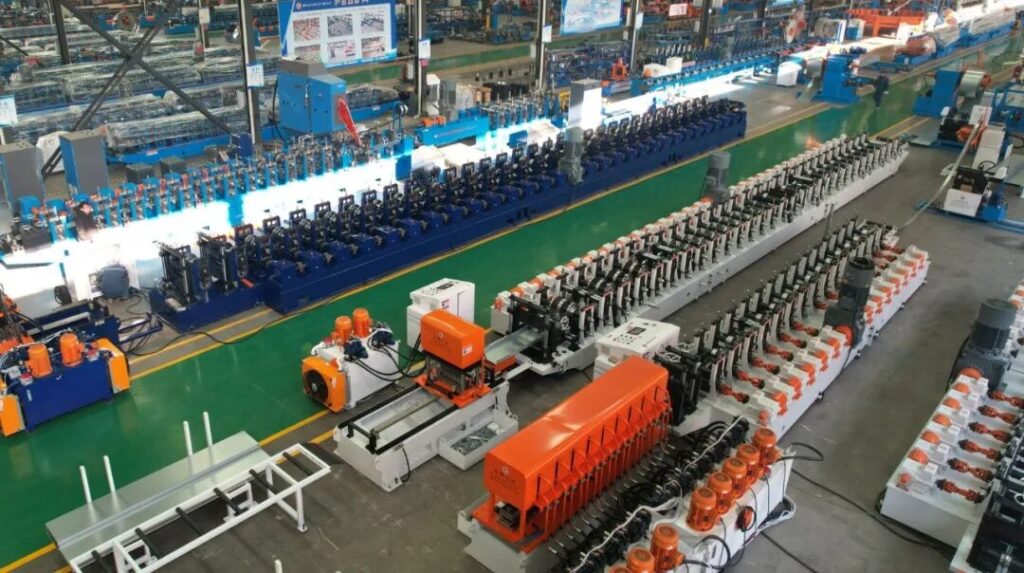
Space Requirements
A typical production line requires:
- Length: ~35 meters
- Width: ~5 meters
- Additional space for material handling and storage
Layout Optimization Concept
Efficient factory layouts reduce material handling time and improve workflow continuity.
Key principles include:
- Linear production flow
- Minimal cross-movement of materials
- Centralized control station placement
Buyer Guide: How to Choose a PV Panel Brackets Production Line
Step 1: Define Production Capacity
Manufacturers should evaluate:
- Daily output requirements
- Target market demand
- Product variety
Step 2: Evaluate Equipment Precision
High-end projects require ±1 mm accuracy or better to ensure installation compatibility.
Step 3: Check Automation Level
A fully automated line reduces labor dependency and improves long-term ROI.
Step 4: Consider Future Expansion
A scalable system allows additional machines to be integrated later.
FAQ
What is a PV panel brackets production line used for?
It is used to manufacture metal mounting structures that support solar panels in rooftop and ground-mounted systems.
What materials are commonly used in PV panel brackets production?
Galvanized steel, hot-dip galvanized steel, and high-strength carbon steel are most commonly used.
What is the typical production speed of a roll forming line?
Most modern systems operate at speeds up to 45 meters per minute depending on profile complexity.
Is a fully automated production line better than semi-automatic systems?
Yes, because it reduces labor cost, improves consistency, and increases production efficiency.
How accurate is a modern PV panel brackets production line?
Advanced systems can achieve ±1 mm precision using servo-controlled forming and cutting systems.
What industries use PV panel brackets?
They are widely used in solar energy, construction, infrastructure, and renewable energy projects.
Can one production line produce different profiles?
Yes, with intelligent mold change systems, C-channel and U-channel profiles can be produced on the same line.
Final Conclusion
A modern PV panel brackets production line represents the core of efficient solar mounting system manufacturing. By integrating roll forming, CNC punching, servo cutting, and intelligent control systems, manufacturers can achieve high precision, high output, and low operational cost.
As the global demand for solar energy continues to grow, automation and digital manufacturing will define the competitiveness of photovoltaic equipment producers. Investing in an advanced production line is no longer just an upgrade—it is a strategic necessity for long-term success in the renewable energy industry.
If you enjoyed this article on Jinbolida’s smart manufacturing and digital factory expertise, follow us for more insights and updates:
- 📘 Facebook: Stay tuned for our latest smart production line projects → Facebook
- 📱 WhatsApp: Contact us anytime for custom production solutions → Chat Now
- ▶️ YouTube: Watch our automated line demos and real-world applications → YouTube
Let’s keep innovating and shaping the future of smart manufacturing — together!
 English
  Arabic
  Russian
  Spanish
  French