
Sheet Metal Punch: Industrial Applications Guide
Table of Contents
Introduction
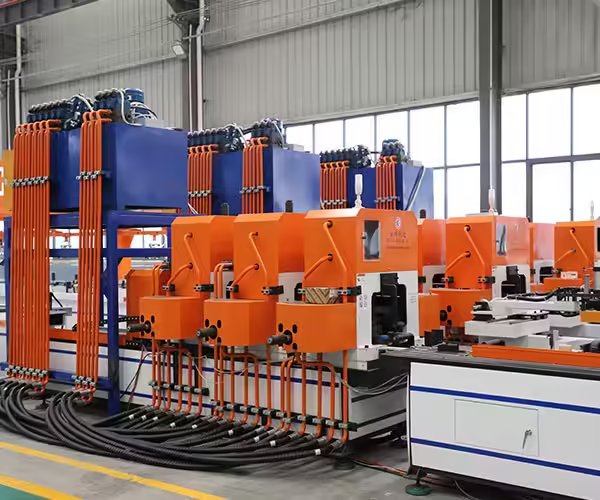
A sheet metal punch is a crucial tool in metal fabrication, allowing manufacturers to create precise holes and shapes efficiently. It plays a key role in industries ranging from automotive manufacturing to solar bracket production. Understanding the principles, types, and applications of sheet metal punches ensures better decision-making in industrial operations.
Understanding Sheet Metal Punch
Definition and Function
A sheet metal punch is a mechanical or hydraulic tool that removes material from a sheet of metal by pressing a punch through it. The process works in combination with a die, which supports the sheet and shapes the cut, enabling consistent and accurate results.
Core Components
The punch applies force to the sheet metal, while the die molds the cut. The press machine powers the punch, and systems can range from simple manual presses to advanced CNC-controlled hydraulic machines.
Types of Sheet Metal Punch


Shape-Based Classification
Punches come in different shapes depending on the required hole or cut. Round punches are ideal for standard circular holes, square or rectangular punches suit structural components, and custom-shaped punches are used for specialized industrial needs.
Operation-Based Classification
Manual punches are suited for low-volume production. Hydraulic punches provide additional force for thicker metals. CNC punching machines allow high-speed automated production with precision, ideal for repetitive or complex patterns.
Material Compatibility
The choice of punch depends on the metal type and thickness. Aluminum, mild steel, stainless steel, and coated metals each have different punching requirements to achieve clean cuts and extend tool life.
How a Sheet Metal Punch Works
Punching Process Explained
The punch forces through the metal, removing a piece called a slug, while the die ensures clean edges. This process maintains the integrity of the surrounding metal and enables accurate shaping.
Shearing, Blanking, and Piercing Concepts
Shearing slices the metal along the edges of the punch, blanking removes sections to create a defined shape, and piercing creates holes efficiently without wasting material. Each process serves specific industrial purposes.
Punching Compared to Laser Cutting
Laser cutting provides high precision and complex shapes, but sheet metal punching is faster for high-volume repetitive tasks and is more cost-effective for thicker materials.
Industrial Applications of Sheet Metal Punch
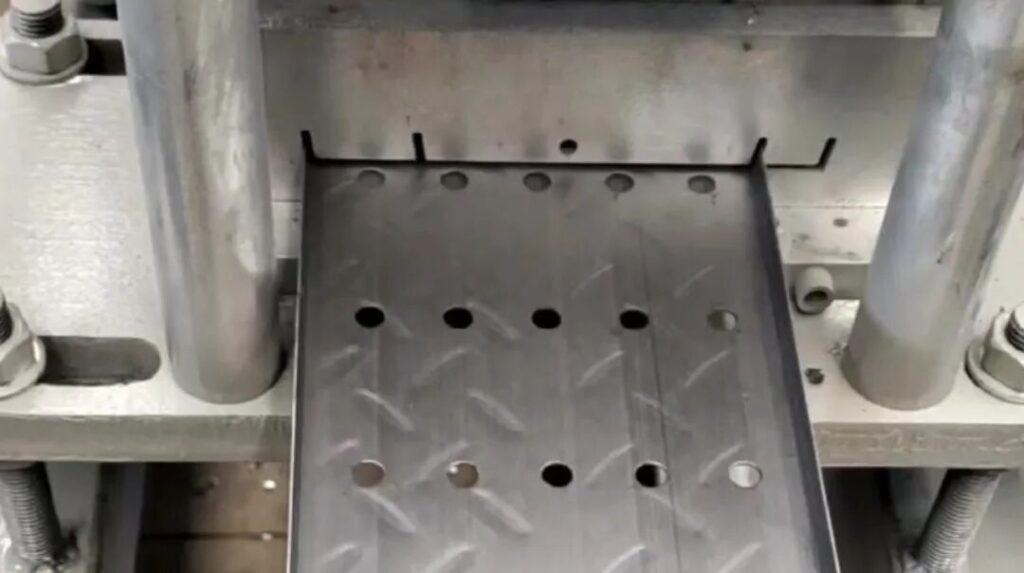
Automotive Industry
Punches produce panels, brackets, and mounting points, ensuring consistent fit and assembly quality.
Electronics Industry
Sheet metal punches are used to manufacture chassis, enclosures, and frames, providing accurate hole patterns and reducing assembly errors.
Construction and Solar Energy
Punching machines are essential for producing structural frameworks and photovoltaic brackets, enabling uniformity and durability in metal components.
Real-World Example: Photovoltaic Bracket Manufacturing
The Three-Station Hydraulic Punching Machine is specialized for producing C-shaped and U-shaped steel brackets for solar panels. It ensures precise hole patterns, reduces material waste, and improves production efficiency, making it essential for reliable solar bracket fabrication.
Parameter Comparison of Punching Machines
| Machine Type | Efficiency | Material Range | Feeding Speed | Accuracy | Industrial Advantage |
|---|---|---|---|---|---|
| Nine-Station Punch Machine | 12–18 m/min | C-shaped steel up to 8.5 m | 120 m/min | ±0.5 mm | High-speed multi-hole punching for complex components |
| Six-Station Hydraulic Punch | 12–18 m/min | Q235, Q550 | 120 m/min | ±0.5 mm | Three-side punching with consistent precision |
| Three-Station Hydraulic Punch | Variable | C/U-shaped steel | 80–100 m/min | High precision | Optimized for photovoltaic bracket production |
| Heavy-Duty Stamping Press | ≤35 m/min | Steel, aluminum, stainless | 80 m/min | ±0.1 mm | Supports punching, bending, forming, suitable for mass production |
This table allows users to compare machines by efficiency, material capability, feeding speed, accuracy, and industrial advantages to make better equipment selection decisions.
Selecting the Right Sheet Metal Punch

Considering Metal Thickness
Thicker metals require hydraulic or CNC punch systems, while thin sheets can be processed with manual punches.
Matching Punch to Hole Shape
Selecting a punch that matches the desired hole shape—whether circular, rectangular, or custom—ensures accurate production and prolongs tool life.
Production Volume Considerations
Manual punches are suitable for small-batch operations. Hydraulic and CNC machines are ideal for medium to high-volume production, offering speed and consistent precision.
Best Practices and Maintenance
Ensuring Efficient Punching
Proper lubrication, precise alignment of metal sheets, and selecting the correct punch for the material type improve efficiency and extend tool lifespan.
Safety and Longevity
Using protective equipment, performing regular inspections, and following proper machine shutdown procedures enhance operator safety and maintain punch durability.
Conclusion
A sheet metal punch is essential for precise and efficient metal fabrication. Understanding its types, processes, and industrial applications enables manufacturers to optimize production and maintain high quality. Real-world examples, such as photovoltaic bracket production, demonstrate its versatility and critical role in manufacturing operations.
Need specific selection advice or custom machine recommendations? Contact our engineers for expert guidance and tailored solutions.
FAQ About Sheet Metal Punch
Can a punch handle thick steel sheets?
Hydraulic and CNC punches are designed for thicker metals, whereas manual punches are limited to thinner sheets.
How can burrs be prevented after punching?
Maintaining sharp punches, using properly fitted dies, and light post-punch deburring reduce burr formation.
CNC Punching vs Laser Cutting – which is better?
CNC punching is faster for repetitive holes and thick metal, while laser cutting excels in complex shapes and precision.
How often should punches be maintained?
Maintenance depends on material type, thickness, and usage. Regular cleaning, lubrication, and inspection extend punch lifespan.
Can one punch machine handle multiple metals?
Some CNC or hydraulic punches are versatile, but manufacturer specifications should be checked to prevent premature wear.
If you enjoyed this article on Jinbolida’s smart manufacturing and digital factory expertise, follow us for more insights and updates:
- 📘 Facebook: Stay tuned for our latest smart production line projects → Facebook
- 📱 WhatsApp: Contact us anytime for custom production solutions → Chat Now
- ▶️ YouTube: Watch our automated line demos and real-world applications → YouTube
Let’s keep innovating and shaping the future of smart manufacturing — together! 🚀
 English
  Arabic
  Russian
  Spanish
  French