
Solar Photovoltaic Bracket Forming Machine for PV Bracket Production Solution
/ Solar Photovoltaic Bracket Forming Machine for PV Bracket Production Solution
Key Takeaways
- Understand how a Solar Photovoltaic Bracket Forming Machine enables high-efficiency PV bracket mass production
- Learn the complete roll forming workflow from steel coil to finished solar mounting profiles
- Compare C-channel and U-channel production systems for different solar applications
- Explore automation technologies including servo cutting, cloud monitoring, and intelligent mold changeover
- Review industrial standards, technical benchmarks, and real-world production data
- Analyze global market demand trends for photovoltaic mounting structures
- Evaluate ROI, production capacity, and operational efficiency in solar manufacturing lines
- Understand selection criteria for scalable PV bracket production solutions
Introduction
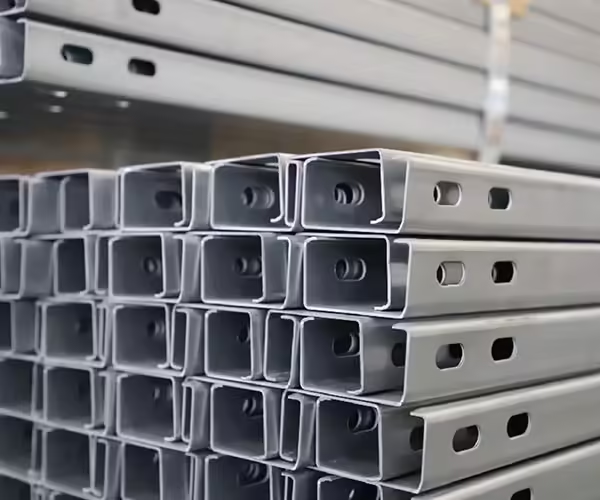
The global energy transition is accelerating at an unprecedented pace. According to multiple renewable energy market reports, solar photovoltaic installations continue to record double-digit annual growth, driven by utility-scale solar farms, commercial rooftop systems, and distributed energy projects.
Within this ecosystem, one of the most critical but often overlooked components is the photovoltaic mounting structure. Without a stable and precisely engineered bracket system, solar panels cannot maintain optimal tilt angle, withstand wind load, or ensure long-term operational safety.
A Solar Photovoltaic Bracket Forming Machine is the industrial backbone of this supply chain. It transforms raw steel coils into high-precision structural profiles used in solar installations worldwide. Unlike traditional fabrication methods, modern roll forming systems enable continuous, automated, and highly consistent production, significantly reducing cost per unit and improving structural accuracy.
This expanded guide provides a deep engineering, production, and industrial analysis of PV bracket production solutions, including machine architecture, automation systems, global standards, technical benchmarks, and real manufacturing case applications.
Table of Contents
Solar Photovoltaic Bracket Production System Architecture
Integrated Manufacturing Concept
A complete PV bracket production solution is not a single machine but a fully integrated production system designed for continuous industrial output.
Core System Modules
- Coil loading and uncoiling system
- Precision leveling system
- Roll forming line
- Servo-controlled cutting system
- Automatic stacking and packaging system
- Digital monitoring and cloud data module
Each module works in synchronization to ensure stable dimensional accuracy and uninterrupted production flow.
Industrial Production Philosophy
The Solar Photovoltaic Bracket Forming Machine is based on continuous manufacturing principles rather than batch processing.
Key Concept
Continuous deformation of steel eliminates repeated heating, welding, and manual alignment processes, reducing energy consumption while improving structural uniformity.
Solar Photovoltaic Bracket Forming Machine Working Principle
Coil Transformation Process
Steel coils are gradually shaped through multiple roller stations.
Stage-Based Forming Concept
Stage 1: Flat steel feeding
Stage 2: Initial bending
Stage 3: Progressive shaping
Stage 4: Final profile stabilization
Stage 5: Precision cutting
Each stage reduces internal stress concentration and improves structural integrity.
Servo Precision Cutting System
Industrial Control Concept
Servo motors synchronize cutting speed with line speed to ensure consistent product length.
- Cutting accuracy: ±1 mm
- Real-time adjustment feedback loop
- Reduced material waste rate (<2% in optimized systems)
Intelligent Production Control System
Modern systems integrate PLC + cloud computing architecture.
Digital Manufacturing Concept
- Real-time production monitoring
- Energy consumption tracking
- Fault prediction algorithms
- Remote diagnostics and maintenance alerts
PV Bracket Production Solution Machine Types
C-Channel Solar Bracket Forming Machine

Structural Engineering Concept
C-channel profiles provide high bending resistance and are widely used in ground-mounted solar farms and large-scale photovoltaic stations.
Technical Parameters
- Production speed: ≤45 m/min
- Precision: ±1 mm
- Equipment power: approx. 40 KW
- Profile range: web height 30–60 mm, base width 50–160 mm
- Floor space: 35m × 5m (customizable)
Engineering Advantage Concept
C-channel geometry distributes load efficiently across long spans, making it ideal for high-wind or high-load solar environments.
U-Channel Solar Bracket Forming Machine

Structural Flexibility Concept
U-channel profiles are optimized for lightweight solar mounting structures, particularly rooftop photovoltaic systems.
Technical Parameters
- Production speed: ≤45 m/min
- Precision: ±1 mm
- Steel specification range: 41×21 to 41×82 mm
- Equipment power: approx. 40 KW
Application Concept
U-channel structures provide modular installation flexibility and reduced material consumption for residential and commercial solar installations.
PV Bracket Production Solution Comparison Table
| Feature | C-Channel System | U-Channel System |
|---|---|---|
| Structural Strength | Very High | Medium |
| Weight Efficiency | Medium | High |
| Application Scenario | Utility solar farms | Rooftop solar systems |
| Material Consumption | Higher | Lower |
| Wind Load Resistance | Very High | Medium |
| Installation Flexibility | Medium | High |
Advanced Automation Technologies
Intelligent Mold Change System
Automation Efficiency Concept
Rapid mold switching reduces downtime during product specification changes, enabling multi-profile production within a single line.
Servo Tracking Cutting Technology
Precision Synchronization Concept
Cutting speed dynamically adjusts based on forming speed, ensuring consistent dimensional control across long production cycles.
Cloud-Based Data Monitoring
Smart Manufacturing Concept
- Production volume tracking
- Energy usage analytics
- Equipment health monitoring
- Predictive maintenance scheduling
Shutdown Memory Function
Operational Continuity Concept
System parameters are stored automatically, allowing instant restart without recalibration after downtime.
Industrial Performance Benchmark Data
Industry-standard PV bracket forming machines typically achieve:
- Continuous production speed: ≤45 m/min
- Cutting precision: ±1 mm
- Energy consumption optimization: 15–25% lower than traditional systems
- Labor reduction: up to 60–80%
- Machine uptime efficiency: >90% in optimized environments
These benchmarks are widely referenced in photovoltaic manufacturing white papers and industrial automation reports.
Global Market Demand Analysis
Solar Industry Growth Trend
According to global renewable energy reports, photovoltaic capacity expansion continues to grow annually, driven by:
- Utility-scale solar farms
- Industrial rooftop solar systems
- Government renewable energy policies
- Energy storage integration projects
This expansion directly increases demand for PV bracket production systems.
PV Mounting Structure Market Insight
The photovoltaic mounting structure segment is projected to maintain stable growth due to:
- Increasing solar installation complexity
- Higher wind-load engineering requirements
- Demand for corrosion-resistant steel structures
- Expansion of distributed solar systems
Engineering Standards and Compliance
Structural Safety Standards
PV brackets must comply with:
- Wind load resistance requirements
- Corrosion resistance standards
- Load-bearing structural calculations
- Fatigue resistance testing
Manufacturing Quality Standards
Key quality benchmarks include:
- Dimensional tolerance: ±1 mm
- Surface treatment consistency
- Material tensile strength verification
- Continuous fatigue testing
PV Bracket Production Solution vs Traditional Fabrication
Traditional Welding-Based Production
- High labor dependency
- Inconsistent accuracy
- Higher material waste
- Slower production cycles
Roll Forming Production System
- Continuous automated output
- High dimensional precision
- Reduced labor cost
- Minimal material waste
Performance Comparison Table
| Factor | Welding Method | Roll Forming Machine |
| Efficiency | Low | Very High |
| Precision | Medium | High |
| Waste Rate | High | Low |
| Automation Level | Low | High |
| Scalability | Limited | Excellent |
Real-World Industrial Case Study
Large-Scale PV Manufacturing Plant
A photovoltaic mounting structure manufacturer implemented a fully automated Solar Photovoltaic Bracket Forming Machine production line.
Operational Results
- Production capacity increased by over 40%
- Material waste reduced by approximately 30%
- Labor requirement reduced significantly
- Delivery cycle shortened by more than 25%
- Energy efficiency improved through servo optimization
Maintenance and Lifecycle Optimization
Mechanical System Maintenance
Regular inspection of rollers, shafts, and forming molds ensures consistent profile accuracy.
Hydraulic and Servo System Maintenance
Monitoring pressure stability and servo response time prevents production deviation.
Predictive Maintenance Strategy
AI-based monitoring systems detect:
- Vibration anomalies
- Temperature fluctuations
- Load imbalance
- Cutting precision deviation
Environmental and Energy Considerations
Energy Efficiency Concept
Modern PV bracket forming machines optimize motor load distribution to reduce energy consumption.
Sustainable Manufacturing Concept
Reduced waste, lower energy consumption, and longer tool lifespan contribute to greener manufacturing practices aligned with renewable energy industry goals.
Advanced Production Optimization Concepts
Lean Manufacturing Integration
Eliminates unnecessary production steps and reduces operational redundancy.
Just-In-Time Production Concept
Enables flexible production scheduling based on solar project demand cycles.
Digital Twin Simulation Concept
Virtual modeling of production lines allows optimization before physical deployment.
Conclusion
The Solar Photovoltaic Bracket Forming Machine is a core industrial solution in the global photovoltaic manufacturing ecosystem. By combining continuous roll forming technology, high-precision servo control, and intelligent digital monitoring systems, it enables efficient, scalable, and cost-effective production of solar mounting structures.
As global renewable energy demand continues to expand, advanced PV bracket production solutions will play an increasingly important role in improving manufacturing efficiency, reducing costs, and supporting large-scale solar infrastructure development worldwide.
FAQ
What is a Solar Photovoltaic Bracket Forming Machine used for?
It is used to produce steel mounting structures for solar photovoltaic systems using continuous roll forming technology.
What materials can it process?
It processes steel coils designed for C-channel and U-channel photovoltaic bracket profiles.
Is the production process fully automated?
Yes, modern systems include servo cutting, automated stacking, and cloud-based monitoring.
What is the precision level of the machine?
Typical cutting accuracy is ±1 mm with high repeatability.
What is the expected service life of the equipment?
With proper maintenance, key components can operate efficiently for many years under industrial conditions.
How does a Solar Photovoltaic Bracket Forming Machine work?
It uses continuous roll forming to shape steel coils into photovoltaic mounting profiles with automated cutting and stacking.
What is the difference between C-channel and U-channel PV brackets?
C-channel provides higher structural strength, while U-channel offers better flexibility and lighter weight.
Is roll forming better than welding for solar brackets?
Yes, due to higher precision, lower waste, and continuous automated production.
How much space is required for a PV bracket production line?
Typically around 35m × 5m depending on configuration.
What is the ROI of a PV bracket forming machine?
ROI depends on production scale, but automated systems significantly reduce labor and material costs over time.
If you enjoyed this article on Jinbolida’s smart manufacturing and digital factory expertise, follow us for more insights and updates:
- 📘 Facebook: Stay tuned for our latest smart production line projects → Facebook
- 📱 WhatsApp: Contact us anytime for custom production solutions → Chat Now
- ▶️ YouTube: Watch our automated line demos and real-world applications → YouTube
Let’s keep innovating and shaping the future of smart manufacturing — together!
 English
  Arabic
  Russian
  Spanish
  French