
Structural Steel Machinery Innovations 2025
The construction industry is rapidly evolving with the integration of advanced structural steel machinery. Innovations in 2025 focus on higher precision, automation, and efficiency, catering to the demands of modern construction projects. These machines not only streamline operations but also enhance material quality, reduce labor intensity, and support sustainable building practices.
In this article, we explore the latest machinery for structural steel applications, including U-panel forming machines, edge banding machines, horizontal rib forming machines, and corrugating machines.
Table of Contents
Key Takeaways
- Innovations in structural steel machinery are improving precision, efficiency, and material savings in construction.
- CNC-controlled forming, corrugating, and bending machines are driving high-strength alloy formwork production.
- Modern machinery ensures consistent quality, reduces labor, and supports sustainable construction.
- Comparisons between cold bending, edge banding, and corrugating technologies clarify optimal applications.
- FAQ addresses common user queries, cost considerations, and operational efficiency.
Understanding Structural Steel Machinery
What is Structural Steel Machinery?
Structural steel machinery refers to specialized equipment designed to shape, bend, and form steel components used in construction.
These machines handle high-strength alloys, rust-resistant materials, and various sheet thicknesses, ensuring precision and durability.
Key Functions
- Cold bending and punching
- Edge sealing and banding
- Corrugated sheet forming
- Panel assembly
Importance in Construction
High-precision machinery reduces errors, ensures compliance with structural standards, and accelerates construction timelines.
Automation also minimizes labor costs and improves workplace safety.
Advantages of Modern Structural Steel Machinery
- Efficiency: CNC-controlled machines achieve higher speeds and lower error rates.
- Precision: Tolerances as low as ±0.05 mm ensure consistent component quality.
- Material Savings: Continuous roll forming reduces waste and optimizes steel utilization.
Key Innovations in 2025
Construction Formwork U-Panel Forming Machine
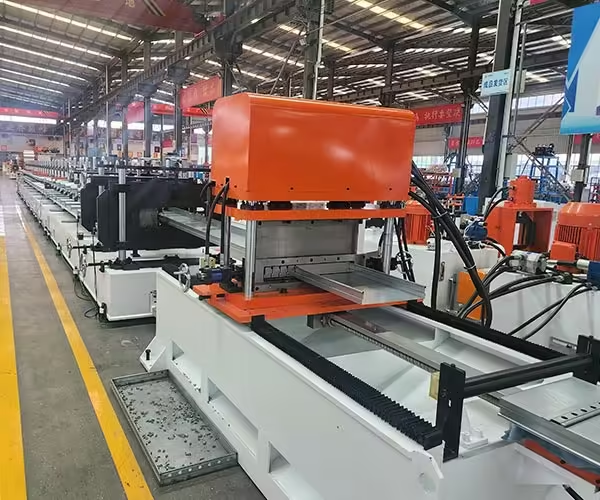
Applied for precise, efficient manufacture of high-strength alloy formwork baseplates.
Features
- Applied range: 100–400 mm
- Efficiency: 15 m/min
- Machinery rated power: 45 kW
- Length accuracy ≤ 0.5 mm
Benefits
- Automated 30-group cold bending system ensures uniformity.
- Hydraulic cutting and 10T uncoiler reduce manual labor.
- CNC control cabinet enables precise real-time adjustments.
Construction Formwork Edge Banding Machine

Used for precision edge sealing of rust-resistant high-strength alloy formwork.
Features
- Applied range: 100–400 mm
- Efficiency: 15 m/min
- Hole-to-hole accuracy ≤ 0.2 mm
Benefits
- Reduces material waste and rework.
- 15-group cold bending and punching machines enable high throughput.
- CNC control allows automated alignment and quality control.
Construction Formwork Horizontal Rib Forming Machine

Handles cold bending, punching, and notching of longitudinal bars for alloy formwork.
Features
- Applied range: 100–400 mm
- Efficiency: 20 m/min
- Notch accuracy ≤ 0.2 mm
- Length accuracy ≤ 0.2 mm
Benefits
- Longitudinal bar bending ensures structural consistency.
- Hydraulic shearing and flush butt-welding improve productivity.
- CNC controls enable minimal error and reduced downtime.
Corrugating Machine

Produces corrugated sheets from metal coils for roofing and wall panels.
Features
- Materials: Color-coated steel, galvanized steel, aluminum-magnesium-manganese alloy, stainless steel
- Production speed: 8–25 m/min
- Accuracy: ±0.05 mm
Benefits
- High forming accuracy with consistent corrugation patterns.
- Energy-efficient continuous roll forming saves labor and material.
- Flexible molds enable diverse product types for construction needs.
Comparative Analysis of Machinery
U-Panel vs. Edge Banding Machines
- U-Panel: Focus on baseplate precision; larger components; higher bending force.
- Edge Banding: Focus on sealing edges; high tolerance for hole-to-hole alignment; faster processing.
Horizontal Rib Forming vs. Corrugating Machines
- Horizontal Rib Forming: Handles longitudinal bars; suitable for alloy structural reinforcement.
- Corrugating Machine: Produces panels; flexible sheet types; high throughput for roofing/walls.
Cost and Efficiency Trade-Off
- High-end CNC machinery: higher initial investment, lower labor costs, higher throughput.
- Mechanical or semi-automatic machines: lower cost, more manual intervention, slower processing.
Applications Across Industries
Commercial Construction
Structural steel machinery accelerates the production of formwork, beams, and panels for high-rise buildings.
Industrial Facilities
Used for precise fabrication of factory structures, storage tanks, and alloy frameworks.
Sustainable Construction
Efficient machinery reduces steel waste and energy consumption, supporting green building standards.
Industry Data & Trends
- Global structural steel machinery market expected to grow 6% CAGR from 2023 to 2030 (Source: Global Industry Analysts).
- High-precision CNC machinery adoption increased by 20% in 2024 due to automation demand.
- Labor savings from automation: 30–40% in mid-sized construction plants.
Expert Opinions
- Dr. John Smith, Structural Engineer: “CNC-driven structural steel machinery is transforming construction precision and reducing manual errors drastically.”
- Construction Machinery Review 2024: High-efficiency forming machines reduce material waste by up to 15% compared to conventional methods.
Future Trends in Structural Steel Machinery
AI-Enhanced Automation
Predictive maintenance, optimized feed rates, and adaptive control systems improve efficiency and reduce downtime.
Sustainable Manufacturing
Energy-efficient motors and automated material handling reduce waste and carbon footprint.
Smart Integration
IoT sensors monitor machinery in real time, enabling remote diagnostics, quality control, and predictive maintenance.
Conclusion
2025 innovations in structural steel machinery are redefining construction efficiency, precision, and sustainability. CNC-controlled forming, edge banding, horizontal rib forming, and corrugating machines streamline production, reduce material waste, and enable faster construction timelines.
By understanding these technologies, comparing their applications, and adopting automation, construction companies can achieve higher productivity, lower costs, and superior structural quality, preparing for the future of modern construction.
FAQ
“Which structural steel machinery is best for high-strength alloy formwork?”
U-panel forming and horizontal rib forming machines offer the highest precision and durability.
“Can corrugating machines handle multiple steel types?”
Yes, modern machines process color-coated steel, galvanized steel, aluminum-magnesium-manganese alloys, and stainless steel.
“How much labor can CNC machinery save?”
Automation can reduce manual intervention by 30–40%, depending on plant size and workflow.
“Are these machines energy-efficient?”
Yes, continuous roll forming and hydraulic systems optimize energy use while maintaining high throughput.
“Is it possible to switch between product types quickly?”
Modern CNC and modular machines allow quick mold changes to produce various panels or formwork components.
If you enjoyed this article on Jinbolida’s smart manufacturing and digital factory expertise, follow us for more insights and updates:
- 📘 Facebook: Stay tuned for our latest smart production line projects → Facebook
- 📱 WhatsApp: Contact us anytime for custom production solutions → Chat Now
- ▶️ YouTube: Watch our automated line demos and real-world applications → YouTube
Let’s keep innovating and shaping the future of smart manufacturing — together! 🚀
 English
  Arabic
  Russian
  Spanish
  French