
The Digital Evolution of Steel Sheet Forming: Processes and Precision Machinery
/ The Digital Evolution of Steel Sheet Forming: Processes and Precision Machinery
Table of Contents
Introduction
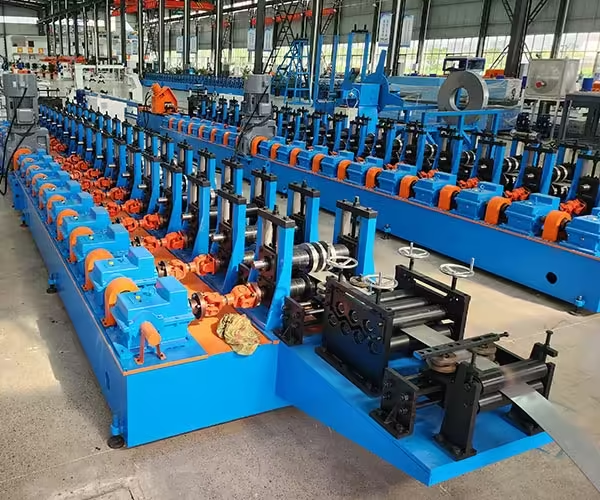
Steel sheet forming is at the heart of modern manufacturing, converting raw metal coils into high-performance components for construction, transportation, renewable energy, and industrial applications. The evolution of this process reflects a shift toward automation, precision, and intelligent manufacturing.
Understanding Steel Sheet Forming: Core Concepts and Equipment
Steel sheet forming is the mechanical manipulation of flat metal sheets into predetermined profiles or finished components. These processes combine multiple machinery types to ensure efficiency, accuracy, and high-quality output.
Roll Forming: The Backbone of Modern Manufacturing
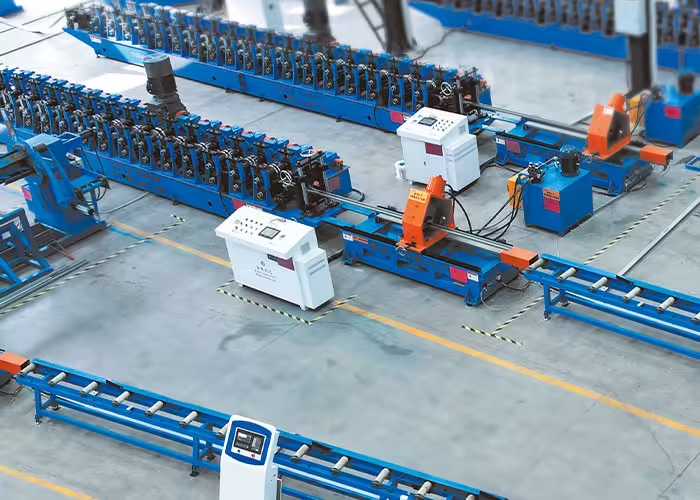
Roll forming is a continuous bending process where coiled metal passes through a series of sequential roll stands, each performing incremental shaping. This method produces structural profiles like C/Z purlins, square tubes, or L/W-shaped components efficiently.
Roll forming is ideal for high-volume production because it reduces labor, ensures repeatable accuracy, and supports complex profile designs.
Punching Equipment: Precision Integration

Punching equipment allows precise hole placement and cutting during forming. Integrated systems, such as C/U-shaped steel punching lines, ensure accurate alignment for downstream assembly. Proper punching reduces assembly errors, scrap rates, and production delays.
Auxiliary Equipment for Steel Forming Machines
Auxiliary devices enhance primary forming machine performance. Examples include automated feeders, stacking systems, and inline conveyors. These components increase throughput, reduce manual labor, and maintain consistent quality.
Specialized Forming Machine Types
Different forming machines are designed for specific applications:
- W, L, Z-shaped Steel Forming Machines: For architectural and structural applications.
- Construction-type Forming Machines: Used for beams, purlins, and other structural steel.
- Traffic Barrier Forming Machines: Ensures safety standards for road infrastructure.
- Solar Photovoltaic Bracket Forming Machines: Supports renewable energy installations.
Advanced Forming Processes and Ultra-Precision Manufacturing
Modern manufacturing requires forming machines to operate as intelligent production lines. Integration of forming, welding, and stacking ensures high efficiency and ultra-precise output.
High-Speed Tube Mill Production Line

The tube mill line converts metal coils into finished square or round tubes for furniture, automotive components, pipelines, and construction.
Core Process Steps:
- Roll Forming: Shapes flat metal into tubular profiles.
- High-Frequency Welding: Ensures a strong continuous seam.
- Sizing and Straightening: Delivers precise dimensions and perfectly straight tubes.
Precision Forming for Steel Formwork
High-strength alloy formwork demands tight tolerances. Modern forming lines achieve r-angle accuracy <0.5° and length/hole-to-hole accuracy within ±0.2 mm, improving tenfold over standard industry methods.
This precision allows the production of reusable formwork that replaces costly wooden or aluminum alternatives, increasing both efficiency and sustainability.
Real-World Case Studies: Practical Applications
Case Study 1: Construction Beam Production
A manufacturer producing C-shaped beams experienced inconsistent hole alignment with older punching equipment, leading to assembly delays. By integrating an automated roll forming and punching line with high-frequency welding, they reduced errors by 50% and increased throughput by 35%.
Case Study 2: Photovoltaic Bracket Fabrication
A solar mounting manufacturer needed to switch quickly between C and Z-shaped profiles. Installing an intelligent PV support production line allowed automated profile switching, eight-station punching, and stacking. Production flexibility increased while labor costs decreased by 40%.
Case Study 3: Automotive Tubing Efficiency
An automotive supplier required high-speed tube production with exact dimensional accuracy. Upgrading to a fully automated tube mill line with precision straightening and high-frequency welding reduced scrap rates by 25% and ensured consistent product quality across multiple batches.
Intelligent Manufacturing and Automated Forming Lines
The future of steel sheet forming lies in smart, automated production lines that integrate forming, punching, welding, and assembly.
Interchangeable Profiles for Flexible Manufacturing
Modern lines allow rapid switching between profile types, enabling manufacturers to respond to changing production requirements without significant downtime.
Automated Punching, Stacking, and Quality Control
Integrated eight-station punching, loop storage, and automated stacking streamline production workflows. Inline sensors ensure dimensional accuracy and detect defects in real time.
Cloud-Based Monitoring and Full-Chain Manufacturing
Modern systems can record energy consumption, production volumes, and equipment performance in real time via cloud connectivity. This data supports management decisions, predictive maintenance, and efficiency optimization.
Parameterized Comparison Table: Steel Sheet Forming Line Capabilities
| Feature | Standard Range | Benefit | Notes |
|---|---|---|---|
| Roll Forming Speed | 20–60 m/min | High throughput, adjustable for profile complexity | Supports multi-profile production |
| Welding Frequency | 100–200 kHz | Continuous seam strength | High-frequency welding enhances durability |
| Dimensional Accuracy | ±0.2 mm | Meets ultra-precision standards | Critical for PV, automotive, and structural applications |
| Profile Types | C, Z, W, L | Flexible production | Quick profile change reduces downtime |
| Automation Level | Semi to Fully Automatic | Reduces labor dependency | Includes stacking, feeding, inspection |
| Cloud Connectivity | Enabled | Real-time monitoring | Energy efficiency and process optimization |
| Cycle Efficiency | 80–95% | Maximizes production output | Measured in parts per shift |
Drivers of Efficiency in Modern Forming
- High Throughput: Continuous forming and integrated welding increase production speed.
- Precision Manufacturing: Tight tolerances minimize scrap and rework.
- Flexibility: Interchangeable profiles and adaptable tooling handle diverse product lines.
- Cost Optimization: Reduced labor, energy-efficient hydraulic systems, and cloud monitoring lower operational costs.
Conclusion
The digital evolution of steel sheet forming reflects the integration of intelligent automation, precision engineering, and full-chain manufacturing. Manufacturers can achieve higher throughput, improved accuracy, flexible production, and reduced operational costs by investing in modern forming lines. Real-world cases demonstrate the benefits of precision, automation, and smart monitoring, ensuring competitiveness in high-value industrial markets.
For manufacturers seeking guidance on selecting the ideal steel sheet forming line, consulting with technical experts can optimize machine selection, production workflow, and return on investment.
FAQ
Q: How do I know if a forming line will save labor costs?
Intelligent lines integrate feeding, forming, punching, and stacking, reducing manual intervention and streamlining workflow.
Q: Can a line handle multiple profile types?
Yes, modern lines support rapid switching between C, Z, W, and L profiles, ideal for PV supports and multi-purpose structural production.
Q: What precision is achievable in modern forming equipment?
Advanced forming lines achieve r-angle accuracy <0.5° and length/hole accuracy ±0.2 mm, improving tenfold over standard tolerances.
Q: Which industries rely most on these automated forming lines?
Key sectors include construction, renewable energy, rail transit, automotive components, and power transmission.
Q: How long does it take to install a new steel sheet forming line?
Installation of a modern steel sheet forming line typically ranges from 4 to 12 weeks, depending on the complexity of the line, number of forming and punching stations, and integration with existing factory systems.
Q: Can steel sheet forming lines be customized for unique product profiles?
Yes, advanced steel sheet forming systems allow for customizable roll sets, punches, welding modules, and automated stacking. This enables production of unique profiles for construction, automotive, and renewable energy applications.
Q: What is the typical maintenance schedule for a steel sheet forming line?
Routine maintenance for a steel sheet forming line includes weekly checks on rollers, hydraulic systems, and electrical components. Predictive maintenance using smart sensors and cloud monitoring can extend equipment life and reduce unplanned downtime.
Q: How does steel sheet forming ensure consistent quality across batches?
Modern steel sheet forming lines use precise roll forming, high-frequency welding, and automated inspection systems. This ensures consistent dimensions, r-angle accuracy, and hole alignment across all production batches.
Q: Are steel sheet forming lines energy efficient?
Yes, contemporary steel sheet forming equipment uses energy-efficient motors, optimized hydraulics, and smart control algorithms. Cloud monitoring allows tracking of energy consumption and further efficiency improvements.
Q: Can a steel sheet forming line handle different steel grades?
Modern steel sheet forming lines are compatible with various grades, including mild steel, high-strength steel, and galvanized sheets. Material settings can be adjusted without compromising accuracy or speed.
Q: How does automation in steel sheet forming impact labor costs?
Automated steel sheet forming lines reduce reliance on manual operators by integrating feeding, forming, punching, and stacking. This lowers labor costs, reduces human error, and increases throughput.
Q: Is operator training required for steel sheet forming lines?
Yes, operators of steel sheet forming equipment need training on safety, workflow management, and system monitoring. However, intuitive control interfaces and automation make training faster compared to traditional manual lines.
Q: How do steel sheet forming lines handle quality inspection?
Modern steel sheet forming lines integrate inline measurement systems to check dimensions, angle precision, and hole positions. Data is logged for quality control and traceability across batches.
Q: What industries benefit most from steel sheet forming lines?
Industries like construction, automotive, renewable energy, rail transit, power transmission, and furniture manufacturing heavily rely on automated steel sheet forming for high-precision and high-volume production.
If you enjoyed this article on Jinbolida’s smart manufacturing and digital factory expertise, follow us for more insights and updates:
- 📘 Facebook: Stay tuned for our latest smart production line projects → Facebook
- 📱 WhatsApp: Contact us anytime for custom production solutions → Chat Now
- ▶️ YouTube: Watch our automated line demos and real-world applications → YouTube
Let’s keep innovating and shaping the future of smart manufacturing — together! 🚀
 English
  Arabic
  Russian
  Spanish
  French