
Top Construction Formwork Edge Banding Machine Tips
Blog Key Takeaways
- Overview of construction formwork edge banding machine applications in modern construction
- Step-by-step operational and maintenance guidelines for efficiency and precision
- Comparison of traditional vs advanced edge banding machines
- Industry standards, certifications, and compliance guidelines
- Real-world case studies and usage scenarios
- Cost-benefit analysis and ROI insights
- FAQs addressing practical operational questions
- Safety, quality, and sustainability best practices
Table of Contents
Introduction

In today’s construction landscape, precision, durability, and efficiency are more important than ever. Formwork quality directly affects structural integrity, project timelines, and material costs. Enter the Construction Formwork Edge Banding Machine—a high-precision, automated solution that ensures perfectly sealed edges on high-strength alloy formwork.
Modern construction projects demand faster turnaround, minimal errors, and consistent quality. Traditional edge sealing methods rely heavily on manual labor, which can introduce variability and inefficiencies. By leveraging advanced edge banding machines, contractors can enhance safety, reduce material waste, and achieve superior structural results.
In this blog, we’ll cover:
- How the machine works and its main components
- Operational guidelines and precision tips
- Maintenance and troubleshooting best practices
- Comparison with traditional methods
- Industry standards and certifications
- Real-world use cases and performance data
- FAQs addressing common concerns
Understanding Construction Formwork Edge Banding Machine
Core Concept
A Construction Formwork Edge Banding Machine is an advanced automated system designed to streamline the sealing and finishing of high-strength alloy formwork used in large-scale concrete construction projects. Unlike manual methods, this machine ensures consistent edge quality while reducing labor costs and human error.
Modern construction demands uniformity in panel edges to prevent concrete leaks, improve structural aesthetics, and maintain long-term durability. By automating this process, the machine allows construction teams to focus on other high-value tasks, increasing overall project efficiency.
Key Advantages:
- Handles formwork widths from 100–400mm, covering most standard panels in commercial and residential construction.
- Operates at speeds up to 15 meters per minute, significantly faster than traditional manual sealing methods.
- Delivers high precision, with hole-to-hole accuracy ≤ 0.2mm and length accuracy ≤ 0.5mm, ensuring perfect alignment for assembly.
Key Components
The machine’s performance relies on its specialized components, each designed to optimize efficiency and quality:
- 15-Group Cold Bending Machine
- Allows flexible shaping of formwork edges to meet precise angle requirements.
- Minimizes material stress during bending, reducing cracks or deformities in high-strength alloys.
- Punching-Cutting Machine
- Ensures precise hole alignment and cutting, critical for panel assembly.
- Reduces the risk of misalignment, which can compromise structural integrity.
- 5T Uncoiler
- Provides continuous material feeding to prevent production interruptions.
- Supports high-volume operations, ideal for large-scale construction projects.
- Flush Butt-Welding Machine
- Seamlessly welds panel edges, creating a smooth, continuous finish.
- Reduces potential weak points where concrete could leak or rust could form.
- CNC Control Cabinet
- Centralized operation ensures repeatable precision and minimizes operator error.
- Programmable for different panel sizes, shapes, and production requirements.
Advanced Performance Parameters
| Parameter | Details |
|---|---|
| Applied Range | 100 – 400mm |
| Efficiency | 15m/min |
| Machinery Rated Power | 45KW |
| Accuracy of Hole-to-Hole | ≤0.2mm |
| Length Accuracy | ≤0.5mm |
| Machinery Weight | 26t |
| Material Compatibility | High-strength alloy |
| Operating Temperature | 0–50°C |
| Maintenance Interval | 500–800 operational hours |
Insight: Machines that meet these specifications provide higher throughput, reduce defects, and ensure compliance with modern construction standards such as ISO 9001:2015 and CE certification.
Step-by-Step Operational Guidelines
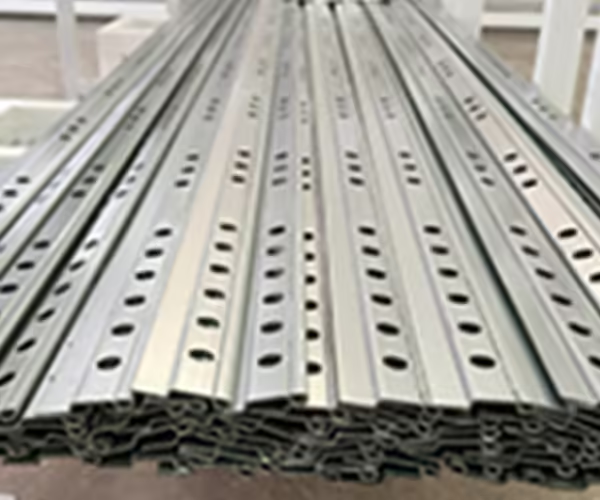
Machine Preparation
Proper preparation is critical for achieving high-quality output and extending machine life:
- Clean and Inspect Components
- Remove dust, metal scraps, and any residual welding debris from rollers and cutting units.
- Inspect for wear or damage to ensure consistent operation.
- CNC Settings
- Input panel dimensions and edge specifications into the CNC control cabinet.
- Double-check programmed angles, hole positions, and length tolerances before starting production.
- Material Alignment
- Ensure the uncoiler feeds material straight and without tension variation.
- Check that the feed path is free of obstructions to prevent jams during operation.
Edge Banding Process
Operational precision during the edge banding process is key to achieving high-quality results:
- Cold Bending
- Adjust the cold bending machine to match panel thickness and required angles.
- Avoid excessive pressure, which could deform or weaken the alloy.
- Punching and Cutting
- Set punching intervals and hole dimensions according to panel design.
- Perform test cuts to verify accuracy before full-scale production.
- Flush Butt-Welding
- Monitor welding to ensure edges fuse seamlessly.
- Inspect for minor gaps, especially at panel joints, to prevent structural weaknesses.
- Quality Verification
- Measure the first few meters of produced panels with calipers to confirm hole-to-hole and length accuracy.
- Adjust CNC or mechanical settings if deviations are detected.
Post-Operation Maintenance
Maintaining the machine after each production cycle extends its service life and preserves operational accuracy:
- Cleaning
- Remove leftover metal shavings, dust, and welding debris from all mechanical units.
- Pay special attention to punching and bending surfaces to prevent corrosion.
- CNC Calibration
- Verify that the CNC control cabinet settings remain accurate for the next batch.
- Update software and backups as necessary for repeatable precision.
- Lubrication
- Apply high-quality lubricants to bending, punching, and moving parts.
- Check for any signs of wear or loosening screws and bolts to prevent future malfunctions.
- Routine Inspections
- Inspect electrical wiring and connections for potential hazards.
- Test emergency stop functions and safety interlocks to ensure operator protection.
Comparison: Traditional vs Modern Edge Banding Machines
| Feature | Traditional Machine | Modern Edge Banding Machine |
|---|---|---|
| Precision | Moderate | High (≤0.5mm) |
| Efficiency | 5–8 m/min | 15 m/min |
| Labor Requirement | High | Minimal |
| Edge Quality | Variable | Consistent |
| Maintenance Complexity | Moderate | Predictive, CNC-guided |
| Initial Cost | Lower | Higher upfront, better ROI |
| Sustainability | Low | Eco-friendly material handling |
Recommendation: Modern machines are ideal for projects requiring high-volume, high-quality outputs, despite higher initial costs.
Maintenance and Troubleshooting
Common Issues
- Inconsistent Edge Sealing: Check material alignment and CNC settings
- Welding Gaps: Adjust flush butt-welding pressure and temperature
- Reduced Speed: Inspect uncoiler and bending units for jams or wear
Maintenance Schedule
- Daily: Clean rollers, check material feeding, verify CNC programming
- Weekly: Lubricate bending/punching units, inspect electrical systems, check for wear
- Monthly: Full calibration of CNC, component inspection, software updates
Safety Protocols
- Wear protective equipment at all times
- Keep work area free from debris
- Ensure all guards are in place during operation
Industry Standards and Compliance
- ISO 9001:2015: Quality management and consistent production
- CE Certification: Safety and operational compliance in European markets
- ANSI/ASTM Standards: Material handling, welding, and cutting accuracy
- Local Building Codes: Compliance with structural safety and formwork guidelines
These standards ensure that the Construction Formwork Edge Banding Machine not only delivers high-quality outputs but also meets regulatory requirements for construction safety and environmental compliance.
Real-World Case Studies
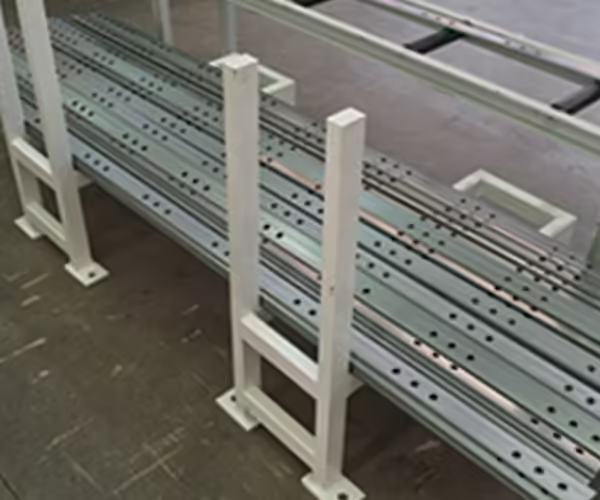
Case 1: Large Residential Project
- Machine handled 2,000 panels of high-strength alloy formwork
- Reduced labor by 35%
- Edge sealing errors decreased by 50%
Case 2: Commercial High-Rise Construction
- Used CNC-guided edge banding for variable panel sizes
- Achieved 15 m/min efficiency with consistent length accuracy ≤0.5mm
- Prevented rust-related defects on exposed concrete edges
Case 3: Prefabricated Concrete Factory
- Continuous production with 5T uncoiler integration
- Improved workflow by automating punch, cut, and welding processes
- Enhanced sustainability by reducing scrap and energy consumption
Cost-Benefit Analysis
| Cost Factor | Traditional Method | Modern Edge Banding Machine |
|---|---|---|
| Labor Costs | High | Lower (automation) |
| Material Waste | Moderate | Reduced |
| Downtime | Moderate | Minimal |
| Production Rate | 5–8 m/min | 15 m/min |
| ROI Timeline | 24 months | 12–18 months |
Insight: Investing in a modern edge banding machine pays off through higher throughput, reduced labor, and fewer defects.
Best Practices for Contractors
- Pre-program CNC for standard panel sizes to save setup time
- Batch production by panel dimensions to optimize efficiency
- Regularly monitor first meters for errors
- Train operators to understand CNC functions and emergency protocols
FAQ
Q1: What panel sizes are compatible?
A1: The machine handles formwork widths of 100–400mm.
Q2: How fast can it operate?
A2: Up to 15 meters per minute depending on panel material and thickness.
Q3: Is specialized training required?
A3: Basic CNC training is recommended; automation minimizes manual intervention.
Q4: How precise is the edge sealing?
A4: Hole-to-hole accuracy ≤0.2mm, length accuracy ≤0.5mm.
Q5: How often should the machine be maintained?
A5: Daily cleaning, weekly lubrication, and monthly CNC calibration are best practices.
Q6: Does the machine comply with international standards?
A6: Yes, including ISO 9001:2015, CE certification, and ASTM guidelines for welding and cutting accuracy.
Conclusion
The Construction Formwork Edge Banding Machine is a critical investment for modern construction. It improves precision, reduces labor costs, and enhances structural quality. By following operational tips, adhering to maintenance routines, and understanding industry standards, contractors and manufacturers can achieve maximum efficiency, sustainability, and ROI.
With innovations in CNC control, automated punching, and flush butt-welding, 2026 marks a transformative era for edge banding technology in construction.
If you enjoyed this article on Jinbolida’s smart manufacturing and digital factory expertise, follow us for more insights and updates:
- 📘 Facebook: Stay tuned for our latest smart production line projects → Facebook
- 📱 WhatsApp: Contact us anytime for custom production solutions → Chat Now
- ▶️ YouTube: Watch our automated line demos and real-world applications → YouTube
Let’s keep innovating and shaping the future of smart manufacturing — together!
 English
  Arabic
  Russian
  Spanish
  French