
Which Traffic Barrier Forming Machine is Best? A Buyer’s Guide
Table of Contents
Introduction
The Role of Road Safety Barriers
Traffic barriers play a crucial role in protecting vehicles and drivers on highways and urban roads. They prevent accidents, guide traffic flow, and reduce the severity of collisions.
Why Automation is Essential
Traditional manual or semi-automatic production of guardrails can be slow, labor-intensive, and inconsistent. A Traffic Barrier Forming Machine brings automation, efficiency, and precision to the production process, making it a smart investment for manufacturers.
Understanding Traffic Barrier Forming Machines
What is a Traffic Barrier Forming Machine?
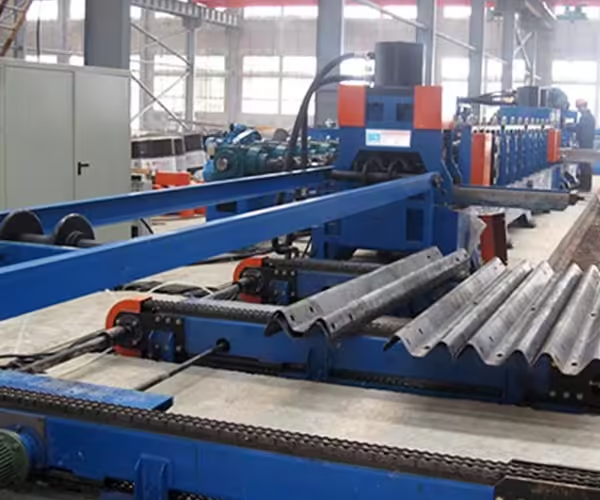
A Traffic Barrier Forming Machine is automated equipment designed to produce steel or composite guardrails used on roads. It can handle continuous production, ensuring consistent quality and efficiency.
Common Types of Machines
- Steel Guardrail Forming Machine: Designed for W-beam or double-wave steel barriers.
- Concrete Barrier Forming Machine: Produces pre-cast concrete barriers for highways or construction sites.
- Hybrid Systems: Some machines combine cold bending and punching functions for specialized guardrails.
Traffic Barrier Forming Process Overview

Step 1: Material Loading
Steel coils, usually 2.0–4.5mm thick, are fed into the machine. The width can be customized according to the guardrail specifications. This step ensures smooth and continuous production.
Step 2: Cold Bending Forming
Precision rollers bend the steel into W-shaped or other wave-shaped guardrails. This stage can produce double-wave, triple-wave, or custom designs, depending on project needs.
Step 3: Punching and Cutting
Flying shear technology enables continuous cutting with high precision (±0.5mm). This ensures each panel meets strict industry standards.
Step 4: Finished Product Handling
The formed guardrails are automatically transported out of the line, ready for storage or installation. Automated handling reduces labor and prevents damage to finished products.
Advantages of an Integrated Production Line
High Efficiency and Continuous Production
An integrated line reduces downtime, increases output, and achieves speeds of 25–55 meters per minute. This is significantly faster than manual or semi-automatic production.
Precision and Consistency
Advanced control systems and precision rollers ensure each guardrail meets dimensional and wave shape standards. Automation minimizes human errors and improves product reliability.
Cost and Labor Savings
Continuous production reduces material waste, while high automation lowers labor requirements. This makes the overall production process more cost-effective.
Flexibility and Adaptability
By changing rollers or forming sections, manufacturers can produce different wave shapes, thicknesses, or transition sections. This adaptability allows the same machine to handle multiple project types.
Concepts to Know Before Buying
Cold Bending vs. Hot Bending
- Cold Bending: Shapes steel at room temperature for precise, smooth guardrails.
- Hot Bending: Uses heat to bend steel, which can be faster but less precise.
Understanding these methods helps buyers choose the best solution for their needs.
Full Automation vs. Semi-Automation
- Full Automation: Minimal manual intervention, higher consistency, ideal for large-scale production.
- Semi-Automation: Some manual handling required, lower cost but less efficient.
Material Selection Concepts
- Steel thickness, galvanized vs. uncoated steel, and width specifications impact durability and production efficiency.
- Choosing the right material ensures guardrails meet safety and regulatory standards.
Comparing Traffic Barrier Machines
| Feature | Standard Cold Bending Machine | Full Integrated Production Line |
|---|---|---|
| Automation | Semi-automatic | Fully automatic |
| Output Speed | 15–30 m/min | 25–55 m/min |
| Cutting Precision | ±1 mm | ±0.5 mm |
| Labor Requirement | Moderate | Low |
| Adaptability | Limited | High, supports multiple designs |
This comparison helps buyers understand which system suits their production needs.
How to Choose a Traffic Barrier Forming Machine

Production Capacity
Consider your target output. Higher speeds and fully automated lines are suitable for large-scale production.
Material Compatibility
Choose a machine that can handle the types and thicknesses of steel you plan to use.
Service and Maintenance
Check if the manufacturer offers installation support, operator training, and after-sales service.
Conclusion
Investing in a Traffic Barrier Forming Machine enables manufacturers to produce high-quality guardrails efficiently, reduce labor costs, and maintain consistent product quality. Choosing the right machine, whether fully automated or semi-automatic, depends on your production needs, material specifications, and budget. With proper selection, this equipment becomes an indispensable tool for modern road safety infrastructure production.
FAQ
1. Can a beginner operate this machine?
Yes. Most modern machines feature user-friendly interfaces and PLC control, making them easy to learn even for new operators.
2. How fast can the machine produce guardrails?
Depending on the model, speeds range from 25–55 meters per minute for fully automated lines.
3. What types of guardrails can it produce?
The machine can produce W-beam, double-wave, triple-wave, and some customized designs with adjustable rollers or forming sections.
4. How much labor is required?
Fully automated lines require minimal operators, usually 1–2 people for monitoring and maintenance.
5. How precise are the finished panels?
Cutting precision can reach ±0.5mm, ensuring high consistency and compliance with industry standards.
6. Is it cost-effective to invest in a full integrated line?
Yes. Higher efficiency, material savings, and labor reduction often offset the initial investment within a short period.
If you enjoyed this article on Jinbolida’s smart manufacturing and digital factory expertise, follow us for more insights and updates:
- 📘 Facebook: Stay tuned for our latest smart production line projects → Facebook
- 📱 WhatsApp: Contact us anytime for custom production solutions → Chat Now
- ▶️ YouTube: Watch our automated line demos and real-world applications → YouTube
Let’s keep innovating and shaping the future of smart manufacturing — together! 🚀
 English
  Arabic
  Russian
  Spanish
  French