
Guide automatisé des équipements de traitement des métaux
Table des matières
Modern metal manufacturing is rarely built around one machine.
A finished photovoltaic bracket, structural channel, steel formwork panel, highway barrier or welded tube may pass through several processes before it becomes a qualified product. Raw material has to be loaded, fed, positioned, punched, formed, cut, transferred, inspected and finally stacked or prepared for the next operation.
For manufacturers planning new capacity, the challenge is therefore not simply choosing the fastest machine.
It is determining:
- Which manufacturing processes are actually required
- Which equipment should operate independently
- Which processes should be integrated
- How material should move between machines
- What level of automation is economically justified
- How future products can be added without rebuilding the entire factory
This is the purpose of an automated metal processing production line.
Jinbolida develops metal processing equipment and integrated production lines for applications including photovoltaic energy, construction, steel structures, tube manufacturing, transportation and power infrastructure. Its equipment portfolio includes roll forming machines, punching systems, photovoltaic bracket production lines, steel formwork lines, tube manufacturing equipment and supporting automation.
This guide explains how those technologies fit together and how manufacturers can select an appropriate production architecture around the finished product rather than around an individual machine.
Qu’est-ce que l’équipement automatisé de traitement
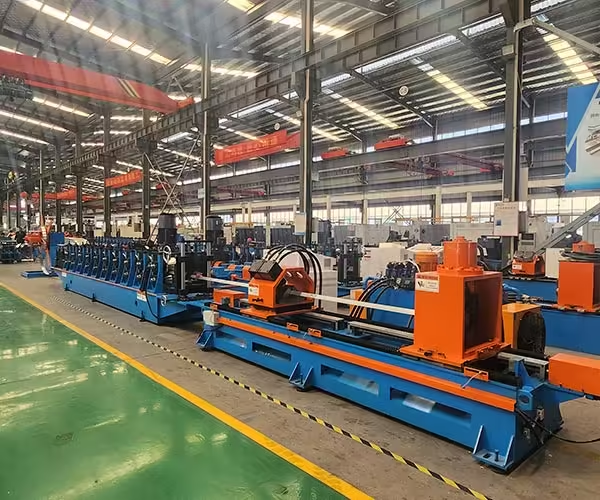
Automated metal processing equipment refers to machinery that performs one or more manufacturing operations with controlled mechanical, electrical, hydraulic or CNC-based systems.
Typical operations include:
- Manipulation de bobines
- Alimentation
- Nivellement
- Perforation
- Coupe
- Rouleau formant
- Sawing
- Soudage
- Tube forming
- Dimensionnement
- Redressage
- Transfert de matériel
- Flipping
- Empilage
An individual machine may perform one process.
An integrated production line connects several operations so that material can move from raw stock toward a finished component with less manual intervention.
A simplified example is:
Coil Loading → Feeding → Punching → Roll Forming → Cutting → Transfer → Stacking
Another product might require:
Strip Feeding → Tube Forming → Welding → Sizing → Straightening → Cutting
The correct configuration depends entirely on the product.
Commencez par le produit fini, pas par la machine
A frequent equipment-purchasing mistake is beginning with questions such as:
What is the fastest roll forming machine?
or:
How much does an automatic punching machine cost?
These questions come too early.
The first step should be defining the finished component.
A technical specification should include:
| Informations sur le produit | Pourquoi c'est important |
|---|---|
| Dessin en coupe transversale | Determines forming method |
| Matériel | Determines process behavior |
| Épaisseur | Influences machine capacity |
| Force d'élasticité | Affects forming and punching |
| Modèle de trou | Determines punching configuration |
| Longueur finie | Influences cutting and handling |
| Tolérance | Determines required control |
| État de surface | Affects tooling and handling |
| Volume annuel | Determines capacity |
| Nombre d'UGS | Determines flexibility |
| Taille du lot | Influences changeover strategy |
Once this information is available, the manufacturing process can be built backward from the product.
Les principaux types d'équipements de traitement des métaux
Jinbolida’s current manufacturing portfolio can be divided into several major equipment groups.
These include:
- Machines à former des rouleaux
- Automatic punching equipment
- Photovoltaic bracket production lines
- Steel formwork production lines
- Tube mill production lines
- Profile processing equipment
- Auxiliary and automated handling systems
Each solves a different part of the manufacturing problem.
Machines de formage de rouleaux
Roll forming is a continuous process that transforms sheet or strip into a required cross-sectional profile through a sequence of roller stations.
The material passes progressively through the machine.
Rather than producing the final bend immediately, each station completes part of the deformation.
Une séquence simplifiée est la suivante
Flat Strip → Initial Bend → Intermediate Form → Final Section
The general process is described in this technical overview of roll formage.
Jinbolida Machines de formage d'acier en forme de W, L et Z are designed for multiple structural profile types, including C-, U-, Z-, W- and L-shaped sections.
Roll forming is particularly useful where manufacturers require:
- Long continuous profiles
- High repeatability
- Consistent cross sections
- Medium-to-high production volume
- Integrated punching or cutting
Quels produits peuvent être formés au rouleau ?
Les applications typiques comprennent :
- C channels
- U channels
- Profils Z
- Purlins
- Structural rails
- Photovoltaic supports
- Guardrail components
- Construction profiles
- Steel framing components
A major advantage is that several operations can potentially be incorporated into one line.
Par exemple:
Decoiling → Leveling → Punching → Forming → Cutting
This can reduce material transfers between separate machines.
Qu'est-ce qui détermine la conception de la machine de form
The profile drawing alone is not enough.
Machine design also depends on:
- Qualité matérielle
- Force d'élasticité
- Plage d'épaisseur
- Largeur de bobine
- Nombre de virages
- Bend radii
- Vitesse de ligne
- Exigences de surface
- Product tolerance
A simple thin U channel can require a much different machine from a thick structural C section with return lips.
This is why machine station count, shaft size and motor power should not be compared without understanding the product.
Équipement de poinçonnage automatique
Many metal components require holes, slots, notches or connection features before they can be assembled.
Automatic punching equipment can process these features repeatedly while coordinating material movement through programmable feeding.
Jinbolida fournit équipement de poinçonnage automatisé for profiles, photovoltaic mounting components, connectors and other industrial parts.
Depending on the project, a punching system can include:
- Servo-alimentateur
- Hydraulic punch
- Mechanical punch
- Plusieurs postes de poinçonnage
- Automatic cutting
- CNC positioning
- Transfert de matériel
Pourquoi le poinçonnage est souvent le goulot d'étranglement de la capacité réelle
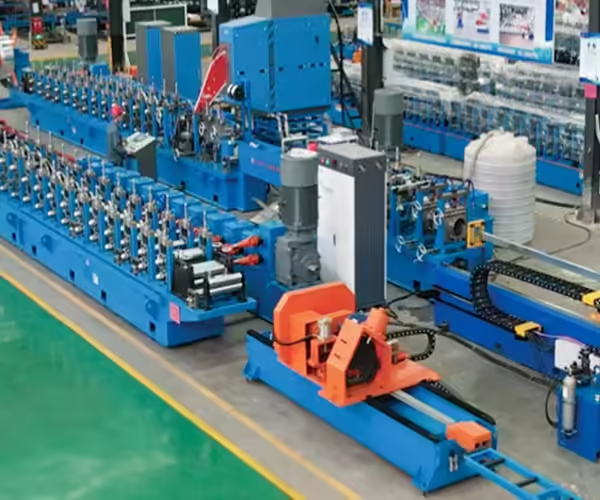
A production line may have a roll former capable of high continuous speed, but a complex punching pattern can limit actual output.
Suppose a component requires:
- Four round holes
- Six elongated slots
- Two different punching stations
The line needs enough punching capacity to complete all these operations before the material can continue.
Therefore:
Maximum roll forming speed ≠ finished production speed
A balanced line must coordinate:
feeding + punching + forming + cutting + handling.
Alimentation servo et positionnement CNC
Servo feeding becomes especially useful when hole positions vary between products.
Instead of mechanically changing every stop position, programmed recipes can contain:
- Espacement des trous
- Nombre de trous
- Longueur finie
- Quantité de produit
This supports manufacturers producing several specifications.
Your equipment selection should therefore consider not only the punching force but also how the material reaches the punch accurately.
Lignes de production de supports photovoltaïques
Photovoltaic mounting structures can require multiple formed and punched metal components.
Typical parts may include:
- C channels
- U channels
- Rails de montage
- Posts
- Braces
- Plaques de connexion
- Plaques de base
- Various punched fittings
Un complet ligne de production de supports photovoltaïques can therefore combine several manufacturing processes.
Depending on the bracket design, the line may include:
Decoiling → Leveling → Servo Feeding → Punching → Roll Forming → Cutting → Unloading → Stacking
Jinbolida machines de formage de supports solaires photovoltaïques are designed for C-, U-, Z- and customized support profiles.
Pourquoi la fabrication de supports photovoltaïques nécessite un équipement flexible
The photovoltaic industry can involve many profile specifications.
Different mounting systems may require different:
- Section dimensions
- Thicknesses
- Modèles de trous
- Lengths
A manufacturer serving several customers may therefore value flexibility more than maximum single-product speed.
Possible approaches include:
- Adjustable forming stations
- Outillage interchangeable
- Servo-controlled punching
- Stored production recipes
The correct system depends on product variety and batch size.
Lignes de production de coffrages en acier
Steel formwork is used to create temporary or reusable molds for concrete construction.
Unlike a simple profile-forming application, steel formwork manufacturing can require several processing stages.
Jinbolida’s steel formwork solutions integrate processes such as:
- Alimentation
- Perforation
- Formation
- Related component processing
- Automated manufacturing
A complete system should be developed according to:
- Panel geometry
- Épaisseur du matériau
- Hole requirements
- Capacité de production
- Niveau d'automatisation
For manufacturers producing large quantities of standardized panels, process integration can significantly reduce repeated material handling.
Pourquoi les lignes de coffrage en acier nécessitent une forte intégration des processus
Steel formwork components often need several manufacturing operations before assembly.
If each operation is performed separately, the workflow might become:
Punch → Store → Move → Form → Store → Move → Process Again
Every transfer introduces:
- Travail
- Waiting
- Inventory
- Floor-space requirements
Integrating compatible operations reduces unnecessary handling.
However, integration should only be used where it genuinely improves throughput.
Lignes de production de broyeurs à tubes
Tube manufacturing is different from open-profile roll forming.
A tube mill continuously transforms strip material into a closed tube section.
A typical process may include:
Coil Preparation → Strip Feeding → Progressive Forming → Welding → Sizing → Straightening → Cutting
Jinbolida’s tube mill production systems are designed for products including:
- Tubes ronds
- Tubes carrés
- Tubes rectangulaires
The line configuration depends on:
- Tube diameter
- Épaisseur de paroi
- Matériel
- Welding process
- Vitesse de production
- Finished tolerance
Comment le formage de tubes diffère du formage de rouleaux de profil
Both processes use progressive roller deformation, but their final products and downstream operations differ.
Formage de rouleaux de profil ouvert
Typically produces:
- C channels
- U channels
- Z sections
- Rails
laminoir à tubes
Typically produces:
- Round tube
- Square tube
- Rectangular tube
Tube mills additionally require processes such as:
- Soudage
- Weld-seam control
- Dimensionnement
- Redressage
This makes a tube mill an integrated continuous manufacturing system rather than simply a forming machine.
Fabrication de tubes carrés et rectangulaires
Square tube is widely used in:
- Construction
- Frames
- Machinery
- Industrial structures
- Systèmes de stockage
Depending on production architecture, the strip may first form into a round section and then be sized into the final shape.
Important finished-product requirements can include:
- Épaisseur de paroi
- Rayon d'angle
- Droiture
- Weld quality
- External dimension
These requirements should be defined before tube mill selection.
Équipement de traitement de profils
Not every product is manufactured efficiently through one integrated line.
Some profiles need secondary operations after the primary forming process.
Ceux-ci peuvent inclure :
- Sawing
- Forage
- Perforation
- Coupe
- Soudage
- Milling
Jinbolida équipement de traitement de profil expands the manufacturing system beyond basic roll forming.
This becomes important for manufacturers producing finished assemblies rather than simple raw profiles.
Sciage et traitement coupe-longueur
Sawing may be appropriate where:
- Profile walls are relatively heavy
- Cut-end quality matters
- Closed sections are processed
- A shaped finished profile must be cut
The machine selection depends on:
- Cross section
- Épaisseur de paroi
- Force matérielle
- Required cycle time
A high-speed upstream process can lose its advantage if sawing becomes the bottleneck.
Découpe laser dans une fabrication flexible
Laser cutting provides a different approach from dedicated mechanical tooling.
A CNC laser system follows programmed geometry rather than relying on a fixed punch die for every shape.
This makes it particularly attractive for:
- Variété de produits
- Complex contours
- Smaller batches
- Rapid design changes
The U.S. National Institute of Standards and Technology provides extensive resources on advanced manufacturing, including automation, measurement and modern production technologies used to improve industrial manufacturing.
Laser cutting does not replace punching in every situation.
For extremely high-volume repeated holes, dedicated punching may provide faster cycle times.
The correct choice depends on product mix.
Formage de rouleaux vs poinçonnage vs découpe laser
These technologies should not necessarily be viewed as competitors.
They solve different problems.
| Processus | Le mieux adapté |
| Rouleau formant | Continuous cross-sectional profiles |
| Perforation | Repetitive holes, slots and notches |
| Laser cutting | Flexible contours and changing geometry |
| Sawing | Finished profile cut-off |
| Tube mill | Continuous welded tube production |
A complex factory can use several of them together.
Équipement de traitement de bobines
Many of these manufacturing lines begin with coil.
The front end may include:
- Hydraulic uncoiler
- Coil loading trolley
- Niveleur
- Guide
- Alimentateur
This equipment prepares raw material for downstream processing.
A machine can only perform consistently when material enters the processing section correctly.
Poor coil handling can contribute to:
- Misalignment
- Feed instability
- Dégâts superficiels
- Unplanned stoppages
This is why coil processing equipment should be considered part of the production system.
Dérouleurs hydrauliques
A hydraulic uncoiler supports the coil and expands a mandrel against its inner diameter.
The main selection parameters include:
- Poids maximum de la bobine
- Diamètre intérieur de la bobine
- Diamètre extérieur de la bobine
- Largeur de bande
- Vitesse de ligne
A light 1-ton coil requires a different structure from a heavy 10-ton coil.
Equipment should therefore be selected according to maximum realistic material conditions.
Nivellement avant traitement
Coiled material can retain shape from storage.
A leveling stage can improve strip condition before:
- Perforation
- Formation
- Coupe
Poor incoming flatness can make downstream tooling work harder.
The leveler should therefore be selected according to:
- Épaisseur
- Largeur
- Force matérielle
Équipement automatisé de manutention
Manufacturing does not end when processing finishes.
Products still need to be:
- Removed
- Transferred
- Turned
- Sorted
- Stacked
If this remains entirely manual, a fast production line can still experience low effective throughput.
Automated material handling can include:
- Roller conveyors
- Tableaux de transfert
- Déchargement automatique
- Flipping systems
- Robotic transfer
- Pileuses
- Palettiseurs
Jinbolida industry automation solutions include automated loading and unloading, CNC transfer, robotic workstations and other integrated systems across photovoltaic, automotive, power, infrastructure and construction applications.
Pourquoi la manutention devrait être conçue tôt
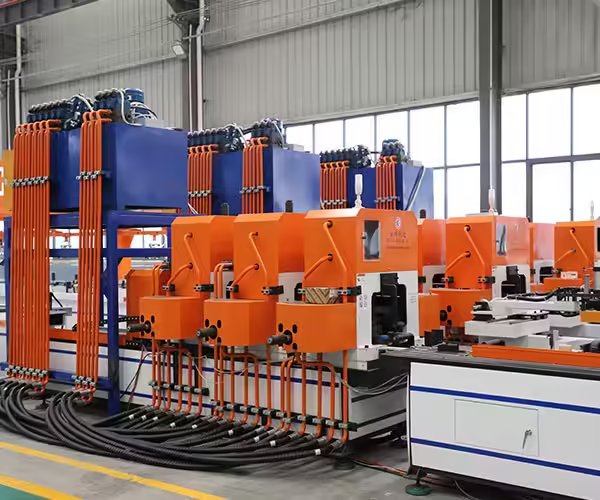
Suppose the forming machine produces one part every 15 seconds.
Manual unloading requires 25 seconds.
The line will eventually need to stop.
Therefore, downstream handling should be capable of maintaining the processing cycle.
The correct approach is:
Process capacity → Transfer capacity → Stacking capacity
rather than optimizing each machine separately.
Chargement et déchargement robotiques
Industrial robots can be useful when a product needs more than simple linear movement.
Les tâches typiques comprennent :
- Pick and place
- Chargement machine
- Machine unloading
- Product rotation
- Sorting
- Palletizing
Le Occupational Safety and Health Administration’s industrial robotics guidance notes that industrial robots are commonly applied to material handling and machine loading/unloading.
Robots are especially attractive where several different movements or product recipes are needed.
Convoyeur ou Robot ?
More advanced is not always better.
If a profile simply needs to move five meters in a straight line, a roller conveyor may be more practical than a robot.
A robot becomes useful when the product must:
- Change direction
- Rotate
- Change height
- Move to several destinations
Automation should solve a production problem rather than simply increase equipment complexity.
Palettisation et empilement automatisés
High-output lines can produce components faster than operators can organize them.
Automated stacking can help:
- Maintain production continuity
- Reduce repetitive lifting
- Create consistent bundles
- Reduce handling damage
For long profiles, stacking design should consider:
- Longueur
- Rigidity
- Poids
- Revêtement de surface
Long thin products may require several support points to avoid bending during transfer.
Systèmes de contrôle CNC et PLC
Modern production lines depend on coordinated control.
A control system may manage:
- Servo position
- Feeding distance
- Séquence de poinçonnage
- Longueur de coupe
- Product count
- Machine interlocks
- Alarmes
- Production recipes
Jinbolida’s current industrial solutions include CNC feed control lines and automated processing systems across several sectors.
The value of digital control is not simply automatic operation.
It is creating repeatable production conditions.
Recettes de produits et changements rapides
A factory producing several products may store programs for:
- Produit A
- Produit B
- Produit C
Each recipe can contain parameters such as:
- Modèle de trou
- Longueur
- Quantité
- Servo positions
This reduces manual data entry during changeover.
Mechanical tooling may still need adjustment, but digital parameters can be restored quickly.
Données de fabrication et de production intelligentes
As machines become more connected, production information can be recorded.
Possible data includes:
- Quantité de produit
- Machine running time
- Temps d'arrêt
- Historique d'alarme
- Production recipe
- Temps de cycle
NIST describes fabrication intelligente as the application of advanced sensing, controls, modeling and manufacturing data to improve industrial performance.
This is where individual machines begin to become part of a digital factory.
Automatisation des machines par rapport à l'automatisation des lignes de production
These concepts should be separated.
Automatisation des machines
One machine automatically performs its operation.
Production-Line Automation
Multiple machines exchange information and coordinate material flow.
Par exemple:
Feeder ready → Punch ready → Forming ready → Cutter ready → Stacker ready
If the stacker stops, upstream equipment should respond appropriately.
This is more sophisticated than automating each machine independently.
How to Decide Which Processes Should Be Integrated
Integration provides the greatest benefit when processes:
- Follow the same product sequence
- Have compatible cycle times
- Use the same raw material
- Operate at high volume
Separate machines can be better when:
- Product variety is extremely high
- Processes serve different product families
- La taille des lots est petite
- Existing equipment can be reused
There is no universal requirement to integrate every operation.
The objective is the lowest practical cost per qualified product.
Dedicated Line vs Flexible Production Line
Manufacturers frequently need to choose between maximum output and maximum product variety.
Dedicated Line
Best suited to:
- Stable products
- High volume
- Longues campagnes de production
Potential advantages:
- Simpler setup
- Débit élevé
- Fewer adjustment points
Flexible Line
Best suited to:
- Multiple SKUs
- Fabrication sous contrat
- Changements fréquents de produits
Potential advantages:
- Faster product switching
- Reduced need for multiple machines
- Better response to changing orders
The correct decision depends on actual sales mix.
Comment calculer la capacité de production requise
Capacity planning should begin with real demand.
A simple calculation is:
Annual Demand ÷ Working Days ÷ Shifts ÷ Effective Hours
Suppose annual demand is:
4,800,000 meters
The factory operates:
- 300 days/year
- 2 shifts/day
- 8 hours/shift
The theoretical requirement is:
4,800,000 ÷ 300 ÷ 2 ÷ 8 = 1,000 meters/hour
But this assumes 100% utilization.
Real operations include:
- Changement de bobine
- Configuration
- Entretien
- Inspection
- Changement d'outil
The machine should therefore have enough practical capacity to accommodate real production losses.
Bottleneck Analysis Is More Important Than Maximum Speed
Consider a hypothetical line:
| Processus | Capacité |
| Alimentation | 40 m/min |
| Perforation | 25 m/min equivalent |
| Formation | 35 m/min |
| Coupe | 30 m/min |
| Empilage | 20 m/min equivalent |
The effective line is closer to:
20 m/min
because the stacking process is the limiting stage.
Buying a 50 m/min forming machine would not fix the real problem.
Material Selection Influences Equipment Selection
Metal processing equipment should be designed around actual production material.
Les informations importantes comprennent notamment
- Nuance d'acier
- Force d'élasticité
- Résistance à la traction
- Épaisseur
- Revêtement de surface
Hot rolled, cold rolled, galvanized and stainless materials can behave differently.
For example, stronger steel may require:
- Force de formation plus importante
- More springback compensation
- Higher punching force
The machine supplier should therefore receive the applicable material standard or mill certificate.
Hot Rolled vs Cold Rolled Steel
Hot rolled steel is commonly used in heavier structural applications.
Cold rolled material can provide:
- Smoother surface
- Improved thickness consistency
- Suitability for thin precision components
Neither is universally superior.
The correct material depends on the finished component.
Le Association mondiale de l'acier provides useful definitions of hot rolling, cold rolling, galvanized material and other steel-processing terminology.
Galvanized Steel for Outdoor Components
Galvanized steel is frequently selected where corrosion protection matters.
Applications may include:
- Photovoltaic brackets
- Outdoor structural components
- Infrastructure products
The forming line should minimize unnecessary damage to the zinc coating.
This requires attention to:
- Propreté des rouleaux
- Tooling surfaces
- Guides
- Downstream handling
Surface quality should be included in finished-product acceptance criteria.
How to Select Equipment for Photovoltaic Manufacturing
A photovoltaic bracket manufacturer should begin by listing every component it intends to produce.
The factory may need:
- Profile forming machines
- Poinçonnage multi-stations
- Connector processing
- Coupe
- Empilage automatique
Le photovoltaic bracket forming machine range should then be evaluated according to:
- Dessin de profil
- Matériel
- Modèle de trou
- Capacité
- Number of sizes
This is more effective than choosing equipment according to machine model alone.
How to Select Equipment for Construction Profiles
Construction manufacturers can produce a wide range of parts.
Ceux-ci peuvent inclure
- C/U/Z profiles
- Structural members
- Formwork components
- Panels
Jinbolida construction forming equipment covers multiple cold-formed applications.
Les acheteurs doivent évaluer:
- Épaisseur
- Dimensions du profil
- Structural function
- Volume de production
Long, repetitive profiles are strong candidates for continuous roll forming.
How to Select Equipment for Highway Infrastructure
Highway components can require:
- Formation
- Perforation
- Coupe
- Soudage
- Transfert de matériel
Jinbolida also applies automated processing technologies to highway guardrail manufacturing through its traffic barrier forming equipment.
Infrastructure products can involve heavier material and demanding cycle requirements.
The complete process should therefore be evaluated rather than buying separate machines without capacity coordination.
How to Select Equipment for Tube Production
Tube manufacturers need to define:
- Round, square or rectangular tube
- Diameter range
- Épaisseur de paroi
- Matériel
- Exigences en matière de soudage
- Vitesse
These factors determine tube mill configuration.
Where several sizes are required, changeover strategy should also be considered.
A line capable of many sizes may still be inefficient if tooling change requires excessive downtime.
How to Evaluate a Machine Supplier
A machine quotation should be evaluated technically before comparing price.
Demander:
- Is the machine based on my product drawing?
- Which material properties were used?
- What production speed is guaranteed?
- Is that machine speed or finished output?
- What accuracy is guaranteed?
- How long does changeover take?
- Which operations are automatic?
- Which operations remain manual?
- What safety equipment is included?
- What installation support is included?
- What spare parts are recommended?
- Can future products be added?
These questions help expose major differences between quotations.
What Information Should Be Included in an RFQ?
Prepare:
| Catégorie | Required Information |
| Produit | Dessins 2D/3D |
| Matériel | Grade and mechanical properties |
| Épaisseur | Minimum et maximum |
| Raw stock | Coil or profile dimensions |
| Holes | Pattern and tolerances |
| Longueur | Minimum et maximum |
| Capacité | Annual/hourly target |
| SKUs | Number of specifications |
| Taille du lot | Typical order quantity |
| Automation | Niveau souhaité |
| Usine | Available layout |
| Électricité | Voltage/frequency |
| Qualité | Tolérances critiques |
This helps suppliers propose equipment around a real manufacturing requirement.
Machine Safety Should Be Designed from the Beginning
Automated equipment includes hazards such as:
- Rotating rollers
- Punching zones
- Cutters
- Conveyors
- Robot movement
- Bande mobile
OSHA’s guidage de garde de machine explains that hazardous points of operation, rotating parts and mechanical motion require appropriate safeguarding.
Safety measures may include:
- Gardes fixes
- Portes verrouillées
- Arrêts d'urgence
- Rideaux lumineux
- Perimeter fencing
Requirements depend on the destination market and applicable standards.
Installation and Factory Layout
Machine footprint is only one part of factory planning.
A usable production line needs space for:
- Raw material
- Chargement de bobine
- Machine access
- Modifications d'outils
- Entretien
- Finished product
- Mouvement de chariot élévateur
A machine that physically fits inside the building may still be impractical if there is no room for loading or maintenance.
Share the factory drawing before production-line design is finalized.
Total Cost of Ownership
Initial equipment price is only one part of the investment.
A complete evaluation should consider:
Machine + Tooling + Installation + Labor + Energy + Maintenance + Scrap + Downtime
A cheaper machine can become expensive if it creates:
- High scrap
- Maintenance fréquente
- Slow changeovers
- Excessive labor
Likewise, expensive automation may provide poor return if the factory has low production volume.
The correct goal is:
lowest sustainable cost per qualified product.
Common Equipment Purchasing Mistakes
Choisir par vitesse maximale
The slowest process determines real output.
Comparing Only Price
Machine scope may differ significantly.
Ignoring Material Properties
Yield strength and thickness affect equipment design.
Automating Everything
Automation should target measurable production problems.
Changement sous-estimant
High product variety can make changeover one of the biggest sources of downtime.
Ignoring Material Handling
A fast processing machine can be limited by manual unloading.
Buying Before Finalizing Product Drawings
Machine design should follow the finished component.
Ignoring Future Expansion
Realistic future products should be considered during initial design.
Building a Scalable Metal Processing Factory
A scalable production system does not necessarily start fully automated.
Manufacturers can develop capacity in stages.
Stage 1: Core Processing
Install the primary:
- Formation
- Perforation
- Tube
- Coupe
equipment.
Stage 2: Process Integration
Connect compatible operations.
Stage 3: Handling Automation
Add:
- Conveyors
- Déchargement automatique
- Pileuses
- Robots
Stage 4: Digital Integration
Connect production information for:
- Surveillance
- Entretien
- Scheduling
- Quality tracking
This allows capital investment to follow real production growth.
Foire aux questions
What equipment is used for metal processing?
Common equipment includes roll forming machines, punching machines, laser cutters, saws, tube mills, feeding systems and automated material handling equipment.
What is an automated metal processing line?
It is a production system that connects several manufacturing processes through coordinated mechanical and control equipment to reduce manual transfer and improve production consistency.
What products can a roll forming machine make?
Roll forming can manufacture C channels, U channels, Z profiles, purlins, photovoltaic supports, rails and many other continuous metal profiles.
What is automatic punching equipment used for?
It produces holes, slots and notches in profiles or sheet using programmable or repetitive punching cycles.
What equipment is needed for photovoltaic brackets?
Depending on the component, equipment can include decoilers, feeders, punching machines, roll formers, cutting systems and automatic stacking equipment.
Qu'est-ce qu'une chaîne de production de
A tube mill continuously forms strip into a tube, welds the seam and then sizes, straightens and cuts the finished tube.
Is automated material handling necessary?
Not always. It becomes valuable when manual transfer restricts production, products are heavy or long, or repetitive handling requires significant labor.
Should I buy a dedicated or flexible production line?
Dedicated lines suit stable high-volume products. Flexible lines can be more suitable when multiple specifications and frequent changeovers are required.
What determines production line capacity?
Effective capacity depends on feeding, processing, punching, forming, cutting, changeover and material handling rather than one machine’s maximum speed.
What information should I send for a machine quotation?
Provide product drawings, material specification, thickness, hole pattern, product length, required production volume, number of SKUs, factory layout and automation requirements.
Can one production line make several products?
In some applications, adjustable or interchangeable tooling and programmable controls can support multiple related products. Feasibility depends on how similar the products are.
What is the difference between machine automation and factory automation?
Machine automation controls one process. Factory automation coordinates several machines, material handling and production data across the complete manufacturing flow.
Conclusion
Modern metal manufacturing should be designed around the complete production process rather than individual machines.
A roll forming machine creates continuous profiles. Punching equipment adds holes and connection features. Tube mills manufacture welded tube products. Steel formwork lines integrate structural component processing, while photovoltaic production systems combine forming, punching, cutting and material handling around specialized mounting components.
Coil processing, CNC control, conveyors, automatic loading, robotics and stacking then connect these processes into a more efficient manufacturing system.
For equipment buyers, the most important principle is simple:
Start with the finished product and build the production process backward.
Define the drawing, material, tolerance, production capacity and product mix first. Then determine which operations should remain independent and which should be integrated.
Manufacturers planning new capacity can explore Jinbolida’s complete equipment portfolio, including W, L and Z profile forming machines, construction forming equipment, traffic barrier forming machines, équipement de formage de supports photovoltaïques et systèmes de poinçonnage automatiques.
Jinbolida’s broader solutions industrielles also show how automated metal processing technologies are applied across photovoltaic energy, construction, steel structures, transportation, automotive manufacturing and power infrastructure.
If you are developing a new machine, production cell or complete automated line, prepare your product drawings, material specifications, required processes, output target, product range and factory layout, then contactez Jinbolida to evaluate a manufacturing system around your actual production requirements.
 French
  English
  Arabic
  Russian
  Spanish