
Pipe Cutting Laser Machine: The Complete Buyer's Guide for 2026
Key Takeaways
- Understand what a Pipe Cutting Laser Machine is and how it works.
- Learn the differences between laser cutting and traditional pipe processing methods.
- Discover which materials and tube profiles can be processed efficiently.
- Explore the key components that determine cutting quality and production stability.
- Compare different laser power options for various manufacturing needs.
- Identify the industries that benefit most from tube laser cutting technology.
- Learn how automation improves productivity while reducing labor costs.
- Review essential factors to consider before investing in a new machine.
- Understand maintenance requirements for long-term performance.
- Find answers to frequently asked questions from equipment buyers.
Modern manufacturing is becoming increasingly dependent on automation, precision, and production flexibility. Whether producing structural steel components, automotive frames, furniture tubing, fitness equipment, or construction materials, manufacturers are expected to deliver higher quality products while keeping production costs under control.
A Pipe Cutting Laser Machine has become one of the most valuable production assets for companies processing round tubes, square tubes, rectangular tubes, angle steel, channel steel, and various special-shaped profiles. Compared with traditional cutting technologies, laser cutting provides cleaner edges, higher dimensional accuracy, faster processing speeds, and significantly greater production flexibility.
This complete buyer’s guide explains everything manufacturers should know before investing in a Pipe Cutting Laser Machine. From machine structure and working principles to material compatibility, power selection, production applications, and purchasing considerations, this guide provides a practical overview for decision-makers planning equipment upgrades in 2026.
Table of Contents
What Is a Pipe Cutting Laser Machine?
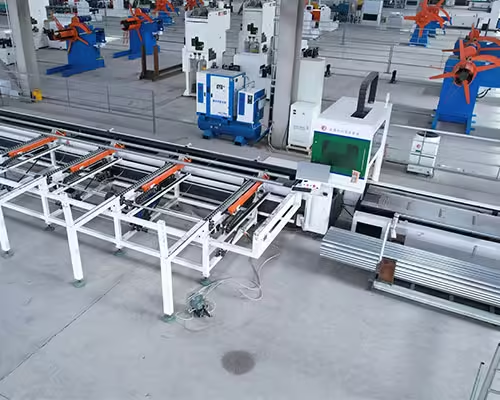
A Pipe Cutting Laser Machine is a CNC-controlled manufacturing system designed to cut metal tubes and structural profiles with a focused laser beam. Unlike conventional saws or mechanical cutting equipment, laser cutting removes material through concentrated thermal energy, producing highly accurate cuts with minimal deformation.
The machine is capable of processing multiple profile types without requiring dedicated molds or tooling, making it suitable for both mass production and customized manufacturing.
High-Precision Tube Processing
Modern laser cutting systems can achieve positioning accuracy of approximately ±0.05 mm, allowing manufacturers to produce components that meet demanding engineering tolerances.
This level of precision reduces assembly errors and improves consistency across production batches.
Multiple Cutting Functions
A modern machine performs far more than straight cutting.
Typical processing operations include:
- Straight cutting
- Angle cutting
- Bevel cutting
- Hole cutting
- Slot cutting
- Contour cutting
- Chamfering
- Marking
- Complex profile cutting
Combining multiple operations into one machine reduces secondary processing and shortens production cycles.
Wide Material Compatibility
Most systems are suitable for processing carbon steel, stainless steel, galvanized steel, alloy steel, aluminum, and other metallic materials.
The flexibility to switch between different materials makes laser cutting an attractive solution for manufacturers serving multiple industries.
How Does a Pipe Cutting Laser Machine Work?
Although laser technology appears highly sophisticated, its operating principle is relatively straightforward.
The machine combines laser generation, CNC motion control, tube positioning, and intelligent software into a fully integrated manufacturing system.
Step 1: Tube Loading
Raw material is automatically or manually loaded onto the feeding system.
Automatic loading systems improve production efficiency while reducing manual labor.
Step 2: Tube Positioning
Pneumatic self-centering chucks clamp the tube securely.
Both front and rear chucks synchronize movement to ensure stable rotation during cutting.
Accurate positioning is essential for maintaining consistent cutting quality throughout the entire tube length.
Step 3: CNC Programming
Operators import CAD drawings or production files into the CNC control system.
The software automatically generates cutting paths while optimizing material utilization.
Modern systems can also simulate the cutting process before production begins.
Step 4: Laser Cutting
The focused laser beam melts or vaporizes the metal while assist gas removes molten material from the cutting area.
The laser head follows the programmed path with high precision, producing clean edges and accurate geometries.
Step 5: Finished Part Collection
After cutting, finished components are unloaded automatically or transferred to stacking systems.
Intelligent sorting systems further reduce manual handling and improve workshop organization.
Main Components of a Pipe Cutting Laser Machine
Understanding the core components helps buyers evaluate machine quality beyond basic specifications.
Each component directly influences cutting performance, reliability, and maintenance costs.
Laser Source
The laser source is the heart of the machine.
It generates the high-energy laser beam used for material processing.
Modern fiber laser sources offer:
- Higher electrical efficiency
- Lower maintenance requirements
- Longer service life
- Stable beam quality
Laser power typically ranges from 1 kW to 30 kW, depending on production requirements.
Laser Cutting Head
The cutting head focuses the laser beam onto the workpiece.
Modern cutting heads include:
- Automatic focus adjustment
- Collision protection
- Height sensing
- Temperature monitoring
These intelligent functions improve cutting consistency while reducing operator intervention.
CNC Control System
The CNC controller coordinates every machine movement.
It controls:
- Axis motion
- Chuck synchronization
- Cutting sequence
- Feed rate
- Laser output
- Automation functions
Advanced software also supports nesting optimization, production scheduling, and remote diagnostics.
Pneumatic Self-Centering Chucks
High-quality chucks provide secure tube clamping while maintaining rotational accuracy.
Typical configurations include:
| Component | Function | Benefit |
|---|---|---|
| Front Pneumatic Chuck | Holds and rotates the tube | Stable positioning |
| Rear Pneumatic Chuck | Supports long workpieces | Improved accuracy |
| Double-Acting Design | Automatic centering | Faster setup |
| Self-Centering System | Maintains alignment | Reduced positioning errors |
The synchronized movement of both chucks ensures smooth processing, especially when cutting long tubes up to 12 meters.
Motion System
The motion system controls the movement of the laser head and machine axes.
High-quality linear guides and servo motors provide:
- Smooth acceleration
- Stable positioning
- High-speed cutting
- Reduced vibration
Some machines reach maximum travel speeds of 80 m/min, significantly increasing production efficiency.
Cooling System
Laser equipment generates considerable heat during operation.
Industrial chillers maintain stable operating temperatures, protecting both the laser source and optical components.
Consistent cooling contributes to longer equipment lifespan and stable cutting quality.
What Materials Can a Pipe Cutting Laser Machine Process?
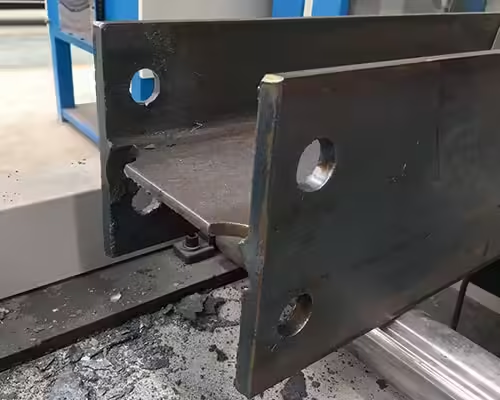
One of the biggest advantages of laser technology is its versatility.
A single machine can process numerous metallic materials without changing tooling.
Carbon Steel
Carbon steel remains one of the most common materials processed by laser cutting systems.
It offers excellent cutting quality and is widely used in construction, machinery manufacturing, and industrial equipment.
Stainless Steel
Stainless steel requires high cutting precision to preserve its corrosion-resistant surface.
Laser cutting minimizes burr formation while producing clean edges suitable for decorative and structural applications.
Aluminum
Aluminum has high reflectivity, making it more challenging to process than steel.
Modern fiber laser technology has greatly improved aluminum cutting performance, allowing manufacturers to achieve accurate results with appropriate power settings.
Galvanized Steel
Laser cutting minimizes mechanical stress on coated materials.
Proper parameter adjustment helps maintain coating integrity while producing precise finished parts.
Alloy Steel
Many industrial components use alloy steels for improved strength and durability.
Laser processing enables accurate cutting while maintaining consistent dimensional quality.
Tube Profiles Supported by Modern Machines
Manufacturers rarely process only one tube shape.
Today’s equipment is designed to handle a wide variety of structural profiles.
Round Tubes
Round tubes are commonly used in:
- Automotive frames
- Fitness equipment
- Agricultural machinery
- Construction structures
Laser cutting enables complex hole patterns and angled cuts without additional fixtures.
Square Tubes
Square tubing is widely used for:
- Furniture frames
- Steel fabrication
- Equipment racks
- Storage systems
Precise corner positioning improves assembly accuracy.
Rectangular Tubes
Rectangular profiles offer higher structural rigidity and are common in architectural and industrial applications.
Laser systems easily process varying wall thicknesses while maintaining consistent edge quality.
Angle Steel
Angle profiles are frequently used in structural engineering and steel construction.
Laser cutting simplifies complex joint preparation compared with conventional machining methods.
Channel Steel
Channel steel components often require multiple holes, slots, and angled cuts.
Laser processing combines these operations into one automated workflow, reducing production time and improving consistency.
Types of Pipe Cutting Laser Machine
Choosing the right Pipe Cutting Laser Machine starts with understanding the different machine configurations available on the market. Each type is designed to meet specific production requirements, tube dimensions, and automation levels.
Rather than focusing only on laser power, buyers should also evaluate machine structure, production capacity, and future expansion needs.
Manual Loading Machines
Manual loading machines are ideal for small workshops and manufacturers with lower production volumes.
Operators load and unload tubes manually, making this solution suitable for prototype production, custom fabrication, and businesses with limited floor space.
Best For
- Start-up manufacturers
- Custom fabrication shops
- Small production batches
- Limited investment budgets
Semi-Automatic Pipe Cutting Laser Machine
Semi-automatic systems combine manual material preparation with automated cutting.
These machines improve productivity while maintaining a relatively affordable investment cost.
Key Benefits
- Reduced labor intensity
- Faster production cycles
- Stable cutting quality
- Easy operation
They are often selected by growing manufacturers looking to increase production without investing in a fully automated production line.
Fully Automatic Pipe Cutting Laser Machine
A fully automatic Pipe Cutting Laser Machine integrates automatic loading, feeding, positioning, cutting, unloading, and intelligent stacking.
This configuration maximizes production efficiency while minimizing manual intervention.
Typical Features
- Automatic bundle loading
- Intelligent material identification
- Automatic sorting
- Real-time production monitoring
- Remote diagnostics
- Smart scheduling software
Large-scale manufacturers often prefer fully automated systems because they reduce labor costs while maintaining consistent production quality around the clock.
Fiber Pipe Cutting Laser Machine vs Traditional Cutting Methods
Many manufacturers upgrading their production facilities compare laser cutting with conventional processing methods such as band saws, plasma cutting, flame cutting, or mechanical drilling.
Each technology has its own strengths, but fiber laser technology has become the preferred solution for precision tube fabrication.
| Feature | Pipe Cutting Laser Machine | Traditional Cutting |
|---|---|---|
| Cutting Accuracy | Up to ±0.05 mm | Lower dimensional consistency |
| Cutting Speed | High-speed continuous processing | Slower production cycles |
| Edge Quality | Smooth with minimal burrs | Often requires secondary finishing |
| Tool Wear | No physical cutting tools | Regular blade or tool replacement |
| Material Waste | Optimized through nesting software | Higher material loss |
| Production Flexibility | Quick program changes | Tool changes often required |
| Automation | High | Limited |
| Maintenance | Lower long-term maintenance | Frequent mechanical maintenance |
For manufacturers producing a variety of tube sizes and profiles, laser cutting provides greater flexibility while reducing overall operating costs.
Why Fiber Laser Technology Is Becoming the Industry Standard
Fiber laser technology has transformed tube fabrication over the past decade.
Compared with earlier laser systems, fiber lasers provide greater efficiency, higher beam quality, and lower operating costs.
Higher Energy Efficiency
Fiber laser sources convert electrical energy into laser energy more efficiently.
Lower power consumption contributes to reduced operating expenses over the machine’s lifetime.
Stable Beam Quality
Consistent beam quality helps maintain cutting accuracy across different materials and thicknesses.
Stable laser output also improves production consistency during long operating shifts.
Longer Service Life
Modern fiber laser sources are designed for continuous industrial production.
With fewer consumable components, maintenance intervals are generally longer than traditional laser technologies.
Lower Maintenance Requirements
Fiber laser systems eliminate many optical components found in older technologies.
As a result, routine maintenance becomes simpler and machine uptime improves.
How Much Laser Power Do You Really Need?

One of the most common questions buyers ask is:
“Should I purchase the highest laser power available?”
The answer depends on production requirements rather than simply choosing the largest number.
Higher power increases cutting capacity but also raises equipment investment and operating costs.
1–3 kW Pipe Cutting Laser Machine
Lower-power machines are suitable for thin-wall tubes and light industrial production.
Typical applications include:
- Furniture manufacturing
- Display racks
- Decorative metal products
- Fitness equipment
- Light steel fabrication
Advantages include lower purchase costs and reduced energy consumption.
3–6 kW Systems
This power range is one of the most popular choices among medium-sized manufacturers.
It balances productivity, versatility, and operating costs.
Suitable for:
- Construction components
- Agricultural machinery
- Automotive parts
- Metal furniture
- General fabrication
6–12 kW Systems
Higher-power machines increase cutting speed while processing thicker materials.
Manufacturers with continuous production schedules often benefit from this range.
Typical industries include:
- Heavy equipment
- Structural steel
- Shipbuilding
- Industrial machinery
12–30 kW High-Power Machines
High-power equipment is designed for demanding industrial applications requiring maximum productivity.
These systems process thicker materials efficiently while maintaining excellent edge quality.
They are generally selected by large manufacturers operating high-volume production lines.
Key Technical Specifications Buyers Should Compare
Machine specifications provide valuable insight into production capability.
However, buyers should evaluate specifications alongside actual production requirements.
| Specification | Typical Range | Why It Matters |
|---|---|---|
| Laser Power | 1–30 kW | Determines cutting capability |
| Cutting Accuracy | ±0.05 mm | Influences product precision |
| Tube Length | 6–12 m | Supports different workpiece sizes |
| Maximum Travel Speed | Up to 80 m/min | Higher productivity |
| Chuck Rotation Speed | Up to 100 rpm | Smooth tube processing |
| Chuck Type | Pneumatic Self-Centering | Stable positioning |
| Equipment Weight | 1–5 tons | Installation planning |
| Supported Profiles | Round, Square, Rectangle, Angle, Channel | Production flexibility |
Specifications alone should not determine purchasing decisions.
Machine stability, software performance, after-sales service, and supplier experience are equally important.
Intelligent Automation Improves Productivity
Modern manufacturing increasingly relies on automation rather than manual operation.
Today’s Pipe Cutting Laser Machine integrates intelligent software with automated mechanical systems to create a more efficient production environment.
Automatic Loading
Automatic loading systems continuously feed raw materials into the machine.
This minimizes idle time and allows operators to focus on production management rather than repetitive handling tasks.
Intelligent Nesting
Advanced nesting software automatically arranges cutting paths to maximize material utilization.
Better nesting reduces scrap while improving production efficiency.
Automatic Unloading
Finished parts are transferred to designated collection areas after cutting.
Automated unloading reduces handling time and minimizes the risk of product damage.
Smart Production Monitoring
Many modern machines provide real-time monitoring of machine status, production progress, and maintenance reminders.
Remote monitoring also allows managers to oversee production across multiple workshops or factory locations.
Industries That Benefit Most from a Pipe Cutting Laser Machine
The flexibility of laser tube processing makes it suitable for a wide range of industries.
Construction Industry
Steel structures, scaffolding, railings, and building frames often require accurate tube cutting.
Laser processing improves dimensional consistency while reducing fabrication time.
Automotive Manufacturing
Vehicle frames, exhaust systems, seat structures, and safety components require precise tube processing.
Laser technology supports high-volume production with repeatable quality.
Furniture Manufacturing
Metal furniture relies on clean edges and accurate joints.
Laser cutting simplifies the production of modern furniture designs while reducing secondary finishing work.
Fitness Equipment
Exercise equipment contains numerous tubular components with complex hole patterns and angled joints.
Laser processing combines multiple operations into a single production step, improving manufacturing efficiency.
Agricultural Machinery
Frames, protective structures, and support components often use square and rectangular tubing.
Laser cutting enables manufacturers to process different tube specifications without changing molds or tooling.
Industrial Equipment
Machinery frames, conveyor systems, storage racks, and automation equipment all benefit from precise tube fabrication.
Laser technology provides the flexibility needed for both standardized and customized production.
Advantages of a Pipe Cutting Laser Machine
Manufacturers are increasingly replacing conventional cutting equipment with laser technology because it offers a balanced combination of precision, efficiency, flexibility, and long-term cost savings. A modern Pipe Cutting Laser Machine not only improves product quality but also streamlines the entire production workflow.
High Precision for Complex Tube Processing
Precision is one of the defining advantages of laser cutting technology.
With cutting accuracy of up to ±0.05 mm, manufacturers can produce components that require little or no secondary finishing. Consistent dimensional accuracy also simplifies downstream assembly and improves overall product quality.
Why Precision Matters
- Better fit between components
- Reduced assembly errors
- Improved product consistency
- Higher customer satisfaction
Faster Production Efficiency
A Pipe Cutting Laser Machine performs multiple operations in a single process, eliminating the need to transfer workpieces between different machines.
High travel speeds and intelligent motion control significantly reduce production cycle times, making laser cutting suitable for both batch production and customized orders.
Typical Productivity Improvements
- Faster setup for different tube sizes
- Reduced production downtime
- Continuous cutting with stable quality
- Increased daily output
Flexible Manufacturing Without Molds
Unlike many traditional fabrication methods, laser cutting does not require dedicated molds or tooling for different tube profiles.
Operators simply load a new program into the CNC system when changing product designs, allowing manufacturers to respond quickly to evolving customer requirements.
This flexibility is particularly valuable for businesses producing customized or low-volume products.
Excellent Edge Quality
Laser cutting produces smooth cutting surfaces with minimal burr formation.
In many applications, components can proceed directly to welding, coating, or assembly without additional grinding or machining.
Cleaner edges also contribute to a more professional finished appearance.
Intelligent Material Utilization
Material costs account for a significant portion of manufacturing expenses.
Modern nesting software automatically arranges cutting paths to maximize material usage and reduce scrap.
Efficient material utilization benefits both production costs and environmental sustainability.
How a Pipe Cutting Laser Machine Reduces Operating Costs
Although the initial investment may be higher than conventional equipment, many manufacturers achieve long-term savings through improved efficiency and lower operating expenses.
Lower Labor Costs
Automation reduces dependence on manual handling and repetitive operations.
One operator can often supervise multiple production processes, allowing manufacturers to optimize workforce allocation.
Reduced Tool Replacement
Mechanical cutting equipment requires regular replacement of blades, drills, or saws due to wear.
Laser cutting uses a focused beam rather than physical contact, eliminating tool wear during normal operation.
This reduces maintenance downtime and consumable expenses.
Less Secondary Processing
Traditional cutting methods often require additional grinding, deburring, drilling, or finishing.
Because laser cutting produces cleaner edges and more accurate geometries, many secondary operations become unnecessary.
This shortens production cycles while reducing labor requirements.
Improved Production Stability
Stable equipment minimizes unexpected downtime.
Consistent cutting quality also reduces the number of rejected parts, improving overall production efficiency.
Return on Investment (ROI): Is a Pipe Cutting Laser Machine Worth It?
Many buyers focus primarily on purchase price. However, evaluating the total cost of ownership provides a more complete understanding of the machine’s long-term value.
The return on investment depends on several factors, including production volume, material utilization, labor efficiency, and maintenance costs.
Factors That Improve ROI
- Higher daily production capacity
- Reduced labor requirements
- Lower material waste
- Improved product consistency
- Shorter delivery times
- Fewer rejected parts
- Reduced maintenance expenses
Manufacturers with continuous production schedules often recover their investment more quickly due to sustained productivity gains.
Comparing Manual and Automated Production
Automation has become a major trend in modern manufacturing. The following comparison highlights how automation can improve production efficiency.
| Comparison Item | Conventional Production | Automated Pipe Cutting Laser Machine |
|---|---|---|
| Material Loading | Manual | Automatic loading system |
| Positioning | Manual adjustment | Automatic self-centering chuck |
| Cutting Process | Multiple machines | Single integrated process |
| Product Changeover | Time-consuming | Fast program switching |
| Labor Requirement | High | Lower |
| Production Consistency | Operator dependent | Highly repeatable |
| Material Utilization | Moderate | Optimized through nesting software |
| Overall Efficiency | Lower | Higher |
For manufacturers handling diverse product lines, automation offers greater flexibility while maintaining consistent production quality.
How to Choose the Right Pipe Cutting Laser Machine

Selecting the appropriate machine involves more than comparing specifications. Buyers should consider both current production requirements and future business growth.
Evaluate Your Product Range
Begin by reviewing the types of tubes and profiles processed in daily production.
Questions to consider include:
- Do you mainly process round tubes?
- Are square and rectangular tubes common?
- Do you frequently cut angle steel or channel steel?
- Will future projects require more complex profiles?
Choosing a machine with broader processing capabilities can help accommodate future expansion.
Consider Material Thickness
Different materials and wall thicknesses require different laser power levels.
Rather than purchasing the highest-power machine available, select a system that matches your typical production requirements while allowing room for future growth.
Analyze Production Volume
Production volume has a direct impact on the level of automation required.
For example:
- Low-volume production may benefit from manual loading.
- Medium-volume production often suits semi-automatic systems.
- High-volume manufacturing typically justifies fully automated solutions.
Matching automation to production demand helps optimize investment efficiency.
Review Software Capabilities
Modern software plays an important role in production efficiency.
Useful software features include:
- Automatic nesting
- CAD/CAM compatibility
- Intelligent path optimization
- Production simulation
- Remote diagnostics
- Real-time monitoring
- Maintenance reminders
Advanced software can improve productivity without changing hardware.
Evaluate After-Sales Support
Reliable technical support is essential for minimizing downtime.
Before making a purchase, buyers should understand the supplier’s service capabilities.
Important considerations include:
- Installation assistance
- Operator training
- Spare parts availability
- Remote troubleshooting
- Software updates
- Warranty coverage
For example, some manufacturers provide warranties of up to five years for key components, offering additional confidence for long-term operation.
Questions to Ask Before Purchasing
Before signing a purchase agreement, decision-makers should gather detailed information from potential suppliers.
Consider asking the following questions:
- What tube profiles can the machine process?
- What is the maximum tube length supported?
- What laser power options are available?
- Is automatic loading included?
- How is cutting accuracy maintained?
- What software functions are included?
- How quickly can spare parts be delivered?
- What training is provided after installation?
- Is remote technical support available?
- What warranty covers the major components?
These questions help buyers compare suppliers using practical criteria rather than price alone.
Common Mistakes Buyers Should Avoid
Even experienced manufacturers can overlook important details when investing in new equipment.
Choosing Based Only on Price
A lower purchase price does not always result in lower operating costs.
Long-term reliability, maintenance requirements, and production efficiency often have a greater impact on total ownership costs.
Ignoring Future Production Needs
Buying equipment based only on current orders may limit future growth.
Selecting a machine with moderate expansion capability can help avoid costly upgrades later.
Overlooking Software Performance
Hardware receives much of the attention during equipment evaluation, but software has a significant influence on productivity.
Efficient programming, nesting, and automation functions contribute directly to production performance.
Underestimating Training Requirements
Even advanced equipment depends on skilled operators.
Proper training improves production efficiency, reduces operational errors, and helps maximize the machine’s capabilities.
Focusing Only on Laser Power
Higher laser power is not always the best solution.
A balanced combination of power, machine stability, software, automation, and after-sales service often delivers greater long-term value than simply selecting the highest specification available.
Daily Maintenance Tips for a Pipe Cutting Laser Machine
Routine maintenance is essential for maintaining cutting accuracy, extending equipment life, and minimizing unexpected downtime. A well-maintained Pipe Cutting Laser Machine delivers more stable performance and helps manufacturers achieve consistent production quality over the long term.
Rather than waiting for faults to occur, operators should follow a preventive maintenance schedule that includes daily inspections, regular cleaning, and periodic system checks.
Daily Inspection
Before starting production, operators should perform a quick visual inspection of the machine.
Daily Checklist
- Check whether the laser head is clean.
- Inspect the protective lens for contamination.
- Verify assist gas pressure.
- Ensure the cooling system is operating normally.
- Check pneumatic pressure for both chucks.
- Confirm lubrication levels.
- Inspect cables and connectors.
- Verify emergency stop functions.
Completing these checks before each shift helps prevent avoidable interruptions during production.
Weekly Maintenance
Weekly maintenance focuses on keeping mechanical components in optimal condition.
Typical tasks include:
- Cleaning guide rails
- Inspecting servo motors
- Checking chuck alignment
- Cleaning dust collection systems
- Verifying laser beam alignment
- Testing CNC system backups
These inspections help maintain smooth machine operation and improve long-term reliability.
Monthly Maintenance
Monthly inspections provide a more comprehensive evaluation of the machine.
Manufacturers should review:
- Cooling system performance
- Air filtration condition
- Electrical cabinet cleanliness
- Motion system calibration
- Fastener tightness
- Software updates
- Safety devices
Keeping detailed maintenance records also makes it easier to identify recurring issues before they affect production.
Common Troubleshooting Guide
Even advanced laser equipment may occasionally experience operational issues. Understanding common symptoms and their possible causes can help minimize downtime.
| Problem | Possible Cause | Recommended Solution |
|---|---|---|
| Poor cutting quality | Dirty protective lens | Clean or replace the lens |
| Excessive burrs | Incorrect focus position | Recalibrate the laser focus |
| Tube slipping during cutting | Low chuck clamping pressure | Inspect the pneumatic system |
| Incomplete cutting | Insufficient laser power or incorrect parameters | Adjust cutting settings |
| Machine alarm | Cooling system abnormality | Check the industrial chiller |
| Uneven cutting edge | Worn nozzle | Replace the cutting nozzle |
| Positioning deviation | Servo calibration error | Recalibrate the motion system |
| Reduced productivity | Improper nesting program | Optimize cutting paths |
Quick troubleshooting not only restores production faster but also prevents minor issues from developing into costly repairs.
Future Trends of Pipe Cutting Laser Machines in 2026

As manufacturing continues to embrace digital transformation, laser tube processing equipment is becoming smarter, more connected, and increasingly automated.
The following trends are expected to shape the future of the industry.
AI-Assisted Programming
Artificial intelligence is making CNC programming faster and more intuitive.
Modern software can automatically recognize tube geometry, recommend cutting parameters, and generate optimized tool paths, reducing programming time and improving production efficiency.
Intelligent Nesting Optimization
Next-generation nesting software uses advanced algorithms to maximize material utilization.
Instead of relying solely on manual programming, intelligent systems continuously optimize cutting layouts based on production requirements, helping manufacturers reduce waste and lower material costs.
Remote Monitoring and Diagnostics
Cloud-based monitoring allows production managers to check machine status from virtually anywhere.
Real-time data provides visibility into production progress, equipment utilization, maintenance schedules, and alarm notifications, enabling quicker decision-making and reducing downtime.
Predictive Maintenance
Rather than waiting for components to fail, predictive maintenance analyzes machine operating data to estimate when maintenance should be performed.
This proactive approach helps reduce unexpected shutdowns, extend component life, and improve overall equipment effectiveness.
Smart Factory Integration
A modern Pipe Cutting Laser Machine is increasingly designed to communicate with broader factory management systems.
Integration with ERP, MES, and production scheduling software allows manufacturers to coordinate order management, inventory control, and workshop operations more efficiently.
Greater Automation
Automation continues to expand beyond loading and unloading.
Future systems are expected to include intelligent sorting, robotic material handling, automated quality inspection, and flexible production scheduling, allowing manufacturers to respond more quickly to changing customer demands.
Pipe Cutting Laser Machine Buyer’s Checklist
Before making a purchasing decision, compare suppliers using practical criteria rather than focusing solely on equipment price.
Use the following checklist during your evaluation process.
| Evaluation Item | Why It Matters |
|---|---|
| Cutting accuracy | Ensures consistent product quality |
| Laser power options | Matches current and future production needs |
| Supported tube profiles | Increases production flexibility |
| Maximum tube length | Meets workpiece size requirements |
| Automation level | Improves productivity and reduces labor |
| CNC software functions | Simplifies programming and nesting |
| Motion system quality | Enhances cutting stability |
| Chuck design | Maintains accurate tube positioning |
| Warranty coverage | Protects long-term investment |
| Technical support | Minimizes production downtime |
| Spare parts availability | Speeds up maintenance and repairs |
| Operator training | Improves efficiency and safety |
A structured evaluation process helps manufacturers select equipment that aligns with both operational goals and future expansion plans.
Conclusion
Selecting the right Pipe Cutting Laser Machine is about more than purchasing new equipment—it is an investment in manufacturing efficiency, production flexibility, and long-term competitiveness.
By carefully evaluating factors such as cutting accuracy, laser power, supported tube profiles, automation level, CNC software, and after-sales support, manufacturers can choose a solution that meets both current production demands and future business growth.
As intelligent manufacturing continues to evolve, laser tube cutting technology will play an increasingly important role in modern fabrication. Companies that invest in reliable, high-performance equipment today will be better positioned to improve productivity, reduce operating costs, shorten delivery times, and maintain consistent product quality in an increasingly competitive global market.
Whether you operate a small fabrication workshop or a large-scale manufacturing facility, choosing a Pipe Cutting Laser Machine that aligns with your production goals can help create a more efficient, flexible, and sustainable manufacturing process for years to come.
FAQ
What is a Pipe Cutting Laser Machine used for?
A Pipe Cutting Laser Machine is used to cut and process metal tubes and structural profiles with high precision. It supports operations such as straight cutting, bevel cutting, hole cutting, slotting, chamfering, and contour cutting, making it suitable for industries including construction, automotive, furniture, fitness equipment, and industrial manufacturing.
What materials can a Pipe Cutting Laser Machine process?
Most modern machines can process carbon steel, stainless steel, galvanized steel, alloy steel, aluminum, and other metallic materials. Material compatibility depends on the laser power, machine configuration, and cutting parameters.
Can one machine cut different tube shapes?
Yes. Modern systems are designed to process a wide variety of profiles, including round tubes, square tubes, rectangular tubes, angle steel, channel steel, and many special-shaped sections without changing molds.
How accurate is a Pipe Cutting Laser Machine?
Many industrial machines provide positioning accuracy of approximately ±0.05 mm, helping manufacturers produce highly consistent components suitable for precision assembly.
What laser power should I choose?
The appropriate laser power depends on your production requirements, material type, and wall thickness. Lower-power machines are suitable for light fabrication, while higher-power systems support thicker materials and high-volume industrial production.
Is automatic loading worth the investment?
For manufacturers with continuous production or large order volumes, automatic loading can significantly improve productivity, reduce manual handling, and lower labor costs. Smaller workshops with limited production may find manual or semi-automatic systems more appropriate.
Does laser cutting require secondary processing?
In many cases, laser cutting produces smooth, clean edges that require little or no additional finishing. However, final processing requirements may vary depending on material type, application, and customer specifications.
How long does operator training usually take?
Most operators can learn basic machine operation within a relatively short period, while advanced programming and maintenance require additional training. Many equipment suppliers provide installation support and operator training as part of their after-sales service.
If you enjoyed this article on Jinbolida’s smart manufacturing and digital factory expertise, follow us for more insights and updates:
- 📘 Facebook: Stay tuned for our latest smart production line projects → Facebook
- 📱 WhatsApp: Contact us anytime for custom production solutions → Chat Now
- ▶️ YouTube: Watch our automated line demos and real-world applications → YouTube
Let’s keep innovating and shaping the future of smart manufacturing — together!
 English
  Arabic
  Russian
  Spanish
  French