
لماذا تفقد خطوط تشكيل الأقواس الكهروضوئية إنتاجها
جدول المحتويات
A photovoltaic bracket roll forming line may be advertised with a high forming speed but produce far fewer qualified brackets during an actual shift. This difference occurs because the roll former is only one part of the complete production system.
Coil loading, strip leveling, servo feeding, punching, forming, cutting, inspection and stacking must operate as a coordinated process. If one repeated stage is slower than the others, it limits the output of the complete line.
Common causes of lost production include:
- Dense punching patterns
- Slow stop-to-cut cycles
- Frequent coil changes
- Long profile changeovers
- Unstable strip feeding
- Excessive setup scrap
- Tool wear and repeated adjustment
- Quality defects
- Manual collection and stacking
- Unrecorded minor stops
- Poor maintenance access
- Unrealistic capacity calculations
The correct production measure is not the maximum speed of the forming rollers. It is the number of qualified finished brackets produced per hour or shift under defined material, profile, hole-pattern and operating conditions.
ما الذي يحدد مخرجات تشكيل لفة القوس الكهروضوئية؟
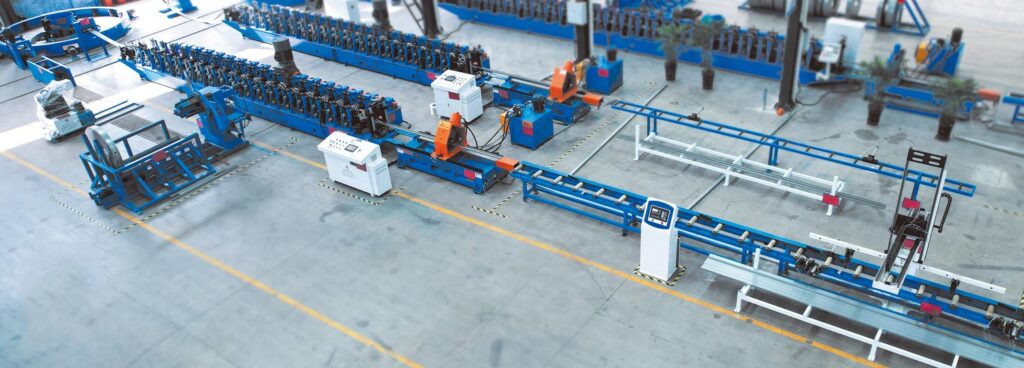
Photovoltaic bracket roll forming converts metal coil into structural profiles used in solar mounting systems. Common products include C-channels, U-channels, slotted struts, Z-shaped purlins, ground-support posts and other customized sections.
A typical production line contains:
- Coil-loading system
- فك اللفائف
- وحدة التسوية
- مغذية مؤازرة
- نظام اللكم
- آلة تشكيل لفة
- جهاز استقامة
- نظام القطع
- جدول النفاد
- Stacking or packaging equipment
جينبوليدا آلة تشكيل أقواس الخلايا الشمسية الكهروضوئية range includes equipment for producing different photovoltaic support profiles from coil-based materials.
The output of the line depends on the combined cycle time of every required operation.
أقصى سرعة للتشكيل
Maximum forming speed describes how quickly material can move through the roller stations under specified conditions. It may not include punching, cutting, coil changes, inspection or stacking.
This figure is useful for machine design, but it should not be used alone to estimate daily output.
سرعة الخط المؤهلة
Qualified line speed is the average rate at which the complete system produces profiles that meet the agreed dimensional, hole-position and surface requirements.
A line may run mechanically at a high speed but create:
- Inaccurate holes
- Unstable cut lengths
- تطور الملف الشخصي
- خدوش السطح
- نتوءات مفرطة
- Stacking damage
Reducing the speed until the profiles become acceptable means the original maximum speed did not represent qualified production.
القطع النهائية لكل نوبة عمل
For production planning, finished pieces per shift is often more useful than meters per minute.
The calculation should use:
- Actual product length
- Number of holes and slots
- دورة اللكم
- طريقة القطع
- Coil-change time
- تردد التحول
- Inspection time
- Planned maintenance
- Typical downtime
- معدل الرفض
أبطأ عملية متكررة تتحكم في الخط
A photovoltaic bracket roll forming line operates as one connected system. The slowest operation that must be repeated for every product or batch becomes the production bottleneck.
| Production stage | Possible output restriction |
|---|---|
| تحميل الملف | Long preparation and unsafe positioning |
| إزالة التربة | Unstable coil release or frequent stops |
| التسوية | Slow adjustment or strip distortion |
| التغذية المؤازرة | Acceleration limits or material slippage |
| اللكم | Dense patterns and long press cycles |
| تشكيل لفة | Complex profiles or high-strength material |
| القطع | Stop-to-cut interruption |
| فحص | Excessive manual checking |
| استلام | Long products cannot be removed quickly |
| التراص | Finished profiles accumulate at the line exit |
| التحول | Tooling replacement and recalibration |
| صيانة | Poor access increases repair time |
Increasing the speed of a stage that is already faster than the bottleneck will not significantly improve total output.
For example, increasing the roll former from 25 to 35 meters per minute provides little value if the punching system can only support the equivalent of 15 meters per minute for the selected hole pattern.
1. اللكم يحد من الخط الكامل
Photovoltaic brackets often contain repeated holes and elongated slots. Punching frequency can become the main output restriction.
جينبوليدا معدات تثقيب الرفوف الكهروضوئية الشمسية includes three-, six- and nine-station systems for different bracket features.
كثافة الثقب تغير الدورة
Two profiles with the same length may require very different production times.
Profile A may contain four holes, while Profile B contains thirty slots, several notches and an embossed feature. The roll former sees the same length, but the punching system completes many more operations for Profile B.
Capacity should therefore be calculated for each representative hole pattern.
عملية التوقف واللكمة
Some systems stop the strip before every punch. This can provide stable positioning, but repeated deceleration and acceleration reduce average speed.
The total punching cycle includes:
- Strip deceleration
- تأكيد الموقف
- حركة الصحافة
- اختراق لكمة
- عودة الأداة
- إزالة سبيكة
- Strip acceleration
Press strokes per minute do not show the full material-positioning time.
اللكم الطائر
Flying punching can operate while the strip continues moving. It may improve output for suitable products, but the system requires accurate synchronization and adequate moving-tool travel.
The configuration should be tested with:
- Minimum and maximum product lengths
- Dense hole patterns
- Maximum material thickness
- Normal operating speed
- Real production material
تآكل الأداة يقلل من السرعة
As punches and dies wear, burrs and stripping force may increase. Operators may reduce line speed or stop frequently to clean slugs and adjust tooling.
A tooling-maintenance plan should record:
- عدد الضربات
- حالة لدغ
- شحذ الأداة
- Clearance
- Punch replacement
- Die replacement
- Product-specific wear
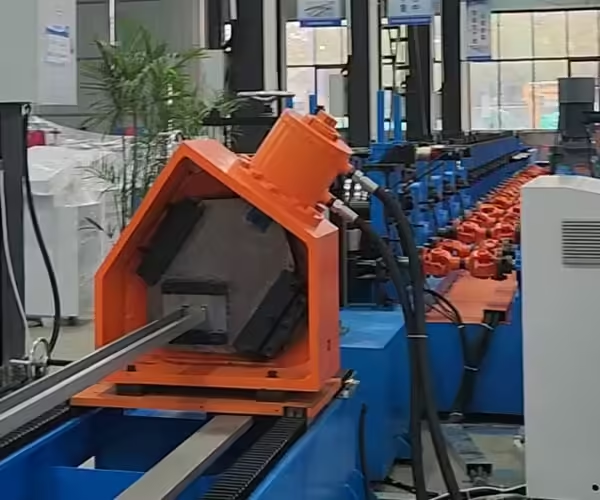
2. القطع يقطع تدفق المواد
After forming, the profile must be cut to the programmed length. The cutting method strongly influences real line speed.
توقف للقطع
A stop-to-cut system temporarily stops the strip or profile.
Its cycle includes:
- Line deceleration
- تأكيد الموقف
- Tool movement
- القطع
- عودة الأداة
- Line acceleration
For long profiles with few cuts, the interruption may be relatively small. For short profiles, frequent cutting can substantially reduce output.
قطع الطيران
A flying cut-off travels with the moving profile. It can reduce interruptions, but the control system must synchronize tool speed, product position and cutting movement.
Poor synchronization may cause:
- Incorrect cut length
- Angled ends
- تشوه الملف الشخصي
- Tool impact
- Repeated alarms
حالة أداة القطع
Worn or incorrectly adjusted cutting tools can create burrs, crushed ends or unacceptable length variation. The line may continue operating, but qualified output declines as more pieces require rework or rejection.
3. تستغرق تغييرات الملف وقتًا أطول من المتوقع
Production planning often assumes that the line runs continuously throughout the shift. In reality, every coil eventually needs replacement.
A coil change may require:
- Stopping the line
- Removing the coil remainder
- Loading a replacement coil
- Centering the coil
- Expanding the decoiler
- Preparing the leading edge
- Threading the strip
- Resetting guides
- Producing setup pieces
- Confirming the new material
If a product uses narrow strip or heavy profiles, the number and duration of coil changes can materially affect daily output.
تقليل وقت توقف تغيير الملف
Possible methods include:
- Coil cars
- Double-head decoilers
- Pre-staged replacement coils
- Standardized loading procedures
- Coil-head preparation
- Strip joining
- Material accumulators
- Clear crane or forklift routes
These features should be justified by actual coil consumption and shift requirements.
تحديد المواد
Incorrect coil selection can cause more loss than the loading time itself. If the wrong grade, thickness or coating enters the line, the resulting profiles may require quarantine or rejection.
Coil identification and recipe verification should be part of the loading procedure.
4. تعمل عمليات تغيير الملف الشخصي على تقليل وقت الإنتاج المتاح
A flexible photovoltaic bracket roll forming system may produce several related profile sizes, but every changeover uses production time.
Changeover tasks may include:
- Replacing roller tooling
- تقف الأسطوانة المتحركة
- ضبط الفواصل
- Changing guides
- Replacing punching dies
- Changing the cut-off tool
- Adjusting the straightener
- Loading a new recipe
- Producing trial pieces
- Completing first-article inspection
The changeover is not complete when the tools have been installed. It is complete when the first qualified product from the new setup is approved.
قياس التحول بشكل صحيح
Record the time between:
- The last qualified product from the previous batch
- The first qualified product from the new batch
This includes setup, testing and inspection.
إعداد داخلي وخارجي منفصل
Some activities can be completed while the line is still producing the previous product.
تشمل الأمثلة:
- Preparing the next tooling set
- Confirming drawings
- Checking the next coil
- Loading recipes
- Preparing inspection instruments
- Positioning lifting equipment
Moving these tasks outside the actual line stop can reduce lost production time.
5. خردة الإعداد تقلل من إنتاجية المواد
Every setup or adjustment can produce nonconforming material.
Typical causes include:
- Incorrect roller gaps
- Incomplete recipes
- Wrong punching pattern
- Strip misalignment
- Unstable leveling
- Cutter calibration
- Straightener adjustment
- Material change
- Tooling replacement
A line may show a high running speed while consuming excessive material during setup.
قياس خردة الإعداد بشكل منفصل
Record:
- Scrap length per startup
- Scrap length per product change
- Scrap after coil change
- Scrap after tooling maintenance
- Scrap caused by alarms
- Scrap used for first-article approval
This helps distinguish normal process waste from avoidable adjustment loss.
توحيد الإعدادات المثبتة
Maintain records for each product:
- Roller positions
- Guide positions
- Leveler settings
- Punching recipe
- Cutter setting
- Straightener setting
- Approved material range
- Inspection results
Stored settings reduce repeated trial-and-error adjustment.
6. عيوب الجودة تختبئ خلف السرعة العالية
Running faster can increase mechanical output while reducing the percentage of acceptable profiles.
Common defects include:
- Incorrect cross-section
- خطأ في موضع الثقب
- Cut-length variation
- تطور الملف الشخصي
- Bow or camber
- نتوءات مفرطة
- Coating scratches
- Crushed cut ends
- Stacking damage
A factory should separate total pieces from qualified pieces.
معدل الجودة
Quality rate compares accepted production with total production.
If a line produces 1,000 pieces but 80 require rework or rejection, the useful output is 920 pieces, not 1,000.
The definition of overall equipment effectiveness commonly considers availability, performance and quality together. For photovoltaic bracket production, this is more informative than recording only the time the machine was moving.
قد تظهر العيوب لاحقًا
Some problems are not discovered at the line exit.
تشمل الأمثلة:
- Hole patterns that do not match connectors
- Gradual twist over long profiles
- Coating damage beneath stacked components
- Incorrect batch identification
- End-to-hole distance errors
Inspection should therefore include functional assembly features, not only appearance.
7. التراص اليدوي يصبح عنق الزجاجة
Long photovoltaic profiles require controlled receiving and stacking. When operators cannot remove products quickly enough, the line must slow down or stop.
Manual handling becomes difficult when:
- Profiles are long
- Line speed is high
- Products are heavy
- Stacks require alignment
- Packaging occurs near the line
- Several products exit in rapid succession
- Floor space is limited
علامات على أن التراص يتحكم في الإخراج
- Finished profiles accumulate on the run-out table.
- Operators regularly request speed reduction.
- Products collide at the exit.
- Surface scratches increase.
- Bundles are uneven.
- The line stops while stacks are moved.
- Quality staff cannot inspect parts before the next product arrives.
الاستقبال والتكديس التلقائي
Automatic equipment may perform:
- Product counting
- تفريغ
- Turning
- تشكيل الطبقة
- تنسيق
- التراص
- Bundle transfer
جينبوليدا معدات مساعدة لآلة التشكيل can be evaluated when receiving and handling restrict production.
Automation should match product length, weight and profile stability. A stacker that works well for rigid C-channels may require different support for thin U-channels.
8. لم يتم تسجيل التوقفات البسيطة
Factories often record major breakdowns but ignore short interruptions.
Minor stops may include:
- Sensor contamination
- Slug jams
- Feed alarms
- Material tracking corrections
- Profile removal
- Product counting
- Manual measurements
- Label changes
- Guide adjustments
- إزالة الخردة
A two-minute stop may not seem important. If it occurs twenty times per shift, it becomes forty minutes of lost production.
استخدم رموز السبب
The control system or operator record should classify stops by cause.
Useful reason codes include:
- مادة
- تغذية
- اللكم
- تشكيل
- القطع
- التراص
- فحص
- الأدوات
- أمان
- المشغل
- المرافق
- Unknown
Avoid using one broad category such as “machine stop,” because it does not identify the corrective action.
مراجعة التردد والمدة
A long but rare failure requires a different solution from a short stop that occurs every few minutes.
Track both:
- Total time lost
- Number of occurrences
High-frequency minor stops often reveal unstable sensors, poor scrap removal or repetitive handling delays.
9. الوصول إلى الصيانة يمدد وقت التوقف عن العمل
A production line may be designed to fit the smallest possible space, but inadequate maintenance clearance makes repairs slower.
Technicians need access to:
- Decoiler mandrel
- بكرات التسوية
- مغذية مؤازرة
- اللكم يموت
- Forming shafts
- نظام القيادة
- محامل
- وحدة استقامة
- Cutting tools
- خزانة كهربائية
- Hydraulic station
- مزالق الخردة
If major components cannot be removed safely, maintenance takes longer and creates additional risk.
ال Solar Support Bracket Forming Machine Line Layout Guide explains how material flow, utilities, stacking and service areas should be incorporated into the factory layout.
10. تستخدم أهداف الإنتاج افتراضات غير واقعية
Capacity estimates often assume:
- Maximum forming speed
- No coil changes
- No profile changes
- No inspection
- No maintenance
- No rejection
- Perfect material
- Immediate stacking
- Continuous operator availability
These assumptions do not describe normal production.
صيغة القدرات العملية
A simple shift estimate can begin with:
Qualified output = theoretical output × availability × performance rate × quality rate
Each factor should be based on recorded production rather than an arbitrary assumption.
على سبيل المثال:
- Theoretical output: 1,200 pieces per shift
- Availability: 85%
- Performance rate: 90%
- Quality rate: 97%
The estimated qualified output is approximately 890 pieces per shift.
This example is not a universal benchmark. It demonstrates why theoretical capacity and qualified output can differ substantially.
استخدم السعة الخاصة بالمنتج
The same line may have different capacity for:
- Long profiles with few holes
- Short profiles with frequent cuts
- Thick high-strength material
- Dense slot patterns
- Products requiring manual inspection
- Profiles requiring frequent changeover
A capacity matrix is more useful than one headline speed.
قياس خسارة الإنتاج
Factories should collect enough information to identify the largest improvement opportunity.
| Metric | What it shows | Recommended unit |
|---|---|---|
| الإخراج المؤهل | Accepted production | Pieces per shift |
| Mechanical speed | Roller-section movement | Meters per minute |
| Actual average speed | Complete operating performance | Meters per minute |
| توفر | Time available for production | نسبة مئوية |
| وقت التحول | Lost time between products | Minutes |
| Coil-change time | Material replacement efficiency | Minutes |
| Setup scrap | Material lost during adjustment | Meters or kilograms |
| معدل الرفض | Quality loss | نسبة مئوية |
| دورة اللكم | Hole-processing constraint | Seconds per product |
| دورة القطع | Length-separation constraint | Seconds per cut |
| توقفات طفيفة | Repeated interruptions | Count and minutes |
| Stacking delay | Exit-handling constraint | Minutes per shift |
NIST’s Sustainable Manufacturing Indicator Repository reflects the broader importance of measurable manufacturing indicators. A photovoltaic bracket factory should select metrics that lead to specific production and resource-efficiency actions.
كيفية العثور على عنق الزجاجة الحقيقي
الخطوة 1: حدد منتجًا تمثيليًا واحدًا
Record the profile drawing, material, length, hole pattern and required quality.
الخطوة 2: الوقت لكل عملية متكررة
يقيس:
- تغذية
- اللكم
- تشكيل
- القطع
- Product removal
- التراص
الخطوة 3: سجل جميع التوقفات
Include both major downtime and minor interruptions.
الخطوة 4: فصل الإنتاج الجيد والمرفوض
Do not count rework or rejected parts as qualified output.
الخطوة 5: تحديد القيد
Look for:
- The slowest repeated cycle
- The most frequent stop
- The largest total downtime
- The main defect source
- The longest changeover task
الخطوة 6: تحسين قيد واحد
Increasing speed in several areas simultaneously can make results difficult to interpret. Improve the confirmed bottleneck first and then measure the complete line again.
أولويات التحسين حسب الأعراض
| أعراض الإنتاج | Likely priority |
|---|---|
| Line pauses at every hole pattern | Punching and feeding cycle |
| Roll former waits for the cutter | Cutting method or synchronization |
| Long stop at end of every coil | Coil handling or strip joining |
| Excessive trial material after changeover | Setup standardization |
| Profiles collect at the exit | Receiving and stacking |
| Output is high but rejection increases | Quality and process stability |
| Frequent short alarms | Sensor, scrap or feeding analysis |
| Maintenance takes too long | Access and spare-parts planning |
| Different shifts produce different results | Training and recipe control |
| Capacity changes greatly by product | Product-specific planning |
الأتمتة لا تزيل الاختناقات تلقائيًا
Automation is useful when it addresses a measurable restriction.
تشمل الأمثلة:
- Double-head decoiler for frequent coil changes
- Servo feeding for variable hole patterns
- Flying cutting for short repeated products
- Automatic stacking for long high-volume profiles
- Recipe management for frequent changeovers
- Alarm history for repeated minor stops
- Tool-life monitoring for punching maintenance
However, adding automation to an unstable process can increase complexity without improving qualified output.
Before adding equipment, confirm:
- Current bottleneck
- Expected time reduction
- مجموعة المنتجات
- Interface requirements
- Maintenance capability
- تدريب المشغلين
- Acceptance method
اختبار قبول المصنع للمخرجات
A factory acceptance test should verify both quality and capacity.
The test should use:
- Agreed material
- Representative profile
- Real hole pattern
- Required product length
- Normal line settings
- Agreed inspection method
Record:
- وقت التشغيل المستمر
- Total pieces
- Qualified pieces
- Rejected pieces
- توقفات طفيفة
- Alarm causes
- دورة اللكم
- دورة القطع
- Average speed
- حالة الأدوات
- Stacking performance
Testing only the roll former without the required punching and cutting cycles does not demonstrate full-line capacity.
For more information about complete coil processing, refer to آلات معالجة لفائف الصلب للأقواس الكهروضوئية.
المعلومات اللازمة لمراجعة القدرات
A machine supplier or engineering team needs:
- رسومات الملف الشخصي
- درجة المواد
- سمك المادة
- وزن الملف
- أطوال المنتج
- أنماط الثقب
- كميات الدفعة
- عدد التحولات
- تردد التحول
- Current cycle times
- Downtime records
- Rejection records
- Existing layout
- Stacking method
- Target output
Without this information, capacity improvement recommendations remain general.
خاتمة
Photovoltaic bracket roll forming lines lose output when the complete production cycle is slower or less stable than the advertised forming speed.
Punching, cutting, coil replacement, changeovers, defects, minor stops and stacking frequently reduce qualified production. The most effective improvement begins by measuring every repeated operation and identifying the true bottleneck.
Factories should track qualified pieces per shift, availability, changeover time, setup scrap, rejection rate and stop reasons. Improving the slowest or least stable process creates more value than increasing the speed of equipment that already waits for another operation.
يوفر جينبوليدا photovoltaic bracket forming machines, punching equipment and auxiliary automation for complete production-line solutions. Manufacturers can submit product drawings, cycle data, factory layouts and output targets through the صفحة الاتصال جينبوليدا for a line-specific capacity evaluation.
التعليمات
لماذا يكون خرج تشكيل اللفة الفعلي أقل من السرعة المقدرة؟
Rated speed often describes only the roller section. Actual output also includes punching, cutting, coil replacement, changeovers, inspection, downtime and stacking. Material strength and hole density also change performance. Qualified finished pieces per shift provide a more realistic measure than maximum meters per minute.
ما هو عنق الزجاجة الأكثر شيوعًا في تشكيل لفة الأقواس الكهروضوئية؟
There is no single bottleneck for every line. Dense hole patterns often make punching the constraint, while short products may be limited by cutting. Long profiles may be restricted by manual stacking. A time study using the real profile, material and hole pattern is required to identify the slowest repeated operation.
كيف يجب على المصنع حساب الطاقة الإنتاجية المؤهلة؟
Start with theoretical pieces based on product length and line speed, then account for availability, actual operating performance and quality rate. Include coil changes, setup, inspection, minor stops and rejected products. Capacity should be calculated separately for representative products because their punching and cutting cycles differ.
هل يمكن للتكديس التلقائي تحسين إخراج الخط بشكل كبير؟
Automatic stacking can improve output when operators cannot remove and align profiles as quickly as the line produces them. It is especially valuable for long, heavy or high-volume products. Before adding a stacker, measure how often receiving causes slowdowns and confirm that the proposed system supports every profile geometry.
كيف يمكن تقليل وقت التغيير دون تغيير الجهاز؟
Prepare tooling, material, drawings, recipes and inspection instruments before stopping the line. Record proven settings for every product, identify tool locations and standardize the changeover sequence. Measure from the last qualified old product to the first qualified new product so setup and first-article approval are both included.
 Arabic
  English
  Russian
  Spanish
  French