
C Purlin Roll Forming Machine: Fixed vs Adjustable Models
Table of Contents
A C purlin roll forming machine converts metal coils into continuous C-shaped structural profiles used in industrial buildings, warehouses, roofing systems, wall structures, solar mounting systems, and prefabricated construction.
When purchasing this equipment, buyers often need to choose between a fixed-size machine and an adjustable model. A fixed machine is optimized for a specific profile or limited product range, while an adjustable machine can change selected web, flange, or lip dimensions.
The right choice depends on product variety, order volume, material specifications, changeover frequency, accuracy requirements, and available investment.
Key takeaways:
- Fixed-size machines suit stable, high-volume production.
- Adjustable machines offer greater flexibility for multiple C purlin sizes.
- “Adjustable” does not mean every dimension changes automatically.
- Material grade and thickness affect forming force and tooling design.
- Pre-punching and post-punching configurations serve different applications.
- Profile adjustment time should be included in production-capacity calculations.
- Buyers should compare finished-product accuracy instead of maximum speed alone.
- Factory acceptance testing should cover different sizes and material thicknesses.
- Complete profile drawings are required before the machine is designed.
What Is a C Purlin Roll Forming Machine?
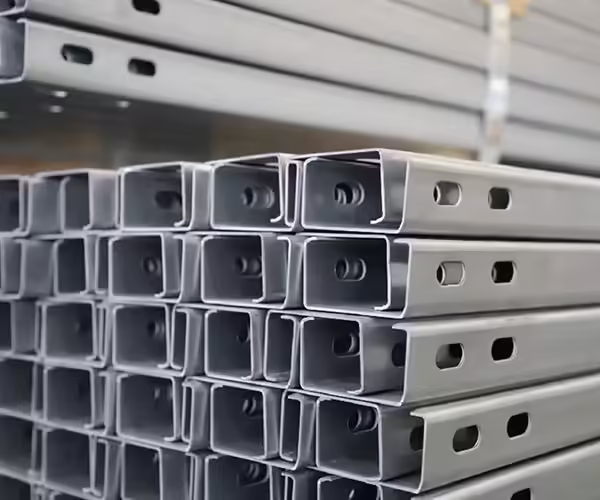
A C purlin roll forming machine is a continuous metal-forming system designed to manufacture C-shaped structural sections from steel coils. The strip passes through multiple roll stations, with each station gradually bending the material into the required cross-section.
A complete line may include an uncoiler, leveling unit, servo feeder, punching system, roll forming unit, cutting system, electrical control cabinet, run-out table, and automatic collection equipment.
The Roll Forming Process
Roll forming is a continuous cold-bending process. Instead of creating the complete profile in one operation, the machine forms the strip progressively through a sequence of rollers.
This gradual process helps control material deformation and enables consistent production of long structural profiles.
Typical C Purlin Features
A finished C purlin normally contains:
- A central web
- Two flanges
- Optional return lips
- Defined corner radii
- Installation holes or slots
- A specified finished length
The dimensions of these features must be taken from an approved product drawing.
Common Applications
C purlins are commonly used as secondary structural members in metal buildings. They may support roof sheets, wall cladding, solar panels, and other construction components.
The required profile should always be determined by the building or mounting-system designer.
Fixed vs Adjustable C Purlin Machines
The main difference is how the equipment handles changes in profile dimensions. A fixed-size machine uses tooling optimized for one profile, while an adjustable machine changes selected dimensions through manual, mechanical, hydraulic, or servo-controlled movement.
| Comparison factor | Fixed-size machine | Adjustable machine |
|---|---|---|
| Product range | One size or narrow profile family | Several related profile sizes |
| Initial cost | Usually lower | Usually higher |
| Tooling design | Relatively simple | More complex |
| Size change | Roll replacement or mechanical reset | Manual or automatic adjustment |
| Production stability | Strong for repeated products | Depends on adjustment accuracy |
| Changeover time | Longer if tooling must be replaced | Shorter when dimensions are programmable |
| Operator skill | Standard setup knowledge | Additional parameter control required |
| Best order type | Large, consistent orders | Mixed or frequently changing orders |
| Maintenance | Relatively straightforward | More adjustment components to inspect |
| Factory planning | Dedicated production | Flexible manufacturing |
The best machine is not necessarily the one with the widest adjustment range. It is the one that matches the manufacturer’s actual product mix.
How a Fixed-Size C Purlin Roll Forming Machine Works
A fixed-size machine uses a dedicated roll configuration for a defined C purlin cross-section. Some small adjustments may be possible, but the main web and flange geometry remain unchanged.
This configuration is particularly effective when a factory produces the same profile continuously.
Dedicated Roll Tooling
The rolls are designed around a specific profile drawing, material range, and forming sequence. Because the tooling does not need to support a broad adjustment range, the production process can be relatively stable.
Simplified Setup
Operators normally adjust strip position, roll clearance, punching parameters, and cutting length. They do not need to reposition the complete forming system for every order.
High-Volume Production
A fixed C purlin roll forming machine can be economical when the same profile accounts for most customer orders. Reduced changeover activity helps maximize available production time.
Main Limitation
If the market later requires different web or flange dimensions, new roll tooling or a separate machine may be needed. Buyers should evaluate future product plans before selecting a dedicated configuration.
How an Adjustable C Purlin Roll Forming Machine Works
An adjustable machine changes selected roll positions to produce several related C purlin dimensions. Adjustment may be completed using handwheels, motors, hydraulic mechanisms, or servo-controlled systems.
The exact adjustment method should be explained clearly in the quotation.
Manual Adjustment
Operators reposition forming components according to a setup table. This option can provide flexibility at a lower cost than a fully automatic system.
However, adjustment speed and repeatability depend more heavily on operator skill.
Motorized Adjustment
Electric motors move designated machine sections to new positions. The operator selects or enters the required dimensions through the control interface.
Motorized adjustment reduces physical work and can make changes more consistent.
Servo-Controlled Adjustment
A servo-controlled C purlin roll forming machine can store product recipes and automatically move adjustable components to programmed positions.
This configuration is useful when the factory produces many small orders or changes specifications frequently.
Verify Which Dimensions Are Adjustable
Some machines adjust only the web width, while flange and lip dimensions remain fixed. Others can adjust several dimensions independently.
The buyer should request a table listing the minimum, maximum, and adjustment method for every important profile dimension.
Web, Flange, and Lip Adjustment
C purlin size is defined by more than its overall width. Web, flange, lip, thickness, and corner radius all affect tooling and forming requirements.
Web Width
The web is the central flat portion of the profile. Adjustable machines commonly change web width by moving the left and right forming assemblies.
The adjustment system must keep both sides aligned with the production centerline.
Flange Height
The flanges extend from the edges of the web. Some equipment can change flange height, while other models require different rolls.
Lip Length
Return lips are relatively small but can strongly influence tooling design. Adjustable lip production may require specialized roll arrangements.
Corner Radius
Corner radius is affected by roll geometry, material thickness, strength, and springback. It may not remain identical across every adjustable profile size without proper tooling design.
Material Requirements for C Purlin Production
The C purlin roll forming machine should be designed around the actual material rather than a general description such as “steel coil.”
Material strength, thickness, coating, and width tolerance influence drive power, shaft dimensions, frame rigidity, roll clearance, and forming sequence.
Galvanized Steel
Galvanized steel is frequently used for construction profiles because its zinc coating provides corrosion resistance. The production line should guide and form the material without creating unnecessary coating damage.
Pre-Painted Steel
Pre-painted material requires careful handling because surface scratches may affect appearance and corrosion protection. Roll finish, cleanliness, clearance, and material support should be controlled.
High-Strength Steel
High-strength steel may require greater forming force and more careful springback compensation than conventional low-carbon steel.
The supplier needs the material grade and mechanical properties to select a suitable machine structure.
Material Thickness Range
A machine designed for thin strip may not have enough rigidity or power for thick material. Conversely, tooling designed mainly for thick strip may not control very thin material effectively.
Provide Real Production Specifications
The buyer should list the most frequently used thicknesses, not only the theoretical minimum and maximum. This helps the supplier optimize the equipment for normal production.
Pre-Punching vs Post-Punching
C purlins often contain holes or slots for bolts, braces, plates, and other connections. These features may be punched before or after roll forming.
Pre-Punching
Pre-punching creates holes while the steel strip is flat. The material is easy to support, and the die has clear access to the punching area.
It is commonly integrated with a servo feeding system.
Advantages
- Convenient die access
- Easy processing of different hole shapes
- Stable support for flat strip
- Suitable for programmable hole spacing
- Lower risk of crushing the finished profile
Points to Check
Hole positions must remain correct after the strip passes through the forming stations. Feeding, forming, and cutting controls should use a coordinated reference.
Post-Punching
Post-punching creates holes in the finished or partially finished C profile. It may be selected when the holes need to reference formed features directly.
Specialized support tooling is usually required to prevent the purlin from deforming.
Advantages
- Hole position can reference the finished profile
- Suitable for certain flange or side holes
- Useful for some specialized product designs
Points to Check
Limited die access, profile support, punching speed, and deformation risk must be evaluated.
Pre-Cut vs Post-Cut Systems
Cutting configuration influences finished-end shape, production continuity, and tooling requirements.
Pre-Cutting
The flat strip is cut to length before it passes through the forming stations. One cutting tool may support multiple profile sizes because it processes flat material.
However, separate blanks move through the machine rather than one continuous strip.
Post-Cutting
The completed C purlin is cut after roll forming. The cutting die must match the finished cross-section.
A fixed-size machine can use a dedicated profile die, while an adjustable machine may require a flexible cutting system.
Flying Cutting
A flying cutting system moves with the profile and completes the cut without stopping the forming line. It can improve continuous output but requires accurate synchronization.
Cut-End Quality
Regardless of the cutting method, buyers should inspect length tolerance, squareness, burrs, coating damage, and profile deformation.
Production Speed and Real Capacity
Maximum forming speed is only one part of total capacity. Punching cycles, cutting, size changes, coil loading, inspection, and maintenance all reduce available production time.
The correct calculation should be based on saleable finished purlins.
Rated Forming Speed
This figure describes the maximum speed of the forming section under defined conditions. It may not include stops for punching or cutting.
Integrated Production Speed
Integrated speed reflects the performance of the full line. A slow punching press or cutting cycle may limit output even when the forming section can run faster.
Adjustment Time
An adjustable C purlin roll forming machine may reduce tooling replacement, but it still requires time for dimension changes and sample inspection.
First-Article Approval
After every size change, the first finished profile should be measured before normal production resumes. This inspection time should be included in production planning.
When Should You Choose a Fixed Machine?
A fixed-size machine is generally suitable when the factory has stable contracts for a limited number of profiles.
It can provide a practical balance of cost, production stability, and simplified operation.
Suitable Production Conditions
Consider a fixed model when:
- One profile represents most orders
- Production batches are large
- Specification changes are infrequent
- Operators need a simple setup process
- Initial investment is limited
- Additional machines can be added later
Main Purchasing Advantage
The buyer invests mainly in the functions needed for the defined product. There is less mechanical and control complexity than in a wide-range automatic line.
When Should You Choose an Adjustable Machine?
An adjustable model is suitable when a factory serves several construction systems, distributors, or project-specific orders.
It can reduce the need to purchase a separate forming machine for each profile size.
Suitable Production Conditions
Consider an adjustable model when:
- Customers require several C purlin sizes
- Orders change frequently
- Batch quantities are relatively small
- Factory floor space is limited
- Faster size changes are commercially valuable
- Product recipes need to be stored
- Future flexibility is a priority
Main Purchasing Advantage
One production line can support a wider product range. This may improve equipment utilization when no single profile provides enough volume for a dedicated machine.
Main Purchasing Risk
A broad advertised range may not deliver the same accuracy, speed, or stability for every possible size. The buyer should verify representative profiles from the smallest to the largest range.
Adjustable Machine vs Multiple Fixed Machines
Some factories must decide whether to purchase one flexible line or several dedicated machines.
The decision should be based on product volume, factory space, labor, maintenance, and the financial effect of changeovers.
| Decision factor | One adjustable machine | Multiple fixed machines |
|---|---|---|
| Initial investment | Concentrated in one flexible line | Distributed across several machines |
| Floor space | Usually lower | Usually higher |
| Product flexibility | High within the agreed range | Limited to installed tooling |
| Simultaneous production | One size at a time | Several profiles can run together |
| Downtime impact | One failure affects all supported sizes | Other lines may continue |
| Changeover activity | Required between products | Reduced when each machine is dedicated |
| Maintenance complexity | More adjustment mechanisms | More total machines to maintain |
| Best factory type | Mixed orders and limited space | High-volume, stable product families |
A high-volume manufacturer may achieve better output using several fixed lines. A flexible contract manufacturer may gain more value from one adjustable machine.
Important Accuracy Requirements
A C purlin must fit other building components during installation. Dimensional variation can create assembly delays and structural alignment problems.
Accuracy requirements should appear in the purchase specification and acceptance document.
Cross-Section Dimensions
Measure:
- Web width
- Flange height
- Lip length
- Corner radius
- Opening width
- Overall height
Straightness
Long purlins should remain straight within the agreed tolerance. Incorrect roll alignment, uneven forming force, or unstable strip feeding may create bow.
Twist
Twist occurs when the profile rotates along its length. It may be caused by asymmetrical forming, roll misalignment, or inconsistent material.
Hole Position
Check the distance between holes and the relationship between each hole and the finished profile ends.
Dimensional Repeatability
One correct sample does not prove stable production. Measurements should be repeated across several profiles manufactured during a continuous test.
How to Select the Right C Purlin Roll Forming Machine
A useful quotation requires detailed product, material, and factory information.
Sending only a photo or general profile name may result in incorrect tooling and an incomplete price comparison.
Product Drawings
Provide drawings showing:
- Minimum and maximum web width
- Flange dimensions
- Lip dimensions
- Corner radii
- Material thickness
- Hole patterns
- Finished lengths
- Required tolerances
Material Data
Provide:
- Steel grade
- Yield strength
- Tensile strength
- Coating type
- Thickness range
- Strip-width range
- Coil dimensions
- Maximum coil weight
Production Targets
Explain:
- Required profiles per shift
- Main product sizes
- Average batch size
- Number of size changes
- Required automation level
- Future product range
Factory Conditions
Confirm:
- Voltage, phase, and frequency
- Available production area
- Coil loading method
- Crane or forklift capacity
- Foundation conditions
- Number of operators
Jinbolida provides different W-, L- and Z-shaped steel forming machines and customized profile-forming solutions for structural production requirements.
Factory Acceptance Test Checklist
The factory acceptance test should verify that the completed machine produces profiles according to the approved drawings.
For an adjustable line, testing only one middle-size profile is not enough.
Test Representative Sizes
The test should include:
- A small profile within the range
- A frequently produced profile
- A large profile within the range
- A thin material specification
- A thick material specification
Verify Adjustment Functions
Ask the supplier to demonstrate:
- Recipe selection
- Automatic or manual size adjustment
- Tooling changes
- Punching-program changes
- Cutting adjustment
- First-profile measurement
Inspect Finished Products
Check:
- Cross-sectional dimensions
- Length
- Hole position
- Straightness
- Twist
- Cut-end condition
- Surface coating
- Production stability
Document the Results
Record material specifications, machine settings, speed, measurement results, adjustment time, and observed problems.
Common C Purlin Machine Buying Mistakes
Understanding common errors can help buyers avoid tooling changes and production delays.
Selecting by Price Alone
A low quotation may exclude the uncoiler, punching dies, adjustable cutting system, installation, commissioning, or roll tooling.
Using an Incomplete Drawing
Missing corner radii, lips, hole positions, or tolerance requirements can lead to incorrect machine design.
Assuming Every Dimension Is Automatic
Some machines automatically adjust web width but require manual changes for flanges, lips, punching dies, or cutting tools.
Ignoring Material Strength
Thickness alone does not describe forming difficulty. High-strength steel may require a stronger machine than conventional steel of the same thickness.
Comparing Only Maximum Speed
Real output includes punching, cutting, changeovers, inspections, coil loading, and downtime.
Skipping Multi-Size Testing
An adjustable machine should demonstrate performance across representative points in its advertised range.
Conclusion
The choice between a fixed and adjustable C purlin roll forming machine should be based on actual orders rather than the widest advertised production range.
Fixed machines are practical for factories producing large quantities of stable profiles. Adjustable models are better suited to manufacturers handling multiple sizes, smaller batches, and frequent product changes.
Before purchasing, define the complete profile range, material properties, hole patterns, production targets, adjustment method, and acceptance criteria. Ask the supplier to identify exactly which dimensions can be adjusted and which components require tooling changes.
Buyers can explore Jinbolida’s complete range of industrial roll forming equipment for different structural profiles. For a customized configuration based on your C purlin drawings, materials, punching requirements, and production targets, submit the project details through the contact page.
FAQ
What does a C purlin roll forming machine produce?
It produces continuous C-shaped structural sections from metal coils. These profiles are commonly used in roofing, wall, warehouse, industrial building, and solar mounting structures.
What is the difference between fixed and adjustable machines?
A fixed machine is optimized for one profile or a narrow range. An adjustable machine can change selected profile dimensions through manual, motorized, or automatic controls.
Can one machine produce both C and Z purlins?
Some machines are designed to produce both profile types, but this capability depends on the tooling and adjustment system. Buyers should submit both drawings for technical confirmation.
Can the machine process galvanized steel?
Yes, when its tooling, power, roll clearance, and material handling are designed for the specified galvanized steel grade and thickness.
How long does a profile-size change take?
Changeover time varies according to the adjustment method. Servo-controlled systems can reduce adjustment time, while manual systems generally require more operator input and measurement.
Can flange and lip dimensions be adjusted?
This depends on the machine design. Some models adjust only web width, while others support changes to web, flange, or lip dimensions.
Should holes be punched before roll forming?
Pre-punching is commonly used because the strip is flat and easy to support. Post-punching may be selected when holes need to reference the finished profile.
How is machine speed determined?
Stable speed depends on material grade, thickness, profile dimensions, punching frequency, cutting method, and accuracy requirements.
What information is needed for a quotation?
Provide product drawings, material specifications, thickness range, hole patterns, finished lengths, production targets, adjustment requirements, and factory electrical conditions.
How should an adjustable machine be tested?
Test several sizes and thicknesses across the agreed range. Measure dimensions, holes, straightness, twist, cut quality, speed, and adjustment time.
If you enjoyed this article on Jinbolida’s smart manufacturing and digital factory expertise, follow us for more insights and updates:
- 📘 Facebook: Stay tuned for our latest smart production line projects → Facebook
- 📱 WhatsApp: Contact us anytime for custom production solutions → Chat Now
- ▶️ YouTube: Watch our automated line demos and real-world applications → YouTube
Let’s keep innovating and shaping the future of smart manufacturing — together!
 English
  Arabic
  Russian
  Spanish
  French