
Máquina perfiladora solar de canal C: guía de calidad
Tabla de contenido
Introducción

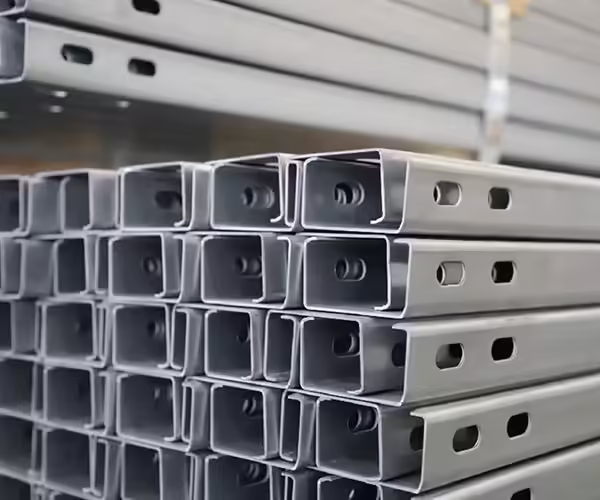
Los perfiles de canal C se utilizan ampliamente en estructuras de montaje fotovoltaico porque su geometría de sección abierta puede combinar soporte estructural con puntos de conexión convenientes para pernos, abrazaderas y otros componentes de montaje. Sin embargo, producir un canal de soporte solar largo implica consistentemente algo más que simplemente doblar acero galvanizado en una sección transversal en forma de C.
A máquina perfiladora solar de canal C necesita controlar el ancho de la banda, la altura de la brida, los labios de retorno, los ángulos de curvatura, la posición de la ranura, la rectitud, la torsión, la longitud de corte y el estado de la superficie durante la producción continua. Los pequeños cambios dimensionales pueden volverse importantes cuando los perfiles largos necesitan alinearse con otros componentes durante el ensamblaje del soporte fotovoltaico.
El desafío se vuelve mayor cuando la misma línea de producción maneja varias dimensiones de canal, diferentes espesores de material o múltiples patrones de punzonado. El diseño de herramientas, la servoalimentación, la secuencia de punzonado, la alineación de los rodillos, la compensación del resorte, el corte y el cambio deben funcionar como un solo proceso coordinado.
Por esta razón, la calidad de la producción del canal C debe evaluarse desde el soporte terminado hacia atrás en lugar de observar únicamente la velocidad de formación o el número de soportes de rodillos.
¿qué es una máquina formadora de rollos de canal C solar?
Una máquina perfiladora de canal C solar transforma continuamente tiras metálicas en perfiles en forma de C o con labios en forma de C utilizados en estructuras de montaje fotovoltaicas.
Una ruta de producción típica puede incluir:
carga de bobina → desenrollado → nivelación → servoalimentación → punzonado → perfilado → enderezamiento → medición → corte → recepción
La configuración exacta depende del soporte terminado.
Algunos perfiles contienen agujeros simples en la web.
Otros incluyen:
- tragamonedas largas,
- orificios de montaje repetidos,
- devuelve labios,
- nervaduras de refuerzo,
- varios tamaños de canales,
- espaciado de orificios personalizado,
- o funciones de conexión más complejas.
Las fábricas centradas en soportes fotovoltaicos en forma de C pueden revisar los JBLDIE Máquina formadora de rollos de acero con canal C para soportes solares fotovoltaicos como referencia para este tipo de equipos de producción.
En última instancia, la máquina debería configurarse de acuerdo con el dibujo final real en lugar de una definición genérica de “canal C solar”
Por qué los perfiles de canal C requieren un control de formación cuidadoso
A primera vista, un canal C puede parecer más simple que un tubo cerrado o un perfil asimétrico complejo.
En realidad, interactúan varias dimensiones.
Un canal C típico puede incluir:
- una web central,
- două bârtii laterale,
- doi buze de return,
- cuatro o más regiones de curvatura,
- tragamonedas perforadas,
- y un ancho de apertura definido.
Si cambia el ángulo de una brida, cambia el ancho de apertura.
Si un labio de retorno salta hacia afuera, puede afectar el área de conexión.
Si un lado se forma de manera más agresiva que el otro, el perfil terminado puede torcerse.
Si la tira se desplaza lateralmente antes de perforarla o formarla, es posible que los agujeros ya no se alineen con la línea central prevista.
Por tanto, la calidad depende de cómo se desarrolla progresivamente toda la sección transversal a través de los soportes de conformación.
Comience con el dibujo del canal C terminado
Antes de diseñar herramientas, el dibujo terminado completo debería estar disponible.
Ar trebui să define:
- ancho de la red,
- altura de brida,
- dimensiuni labii,
- radio de curvatura,
- angulos de curvare,
- grosor del material,
- grado de acero,
- dimensiuni pentru găuri,
- dimensiuni de sloturi,
- espaciarea găurii,
- distancia desde los agujeros hasta los extremos cortados,
- longitud terminada,
- y tolerancias críticas.
Una descripción como “canal solar de 41 mm” no suele ser suficiente.
Dos perfiles con el mismo ancho nominal pueden diferir en:
- adâncime de brida,
- ángulo de labios,
- radio de esquina,
- patrón de ranura,
- grosor del material,
- o interfaz de montaje.
Estas diferencias pueden requerir diferentes herramientas y estrategias de punzonado.
Por lo tanto, la línea de producción debería diseñarse en torno al componente real y no sólo a la familia de perfiles general.
Las principales dimensiones de calidad en la producción de canales solares C
Varias dimensiones merecen especial atención.
| Artículo de calidad | Por qué es importante |
|---|---|
| Ancho web | Afecta la sección general y la ubicación del agujero |
| Altura de la brida | Influye en la resistencia y la geometría de montaje |
| Dimensión labial | Afecta la geometría de apertura y conexión |
| Ángulo de curvatura | Controla la forma de la sección final |
| Ancho de apertura | Influye en la compatibilidad con abrazaderas o conectores |
| Posición de ranura | Admite alineación de instalación |
| Espaciado de agujeros | Debe permanecer consistente en perfiles largos |
| Rectitud | Importante para montaje y manipulación |
| Giro | Puede impedir una instalación correcta |
| Cortar longitud | Influye en el diseño del campo |
| Condición de la superficie | Importante para componentes exteriores revestidos |
No todas estas dimensiones deben tratarse como independientes.
Por ejemplo, cambiar el ángulo de la brida también puede cambiar el ancho de apertura y la posición del labio.
Por qué los labios de retorno son difíciles de formar
Muchos canales C fotovoltaicos contienen labios de retorno en los bordes exteriores de las bridas.
Estos labios pueden ser relativamente pequeños en comparación con el perfil completo, pero crean una complejidad de formación adicional.
Las herramientas deben doblar el labio y al mismo tiempo controlar el reborde más grande debajo.
Si el labio se forma de manera demasiado agresiva, el borde de la tira puede experimentar una tensión longitudinal excesiva.
Posibles resultados incluyen:
- onda de borde,
- distorsión de labios,
- ancho de apertura desigual,
- girar,
- o marcado de superficies.
En muchos diseños de herramientas, las características de borde más pequeñas comienzan a formarse relativamente temprano para que permanezcan accesibles antes de que la forma del canal más grande se cierre a su alrededor.
La secuencia exacta depende de la geometría del perfil.
Esto ilustra por qué se debe desarrollar un patrón floral de canal C como un proceso completo.
El patrón floral controla cómo se desarrolla el canal
El patrón floral representa la forma del perfil en cada etapa de formación.
Una progresión simplificada podría parecer:
tira plana → flexión inicial del labio → desarrollo de bridas → formación de canales más profundos → corrección del ángulo final → calibración
La secuencia real puede contener muchas más etapas.
Un buen patrón floral debería controlar la tensión del material progresivamente.
Si las bridas alcanzan su ángulo final demasiado rápido, el material puede volverse inestable.
Si los labios de retorno se retrasan demasiado, las herramientas posteriores pueden tener acceso limitado.
Si un lado se desarrolla más rápido que el otro, el perfil puede torcerse o moverse lateralmente.
La secuencia correcta depende de:
- ancho del canal,
- altura de brida,
- lip geometry,
- grosor del material,
- steel strength,
- radio de curvatura,
- and required production speed.
El acero galvanizado es común en la producción de soportes fotovoltaicos
Photovoltaic support profiles frequently use galvanized steel because they are often installed in outdoor environments.
For roll forming, galvanized steel introduces two simultaneous requirements:
Control dimensional
The steel substrate needs to form into the required geometry.
Surface protection
Rollers, guides, feeders, and handling equipment should avoid unnecessary coating damage.
Tooling should remain clean and free from:
- embedded metal particles,
- sharp damage,
- óxido,
- rough surfaces,
- and other contaminants.
A small damaged area on one rotating roller can create repeated marks over a long length of finished channel.
Surface inspection should therefore be part of normal production quality control.
La resistencia del material cambia el Springback
When a flange leaves a forming stand, it does not necessarily remain exactly at the angle imposed by the rollers.
The material partially recovers elastically.
Esto es primavera.
Different steel grades can exhibit different amounts of recovery even when nominal thickness remains the same.
For a C-channel, springback may influence:
- angul bridului,
- ángulo de labios,
- overall opening,
- web-to-flange relationship,
- and finished width.
Tooling can compensate through controlled over-forming and final calibration.
However, a setting established for one steel grade may not produce identical geometry with another.
Material specification should therefore be treated as part of the machine setup.
La variación de espesor también cambia el resultado
Roll tooling is normally designed around a defined thickness range.
When thickness changes, material contact with the rollers also changes.
A thicker strip can experience:
- greater forming load,
- different springback,
- increased shaft load,
- and different effective roll gaps.
A thinner strip can become more sensitive to:
- wave,
- unstable guiding,
- excessive roll pressure,
- and local deformation.
When a stable C-channel suddenly changes dimensions after a coil change, material thickness should be checked before multiple roll stands are adjusted.
El ancho de la tira es fundamental para la geometría del canal C
The flat strip supplies all the material that becomes:
- the web,
- two flanges,
- two lips,
- and bend regions.
Incorrect strip width therefore appears somewhere in the finished section.
Depending on how the tooling references the strip, excess or insufficient width may change:
- longitud de labios,
- dimensiuni de brida,
- profile opening,
- or symmetry.
Slitting consistency is therefore important.
When one lip becomes longer than the other, the first assumption should not automatically be that the final lip-forming roll is wrong.
Verificar:
- incoming strip width,
- strip centerline,
- slitting condition,
- and entry guides.
La alineación de entrada afecta tanto la formación como el punzonado
The strip needs to enter the line on a stable centerline.
If it moves laterally before punching, the holes may be offset.
If it enters the roll former off-center, the two sides may develop differently.
The result can include:
- unequal flanges,
- different lip dimensions,
- camber,
- girar,
- or shifted hole positions.
Entry guides should therefore establish the strip position without applying excessive side force.
A strip that continuously presses strongly against one guide is often a sign that the upstream material path should be reviewed.
El punzonado es una parte fundamental de la producción de canales solares C
Unlike many ordinary structural channels, photovoltaic brackets frequently contain repeated holes and elongated slots.
These features allow the profile to connect with:
- sujetadores,
- montarea păturii,
- support members,
- conectores,
- and other system components.
This means the punching process can be just as important as roll forming.
JBLDIE Equipos de perforación de bastidores para sistemas solares fotovoltaicos is designed around hole-processing requirements for photovoltaic support components.
The main engineering challenge is not simply creating the hole.
The final hole must appear in the correct position after feeding, punching, forming, and cutting are complete.
La posición del orificio debe verificarse en el perfil terminado
A hole may be positioned correctly in flat strip but appear different relative to the finished C-channel after forming.
This is especially relevant when holes or slots are close to:
- bend lines,
- ribs,
- embossments,
- flange transitions,
- or heavily formed areas.
The material around the feature changes shape during roll forming.
For this reason, quality inspection should measure hole position on the completed profile.
The finished component—not the flat punched blank—is what eventually needs to fit the photovoltaic mounting system.
Las tragamonedas largas necesitan atención especial
PV channels frequently use elongated slots because they provide installation adjustment.
Unlike a round hole, a long slot has directional geometry.
Manufacturers need to control:
- longitud de la ranura,
- ancho de ranura,
- slot orientation,
- pitch,
- distance from edges,
- and distance from finished profile ends.
If the material stretches or shifts during forming, the final relationship of the slot to the channel can change.
The process should therefore be verified using actual finished components rather than only the punching program.
Servoalimentación y paso de hoyos
A servo feeder can move the strip according to programmed distances before each punching operation.
This is useful when the channel contains:
- several slot pitches,
- different hole groups,
- variable product lengths,
- or customized mounting patterns.
However, servo positioning accuracy depends on the whole material feed system.
Possible causes of position variation include:
- strip slip,
- insufficient feeder pressure,
- excessive feeder pressure,
- tensiune în sus,
- material surface condition,
- probleme de codificare,
- aceleración,
- or mechanical wear.
Programmed distance and actual finished hole spacing should therefore be compared during commissioning.
Evite errores acumulativos en la posición del orificio
A long photovoltaic support rail may contain many repeated slots.
Even a small positioning error can become important if it accumulates from one feature to the next.
A good production strategy should therefore consider not only pitch between adjacent holes but also the relationship between:
- first hole,
- last hole,
- cut start,
- cut end,
- and overall finished length.
If the entire hole pattern gradually shifts along the profile, the problem may come from feeding or reference logic rather than the punching die itself.
Quality control should include long-range measurements instead of checking only one local pitch.
Pre-punching versus post-punching
Solar bracket holes can be created before or after forming depending on the profile.
Pre-perforación
The flat strip is punched before entering the roll forming machine.
Ventajas incluyen:
- easier tooling access,
- simpler strip support,
- convenient scrap removal,
- and straightforward integration with servo feeding.
The main consideration is that later forming can influence the final feature position.
Post-Punching
The C-channel is punched after forming or after most of the forming process is complete.
This can reference the final profile geometry more directly.
However, the three-dimensional channel needs suitable support and tool access.
Neither process is universally superior.
The finished drawing should determine the punching position.
Requisitos de orificios multisuperficie Cambie la estrategia del equipo
Some C-channel designs contain holes only on the web.
Others may require features on:
- the web,
- side flanges,
- or several faces.
As the number of punched surfaces increases, the equipment configuration becomes more complex.
Possible strategies include:
- flat-strip pre-punching,
- multiple punching stations,
- independent profile punching,
- or combined processing cells.
Factories processing several photovoltaic bracket specifications may therefore use separate punching equipment in addition to the main forming line.
This approach can allow punching capacity to be scheduled independently from long-profile roll forming.
Por qué perforar puede limitar la velocidad de la línea
The maximum mechanical speed of the forming section does not necessarily equal the actual production speed.
Suppose one C-channel requires only several holes.
Another requires dozens of slots.
The roll forming tooling may be identical, but the second product requires far more punching cycles.
Actual output can therefore be limited by:
- press cycle time,
- feed movement,
- number of stations,
- hole quantity,
- scrap discharge,
- and control synchronization.
This is why qualified pieces per hour can be more meaningful than maximum meters per minute when comparing complete PV bracket production lines.
El conformado por rollo debe permanecer equilibrado de izquierda a derecha
C-channels are often symmetrical in basic cross-section.
The two sides should therefore develop under similar forming conditions.
If the left side and right side experience different:
- roll breche,
- posiciones de herramientas,
- guide pressure,
- mișcare a echipei,
- or material contact,
the finished profile may twist.
One useful troubleshooting approach is to measure both flange angles and both lip dimensions.
If one side is consistently different, inspect the forming sequence rather than applying only final straightening.
¿qué causa el giro del canal C?
Twist is one of the most troublesome defects in long photovoltaic profiles.
Posibile cauze includ:
- off-center strip feeding,
- breche desiguales de rollo,
- tooling misalignment,
- asymmetric wear,
- different forming rates on each side,
- material camber,
- or excessive final correction.
A straightener can make controlled adjustments, but it should not be expected to correct a severely unbalanced forming process.
The profile should already be relatively stable when it leaves the final forming stand.
El ancho de apertura es una dimensión funcional crítica
For a lipped C-channel, the distance between the two lip edges can be especially important.
This opening can influence compatibility with:
- connection components,
- channel nuts,
- clamps,
- or other mounting hardware.
Opening width depends on several variables simultaneously:
- ancho de la red,
- altura de brida,
- angulos de curvare,
- lip angles,
- material springback,
- and tooling setup.
Adjusting one bend can therefore change the opening even when the nominal web remains correct.
Quality control should include the functional opening rather than measuring only individual flange dimensions.
Controle la geometría de los labios con cuidado
Return lips can affect both structural behavior and component connection.
Important lip measurements include:
- longitud de labios,
- ángulo de labios,
- symmetry,
- and relationship with the profile centerline.
If one lip bends inward more than the other, connection behavior can become inconsistent.
Cauzele comune includ:
- incorrect strip center,
- unequal tooling pressure,
- roll wear,
- different roll positions,
- o variación material.
Final lip-forming stands should be adjusted systematically rather than independently by visual judgment.
La rectitud es importante para los soportes fotovoltaicos largos
Long solar mounting profiles need to remain reasonably straight for transportation, stacking, and installation.
Straightness problems can include:
- arco,
- camber,
- y girar.
These defects often come from accumulated longitudinal stress.
Posibile cauze includ:
- incoming strip condition,
- unbalanced forming,
- variación material,
- guide pressure,
- roll misalignment,
- and cutting stress release.
When a profile curves sideways, inspect the incoming strip for camber.
When it twists, compare left and right forming conditions.
When it changes only after cutting, residual stress may be a major contributor.
Cortar puede cambiar la forma final
Before cutting, a continuous C-channel remains partially restrained by material still inside the roll forming line.
After the cut-off system separates the profile, some residual stress can be released.
The product may then:
- open slightly,
- girar,
- arco,
- or show end flare.
This means finished-profile inspection should take place after cutting.
A profile that appears correct while still inside the machine has not yet demonstrated its final unloaded geometry.
Corte de seguimiento de servo versus parada a corte

Different PV bracket production lines can use different cutting approaches.
A stop-to-cut system pauses material movement before cutting.
A tracking or flying cutter follows the moving profile during the cutting cycle.
Tracking cutting can support more continuous production, but it also requires accurate synchronization between the cutter and profile movement.
The choice should depend on:
- geometrie de profil,
- material,
- required length tolerance,
- production speed,
- and cut quality.
Cutting technology should not be selected only because one method sounds more automated.
The finished result remains the priority.
La calidad de la superficie es importante para los canales C galvanizados
Because photovoltaic mounting profiles are often galvanized, unnecessary coating damage should be avoided.
Common surface problems include:
- arañazos,
- repeating roller marks,
- guide abrasion,
- abolladuras,
- punzonarea semnelor de desecho,
- y manejo de daños.
The defect pattern can help locate the source.
A continuous scratch may indicate a fixed guide.
A repeating mark may correspond to one rotating roll.
Random marks may originate from loose debris.
Operators should identify where the defect first appears instead of cleaning only the final forming stand.
Tabla de solución de problemas de calidad del canal C
| Problema | Posible causa | First Check |
|---|---|---|
| Unequal flange height | Strip off-center or tooling mismatch | Alineación de entrada |
| Lip dimensions differ | Unequal forming condition | Lip tooling and strip width |
| Opening too wide | Springback or flange-angle error | Final forming passes |
| Opening too narrow | Excessive over-form | Calibration settings |
| Giro de perfil | Left/right forming imbalance | Roll gaps and alignment |
| Sideways curvature | Incoming camber or lateral force | Raw strip and guides |
| Hole pattern shifts | Feed or reference error | Servoalimentación |
| Slot deformation | Feature too close to forming zone | Punch/forming relationship |
| Variación de longitud | Measurement or cut synchronization | Encoder and cutter |
| Repeating scratches | Damaged roll | Tooling surface |
| Continuous scratch | Fixed contact point | Guides |
| End opens after cutting | Residual forming stress | Final forming progression |
Los equipos de canal C y canal U no deben tratarse como idénticos
C-channel and U-channel profiles may appear closely related, but return lips make C-channel forming more complex.
A basic U-channel usually contains:
- one web,
- two flanges,
- and fewer edge-forming operations.
A lipped C-channel adds additional bends at the outer edges.
This affects:
- tooling sequence,
- number of forming operations,
- edge stability,
- springback,
- and changeover.
Factories producing U-shaped supports can compare the related Máquina formadora de acero con canal en U para soportes fotovoltaicos solares.
The appropriate machine should follow the actual profile family instead of assuming one roll set can automatically cover every C and U design.
Los perfiles largos y los conectores pequeños deben planificarse por separado
A photovoltaic mounting structure contains more than long C-channel rails.
It may also require smaller connecting components.
These components have different manufacturing characteristics.
Long channels are typically evaluated according to:
- meters per minute,
- profile straightness,
- slot distribution,
- y longitud terminada.
Small connectors may be evaluated by:
- parts per cycle,
- punching operations,
- doblando,
- cortando,
- and automatic discharge.
Using a specialized Máquina perforadora de conectores de soporte para sistemas solares fotovoltaicos can allow connector production to operate separately from the long-profile line.
This can prevent frequent short-component operations from interrupting continuous rail production.
Herramientas fijas versus herramientas de canal C ajustable
Factories with one stable C-channel specification may prioritize dedicated tooling.
This can provide:
- simpler setup,
- repeatable geometry,
- and fewer adjustment variables.
Factories producing several related dimensions may require adjustable or interchangeable tooling.
That can provide greater product flexibility, but it also introduces more setup references.
After changeover, operators should verify:
- ancho de la red,
- altura de brida,
- lip geometry,
- opening,
- poziția grozavă,
- ticălos,
- y cortar longitud.
The ability to change size is only useful when the new profile can be reproduced consistently.
El tiempo de cambio debe medirse prácticamente
A machine may advertise rapid adjustment, but practical changeover involves more than moving the forming rolls.
A C-channel product change may require:
- coil change,
- feeder adjustment,
- punching-tool change,
- ajustare de rollo,
- guide position,
- configuración de enderezador,
- cutting setting,
- PLC recipe,
- and first-piece inspection.
The useful changeover measurement is:
last acceptable part of Product A → first acceptable part of Product B
This reflects the actual effect on factory production.
Inspección de la primera pieza después del cambio
Automatic settings should never replace first-piece inspection.
After a profile or material change, inspect:
- overall section,
- ancho de la red,
- dimensiuni de brida,
- dimensiuni labii,
- opening,
- angulos de curvare,
- posición de ranura,
- slot pitch,
- longitud de corte,
- ticălos,
- girar,
- y calidad de la superficie.
If the first component is acceptable, several consecutive profiles should still be checked.
This confirms process repeatability rather than one successful sample.
La velocidad de producción debe basarse en la producción calificada
Maximum line speed is useful as an equipment reference, but it does not represent qualified production by itself.
A real PV bracket line needs to coordinate:
- decoiling,
- nivelación,
- feeding,
- puñetazos,
- forming,
- enderezamiento,
- cortando,
- and unloading.
If punching cannot keep up with forming, punching becomes the bottleneck.
If the cut-off system requires frequent stops, cutting becomes the bottleneck.
If profiles twist at higher speed, the usable forming speed is lower than the mechanical maximum.
A more meaningful production metric is therefore:
acceptable finished profiles produced over a normal production period
rather than the highest momentary machine speed.
El control de calidad debe combinar datos geométricos y de agujeros
Solar C-channel inspection should combine cross-sectional measurements with longitudinal feature measurements.
A useful inspection plan can include:
Sección cruzada
- ancho de la red,
- altura de brida,
- lip dimension,
- ángulo de curvatura,
- opening width.
Características longitudinales
- slot pitch,
- first-hole position,
- last-hole position,
- distancia desde los agujeros hasta los extremos cortados,
- overall product length.
Forma
- ticălos,
- camber,
- twist.
Superficie
- arañazos,
- daune încălzirea,
- burrs,
- dents.
Looking at these categories together makes troubleshooting easier because several dimensions can point toward the same process cause.
¿qué información se debe proporcionar antes de la configuración de la máquina?
Before configuring a solar C-channel roll forming machine, manufacturers should provide complete production information.
Dibujos de perfil
Include all C-channel dimensions, lips, ribs, and bends.
Material
Provide steel grade, galvanized coating, and relevant mechanical properties.
Espesor
Define minimum, maximum, and normal production thickness.
Coil information
Provide strip width, inner diameter, outer diameter, and maximum coil weight.
Patrón de agujeros
Show every hole and slot together with pitch and end distances.
Longitud del producto
Define normal and maximum finished lengths.
Tolerancia
Identify the dimensions that matter most for assembly.
Gama de productos
List every C-channel size expected on the line.
Frecuencia de cambio
Explain whether products change occasionally or several times per shift.
Production requirement
Define output using real finished products rather than only meters per minute.
With this information, the equipment can be developed from the finished photovoltaic support backward.
Cómo evaluar una máquina formadora de rollos de canal C solar
When comparing equipment, manufacturers should look beyond motor power and maximum line speed.
Las preguntas importantes incluyen:
- Can the tooling reproduce the required lip geometry?
- How is opening width controlled?
- ¿cómo se compensa la recuperación elástica?
- How is the strip centered?
- How are holes positioned?
- How is cumulative feed error controlled?
- How many punching patterns are needed?
- How are product changes completed?
- How is straightness corrected?
- How does the cutter support the profile?
- How is galvanized surface quality protected?
- What will be measured during acceptance testing?
The correct machine is the one that consistently produces the required finished C-channel family under the intended production conditions.
Conclusión
A máquina perfiladora solar de canal C must coordinate much more than continuous bending.
The finished photovoltaic support profile depends on the relationship between raw material, strip width, leveling, feeding, punching, flower-pattern design, return-lip forming, springback compensation, straightening, cutting, and quality inspection.
C-channel production becomes particularly sensitive around the return lips and opening width because small changes in bend angle can affect the functional geometry of the entire section.
Punching adds another layer of control. Slot position should be evaluated after roll forming and cutting, while long profiles should be checked for cumulative pitch error as well as individual hole accuracy.
For factories manufacturing several photovoltaic bracket specifications, changeover and first-piece verification are equally important. A flexible line only creates value when every required product can return to a repeatable dimensional condition.
By designing the production process around the actual finished bracket rather than generic machine specifications, manufacturers can achieve more stable C-channel geometry, more reliable hole positioning, and better integration between long-profile and connector production.
Preguntas frecuentes
¿qué es una máquina perfiladora solar de canal C?
A solar C-channel roll forming machine continuously transforms metal coil into C-shaped or lipped C-shaped profiles used in photovoltaic mounting structures. The line can also integrate leveling, servo feeding, punching, cutting, and automated handling.
¿por qué son importantes los labios de retorno en la producción de canales C solares?
Return lips influence the profile opening, structural geometry, and connection area. Because they add additional bends, their forming sequence and springback need to be carefully controlled.
¿deberían perforarse los orificios del canal C fotovoltaico antes o después de su formación?
Both methods are possible. Pre-punching offers easier tooling access, while post-punching can reference finished profile geometry more directly. The correct method depends on hole position, profile geometry, tolerance, and production requirements.
¿qué causa que un canal C solar se tuerza?
Common causes include off-center feeding, unequal roll gaps, tooling misalignment, asymmetric forming forces, material camber, tooling wear, and excessive correction in later stands.
¿Qué se debe comprobar después de cambiar el tamaño del canal C?
Check web width, flange dimensions, lip geometry, opening width, bend angles, slot position, finished length, straightness, twist, and surface condition before continuous production resumes.
¿necesita configurar una línea de producción de canal C solar?
C-channel equipment should be developed around the actual profile drawing, material, thickness, return-lip geometry, hole pattern, tolerance, product range, and required automation. Contact JBLDIE to discuss your photovoltaic bracket profiles and production-line requirements.
 Spanish
  English
  Arabic
  Russian
  French