
Laser Cutting Metal Machine Efficiency: Complete Guide to Industrial Performance Optimization
/ Laser Cutting Metal Machine Efficiency: Complete Guide to Industrial Performance Optimization
Key Takeaways
- Laser cutting efficiency depends on energy utilization, motion control, and material processing strategy
- Fiber laser systems dominate modern manufacturing due to higher conversion efficiency and lower cost
- Industrial optimization can improve output by 30%–70% depending on automation level
- Smart factory integration significantly reduces waste and downtime
- Real-world applications show strong ROI within 2–4 years in high-volume production
Introduction

In the era of intelligent manufacturing, production efficiency is no longer a secondary indicator—it directly determines enterprise survival in global competition. A modern laser cutting metal machine is not just a cutting tool; it is a core node in digital factory ecosystems.
Industry transformation reports from global manufacturing associations show that laser-based processing has replaced over 65% of traditional mechanical cutting systems in sheet metal industries over the past decade. This shift is driven by precision demand, automation integration, and cost reduction pressure.
Advanced manufacturers such as Jinbolida Precision Machinery Co., Ltd. have pushed this technology further by integrating high-precision mechanical transmission systems and digital factory solutions capable of achieving micron-level to nanometer-level motion accuracy, enabling stable industrial-scale laser processing across global markets.
This article expands beyond basic efficiency tips and explores engineering mechanisms, industrial benchmarks, optimization models, and real production system architectures.
Table of Contents
Laser Cutting Metal Machine Efficiency: Engineering Foundation
Core Definition of Efficiency in Laser Systems
Efficiency in a laser cutting metal machine is defined as the ratio of usable cutting output to total energy and operational input.
Engineering Formula Concept
Efficiency is influenced by:
- Optical conversion efficiency (laser source)
- Mechanical motion efficiency (CNC system)
- Thermal utilization efficiency (material absorption)
Modern fiber laser systems can achieve 35%–45% electrical-to-optical conversion efficiency, while older CO₂ systems typically remain below 15%.
Laser-Material Interaction Mechanism
Laser cutting is based on photothermal energy conversion:
- Laser beam is focused to a microscopic point
- Metal reaches melting or vaporization temperature
- Assist gas removes molten material
Typical energy density at focal point can exceed 10⁶ W/cm², making it one of the most concentrated industrial energy applications.
Laser Cutting Metal Machine Efficiency Optimization System
1. Laser Power Matching Strategy
Engineering Principle: Power Matching vs Overpowering
Higher power increases speed, but excessive power causes:
- Edge oxidation
- Heat-affected zone expansion
- Kerf widening
Industrial best practice:
- Thin sheet (<3mm): 1.5–3KW
- Medium sheet (3–12mm): 6–12KW
- Heavy plate (>12mm): 12–30KW
2. Beam Quality and Focus Stability
Concept: Beam M² Factor
Beam quality is measured using M² (beam propagation factor).
- Ideal fiber laser: M² ≈ 1.1–1.5
- Poor systems: M² > 2.0
Lower M² = tighter focus = higher cutting precision.
3. Cutting Path Optimization (CAM Intelligence)
Smart Nesting Algorithm Concept
Advanced CAM systems use AI-based nesting to maximize material usage.
Typical efficiency improvement:
- Manual layout: 70–80% material utilization
- AI nesting: 88–96% utilization
4. Assist Gas Dynamic Control
Gas Pressure Engineering Model
Gas pressure directly affects:
- Cutting speed
- Edge quality
- Slag removal efficiency
Typical pressure ranges:
- Oxygen cutting: 0.5–2 bar
- Nitrogen cutting: 8–25 bar
Industrial Laser Cutting Metal Machine Performance Standards

Global Manufacturing Benchmark Standards
Industrial laser cutting systems are often evaluated using:
- ISO 9013 (thermal cutting quality standard)
- ISO 2768 (general tolerances)
- ISO 11553 (laser safety systems)
Dimensional Accuracy Standards
| Material Type | Standard Accuracy | High-End Systems |
|---|---|---|
| Carbon steel | ±0.1 mm | ±0.03 mm |
| Stainless steel | ±0.08 mm | ±0.02 mm |
| Aluminum | ±0.15 mm | ±0.05 mm |
Laser Cutting Metal Machine Efficiency in Smart Manufacturing
Digital Factory Integration
Modern laser cutting systems are part of Industry 4.0 digital factories, where machines are interconnected via MES and ERP systems.
Key capabilities:
- Real-time production tracking
- Predictive maintenance
- Automated job scheduling
Closed-Loop Motion Control Systems
Sub-Micron Precision Control
Advanced CNC systems achieve:
- Positioning accuracy: ±0.005 mm
- Repeatability: ±0.003 mm
This enables stable industrial-grade mass production.
Intelligent Fault Detection Systems
AI-based monitoring can detect:
- Nozzle wear
- Lens contamination
- Beam deviation
Early detection reduces downtime by up to 35%–50%.
Energy Consumption and Cost Optimization Model
Energy Efficiency Breakdown
| Component | Energy Share |
|---|---|
| Laser source | 60–70% |
| Motion system | 15–25% |
| Cooling system | 10–15% |
Industrial Cost Structure Insight
Operating cost distribution:
- Electricity: 40%
- Maintenance: 20%
- Labor: 15%
- Consumables: 10%
- Other: 15%
ROI Model in Industrial Use
Typical return on investment:
- Small workshop: 3–5 years
- Medium factory: 2–4 years
- High-volume smart factory: 18–30 months
Real Industrial Application Case Studies
Case Study 1: Automotive Structural Components
A large automotive supplier integrated fiber laser cutting systems into chassis production lines.
Results:
- 52% increase in throughput
- 28% reduction in scrap rate
- 40% improvement in dimensional consistency
Case Study 2: Construction Steel Fabrication
Pipe laser systems were used for structural steel prefabrication.
Outcome:
- 3–5x faster processing than mechanical cutting
- Near-zero secondary finishing required
Case Study 3: Smart Furniture Manufacturing
Automation integration enabled batch customization:
- Zero mold dependency
- Rapid design switching (<5 minutes setup time)
Pipe Cutting Laser Machine Efficiency Engineering
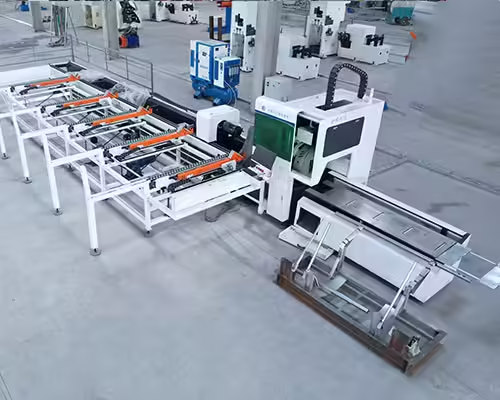
Modern pipe laser systems support:
- Round tubes
- Square tubes
- Channel steel
- Angle steel
Technical performance:
- Cutting accuracy: ≤ ±0.05mm
- Speed: up to 80 m/min
- Chuck rotation: up to 100 r/min
This enables high-efficiency structural manufacturing in automotive and construction industries.
Steel Plate Laser Cutting Machine Efficiency Expansion

Sheet metal systems are optimized for:
- Large-format cutting (up to 24m plates)
- Multi-material processing
- High-volume industrial production
Key advantages:
- No mold cost
- Minimal consumables
- Fully digital workflow
Laser Cutting Metal Machine Technology Trends
1. High-Power Fiber Laser Evolution
Power levels now exceed 30KW in industrial systems, enabling ultra-thick plate cutting.
2. AI-Powered Process Control
AI models optimize:
- Cutting speed
- Gas pressure
- Heat distribution
3. Green Manufacturing Shift
Laser cutting reduces:
- Waste material
- Energy loss
- Secondary pollution
Common Industrial Questions
“How to improve laser cutting efficiency in factories?”
Use AI nesting, optimize gas pressure, and upgrade fiber laser systems.
“What is the biggest cost in laser cutting?”
Energy consumption and machine depreciation.
“Is fiber laser worth it for metal cutting?”
Yes, due to higher efficiency, lower maintenance, and faster speed.
FAQ
What affects laser cutting efficiency the most?
Laser power matching, beam quality, and cutting path optimization.
How fast can industrial laser cutting machines operate?
High-end systems reach 80 m/min depending on material thickness.
Does automation improve laser cutting efficiency?
Yes, automation can improve efficiency by 30%–70%.
What is the lifespan of a laser cutting machine?
Typically 8–15 years with proper maintenance.
Can laser cutting reduce manufacturing costs?
Yes, especially through reduced waste and higher automation.
Conclusion
The evolution of the laser cutting metal machine is tightly connected to the transformation of global manufacturing into intelligent, data-driven production systems.
With advances in fiber laser technology, AI optimization, and digital factory integration, efficiency is no longer defined only by cutting speed—it is defined by system intelligence, energy optimization, and full-process automation.
Manufacturers like Jinbolida Precision Machinery Co., Ltd. represent the direction of this transformation, combining high-precision mechanical transmission systems with digital factory architecture to achieve ultra-high accuracy and scalable global production capability.
The future of laser cutting is not just faster—it is smarter, cleaner, and fully integrated into the digital industrial ecosystem.
If you enjoyed this article on Jinbolida’s smart manufacturing and digital factory expertise, follow us for more insights and updates:
- 📘 Facebook: Stay tuned for our latest smart production line projects → Facebook
- 📱 WhatsApp: Contact us anytime for custom production solutions → Chat Now
- ▶️ YouTube: Watch our automated line demos and real-world applications → YouTube
Let’s keep innovating and shaping the future of smart manufacturing — together!
 English
  Arabic
  Russian
  Spanish
  French