
C vs U Channel Solar Bracket Forming Machines
Table of Contents
Choosing between a C channel and a U channel solar bracket forming machine is not simply a matter of deciding which profile looks stronger or which machine has a higher forming speed. The correct choice depends on the mounting-system design, finished profile geometry, steel specification, hole pattern, load requirement, production volume and number of bracket sizes a factory needs to manufacture.
This distinction is important because photovoltaic modules rely on mounting and racking structures for mechanical support. The U.S. Department of Energy explains that PV arrays require stable, durable mounting structures capable of supporting the array while resisting environmental loads such as wind, rain, hail and corrosion. Its overview of solar photovoltaic system design also notes that mounting configurations differ between rooftops, ground-mounted systems and tracking applications.
For manufacturers, those structural differences eventually become production requirements.
A factory producing long C-channel members for a ground-mounted support system may require a different forming, punching and handling strategy from a factory producing lighter U-channel rails or connecting profiles. Understanding that difference before ordering equipment can prevent oversized machinery, insufficient tooling flexibility and unnecessary changeover time.
What Is a C Channel Solar Bracket?
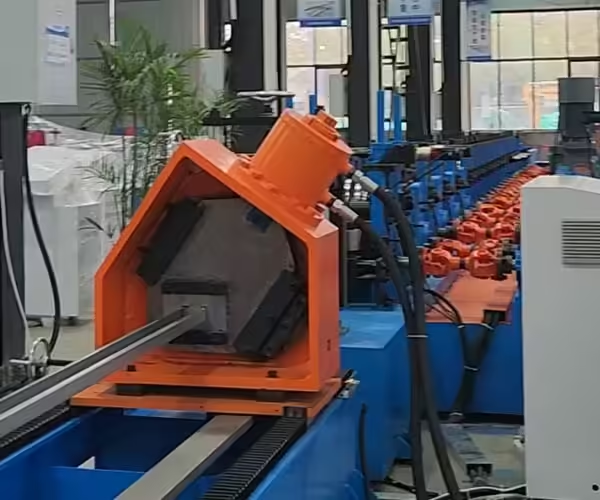
A C channel generally consists of a central web and two flanges extending from the same side of the section. Depending on the structural design, the flange edges may also include return lips.
A simplified cross section resembles:
C
C channels used in solar mounting structures may function as:
- Support rails
- Purlins
- Vertical posts
- Horizontal members
- Bracing profiles
- Structural support channels
Lipped C channels are also widely recognized in cold-formed steel construction. Research published through the Cold-Formed Steel Engineers Institute describes lipped channels as one of the common sections used in cold-formed steel framing and discusses how their cross-sectional geometry influences local buckling behavior. Buyers interested in the structural background can review the CFSEI research on lipped channels.
From a manufacturing perspective, the important point is that the web, flange height, lip dimensions, corner radii and opening width all affect roll tooling design.
Jinbolida provides solar photovoltaic bracket forming machines for C-channel, U-channel and other photovoltaic mounting profiles.
What Is a U Channel Solar Bracket?

A U channel typically consists of a flat base with two side walls extending in the same direction.
Its simplified cross section resembles:
U
Compared with a lipped C channel, a basic U profile normally has fewer bends because it may not include inward return lips.
Depending on the mounting-system design, U channels can be used as:
- Mounting rails
- Support channels
- Frames
- Connection members
- Secondary supports
- Lightweight structural profiles
However, profile names alone should never determine equipment selection.
Two customers may both call a product a “U channel” while supplying completely different drawings, materials, wall heights, slot patterns and tolerances.
For that reason, Jinbolida’s photovoltaic bracket production line solutions are configured according to actual profile drawings, material specifications, punching requirements, output targets and automation requirements rather than profile names alone.
C Channel vs U Channel: Basic Differences
The first comparison should be made at the finished-profile level.
| Factor | C Channel | U Channel |
|---|---|---|
| Typical geometry | Web, flanges and often lips | Base with two side walls |
| Number of bends | Often higher | Often lower |
| Cross-section complexity | Medium to high | Usually simpler |
| Structural use | Primary or secondary support | Rails, frames or secondary support |
| Tooling complexity | Can be higher | Often simpler |
| Changeover requirements | Depends heavily on lips and dimensions | Often easier for similar sizes |
| Punching | May involve web and flanges | Often concentrated on base or sides |
| Forming control | Width, flange, lip and twist | Width, wall height and spreading |
| Common manufacturing concern | Twist and lip accuracy | Opening and wall-angle consistency |
These are general tendencies, not universal engineering rules.
The finished drawing must always take priority.
Which Profile Is Stronger?
This is one of the most common questions, but it does not have a useful answer without dimensions, thickness, material and load direction.
A C channel should not automatically be considered “stronger” simply because it contains more bends.
Structural capacity depends on factors including:
- Section depth
- Flange width
- Lip geometry
- Material thickness
- Yield strength
- Unsupported length
- Connection method
- Load direction
- Local buckling
- Distortional buckling
- Overall member buckling
Likewise, a U channel may be completely adequate for a particular solar mounting component if the system has been designed around that section.
The U.S. Department of Energy notes that photovoltaic racking structures vary substantially depending on installation type. Ground-mounted systems are commonly made from coated or galvanized steel, while rooftop and tracker configurations can use different structural arrangements. More background is available in the DOE’s solar photovoltaic manufacturing overview.
For an equipment buyer, the practical rule is:
The machine manufacturer should reproduce the engineered profile accurately; it should not redefine the structural profile based on what is easiest to manufacture.
How C Channel Geometry Affects Roll Forming
A lipped C channel normally requires the strip to pass through a progressive sequence of bending operations.
The process may need to control:
- Web width
- Flange height
- Lip length
- Lip angle
- Inside corner radius
- Opening width
- Cross-section symmetry
- Straightness
- Twist
The more geometric features a profile contains, the more carefully the roll-pass sequence must be designed.
Trying to create large bends too quickly can increase the risk of:
- Edge wave
- Twist
- Flare
- Bow
- Surface marking
- Unstable dimensions
For this reason, the required number of forming stations cannot be selected using a simple universal formula.
It depends on the actual profile.
Jinbolida’s existing solar photovoltaic bracket forming solution includes C-channel equipment intended for photovoltaic support profile manufacturing.
How U Channel Geometry Affects Roll Forming
A simple U channel may require fewer forming stages than a lipped C section because there are fewer bends.
However, that does not mean U-channel production is automatically easy.
Typical quality issues can include:
- Side-wall angle variation
- Profile spreading
- Uneven wall height
- Base-width deviation
- Bow
- Twist
- Length variation
A profile that opens outward after forming may meet the target width at the machine exit but fail after residual stress stabilizes.
This is why tooling design needs to account for springback and material variation.
For factories producing multiple U-channel sizes, adjustable forming may also become important.
The existing Jinbolida article on solar U bracket forming machine tooling and changeover discusses how tooling, dimensional accuracy and size changes affect production planning.
Does a C Channel Machine Need More Forming Stations?
Often, but not always.
A C channel with return lips has more geometric features than a basic U channel. That can require additional gradual forming operations.
However, the actual station count also depends on:
- Material thickness
- Yield strength
- Profile depth
- Bend radius
- Line speed
- Surface requirements
- Required tolerance
For example, a shallow thin-gauge C channel may be easier to form than a deep, heavy U channel made from higher-strength steel.
Therefore, the useful question is not:
“How many stations does a C channel machine have?”
It is:
“Why has this number of forming stations been selected for my specific profile?”
A professional supplier should be able to explain the forming strategy rather than simply advertising a larger station count as automatically better.
Material Specification Matters More Than Profile Name
Two otherwise identical C channels may require different forming behavior if their steel grades differ.
Before selecting the machine, the buyer should provide:
- Material standard
- Steel grade
- Yield strength
- Tensile strength
- Nominal thickness
- Thickness tolerance
- Coating specification
- Coil width
- Coil weight
Galvanized steel is widely used in photovoltaic racking because corrosion protection is important for outdoor structures. The U.S. Department of Energy notes that ground-mounted racking commonly uses steel that is coated or galvanized for corrosion protection.
For manufacturing purposes, the coating also introduces another consideration: tooling and guides should minimize unnecessary surface scratching.
Punching Requirements Can Change the Machine Choice
In many photovoltaic bracket applications, punching is just as important as forming.
A profile may contain:
- Round holes
- Long slots
- Repeating slots
- Mounting holes
- Connection holes
- Edge notches
- Multiple hole groups
The location of those features can differ between C and U channels.
For example, a U channel may have repeated slots in its base, while a C channel could require features in both the web and flanges.
That affects:
- Punch layout
- Die design
- Feeding strategy
- Servo positioning
- Punching cycle
- Overall line speed
Jinbolida provides dedicated photovoltaic rack punching equipment for different profile and connector-processing requirements.
Pre-Punching for C and U Channels
Pre-punching processes holes or slots before the strip is completely formed.
This approach can offer several advantages:
- Easier access to flat material
- Simpler die structures
- Efficient repetitive punching
- Easy integration with servo feeding
However, the profile engineer must consider whether the forming process changes the final relationship between holes and profile geometry.
This is particularly important when a hole must align with:
- A flange edge
- Another mounting slot
- A connector
- A neighboring structural member
The profile drawing should therefore specify the final hole-position tolerance rather than only the punching position on the flat strip.
Post-Punching for C and U Channels
Post-punching takes place after the profile has been partially or fully formed.
It may be useful where the finished cross section provides the relevant dimensional reference.
However, formed channels can make tooling access more complicated.
A deep C channel with return lips, for example, may provide less direct access than an open U section.
The choice between pre-punching and post-punching should therefore be based on:
- Hole location
- Profile depth
- Finished tolerance
- Production speed
- Tooling access
- Number of punched surfaces
Not every channel should use the same punching arrangement.
C Channel vs U Channel Tooling Complexity
Tooling is often one of the biggest differences between the two production systems.
A simple U profile usually requires control of:
- Base width
- Side-wall height
- Side-wall angle
- Corner radius
A lipped C channel may add:
- Lip length
- Lip angle
- Opening width
- Additional bend transitions
The additional bends can make tooling synchronization more demanding.
However, complexity also increases whenever the machine must handle a wider range of sizes.
A multi-size U-channel machine may therefore be more complex than a dedicated C-channel machine designed for one fixed profile.
Fixed Tooling vs Adjustable Tooling
Buyers should decide whether production is primarily:
High volume + low variety
or
Lower volume + high variety
That distinction often matters more than C versus U.
Fixed Tooling
Fixed tooling can be suitable when a factory runs one or a few stable profiles for long production campaigns.
Potential advantages include:
- Simpler setup
- Fewer adjustment points
- Stable repeatability
- Easier operator training
Adjustable Tooling
Adjustable tooling can be useful when a factory frequently changes profile widths or heights.
Potential advantages include:
- Less tooling replacement
- Faster size changes
- Greater product flexibility
But buyers should verify the actual adjustment process.
Do not rely only on the word “automatic.”
Ask:
- Which dimensions change automatically?
- Which still require manual adjustment?
- Are tooling spacers changed?
- Does the control system store recipes?
- How is the first piece checked?
- How long does complete changeover take?
Compare Changeover Time, Not Just Profile Range
Suppose one machine can produce ten channel sizes.
That sounds attractive.
But if changing between sizes takes two hours, the machine may not be suitable for short production batches.
Another machine may support only six sizes but change between them in 15 minutes.
For a manufacturer producing many small orders, the second line may generate more usable output.
That is why Jinbolida’s solar bracket production line solutions emphasize configurable and interchangeable systems for manufacturers producing multiple bracket specifications.
The purchasing question should therefore be:
How many sellable profiles can I produce efficiently?
Not merely:
How many profiles are theoretically possible?
Production Speed: C vs U Channel
Profile shape can influence achievable forming speed, but speed cannot be evaluated from section type alone.
Effective production speed depends on:
- Number of bends
- Material strength
- Thickness
- Punching cycle
- Cutting method
- Product length
- Required dimensional accuracy
- Surface requirements
- Material handling
Jinbolida lists production speeds up to approximately 45 m/min for certain C- and U-channel solar bracket solutions, but actual line output depends on the complete project configuration.
This distinction matters.
A 45 m/min forming section does not automatically create 45 m/min of finished bracket output if the punching or cutting process repeatedly stops the line.
Rated Speed vs Effective Output
Buyers should request at least three production indicators:
| Metric | Meaning |
| Maximum forming speed | Peak roll-former speed |
| Normal production speed | Typical stable operating speed |
| Finished output | Actual pieces or meters produced |
Finished output is usually the most useful value for factory planning.
It accounts more realistically for:
- Punching
- Cutting
- Acceleration
- Coil changes
- Changeovers
- Unloading
- Quality checks
This principle applies equally to C and U channels.
Which Machine Is Better for High-Volume Production?
If a factory has long-term demand for one C-channel specification, a dedicated C-channel line may provide a very efficient solution.
Likewise, if a large customer requires millions of meters of one U-channel rail, a dedicated U-channel machine may be preferable to a more complicated universal system.
High-volume factories should prioritize:
- Stable forming
- Continuous material flow
- Fast punching
- Reliable cutting
- Low unplanned downtime
- Automatic stacking
- Tool durability
The objective is not simply maximum flexibility.
It is maximum saleable output for the required product.
Which Machine Is Better for Multi-Product Manufacturing?
A contract manufacturer or OEM supplier may have a different priority.
It may need to produce:
- C channels
- U channels
- Different widths
- Different heights
- Multiple thicknesses
- Different hole patterns
In this situation, flexibility becomes more important.
A production strategy may include:
- One flexible forming line for related profiles
- Interchangeable roll tooling
- Adjustable stations
- Recipe-based servo punching
- Separate punching equipment for special components
However, attempting to make one machine perform every possible operation can also create excessive complexity.
The correct balance depends on actual order history.
Can One Machine Produce Both C and U Channels?
Sometimes, but not always economically.
Whether one machine can produce both depends on how similar the profiles are and how the tooling is designed.
Possible approaches include:
- Tooling replacement
- Cassette change
- Adjustable roll stations
- Shared early forming stations
- Dedicated final forming sections
The technical possibility should not be confused with production efficiency.
A machine may be capable of producing both profiles but require extensive manual tooling changes.
For occasional product changes, that may be acceptable.
For daily changeovers, it may become a serious bottleneck.
How to Decide Whether to Combine C and U Production
Before combining both profiles on one line, calculate:
Changeovers per week × changeover duration
For example:
- 8 changeovers/week
- 90 minutes/changeover
Total changeover time:
12 hours/week
If the factory operates 80 productive hours per week, 12 hours represents 15% of available production time before maintenance or other stoppages are considered.
That may justify investing in faster-change tooling or separate machines.
This kind of calculation is more useful than choosing equipment based only on initial purchase price.
C Channel Accuracy Requirements
Important dimensions for a C channel may include:
- Overall depth
- Flange width
- Lip length
- Lip angle
- Opening
- Corner radius
- Straightness
- Twist
- Hole position
- Overall length
A dimensional deviation in one area can influence another.
For example, excessive twist can make hole positions difficult to align during assembly even when the punching process itself is accurate.
U Channel Accuracy Requirements
Important U-channel dimensions may include:
- Base width
- Side-wall height
- Wall angle
- Internal opening
- Overall width
- Straightness
- Twist
- Hole position
- Length
One particularly important issue is profile spreading.
After the material exits the final roll stand, residual stress may cause the side walls to open slightly.
Tooling therefore needs to compensate for the material’s actual forming behavior.
Surface Quality for Solar Bracket Profiles
Both C and U channels may use galvanized or coated steel.
Because photovoltaic support structures can remain outdoors for decades, surface protection is important.
The Department of Energy emphasizes that PV mounting structures need durability against environmental exposure, including corrosion.
During manufacturing, surface damage can result from:
- Dirty tooling
- Misaligned guides
- Excessive roller pressure
- Metal chips
- Sharp edges
- Dragging profiles
- Poor stacking
Factories should therefore include surface appearance in their acceptance criteria.
A profile should not be considered qualified only because its cross-sectional dimensions are correct.
Factory Layout Can Differ Between C and U Lines
Long profiles require sufficient space after cutting for:
- Discharge
- Stacking
- Bundling
- Inspection
- Forklift access
The profile section can also affect how finished products are handled.
Thin U channels may be easier to deform during careless stacking, while deeper C profiles may require different support spacing.
For a broader factory-layout approach, Jinbolida’s solar support bracket forming machine line layout guide explains how finished product size, coil handling, punching, forming, discharge and maintenance access should be planned as one workflow.
Think About the Whole PV Bracket Factory
Manufacturing photovoltaic brackets does not necessarily involve only channel roll forming.
A mounting system may also require:
- Connector plates
- Clamp components
- Base plates
- Brackets
- Fastener interfaces
- Short punched parts
That means a complete factory may need separate profile forming and component punching systems.
DOE’s overview of photovoltaic manufacturing notes that racking-system manufacturing varies significantly depending on the installation environment and system design.
For equipment planning, this reinforces a key point:
Start with the complete bill of manufactured components rather than selecting one roll forming machine in isolation.
C Channel vs U Channel Cost Factors
It would be misleading to say one machine type is always cheaper.
Machine cost depends on much more than profile shape.
Major cost factors include:
- Material thickness
- Number of forming stations
- Tooling complexity
- Punching system
- Servo feeding
- Cutting method
- Line speed
- Automatic width adjustment
- Tool-change system
- Stacking automation
- Control system
- Factory integration
A fixed U-channel line can be simpler than a multi-size C-channel system.
But an advanced U-channel line with automatic width and height adjustment may cost more than a basic fixed C-channel machine.
Therefore, buyers should compare technical scope, not machine names.
When a C Channel Machine Is Usually the Better Choice
A C-channel forming machine may be appropriate when:
- The mounting design requires C or lipped C profiles
- Higher section stiffness is needed for the engineered application
- Long structural support members are required
- Return lips are part of the finished section
- The factory has stable C-channel demand
The structural engineer or mounting-system designer should determine the profile.
The manufacturing line should then be optimized around that section.
When a U Channel Machine Is Usually the Better Choice
A U-channel machine may be more appropriate when:
- The engineered mounting system specifies an open U section
- A simpler open profile is required
- Rails or connection channels use U geometry
- Multiple related U sizes need to be produced
- Rapid size adjustment is commercially important
Again, the decision should follow the product specification.
Common Buying Mistakes
Choosing C or U Based on Machine Price
The final profile should be selected by the product designer before equipment is purchased.
Assuming C Channels Are Always Stronger
Structural performance depends on geometry, material, thickness, load and support conditions.
Ignoring Hole Patterns
Punching may determine overall production speed.
Buying a “Multi-Size” Machine Without Testing Changeover
Always ask for the complete changeover sequence and expected time.
Comparing Only Maximum Speed
Finished output is more useful than maximum roll-former speed.
Ignoring Material Grade
Yield strength and thickness variation affect forming behavior.
Forgetting Surface Requirements
Galvanized profiles can be dimensionally correct but commercially unacceptable if heavily scratched.
Buying One Universal Machine for Too Many Products
Flexibility can become counterproductive if excessive tooling changes reduce productivity.
Practical Selection Table
Use this table as an initial decision guide.
| Requirement | C Channel Line | U Channel Line |
| Lipped structural section | Strong candidate | Usually not applicable |
| Simple open channel | Possible | Strong candidate |
| High-volume fixed profile | Excellent | Excellent |
| Multiple related sizes | Adjustable design recommended | Adjustable design recommended |
| Frequent changeover | Evaluate tooling carefully | Often favorable for simple profiles |
| Complex flange punching | Requires detailed planning | Depends on geometry |
| Base punching | Possible | Common configuration |
| High structural complexity | Often higher | Usually lower |
| Universal solution required | Needs engineering evaluation | Needs engineering evaluation |
This table should not replace a profile drawing review.
Information to Send Before Requesting a Quote
For either a C-channel or U-channel machine, prepare:
- Finished profile drawing
- Material specification
- Material thickness range
- Yield strength
- Coil width
- Coil weight
- Hole pattern
- Hole-position tolerance
- Finished lengths
- Length tolerance
- Required output
- Number of SKUs
- Batch quantities
- Changeover frequency
- Factory voltage
- Factory layout
- Required automation level
If both C and U profiles are required, include all drawings in the same RFQ.
That allows the equipment manufacturer to determine whether shared tooling or separate lines are more practical.
Questions to Ask a Machine Supplier
Before placing an order, ask:
- Can the machine process my exact material grade?
- How many forming stations are proposed?
- Why is that station count appropriate?
- Which roll-tooling material will be used?
- How will springback be controlled?
- What finished tolerances are guaranteed?
- How is punching synchronized with feeding?
- Is cutting continuous or stop-to-cut?
- How long does a complete size change take?
- Which adjustments are automatic?
- What output can the complete line achieve?
- How is profile straightness checked?
- How is surface scratching minimized?
- Can future profile sizes be added?
- What factory space is required?
These questions help reveal the real technical difference between quotations that may otherwise look very similar.
Frequently Asked Questions
What is the main difference between a C channel and a U channel solar bracket?
A C channel usually has a web, two flanges and sometimes return lips, while a U channel normally has a base and two side walls without return lips. The exact geometry depends on the mounting-system design.
Is a C channel solar bracket stronger than a U channel?
Not automatically. Structural strength depends on section dimensions, material, thickness, load direction, connection conditions and unsupported length. Profile selection should be made through structural design.
Can one solar bracket forming machine produce C and U channels?
It may be possible with replaceable, cassette or adjustable tooling, depending on the profile similarity. However, buyers should evaluate changeover time before deciding whether one machine is economically preferable to separate lines.
Which profile is easier to roll form?
A simple U profile may require fewer bends than a lipped C channel, but material thickness, profile depth and steel strength can make a U profile equally demanding. The actual drawing determines forming difficulty.
Which machine is faster?
Neither is universally faster. Effective speed depends on profile complexity, punching, material, cutting and automation.
Do both C and U channel lines need punching equipment?
If the finished profiles contain holes or slots, yes. Punching can be integrated before or after forming depending on the required geometry and tolerance.
What causes a U channel to spread after forming?
Residual forming stress and material springback can cause the side walls to open after the profile exits the tooling. Roll-pass design needs to compensate for this behavior.
Why can C channels twist during roll forming?
Uneven deformation, material variation, asymmetric loading, incorrect tooling alignment or an unbalanced forming sequence can contribute to twist.
Should I buy one flexible machine or two dedicated machines?
It depends on production volume and changeover frequency. High-volume stable production can favor dedicated lines, while manufacturers processing many specifications may benefit from flexible equipment.
What is the most important document for choosing the machine?
The finished profile drawing. It should show geometry, thickness, hole pattern, tolerances and product dimensions.
Conclusion
The choice between a C channel and U channel solar bracket forming machine should begin with the photovoltaic mounting-system design and finished profile drawing.
C channels may involve more complex roll tooling when return lips and multiple bends are required, while U channels can provide a simpler open geometry. However, neither profile is universally easier, faster, stronger or cheaper to manufacture.
Material strength, thickness, punching requirements, product dimensions, tolerance, production volume and changeover frequency can matter just as much as the cross-sectional shape.
For a high-volume manufacturer, a dedicated C- or U-channel line may offer the best productivity. For an OEM supplier handling many specifications, adjustable or interchangeable tooling may provide greater commercial flexibility.
Manufacturers can review Jinbolida’s solar photovoltaic bracket forming machine range, photovoltaic rack punching equipment and solar bracket production line solutions when planning a complete manufacturing system.
For equipment configuration, send your C-channel or U-channel profile drawings, steel specification, thickness range, hole patterns, required output and product mix through the Jinbolida website. This allows the production line to be evaluated around the actual bracket rather than a generic machine specification.
 English
  Arabic
  Russian
  Spanish
  French