
PV Bracket Roll Forming Machine Factory Trends 2027
Table of Contents
Key Takeaways
- PV bracket production lines are moving from individual machines toward fully connected manufacturing systems.
- Flexible C-, U-, and Z-channel production will become more important as solar mounting designs continue to diversify.
- Integrated punching, cutting, forming, measuring, and stacking can reduce handling time and improve consistency.
- Buyers should evaluate usable output, changeover time, profile accuracy, tooling life, and after-sales support instead of comparing forming speed alone.
- Data collection, remote diagnostics, energy monitoring, and preventive maintenance will become standard requirements for advanced production lines.
- Material optimization will matter because steel represents a major portion of the cost and environmental impact of photovoltaic mounting structures.
- A capable PV bracket roll forming machine factory should provide profile analysis, tooling design, production-line integration, testing, training, and long-term technical support.
- The best production line is not necessarily the fastest machine. It is the line that consistently produces qualified profiles at the required cost.
Introduction
The global photovoltaic market is entering a new stage in which mounting-system manufacturers must produce more profiles, respond to shorter delivery schedules, and meet tighter quality requirements. According to the IEA-PVPS Snapshot of Global PV Markets 2026, approximately 698 GW of new photovoltaic systems were installed worldwide during 2025, bringing cumulative installed capacity close to 3 TW. This continued expansion creates direct demand for steel channels, rails, connectors, posts, purlins, and other solar mounting components.
However, increasing demand does not automatically guarantee higher profits for bracket manufacturers. Steel prices, labor costs, profile variation, punching accuracy, production waste, and equipment downtime can significantly affect the cost of every finished bracket.
For this reason, buyers searching for a reliable PV bracket roll forming machine factory in 2027 will pay more attention to complete manufacturing capability rather than a single machine specification. They need production lines that can manufacture accurate profiles, switch between orders efficiently, collect operating data, and remain stable during long production shifts.
Jinbolida’s solar photovoltaic bracket forming machines are designed for producing C-channel, U-channel, and other metal profiles used in solar mounting systems. The available solutions can also be combined with solar photovoltaic rack punching equipment to create a more continuous production process.
This guide explains the main PV bracket production-line trends expected to shape purchasing decisions in 2027.
What Is a PV Bracket Roll Forming Production Line?
A PV bracket roll forming production line converts metal coil into structural profiles used to support photovoltaic modules. Common products include C channels, U channels, Z sections, mounting rails, posts, purlins, braces, clamps, and connecting components.
Unlike basic bending equipment, a roll forming line shapes the strip gradually through a sequence of roller stations. Each station makes a controlled change until the required cross-section is completed.
Main Production Stages
A typical line may include:
- Coil loading
- Decoiling
- Leveling and feeding
- Servo measuring
- Punching or slotting
- Roll forming
- Straightening
- Cutting to length
- Product discharge
- Automatic stacking or collection
The exact configuration depends on the profile drawing, material strength, thickness range, hole pattern, target speed, and required automation level.
Forming Section
The forming section determines the final geometry of the profile. Roller design, shaft rigidity, forming sequence, transmission stability, and frame construction all affect dimensional accuracy.
Punching Section
The punching section creates installation holes, elongated slots, connection holes, or locating features. In a modern line, punching data can be imported through a control system so that different hole patterns are produced without repeated manual measurement.
Cutting Section
The cutting unit separates the continuously formed profile into finished lengths. Depending on the project, the line may use pre-cutting, post-cutting, flying cutting, or stop-to-cut operation.
Why PV Bracket Manufacturing Will Change in 2027
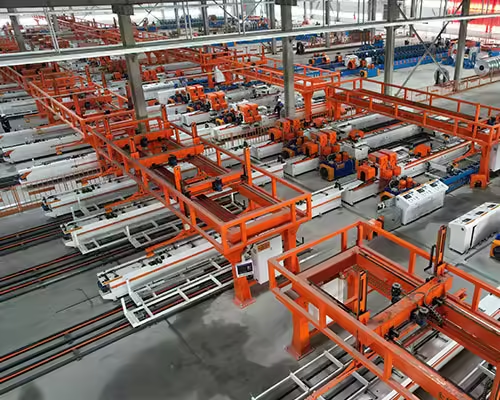
The direction of equipment development is closely connected to the broader solar market. Global solar deployment continues to grow, while manufacturers face pressure to improve productivity, traceability, and material efficiency.
The International Energy Agency has emphasized that automation has already improved labor productivity within solar manufacturing. It has also identified manufacturing efficiency, supply-chain resilience, and industrial clustering as important factors in the future development of clean-energy manufacturing.
These changes are influencing downstream mounting-system production as well. A PV bracket roll forming machine factory is increasingly expected to understand not only mechanical forming but also automation, production data, material utilization, and factory integration.
Larger Project Volumes
Utility-scale solar projects require large quantities of standardized profiles. A small deviation repeated across thousands of components can create major assembly problems at the project site.
More Product Variations
Manufacturers may receive orders for different profile widths, flange heights, lip dimensions, steel thicknesses, hole spacings, and coating types. Fixed-purpose equipment can become a bottleneck when order specifications change frequently.
Greater Cost Pressure
Customers continue to expect competitive component prices. As a result, bracket manufacturers need to reduce scrap, shorten setup time, control labor requirements, and improve the percentage of qualified products.
Trend 1: Integrated PV Bracket Production Lines
One of the clearest 2027 trends will be the transition from independent machines to integrated production lines.
In a traditional workshop, coil feeding, punching, forming, cutting, and stacking may be completed separately. This arrangement requires more handling, more operators, and more work-in-process inventory.
An integrated system connects these operations through one coordinated control structure.
From Separate Processes to Continuous Production
Continuous production reduces repeated loading and positioning. Material can move from the coil to a finished profile with fewer manual transfers.
For manufacturers with stable order volumes, this can improve both production efficiency and quality consistency.
Integrated Punching and Forming
Punching and forming must be synchronized carefully. Incorrect feed length or punch timing can cause hole-position errors, especially when a profile contains several hole patterns.
Jinbolida’s photovoltaic bracket connector punching machine is intended for automated punching, cutting, and forming of C-shaped, U-shaped, triangular, and related connecting components. The equipment can be evaluated as part of a broader automated bracket-production system rather than only as a standalone punching unit.
Why Integration Matters
Integration allows production data to be managed through a central interface. Operators can select a recipe, enter the required length and quantity, and monitor the line from one control position.
The practical benefit is not merely higher speed. It is lower process variation between one production stage and the next.
Trend 2: Faster Profile Changeovers
Solar mounting manufacturers do not always produce one profile continuously. Many factories must complete several smaller orders for different projects, customers, or regions.
Therefore, changeover time will become an increasingly important purchasing metric.
Adjustable C, U, and Z Profiles
Some roll forming systems use manually adjusted rollers, while more advanced machines use motorized or servo-controlled positioning. The correct choice depends on the number of profile sizes and how frequently production changes.
A factory that produces one standard C channel may not need a complex automatic adjustment system. A contract manufacturer producing many profile sizes could gain substantial value from automatic width adjustment and stored recipes.
Quick-Change Tooling
Quick-change tooling allows operators to replace a cassette, forming module, or selected roller group rather than rebuilding the complete forming station.
When Quick Change Is Worth the Cost
Quick-change systems are most valuable when:
- Product changeovers happen several times per week.
- Downtime is expensive.
- The factory produces multiple profile families.
- Operators need repeatable settings.
- Delivery schedules are short.
Buyers comparing C- and U-profile requirements can also read Solar Mounting Bracket Roll Forming Machine: C vs U Profiles for a more focused discussion of profile selection.
Trend 3: Smarter Punching Systems
Hole configuration is a critical part of photovoltaic bracket manufacturing. Even when the profile dimensions are correct, inaccurate holes can prevent fast installation or create alignment problems.
In 2027, punching systems will become more programmable and closely connected to production recipes.
Multi-Station Punching
Multi-station equipment can distribute different hole types across several punching units. This reduces die-change frequency and makes complex patterns easier to manage.
Jinbolida offers three-station, six-station, and nine-station punching equipment for different processing requirements. For example, multi-station systems can be configured to process several sides of a C-shaped profile and produce different hole types within the same workflow.
Servo Feeding
Servo feeding provides controlled strip movement between punching cycles. The system uses programmed dimensions rather than relying entirely on mechanical stops.
Cumulative Error Control
Cumulative error occurs when a small feed deviation is repeated along a long component. A properly engineered servo system measures each movement independently and uses feedback to maintain hole spacing.
For long solar posts or rails, this can be more important than the headline punching speed.
Trend 4: Production Data and Digital Monitoring
A modern PV bracket roll forming machine factory will increasingly offer equipment that generates useful production data.
The purpose of digitalization is not to add a screen to a machine. It is to help production managers understand what the line is doing and why output changes.
Real-Time Production Counting
The control system can record the number of finished components, total processed length, order progress, and production time.
This information helps supervisors compare planned output with actual output.
Energy Monitoring
Energy-monitoring modules can record electricity consumption during different production stages. Managers can then calculate energy consumption per meter or per finished component.
Alarm History
An alarm record shows when a fault occurred, which sensor or system generated it, and how frequently the problem repeats.
Turning Alarms into Maintenance Actions
A repeated feeding alarm may indicate material alignment problems, sensor contamination, or roller wear. Reviewing alarm history allows maintenance personnel to solve the underlying cause rather than repeatedly restarting the machine.
Trend 5: Remote Diagnostics and Predictive Maintenance
International equipment buyers often worry about how quickly a technical problem can be solved. This makes remote support a major consideration when choosing a PV bracket roll forming machine factory.
Remote Diagnostics
With authorized remote access, technical engineers can review control parameters, alarms, input signals, and production settings without immediately traveling to the customer’s factory.
Remote diagnostics cannot replace every on-site repair, but it can reduce troubleshooting time for software, sensor, parameter, and communication issues.
Predictive Maintenance
Predictive maintenance uses operating information to identify abnormal conditions before a major failure occurs.
Components That Require Monitoring
Common monitoring points include:
- Forming rollers
- Bearings
- Gearboxes
- Hydraulic systems
- Servo motors
- Encoders
- Cutting blades
- Punching dies
- Lubrication systems
In many factories, a practical preventive-maintenance schedule is more useful than an overly complicated artificial-intelligence platform. The machine supplier should first establish clear inspection intervals, lubrication requirements, spare-parts lists, and wear limits.
Trend 6: Higher Material Efficiency
Steel is a major cost component in photovoltaic mounting products. Even a small reduction in waste can create meaningful savings when production volume is high.
Coil Width Optimization
Before purchasing a line, the manufacturer should calculate the required strip width for each profile. Poor strip-width planning can leave unnecessary edge scrap or increase material consumption.
Controlled Cut Length
An accurate measuring and cutting system reduces overlength. It also limits the need for secondary trimming.
Profile Design Optimization
In some projects, profile geometry can be adjusted to achieve the required structural performance with more efficient material use. Any change must still be verified through engineering calculations and relevant structural requirements.
The broader solar industry is also giving more attention to environmental assessment and lifecycle data. The IEA-PVPS updated its photovoltaic lifecycle inventory work in 2026 to include balance-of-system components and more current manufacturing datasets, illustrating the growing importance of measurable environmental performance.
Less Scrap Does Not Mean Thinner Steel
Material efficiency should not be confused with using insufficient material. The profile must still meet structural loading, corrosion-resistance, durability, and project-standard requirements.
The objective is to eliminate avoidable waste while maintaining qualified performance.
Trend 7: Lines Designed for High-Strength Steel
Solar support structures increasingly require a balance of lower weight and adequate strength. This encourages the use of higher-strength steel in certain profile designs.
However, stronger material is not always easier to form.
Greater Springback
High-strength steel may recover more after passing through the rollers. Tooling designers must compensate for this springback to achieve the required final angle.
Higher Forming Load
Stronger or thicker material increases the load on shafts, bearings, rollers, frames, transmissions, and motors.
Why Buyers Must Provide Material Data
A quotation based only on profile dimensions is incomplete. Buyers should also provide:
- Steel grade
- Yield strength
- Tensile strength
- Thickness range
- Coil width
- Surface coating
- Coil weight
- Dimensional tolerance
Without these details, a supplier cannot properly evaluate forming force or tooling requirements.
Trend 8: More Automated Handling and Stacking
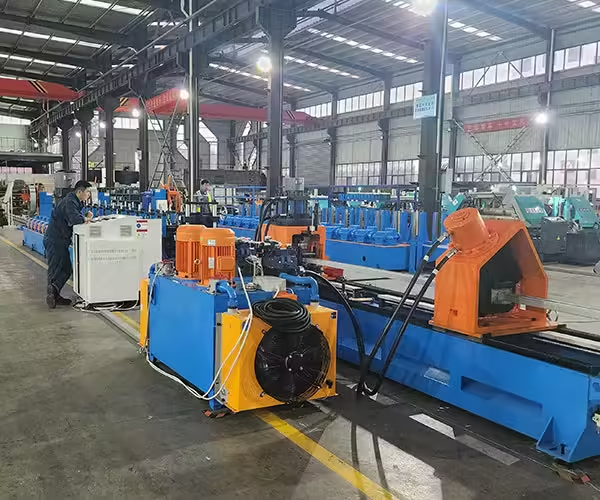
The end of the production line is often overlooked. A fast roll former can still suffer from low overall productivity when finished profiles must be manually collected, counted, aligned, and bundled.
Automatic Receiving
A receiving table supports the finished profile as it exits the cutting unit. It can reduce scratches, deformation, and unsafe handling.
Automatic Stacking
Stacking systems arrange profiles into predetermined quantities or layers.
Benefits Beyond Labor Reduction
Automatic stacking can improve bundle consistency, reduce profile collision, and make downstream packaging easier. It is particularly valuable for long profiles that are difficult for one operator to handle safely.
Trend 9: Customization Based on Finished Products
In 2027, buyers will expect more than a standard machine catalog. They will look for production lines configured around their actual components.
A professional PV bracket roll forming machine factory should begin with the finished product and work backward toward the equipment configuration.
Profile Drawing Review
The supplier should review the complete cross-section, tolerances, hole patterns, material, cutting method, and annual production target.
Sample Evaluation
Existing samples can reveal edge shape, surface requirements, coating sensitivity, straightness, and packaging expectations that may not be obvious from a basic drawing.
Capacity Planning
Required capacity should be calculated from order volume, working hours, changeover time, maintenance time, and expected line utilization.
Avoid Buying Excess Speed
A machine rated at a high linear speed may not maintain that speed during punching, cutting, or product handling. Buyers should request an estimate of qualified finished output under their real production conditions.
Automatic Line vs Semi-Automatic Line
The right level of automation depends on order volume, labor availability, profile variety, investment budget, and quality requirements.
| Evaluation Factor | Semi-Automatic Line | Fully Automatic Line |
|---|---|---|
| Initial investment | Lower | Higher |
| Labor requirement | Higher | Lower |
| Product changeover | More manual adjustment | Recipe-based or motorized adjustment |
| Production consistency | More operator-dependent | More repeatable |
| Data collection | Limited | More comprehensive |
| Integration | Separate or partially connected processes | Connected punching, forming, cutting, and handling |
| Maintenance complexity | Relatively simple | Requires stronger electrical and control support |
| Best application | Lower volume or stable products | High volume, varied orders, or strict traceability |
When a Semi-Automatic Line Makes Sense
A semi-automatic line may be appropriate for a new factory with limited production volume, a small number of profiles, and available labor.
Its simpler structure can also make maintenance easier for factories with limited automation experience.
When a Fully Automatic Line Makes Sense
A fully automatic line becomes more attractive when labor costs are high, order volume is stable, profile variation is frequent, or customers require detailed production records.
The investment should be evaluated through total production cost rather than purchase price alone.
C-Channel vs U-Channel PV Bracket Machines
C and U profiles may look similar, but their tooling and applications can differ.
| Feature | C-Channel Profile | U-Channel Profile |
| Cross-section | Includes flanges and may include lips | Open U-shaped section |
| Typical use | Purlins, posts, rails, and structural supports | Rails, supports, frames, and connecting structures |
| Forming complexity | Can be higher when lips are included | Often simpler, depending on geometry |
| Adjustment demand | Useful for multiple web and flange sizes | Useful for different widths and depths |
| Punching options | Bottom, side, or multi-face punching | Bottom or side punching |
| Key buying concern | Lip angle, flange accuracy, twist control | Width, side-wall angle, and straightness |
Jinbolida provides both a solar photovoltaic bracket C-channel steel roll forming machine and a solar photovoltaic bracket U-channel steel forming machine. The correct selection should be based on the customer’s finished component rather than the machine name alone.
How to Evaluate a PV Bracket Roll Forming Machine Factory
Selecting the supplier is as important as selecting the machine configuration.
Engineering Capability
The factory should be able to analyze forming feasibility, material behavior, hole positioning, cut-off deformation, and production takt time.
Ask whether tooling design and control programming are completed internally or outsourced.
Manufacturing Capability
The supplier should have suitable equipment for machining rollers, shafts, frames, dies, and other precision components.
Factory Inspection Questions
During an on-site or video inspection, ask:
- How are rollers machined and heat-treated?
- How are shafts inspected?
- Is the machine assembled and tested in one facility?
- What dimensional instruments are used?
- Can the supplier demonstrate a similar production line?
- How long is the continuous trial run?
- Which spare parts are included?
Testing Procedure
A meaningful factory acceptance test should use the buyer’s specified material whenever possible.
The test should evaluate profile dimensions, hole positions, cut length, straightness, surface condition, production speed, noise, vibration, and continuous operation.
Documentation
Useful documentation may include:
- General arrangement drawing
- Electrical diagram
- Hydraulic diagram
- Foundation requirements
- Operation manual
- Maintenance schedule
- Spare-parts list
- Tooling drawing
- Parameter backup
- Training materials
Installation and Training
International buyers should confirm whether the supplier provides remote guidance, on-site installation, operator training, and maintenance training.
Jinbolida states that its forming and punching systems can be customized according to product dimensions, material types, and production-capacity requirements. Buyers can submit drawings and production needs through the Jinbolida contact page for a tailored line proposal.
Important Specifications Buyers Should Compare
Machine quotations often contain many specifications, but not all figures have equal practical value.
Qualified Production Speed
Qualified speed is the rate at which the complete line produces acceptable finished parts. It is more useful than the no-load speed of the forming section.
Profile Tolerance
Tolerance should be defined for the web, flange, lip, angle, straightness, twist, hole position, and cut length.
Thickness Range
A wide stated range does not guarantee equal performance at every thickness. Ask whether tooling adjustment or roller replacement is required.
Changeover Time
The supplier should explain which settings change manually, which settings change automatically, and how long a trained operator needs to complete the process.
Tooling Life
Tooling life depends on material grade, thickness, coating, lubrication, roller material, heat treatment, and maintenance.
Ask for the Testing Method
A tolerance or tooling-life claim is meaningful only when the measurement method and operating conditions are clear.
Common Purchasing Mistakes
Comparing Only the Lowest Price
A lower quotation may exclude decoilers, punching dies, automatic stacking, installation, freight preparation, spare parts, or software functions.
Compare the complete production scope.
Focusing Only on Maximum Speed
Maximum forming speed may not equal actual line output. Punching cycles, cutting time, profile length, and stacking capacity can limit production.
Sending an Incomplete Drawing
A simple cross-section without material and tolerance information is not enough for accurate engineering.
Ignoring Local Power Requirements
Voltage, frequency, phase, control-cabinet standards, and electrical-component preferences should be confirmed before manufacturing.
Skipping the Acceptance Standard
The contract should define how machine performance will be tested before shipment.
A Practical RFQ Checklist
To receive an accurate proposal from a PV bracket roll forming machine factory, prepare the following information:
- Finished profile drawings
- Product samples, when available
- Material grade and yield strength
- Thickness range
- Coil width and maximum coil weight
- Hole shapes and punching positions
- Required profile lengths
- Dimensional tolerances
- Target output per shift
- Number of profile sizes
- Required changeover frequency
- Automation requirements
- Receiving and stacking requirements
- Factory voltage and frequency
- Preferred electrical components
- Installation destination
- Required certifications and documentation
Providing this information at the beginning reduces quotation revisions and helps the supplier design a production line around actual needs.
What Will Define a Competitive Factory in 2027?

The leading PV bracket roll forming machine factory will not compete only through machine price. It will compete through engineering, flexibility, production stability, and service.
Application-Based Engineering
The supplier will design the line around the bracket, not force the bracket to fit an existing machine.
Digital Production Support
Production recipes, alarm records, remote diagnostics, and operating data will help factories manage equipment more efficiently.
Complete-Line Responsibility
Buyers increasingly prefer one supplier to coordinate feeding, punching, forming, cutting, stacking, and control.
Global Service Capability
Export documentation, installation planning, spare-parts support, and fast technical communication will strongly influence purchasing decisions.
Jinbolida positions itself as a digital factory solution provider and offers photovoltaic bracket forming, punching, auxiliary, and profile-processing equipment. Its existing solar support solutions include interchangeable C/Z profile production, automated punching, and continuous manufacturing functions that reflect the industry’s movement toward integrated lines.
FAQ About PV Bracket Roll Forming Machines
What machine is used to manufacture solar panel brackets?
Solar panel support profiles are commonly produced with cold roll forming machines. A complete line may include a decoiler, leveler, servo feeder, punching unit, roll former, cutting unit, receiving table, and stacking system.
How much does a PV bracket roll forming production line cost?
The price depends on profile complexity, material thickness, punching requirements, forming speed, automation level, tooling quantity, and auxiliary equipment. Buyers should provide drawings and production targets before requesting an accurate quotation.
Can one machine produce both C and U profiles?
Some flexible machines can produce multiple related profiles through adjustment or tooling changes. However, the feasibility depends on the difference between the cross-sections, dimensional range, material thickness, and required changeover time.
How fast can a solar bracket roll forming machine run?
Production speed varies by configuration and product. The actual output may be limited by punching frequency, cut length, material strength, changeover time, and stacking capacity. Buyers should compare qualified finished output instead of no-load forming speed.
Can the production line punch holes before forming?
Yes. Pre-punching is widely used when flat strip positioning provides easier tooling access. The control system must compensate for material movement and dimensional changes during forming.
Is post-punching better than pre-punching?
Neither method is always better. Pre-punching can simplify die access, while post-punching may position holes relative to the final formed profile. The correct method depends on profile geometry, hole tolerance, production speed, and tooling design.
What materials can a PV bracket machine process?
Depending on its design, the line may process galvanized steel, carbon steel, stainless steel, or aluminum coil. The machine must be engineered for the specific material grade, thickness, coating, and yield strength.
How do I know whether the machine can meet my tolerance?
Ask the supplier to define the acceptance standard and produce samples using the specified material. Measure profile dimensions, angles, straightness, twist, hole position, and cut length during the factory acceptance test.
How many operators does an automatic production line need?
The number depends on coil loading, packaging, inspection, automation level, and factory layout. An integrated line can reduce direct labor, but operators are still required for material preparation, quality checks, maintenance, and finished-product handling.
What information should I send to the machine factory?
Send the profile drawing, material specification, thickness, coil data, hole pattern, tolerance, target output, required lengths, factory voltage, and preferred automation level.
Can the machine supplier provide custom tooling?
A qualified supplier should be able to design tooling according to the customer’s profile and material. Tooling should be confirmed through drawings, simulation or engineering analysis, sample production, and final acceptance testing.
How long does it take to change from one profile size to another?
Changeover time can range from a short motorized adjustment to a longer manual tooling replacement. Ask the supplier to demonstrate the actual procedure during machine testing.
Is an automatic stacking system necessary?
It is not necessary for every factory, but it can improve productivity when profiles are long, heavy, easily scratched, or produced at high speed. It also reduces manual handling at the end of the line.
How can I reduce scrap in PV bracket production?
Use accurate coil-width calculations, controlled servo feeding, reliable cutting, stable tooling, clear setup procedures, and regular inspection. Production data can also help identify when scrap increases and which process causes it.
What after-sales service should a supplier provide?
Important services include installation guidance, operator training, parameter backup, remote diagnostics, spare-parts support, maintenance instructions, and clear response procedures.
Conclusion
PV bracket manufacturing in 2027 will be shaped by automation, flexible production, material efficiency, digital monitoring, and stronger integration between forming and punching operations.
For buyers, the most important decision is not simply which machine has the highest stated speed. The real question is which production line can repeatedly manufacture qualified profiles, manage product changes, reduce material waste, and support long-term business growth.
A dependable PV bracket roll forming machine factory should review your product drawings, understand your material, calculate realistic output, design suitable tooling, test the complete line, and provide ongoing technical support.
Jinbolida offers solar photovoltaic bracket forming machines, photovoltaic rack punching equipment, and customized digital manufacturing solutions for solar support components. To discuss profile drawings, production capacity, automation requirements, or a complete factory plan, visit the Jinbolida contact page and request a customized production-line proposal.
If you enjoyed this article on Jinbolida’s smart manufacturing and digital factory expertise, follow us for more insights and updates:
- 📘 Facebook: Stay tuned for our latest smart production line projects → Facebook
- 📱 WhatsApp: Contact us anytime for custom production solutions → Chat Now
- ▶️ YouTube: Watch our automated line demos and real-world applications → YouTube
Let’s keep innovating and shaping the future of smart manufacturing — together!
 English
  Arabic
  Russian
  Spanish
  French