
How to Choose a PV Bracket Roll Forming Machine for Multi-Profile Production
/ How to Choose a PV Bracket Roll Forming Machine for Multi-Profile Production
Table of Contents
Selecting a PV bracket roll forming machine becomes more complex when a factory needs to manufacture several bracket sizes, hole patterns or profile types. A production line that performs well with one fixed C-channel may not provide the same accuracy, changeover efficiency or output when it is required to process U-channels, slotted struts, purlins and customized solar support profiles.
The correct equipment should therefore be selected from the finished bracket backward. Profile drawings, raw-material properties, dimensional tolerances, punching requirements and expected production volume should all be confirmed before the machine structure and automation level are determined.
Key points covered in this guide:
- How to define the required profile range
- Which material specifications affect machine design
- How fixed and adjustable forming lines differ
- Why punching can become the real production bottleneck
- How to calculate qualified output instead of relying on maximum speed
- Which changeover functions are useful for multi-profile production
- What should be tested before the machine is shipped
- Which technical information should be submitted for a customized solution
A suitable PV bracket roll forming machine should repeatedly produce every agreed profile within the required dimensional and hole-position tolerances. For multi-profile production, the most important considerations are the adjustment range, tooling method, changeover time, material-strength range, punching flexibility and verified output for each product specification.
Start with the Finished PV Bracket Profiles
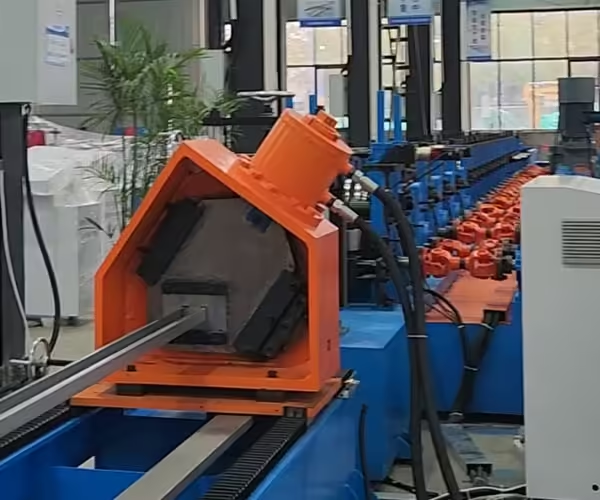
A machine quotation should not be the first document used to define a production line. The starting point should be a complete collection of finished-product drawings.
Photovoltaic mounting structures may contain:
- C-channel mounting rails
- U-channel support profiles
- Slotted strut channels
- Z-shaped purlins
- Ground-mounted support posts
- Roof-mounting rails
- Bracing members
- Connector plates
- Customized open-section profiles
These components may look similar, but differences in width, flange height, lip design, hole pattern and material thickness can require different roller arrangements and punching tools.
Factories planning to manufacture several types of solar support components can review Jinbolida’s Solar Photovoltaic Bracket Forming Machine range, which includes equipment for C-channel, U-channel and related photovoltaic mounting profiles.
Identify the Profile Family
Profiles that belong to the same geometric family are more likely to share one adjustable forming system. For example, several C-channel products may differ mainly in web width, flange height or lip length.
A C-channel and a U-channel, however, may require different tooling because the lip geometry changes the forming sequence. Profiles with substantially different section depths, bend positions or material thicknesses may also be unsuitable for the same roller set.
The important question is not simply, “Can the machine produce different sizes?” It is:
“What dimensions can change automatically, what tooling must be replaced, and what dimensions remain fixed?”
Separate Standard Products from Project-Specific Products
Standard profiles normally have stable dimensions and predictable production volumes. A dedicated line can be effective when one or two profiles account for most of the factory’s output.
Project-specific solar brackets may require different lengths, slots, hole spacing and section dimensions. In this situation, adjustable tooling, programmable servo feeding and recipe storage become more valuable.
Compare Fixed and Adjustable Forming Systems
A multi-profile PV bracket roll forming machine can use several adjustment concepts. Each option has different implications for rigidity, changeover time and tooling complexity.
| Machine configuration | Main advantage | Main limitation | Suitable production |
|---|---|---|---|
| Fixed-profile line | Stable tooling and repeatable setup | Limited product variety | Large batches of one profile |
| Spacer-adjusted line | Can change selected profile widths | Requires manual adjustment and verification | Related profiles with occasional changes |
| Cassette or tooling-change line | Broader profile flexibility | Tooling handling and storage are required | Several distinct profile families |
| Motorized adjustable line | Faster and more repeatable adjustment | Higher control and mechanical complexity | Frequent size changes |
| Servo-adjusted line | Recipe-based positioning and reduced manual work | Requires precise calibration and maintenance | High-mix automated production |
| Separate dedicated lines | High output and simplified operation | More floor space and equipment investment | Several products with consistently high demand |
A flexible machine is not automatically the best choice. Increasing the adjustment range can increase mechanical complexity and create more setup points that must be controlled.
When production demand is concentrated in one profile, a fixed line may provide more stable output. When factories frequently switch between related sizes, motorized or servo adjustment may reduce changeover time and dependence on operator experience.
Confirm Raw-Material Properties
The same profile drawing can behave differently when produced from materials with different yield strength, thickness or coating.
A PV bracket roll forming machine may process galvanized steel, carbon steel, stainless steel, aluminum or zinc-aluminum-magnesium-coated steel, depending on its engineering design. The supplier needs complete material data rather than only a general description such as “galvanized sheet.”
The required information includes:
- Material grade
- Minimum and maximum thickness
- Yield strength
- Tensile strength
- Elongation
- Strip width
- Coil inner and outer diameters
- Maximum coil weight
- Coating type and coating mass
- Surface-quality requirements
According to the general principles of roll forming, a continuous metal strip is gradually bent through successive roller stations. Material strength, thickness and springback influence how those stations must be designed.
Why Material Strength Matters
Higher-strength steel may support lighter mounting structures, but it also produces greater forming resistance and springback. The machine may require stronger shafts, a more rigid frame, suitable drive power and a forming sequence designed for the actual material.
A line tested only with soft, thin steel may not demonstrate how it will perform with the specified high-strength coil. Factory acceptance testing should therefore use material that represents actual production conditions.
Protect Coated Surfaces
Photovoltaic brackets are frequently used outdoors, making coating condition an important quality requirement. Incorrect guides, rough roller surfaces, trapped metal particles and excessive side pressure can scratch or mark coated material.
Rollers, guides and material-contact surfaces should be designed and maintained to protect the finish. Finished profiles should be inspected under appropriate lighting for scratches, coating damage and pressure marks.
Evaluate Punching Requirements Separately
Solar mounting profiles often include round holes, elongated slots, connector holes and repeated installation patterns. These features can determine the real speed of the complete line.
Jinbolida’s Solar Photovoltaic Rack Punching Equipment category includes punching solutions that can be evaluated together with the forming line.
Inline Punching
Inline punching connects feeding, punching, forming and cutting in one coordinated system. It can reduce material transfers and work-in-process inventory.
This configuration is suitable when:
- Hole patterns are repeated
- Production volume is relatively high
- Punching and forming use the same production schedule
- Automated material flow is required
- Hole positions can be programmed through the control system
However, punching frequency may limit total line output. A machine advertised with a high forming speed cannot maintain that speed if it must stop repeatedly for dense hole patterns.
Separate Punching
A separate punching system can provide flexibility when hole patterns change frequently or when several forming lines share one punching resource.
Its limitations include additional handling, intermediate storage and the need to coordinate two production processes. Incorrect reference points may also create cumulative hole-position errors.
The related article Solar Bracket Punching Machine: Inline vs Separate Systems can support further evaluation of these two configurations.
Pre-Punching or Post-Punching
Pre-punching is performed while the strip is still flat. It generally provides good support for repeated holes and makes tooling access easier.
Post-punching occurs after the profile has been partially or completely formed. It may be necessary when a feature must reference the final section, but supporting a three-dimensional profile can make tooling more complicated.
The correct method depends on the profile geometry, hole location, tolerance and production speed.
Measure Qualified Output, Not Only Forming Speed

Machine specifications often emphasize meters per minute, but maximum forming speed does not equal finished production capacity.
Actual output is also affected by:
- Punching cycle time
- Number of holes per product
- Cutting method
- Product length
- Coil replacement
- Changeover frequency
- Setup verification
- Quality inspection
- Material handling
- Stacking and packaging
- Rejected-product rate
- Planned and unplanned downtime
A practical capacity calculation should use qualified finished pieces per hour or per shift.
For example, two PV bracket roll forming machine configurations may both have the same maximum roller speed. The line with better punching coordination, faster coil loading and automatic stacking may produce more accepted brackets during a complete shift.
Request Product-Specific Capacity Data
Ask the supplier to calculate capacity for representative products rather than providing one general speed.
The calculation should state:
- Profile drawing
- Material grade and thickness
- Product length
- Number of punched features
- Cutting method
- Expected operating speed
- Pieces produced per hour
- Assumed efficiency rate
- Changeover time
- Inspection requirements
For a broader explanation of integrated coil handling and production stages, refer to Steel Coil Processing Machines for PV Brackets.
Examine Changeover Design
Multi-profile production creates value only when changeovers are controlled and repeatable. A machine that technically produces six sizes but requires an entire shift to reset may not meet a high-mix production plan.
Mechanical Changeover
Mechanical changeover may involve:
- Moving roller stands
- Adjusting spacers
- Repositioning guides
- Replacing forming rollers
- Changing punching dies
- Adjusting the cutting tool
- Resetting straightening rollers
- Verifying alignment
Each adjustment point should have a reference scale, documented position or measurable baseline.
Recipe-Based Changeover
A control system can store information such as:
- Product length
- Hole spacing
- Punching sequence
- Batch quantity
- Feeder position
- Cutting command
- Adjustable-axis position
- Alarm limits
Recipes improve repeatability but do not eliminate the need for mechanical verification. A stored value cannot correct worn tooling, incorrect roller installation or an uncalibrated servo axis.
First-Article Inspection
After every changeover, the first finished product should be checked before batch production begins.
The inspection should cover:
- Section width and height
- Flange and lip dimensions
- Bend angle
- Hole size and location
- Cut length
- Straightness
- Twist
- End condition
- Surface appearance
- Assembly with representative connectors
Check the Complete Production Line
The roll former is only one part of the system. Multi-profile production depends on how well every unit works together.
A complete line may contain:
- Coil car
- Decoiler
- Leveling unit
- Servo feeder
- Punching system
- Roll forming machine
- Straightening device
- Cut-off system
- Receiving table
- Automatic stacker or bundling unit
Supporting equipment should be selected according to coil weight, line speed, product length and required automation. Jinbolida’s Forming Machine Auxiliary Equipment can be considered when planning coil handling, receiving and efficiency improvements.
Do Not Ignore the Factory Layout
Long photovoltaic profiles require sufficient space for feeding, forming, collection, inspection and packaging. Maintenance access should also be considered around the punching unit, drive system, electrical cabinet and hydraulic station.
A line layout should indicate:
- Machine dimensions
- Material-flow direction
- Operator positions
- Coil-loading area
- Finished-profile collection area
- Electrical supply
- Hydraulic and pneumatic requirements
- Safety fences
- Maintenance clearances
- Overhead crane or forklift routes
Define the Required Accuracy
A general claim such as “high precision” is not enough. Tolerances should be written into the technical agreement and connected to a defined inspection method.
Important measurements include:
| Inspection item | Why it matters |
|---|---|
| Cross-section dimensions | Affects connectors and structural assembly |
| Hole-to-hole distance | Determines field installation compatibility |
| Hole-to-edge distance | Influences connection strength and alignment |
| Cut length | Controls module and support positioning |
| Straightness | Affects installation over long spans |
| Twist | Makes profiles difficult to align |
| Bend angle | Changes profile geometry and fit |
| Surface condition | Influences appearance and coating integrity |
Measurement instruments, reference points, sampling frequency and acceptable variation should be agreed before the machine is manufactured.
Plan the Factory Acceptance Test
A factory acceptance test, or FAT, is the best opportunity to verify the PV bracket roll forming machine before shipment.
The test should use agreed raw material and representative product drawings. If the line is designed for several profiles, testing only the easiest profile does not prove multi-profile capability.
A practical FAT should verify:
- Coil loading and decoiling
- Leveling stability
- Servo-feeding accuracy
- Punching position
- Forming dimensions
- Cutting accuracy
- Profile straightness and twist
- Surface condition
- Changeover procedure
- Recipe recall
- Continuous production
- Safety functions
- Alarm handling
- Finished-product collection
The test report should record the material, product, machine settings, inspection results and continuous running time. Photographs and video can provide additional evidence, but they should not replace dimensional records.
The Photovoltaic Solar Bracket Machine: 2026 Buying Checklist provides additional points for comparing tooling, automation and supplier support.
Build a More Reliable Quotation Package
A detailed inquiry allows the equipment manufacturer to propose a more accurate solution. Before requesting a quotation, prepare:
- All profile drawings
- Material specifications
- Thickness range
- Coil dimensions and weight
- Hole and slot drawings
- Product-length range
- Required tolerances
- Annual production volume
- Batch sizes
- Changeover frequency
- Required automation
- Factory voltage and frequency
- Available floor space
- Preferred feeding direction
- Acceptance criteria
The global photovoltaic industry continues to expand across utility-scale, commercial and distributed applications. Reports from the International Energy Agency Photovoltaic Power Systems Programme provide authoritative information on photovoltaic deployment and market development. For equipment planning, however, general market growth should always be translated into the factory’s actual product mix and production targets.
Common Selection Mistakes
Choosing by Maximum Speed
A high stated speed may not include punching, cutting or stacking. Compare qualified finished pieces under the same product conditions.
Assuming One Machine Can Produce Every Profile
Some dimensions can be adjusted, while others require new tooling or a separate line. Confirm the exact adjustment matrix.
Providing Incomplete Material Information
Thickness alone does not define forming behavior. Material strength, coating and coil dimensions also affect the design.
Ignoring Changeover Time
Multi-profile capability has limited value if tooling replacement and recalibration create excessive downtime.
Testing Only One Product
Each major profile family should be included in the acceptance plan.
Leaving Tolerances Undefined
Accuracy requirements must be measurable and included in the technical agreement.
Conclusion
Choosing a PV bracket roll forming machine for multi-profile production requires more than comparing motor power, roller stations or maximum speed. The equipment must match the complete range of finished drawings, raw materials, punching patterns, tolerances, batch sizes and changeover requirements.
Fixed-profile lines are suitable for stable, high-volume production, while adjustable or tooling-change systems offer greater flexibility. The best choice depends on how often product specifications change and how much qualified output the factory needs from each profile.
Jinbolida provides customized solar photovoltaic bracket forming machines, punching equipment and supporting production-line solutions. To obtain a configuration based on actual manufacturing requirements, submit profile drawings, material data, hole patterns, capacity targets and factory-layout information through the Jinbolida contact page.
FAQ
Can one PV bracket roll forming machine produce both C- and U-channels?
A single line may produce related C- and U-channel sizes when its rollers, guides, punching tools and cutting system are designed for the complete profile range. However, major geometric differences may require cassette tooling or separate roller sets. Every proposed profile should be verified through drawings before multi-profile capability is confirmed.
How long does it take to change from one PV bracket size to another?
Changeover time depends on whether the line uses manual spacers, movable stands, cassette tooling, motorized adjustment or servo-controlled axes. It may also require punching-die and cutting-tool changes. Ask the supplier to demonstrate a complete changeover during FAT and measure the time from the last qualified old profile to the first qualified new profile.
Which material information is needed before designing the machine?
The equipment supplier needs the material grade, yield and tensile strength, elongation, thickness range, strip width, coating, coil inner and outer diameters, maximum coil weight and surface requirements. These details affect forming force, springback, roller design, shaft strength, motor selection, leveling and protection of coated surfaces.
Is maximum forming speed the same as production capacity?
No. Maximum forming speed normally describes how fast material can pass through the roller section. Actual capacity also depends on punching frequency, cutting, product length, coil replacement, changeovers, inspection, stacking and rejection rates. A more useful measure is the number of qualified finished brackets produced per hour or shift.
What should be included in a PV bracket roll forming machine FAT?
The FAT should test agreed profiles using representative production material. It should verify feeding, punching, forming, cutting, dimensions, straightness, twist, surface condition, continuous operation, recipes, changeovers, alarms and safety devices. All acceptance limits, measurement methods and test durations should be documented before testing begins.
If you enjoyed this article on Jinbolida’s smart manufacturing and digital factory expertise, follow us for more insights and updates:
- 📘 Facebook: Stay tuned for our latest smart production line projects → Facebook
- 📱 WhatsApp: Contact us anytime for custom production solutions → Chat Now
- ▶️ YouTube: Watch our automated line demos and real-world applications → YouTube
Let’s keep innovating and shaping the future of smart manufacturing — together!
 English
  Arabic
  Russian
  Spanish
  French