
Guide d'achat de machines à supports photovoltaïques 2027
Table des matières
Points clés à retenir
- A photovoltaic bracket machine should be selected according to the finished profile, material grade, hole pattern, production volume, and required automation level.
- Buyers should compare qualified finished output rather than relying only on the maximum forming speed stated in a quotation.
- C-channel, U-channel, Z-channel, rail, post, and connector products may require different forming and punching configurations.
- Integrated decoiling, leveling, punching, roll forming, cutting, and stacking can reduce manual handling and process variation.
- Automatic adjustment is valuable for factories that frequently switch between profile dimensions or customer orders.
- Material yield strength and coating type are just as important as material thickness when designing rollers, shafts, motors, and punching dies.
- A factory acceptance test should verify profile dimensions, hole locations, cutting accuracy, straightness, surface quality, and continuous operation.
- The lowest-priced machine may not provide the lowest cost per qualified bracket.
- Buyers should confirm installation, training, remote diagnostics, spare parts, and technical documentation before placing an order.
- Jinbolida provides photovoltaic bracket forming and punching solutions that can be customized around drawings, materials, capacity, and finished-component requirements.
Introduction
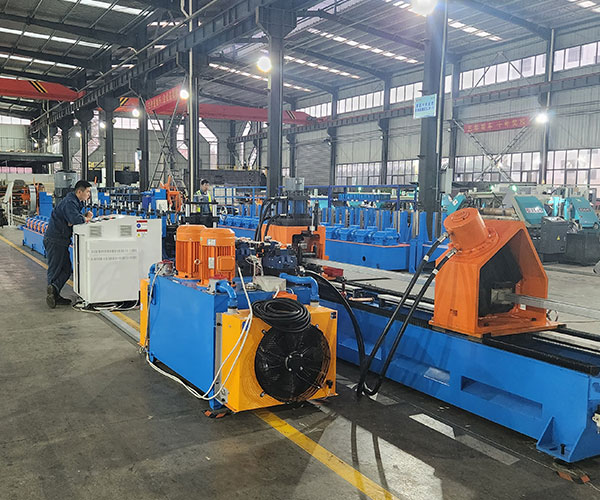
Photovoltaic mounting systems depend on accurately manufactured steel or aluminum components to support solar modules under long-term wind, snow, vibration, and environmental loads. As solar deployment expands, manufacturers of mounting rails, posts, purlins, channels, and connectors need production equipment that can deliver repeatable dimensions while controlling material waste and labor requirements.
The IEA PVPS reported that approximately 698 GW of new photovoltaic capacity was installed worldwide in 2025, bringing cumulative global PV capacity close to 3 TW. This continued market expansion is increasing demand throughout the solar supply chain, including the equipment used to manufacture mounting-system components.
However, purchasing a photovoltaic bracket machine is not simply a matter of choosing the highest speed or lowest quotation. A machine that performs well for one C-channel profile may be unsuitable for a factory that produces several U-channel sizes, high-strength materials, complex slots, or short customized orders.
The right production line must match the buyer’s actual product portfolio, material specifications, available factory space, labor conditions, quality requirements, and expansion plan.
Jinbolida catégorie de machine de formage de supports solaires photovoltaïques includes equipment designed to process carbon steel, galvanized steel, and aluminum into profiles for solar mounting applications. The website also presents dedicated équipement de poinçonnage de supports photovoltaïques solaires for products requiring installation holes, elongated slots, or connector features.
This guide explains how buyers can evaluate machine configurations, production capacity, tooling, automation, testing, and supplier capability before making an investment in 2027.
Qu'est-ce qu'une machine à supports photovoltaïques ?
A photovoltaic bracket machine is an industrial production system used to manufacture metal components for solar module mounting structures.
Depending on the finished product, the system may produce:
- C-shaped support channels
- U-shaped mounting rails
- Purlins en forme de Z
- Sigma profiles
- Canaux à entretoises fendues
- Postes de montage au sol
- Rails de montage sur toit
- Braces and beams
- Plaques de connexion
- Triangular bracket components
- Profils personnalisés en section ouverte
Most long structural profiles are manufactured through cold roll forming. A flat metal strip passes through multiple roller stations, and each station gradually changes the strip until the required cross-section is formed.
Formage de rouleau froid
Cold roll forming shapes metal at room temperature through a continuous sequence of rollers. It is particularly suitable for long profiles that require a consistent cross-section.
The process can provide high repeatability and efficient material use when the roller design, feeding system, alignment, and cutting method are correctly matched to the product.
Perforation
Punching creates round holes, elongated slots, locating holes, bolt holes, or customized openings in the material.
The operation may take place before forming, during the line process, or after the profile is formed. The correct arrangement depends on accessibility, tolerance, hole geometry, and production speed.
Coupe
The cutting system separates the continuous profile into specified lengths.
Common arrangements include pre-cutting, post-cutting, stop-to-cut systems, and flying cutting systems. Each method creates different requirements for speed, profile deformation control, tooling cost, and line coordination.
Comment fonctionne une ligne de production de supports photovoltaïques ?
A complete production line may perform several processes without repeatedly moving the material between separate machines.
Jinbolida’s guide to solar support bracket forming machine line layouts describes a line as a system that may include decoiling, leveling, feeding, punching, forming, cutting, marking, unloading, turning, and stacking.
Étape 1 : Chargement de la bobine
A steel or aluminum coil is placed on the decoiler.
The decoiler supports the coil and releases the strip at a controlled rate. Its weight capacity and expansion range must match the buyer’s coil dimensions.
Étape 2 : Décollage
The coil is gradually unwound and fed toward the leveling section.
A powered decoiler may be preferred for heavier coils or faster production lines, while a passive unit can be sufficient for lighter and slower applications.
Étape 3 : Nivellement
The leveler removes part of the coil curvature and helps create a stable strip before punching or forming.
Poor leveling may affect feed accuracy, hole position, profile straightness, and forming stability.
Étape 4 : Alimentation servo
The feeding system moves the material by a programmed distance.
Servo control is especially important when the profile contains multiple hole patterns or several component lengths within one order.
Étape 5 : Poinçonnage
Hydraulic or mechanical punching units produce the required openings.
A line may use one die for a simple repeating pattern or several stations for multiple holes and slots.
Étape 6 : Formage du rouleau
The strip passes through a series of forming stations.
The number of stations depends on profile complexity, material properties, thickness, tolerance, and required surface quality.
Étape 7 : Redressage
A straightening device makes final adjustments to reduce bow, twist, or sideways movement.
Pourquoi le redressement final est important
Even accurately designed rollers may require final correction because material properties can vary between coils.
A practical straightening mechanism allows trained operators to compensate for normal material variation without rebuilding the tooling.
Étape 8 : Coupe à la longueur
The profile is cut according to programmed order data.
A measuring encoder and control system coordinate the cutting position to reduce length errors.
Étape 9 : Réception et empilement
Finished profiles move onto a receiving table or automatic stacking system.
This section can reduce scratches, prevent long profiles from falling, improve bundle consistency, and lower manual handling requirements.
Principaux types de machines à supports photovoltaïques
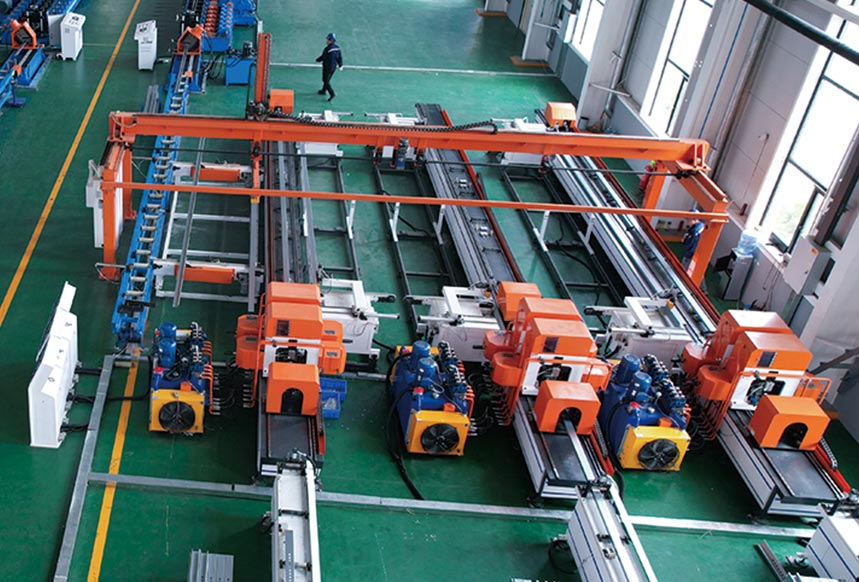
The machine type should follow the finished product rather than a general industry label.
Machine à supports photovoltaïques à canal C
A C-channel profile includes a web, two flanges, and sometimes return lips.
These profiles are commonly used as structural rails, posts, purlins, or support members. The forming process must control flange height, lip angle, opening width, twist, and straightness.
Production réglable sur canal C
An adjustable system can produce a range of web and flange sizes.
This configuration is useful when a factory serves several solar-project customers, but the buyer should confirm which dimensions adjust automatically and which still require tooling changes.
Machine à supports photovoltaïques à canal en U
A U-channel generally has a base and two side walls without inward lips.
Although the geometry may appear simpler than a lipped C section, the line must still control side-wall angle, internal width, base width, and straightness.
Machine de formage de canal Z
A Z profile uses offset flanges on opposite sides of the web.
These profiles may be selected when overlapping, nesting, or structural connection requirements favor a Z-shaped cross-section.
Machine à canaux Strut
Strut channels may include inward edges, serrations, repeated slots, and specialized connection surfaces.
Because these products often contain dense hole patterns, punching capacity can become the limiting factor in the overall production speed.
Poinçonneuse et formatrice de connecteurs
Short connector components may require stamping, punching, cutting, and forming rather than continuous roll forming alone.
Jinbolida’s photovoltaic bracket connector punching machine is presented as a solution capable of producing components within approximately three to five seconds, with stated accuracy of ±0.5 mm for the referenced configuration. Exact performance should be reconfirmed against the buyer’s material, component drawing, and acceptance requirements.
Machines à supports photovoltaïques à canal C ou à canal U
Choosing between C- and U-profile equipment requires more than comparing the visible profile shape.
| Article comparatif | Machine à canal C | Machine à canal en U |
|---|---|---|
| Typical profile | Lipped or unlipped C section | Open U section |
| Applications courantes | Postes, pannes, rails et poutres | Rails, cadres et supports |
| Complexité de formation | Often higher with return lips | Often simpler, depending on design |
| Dimensions clés | Aire, bride, lèvre et ouverture | Base width, wall height and angle |
| Position de poinçonnage | Web, flange or multiple faces | Base or side walls |
| Adjustment options | Width, flange and lip adjustment | Width and wall-height adjustment |
| Main quality risks | Twist, lip-angle error and flare | Side-wall angle and spreading |
| Best purchasing basis | Exact product family and tolerance | Exact product family and tolerance |
Jinbolida has published a dedicated comparison of C- and U-profile solar mounting bracket machines. The article emphasizes that machine selection also depends on material, hole patterns, adjustment requirements, and target capacity rather than profile shape alone.
Pré-poinçonnage vs post-poinçonnage
The location of the punching process can affect line speed, tooling design, and dimensional accuracy.
Pré-poinçonnage
Pre-punching creates holes while the material remains flat.
The punching die can access the strip easily, and flat material is usually simpler to position. However, the forming process may slightly influence the final relationship between the holes and the formed profile.
Post-poinçonnage
Post-punching creates openings after the profile has been formed.
This arrangement can reference the final profile geometry, but the punching tools may need to reach several faces of a three-dimensional section.
Quelle méthode est la meilleure ?
Neither arrangement is universally better.
The supplier should evaluate:
- Forme du trou
- Taille du trou
- Espacement des trous
- Géométrie du profil
- Épaisseur du matériau
- Tolérance requise
- Fréquence de poinçonnage
- Vitesse de ligne
- L'accessibilité
- Potential profile deformation
Poinçonnage hybride
Some production lines use both pre-punching and post-punching.
For example, repeated base slots may be punched in the flat strip, while a specialized side hole is created after forming.
Automatic vs Semi-Automatic Production Lines
Automation should be evaluated through the buyer’s production model.
| Facteur | Ligne semi-automatique | Automatic Line |
| Initial equipment cost | Généralement inférieur | Généralement supérieur |
| Main-d'œuvre directe | Plus haut | Inférieur |
| Dépendance de l'opérateur | Greater | Réduit |
| Méthode de basculement | Mostly manual | Motorized or recipe-based |
| Données de production | Basique | Plus complet |
| Line coordination | Partially connected | Centrally coordinated |
| Traçabilité | Limité | Easier to implement |
| Technical complexity | Inférieur | Plus haut |
| Production appropriée | Lower volume or stable profiles | Higher volume or varied orders |
| Potentiel d'expansion | Modéré | Usually stronger |
When to Choose a Semi-Automatic Machine
A semi-automatic photovoltaic bracket machine may be suitable when the factory produces a limited number of stable profiles and has sufficient operators.
It can also be a practical entry-level choice for a manufacturer testing a new market before investing in full automation.
When to Choose an Automatic Machine
An automatic line is more suitable when order volume is high, labor availability is limited, changeovers occur frequently, or customers require detailed production records.
The financial decision should consider cost per qualified profile rather than equipment price alone.
Fixed-Size vs Adjustable Machines
This is one of the most important choices for a buyer.
Fixed-Size Machine
A fixed-size line is designed for one profile or a narrow range of similar dimensions.
It usually has simpler tooling, fewer adjustment mechanisms, and a lower initial cost.
Meilleure application
A fixed-size machine is a strong option when the factory has a long-term contract for one standardized product.
It may provide high stability because operators do not frequently change roller positions.
Adjustable Machine
An adjustable line changes selected profile dimensions through manual screws, motorized positioning, servo systems, interchangeable spacers, or replaceable cassettes.
It is suitable for factories that produce several related sizes.
Important Limitation
“Adjustable” does not necessarily mean that every dimension can change automatically.
The buyer should request an adjustment matrix showing:
- Adjustable web range
- Adjustable flange range
- Gamme de lèvres réglable
- Supported thickness range
- Required roller replacement
- Required spacer replacement
- Punching-die changes
- Cutting-die changes
- Temps de basculement prévu
How to Calculate the Required Production Capacity
Purchasing an oversized line increases investment, while purchasing an undersized line may prevent the factory from meeting delivery schedules.
Start with Annual Demand
Determine the expected number of profiles or total linear meters required each year.
Separate confirmed demand from potential demand so that the equipment decision is not based only on an optimistic sales forecast.
Calculate Available Production Time
Available hours should exclude:
- Maintenance planifiée
- Changements de produits
- Remplacement de la bobine
- Contrôle qualité
- Opérateur casse
- Tool cleaning
- Retards matériels
- Unexpected stoppages
Convert Forming Speed into Finished Output
A line speed of 30 meters per minute does not always produce 30 meters of qualified product every minute.
Punching cycles, stop-to-cut operations, short product lengths, stacking delays, and operator intervention can reduce effective output.
Use Qualified Output
Qualified output refers to finished components that meet all dimensional and appearance requirements.
Simple Capacity Logic
A practical estimate can be based on:
Qualified output per shift = effective line speed × operating minutes × utilization rate
The utilization rate should be realistic rather than theoretical. Factories with frequent product changes should use a lower utilization assumption than factories producing one continuous profile.
Material Information Required Before Machine Design
A reliable machine quotation requires more than a PDF drawing.
Qualité matérielle
The material grade affects strength, springback, forming load, and tooling wear.
Two coils with the same thickness may behave differently if their yield strengths are significantly different.
Gamme Épaisseur
The supplier must know the minimum, normal, and maximum material thickness.
A very wide thickness range may require additional adjustment, roller clearances, or separate tooling.
Limite d'élasticité
Yield strength indicates how much stress is required before the material begins permanent deformation.
Higher yield strength can increase forming force and springback.
Résistance à la traction
Tensile strength describes the maximum stress the material can withstand before fracture.
It helps the engineering team understand the overall behavior of the strip during forming and punching.
Surface Coating
Common materials may include pre-galvanized steel, hot-dip galvanized steel, zinc-aluminum-magnesium-coated steel, stainless steel, carbon steel, or aluminum.
Protecting Coated Surfaces
Roller finish, material guidance, lubrication, and handling systems must be selected carefully when the coating must remain visually and functionally intact.
A poorly aligned line can scratch the surface even when the final dimensions are correct.
Essential Machine Specifications to Compare
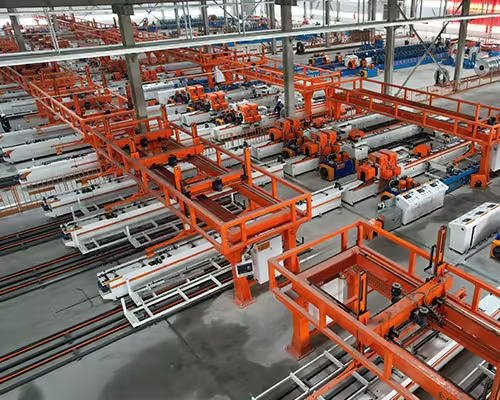
A machine quotation may contain many numbers, but buyers should identify which specifications determine real production performance.
Vitesse de formation
Ask whether the stated speed refers to:
- Empty machine speed
- Forming-only speed
- Speed without punching
- Speed without cutting
- Maximum short-duration speed
- Continuous qualified production speed
Nombre de Stations de Formage
More stations do not automatically guarantee better quality.
The correct number depends on the amount of deformation, material strength, profile shape, surface requirements, and available factory length.
Diamètre de l'arbre
Shaft diameter affects rigidity and load capacity.
However, it should be evaluated together with shaft material, bearing arrangement, station spacing, frame structure, and profile load.
Matériel de rouleau
Common tooling materials may be selected according to wear resistance, machinability, heat treatment, and product surface requirements.
The buyer should ask for the roller material specification and hardness rather than accepting a general description such as “high-quality steel.”
Puissance du moteur principal
Motor power must support the actual forming load with an appropriate safety margin.
An unnecessarily large motor may increase energy use, while an undersized motor can reduce production stability.
Précision de coupe
Cutting accuracy depends on the measuring system, encoder installation, control logic, material slip, and cutting method.
Précision de frappe
Punching accuracy should be defined by a measurable reference.
For example, the contract should explain whether hole position is measured from the profile end, profile centerline, previous hole, or another datum.
Product Tolerances That Should Be Defined
General statements such as “high precision” are not sufficient for machine acceptance.
Dimensions de la section transversale
Define acceptable tolerances for:
- Largeur de la toile
- Hauteur de la bride
- Longueur des lèvres
- Largeur d'ouverture
- Internal width
- Hauteur du profil
Angular Accuracy
Specify allowable deviation for flange, side-wall, and lip angles.
Droiture
Straightness may be measured over the full profile length or over a specified shorter distance.
Torsion
Twist refers to rotational deviation along the length of the profile.
Why Twist Is Important
A twisted mounting rail can create installation difficulty even when every individual cross-sectional measurement appears acceptable.
The acceptance procedure should define both the measuring method and the maximum permissible twist.
Position du trou
Specify longitudinal and transverse hole-location tolerance.
For slotted holes, also define slot length, width, orientation, and distance from the reference edge.
Longueur de coupe
Define permissible positive and negative length deviation.
For installation systems using repeated modular spacing, accumulated length error can become particularly important.
How Punching Capacity Affects Line Speed
Many buyers focus on the roll former, but punching is often the true production bottleneck.
Hole Quantity per Profile
A profile containing one hole every meter requires less punching capacity than a slotted channel containing several openings every few centimeters.
Number of Punching Stations
Multiple stations can distribute different hole types or process several surfaces.
Jinbolida presents three-station, six-station, and nine-station photovoltaic rack punching equipment for varying processing needs. Buyers should select the arrangement based on actual hole combinations rather than station count alone.
Hydraulic vs Mechanical Punching
Hydraulic systems provide controllable force and flexible integration.
Mechanical presses may be appropriate for high-frequency repetitive punching, depending on the product and tooling arrangement.
Punching While Moving
A flying punching system processes material without fully stopping the line.
Is Flying Punching Always Necessary?
Non.
Flying punching adds cost and control complexity. It creates the most value when punching would otherwise significantly limit production and when the buyer’s order volume justifies the additional investment.
How to Reduce Scrap and Material Waste
Material cost has a direct impact on bracket profitability.
Optimiser la largeur de la bande
The required strip width should be calculated from the finished profile and forming allowance.
Using an unnecessarily wide coil creates continuous edge waste across every meter of production.
Alignement de la bobine de contrôle
Sideways strip movement can create uneven profiles and damaged edges.
Guiding devices should hold the material accurately without scratching the coating.
Use Accurate Servo Feeding
Controlled feeding reduces hole-position and cutting errors.
It also makes it easier to change between component lengths through the control program.
Moniteur Outil d'usure
Worn punches and cutting blades can create burrs, deformation, and rejected parts.
Scrap Is a Process Signal
A sudden increase in scrap may indicate coil variation, tooling wear, incorrect adjustment, sensor contamination, feed slip, or operator error.
Recording the reason for each rejected part helps the factory identify recurring losses.
Smart Controls and Production Data
Industrial buyers are increasingly interested in data that supports production planning and maintenance.
Gestion des recettes
A recipe stores relevant settings for a specific profile or order.
Depending on the line, a recipe may include length, quantity, hole spacing, punching sequence, and adjustable profile dimensions.
Order Management
Operators can enter the required product quantity and monitor completed and remaining pieces.
Alarm Records
Alarm history helps maintenance teams identify repeated failures.
Diagnostic à distance
Authorized remote access can allow the supplier to inspect control parameters, sensor status, and fault records.
Cybersécurité et contrôle d'accès
Remote access should be controlled by the machine owner.
The buyer should confirm how connections are approved, when access is enabled, and how passwords or user permissions are managed.
Energy Efficiency and Lifecycle Considerations
Energy use is becoming a more visible part of industrial equipment evaluation.
The IEA’s clean-technology manufacturing research examines production costs, supply-chain concentration, investment, and manufacturing performance across the solar value chain. The IEA PVPS also released updated photovoltaic lifecycle inventory data in July 2026, reflecting greater industry attention to transparent environmental assessment.
Efficient Drive Systems
Properly sized motors and efficient transmissions can reduce unnecessary energy consumption.
Standby Management
Pumps, fans, and auxiliary units do not always need to operate at full output during extended production pauses.
Material Efficiency
For many bracket factories, reducing steel waste may create a larger financial benefit than reducing electricity consumption alone.
Measure Energy per Qualified Product
Total machine power does not explain production efficiency by itself.
A useful metric is the energy consumed per meter, kilogram, or qualified finished component.
Planification de l'aménagement de l'usine
The buyer should plan the production area before the machine is manufactured.
Line Length
A complete line may require space for:
- Stockage de bobines
- Chargement de bobine
- Décoilage
- Forming equipment
- Armoires électriques
- Hydraulic stations
- Receiving tables
- Empilage
- Inspection
- Conditionnement
- Accès maintenance
Material Flow
Raw coils and finished bundles should move through the factory without repeated crossing or turning.
Crane and Forklift Access
The layout must allow safe coil loading and finished-product removal.
Foundation Requirements
Some machines require anchor bolts, foundation pits, or reinforced flooring.
Do Not Ignore Maintenance Space
Operators may need access to rollers, motors, chains, hydraulic units, electrical cabinets, and cutting dies.
A line installed too close to a wall can make routine maintenance unnecessarily difficult.
How to Evaluate a Photovoltaic Bracket Machine Supplier
The supplier should be evaluated as an engineering and service partner, not only as a machine seller.
Profile Analysis
A capable supplier should review whether the profile can be formed continuously and identify areas that may create cracking, springback, twisting, or difficult punching access.
Conception d'outillage
Ask whether rollers and dies are designed internally.
Internal engineering can make future modifications and technical communication more efficient.
Component Machining
Review how rollers, shafts, frames, cutting tools, and punching dies are manufactured and inspected.
Assembly and Testing
The complete line should be assembled and tested before shipment.
Expérience de projet similaire
Ask for examples involving comparable profiles, materials, thicknesses, punching patterns, and automation requirements.
Similar Does Not Mean Identical
A supplier may have produced a C-channel line before, but your product could still require a different forming sequence because of material strength, dimensions, lip geometry, or tolerance.
The supplier should explain both the relevant experience and the required customization.
Questions to Ask During Supplier Evaluation
Use practical questions that reveal how the proposed line will work.
Questions d'ingénierie
- Has the supplier reviewed the full profile drawing?
- Has the material yield strength been confirmed?
- Which dimensions can be adjusted?
- Which parts require replacement during changeover?
- Comment le retour de printemps est-il compensé ?
- How will profile twist be corrected?
- Where will punching take place?
- What limits the actual line speed?
Questions de fabrication
- What materials are used for rollers and shafts?
- How are rollers heat-treated?
- How are shafts and rollers measured?
- Is the frame welded or cast?
- How is frame stress handled?
- Which electrical and hydraulic components are used?
Testing Questions
- Will testing use the customer’s real material?
- How long will the continuous test run last?
- How will profile tolerances be measured?
- Will every hole pattern be tested?
- Will changeover be demonstrated?
- Will production data be recorded?
Questions de service
- Un support technique à distance est-il disponible ?
- Is on-site installation available?
- Quelles pièces détachées sont incluses ?
- How quickly can replacement parts be shipped?
- Are manuals supplied in the required language?
- Are electrical and hydraulic diagrams included?
Liste de contrôle des tests d'acceptation en usine
A formal factory acceptance test helps prevent disagreements before shipment.
| Élément d'essai | Que vérifier | Preuves recommandées |
| Alimentation matérielle | Stable entry and alignment | Continuous operating video |
| Perforation | Hole size, shape and position | Inspection report |
| Dimensions du profil | Web, flange, lip and angles | Measured sample records |
| Droiture | Arc et déviation latérale | Straightness measurement |
| Torsion | Rotation along profile length | Full-length sample check |
| Longueur coupée | Programmed vs actual length | Multiple measured pieces |
| Qualité de surface | Scratches, dents and coating damage | Inspection visuelle |
| Vitesse de production | Qualified output under real conditions | Test de production chronométré |
| Changement | Procédure et durée d'ajustement | Demonstration video |
| Système de contrôle | Recipes, alarms and order quantities | Test fonctionnel |
| Dispositifs de sécurité | Guards, emergency stops and interlocks | Liste de contrôle de sécurité |
| Fonctionnement continu | Stability over an agreed period | Rapport d'essai |
Use the Correct Material
Testing a high-strength production line with thin, soft steel does not prove that it will process the customer’s real coil.
The test material should match the agreed grade, thickness, width, and coating whenever practical.
Measure More Than One Sample
One qualified component is not enough to demonstrate process stability.
Samples should be taken from different stages of the continuous test run.
Common Photovoltaic Bracket Machine Buying Mistakes
Choosing by Price Alone
A low quotation may exclude essential items such as punching dies, automatic adjustment, loading equipment, receiving tables, installation, spare parts, or electrical upgrades.
Compare the full technical scope.
Choisir par vitesse maximale
Maximum speed may refer only to the roll former without punching or cutting.
Ask for the estimated number of qualified finished profiles per shift.
Ignorer la force du matériau
Thickness alone is not sufficient.
A line designed for low-strength steel may not perform correctly with a higher-yield-strength coil of the same thickness.
Requesting Too Much Flexibility
A machine designed to produce an extremely wide range of unrelated profiles may become expensive and difficult to adjust.
Sometimes two focused lines are more practical than one overly complex line.
Laissant les tolérances indéfinies
Without written acceptance criteria, the supplier and buyer may use different definitions of acceptable quality.
Ignorer le support après-vente
A machine may operate for many years, while the initial purchase process lasts only a few months.
Service capability should therefore be evaluated before the order is placed.
How Much Does a Photovoltaic Bracket Machine Cost?
There is no single standard price because production-line configurations vary significantly.
The quotation may be affected by:
- Nombre de tailles de profil
- Force matérielle
- Plage d'épaisseur
- Poids de la bobine
- Forming-station quantity
- Roller and shaft materials
- Punching-station quantity
- Hole complexity
- Méthode de découpe
- Adjustment system
- Empilage automatique
- Electrical component brands
- Hydraulic configuration
- Exigences de sécurité
- Certification
- Destination d'installation
- Training and service scope
Compare Total Investment
The machine price is only one part of the investment.
Buyers should also consider freight, customs, installation, foundation work, lifting equipment, power supply, compressed air, tooling, spare parts, training, and initial raw material.
Compare Cost per Qualified Component
A more expensive line may provide a lower manufacturing cost when it reduces labor, changeover time, scrap, and rejected products.
Request an Itemized Quotation
An itemized quotation makes it easier to understand what is included and compare suppliers fairly.
It also allows the buyer to identify optional equipment that can be added during a later expansion.
How to Prepare an Accurate RFQ
A detailed request for quotation can significantly improve the quality of the proposal.
Fournir les informations suivantes :
- Finished profile drawing
- Several profile sizes, when applicable
- Qualité matérielle
- Rendement et résistance à la traction
- Épaisseur minimale et maximale
- Largeur de bobine
- Poids maximum de la bobine
- Revêtement de surface
- Dessins de trous et de fentes
- Longueurs de produits
- Tolérances dimensionnelles
- Required pieces per hour or shift
- Expected working hours
- Number of changeovers
- Niveau d'automatisation requis
- Exigences en matière de réception et d'empilage
- Tension et fréquence d'usine
- Pays d'installation
- Required certifications
- Marques de composants préférées
- Factory-layout restrictions
- Sample products, when available
Jinbolida photovoltaic support manufacturing guide provides additional information about C- and U-channel production equipment and related support-component manufacturing.
Why Consider Jinbolida for a Photovoltaic Bracket Machine?
Jinbolida provides equipment for forming and punching structural components used in photovoltaic mounting systems.
Product-Based Configuration
The proposed line can be configured around the customer’s finished profile, material type, size range, hole pattern, and capacity requirement.
Forming Equipment
The company’s photovoltaic forming-machine category covers equipment for producing C-shaped, U-shaped, and related mounting profiles from metal coil.
Équipement de poinçonnage
Dedicated rack punching systems can be considered for products containing repeated installation holes, elongated slots, or multi-face features.
Production-Line Integration
Forming, punching, cutting, and auxiliary handling can be evaluated as one production system.
Request a Drawing-Based Proposal
Buyers can submit profile drawings, material information, production targets, and factory requirements through the Page de contact Jinbolida.
A drawing-based proposal is more useful than selecting equipment only from a general catalog because it allows the engineering team to evaluate actual manufacturing conditions.
FAQ About Photovoltaic Bracket Machines
What machine is used to make photovoltaic brackets?
Long photovoltaic mounting profiles are commonly produced with cold roll forming machines. A complete line may include decoiling, leveling, servo feeding, punching, forming, cutting, receiving, and stacking equipment.
Can one photovoltaic bracket machine make different profile sizes?
Yes, some machines can produce several related sizes through manual, motorized, or servo adjustment. However, the buyer should confirm the exact adjustment range and whether rollers, spacers, punching dies, or cutting tools must be replaced.
Can the same machine produce both C and U channels?
It may be possible when the profiles are sufficiently related and the machine is designed with interchangeable or adjustable tooling. In other cases, separate tooling or separate lines may be more efficient.
What material can a photovoltaic bracket machine process?
Depending on its design, the line may process carbon steel, galvanized steel, coated steel, stainless steel, or aluminum. The material grade, yield strength, thickness, width, and coating must be confirmed before machine design.
How fast is a photovoltaic bracket production line?
Actual speed depends on profile complexity, hole frequency, punching method, material properties, cut length, and stacking arrangement. Buyers should ask for qualified finished output under their real production conditions.
How many operators are needed?
A basic line may require operators for coil loading, machine control, product collection, inspection, and packaging. Automatic feeding and stacking can reduce direct labor, but staffing still depends on the factory layout and production process.
Is automatic width adjustment necessary?
Automatic adjustment is useful when profile sizes change frequently. It may not be economically necessary when the factory continuously produces one standard profile.
Should holes be punched before or after forming?
Both arrangements are used. Pre-punching provides easier access to flat material, while post-punching can reference the final formed shape. The best method depends on geometry, tolerance, speed, and tooling access.
How accurate is a photovoltaic bracket machine?
Accuracy depends on the machine design, material consistency, tooling, control system, measuring method, and product length. Buyers should specify tolerances for profile dimensions, angles, straightness, twist, holes, and cutting length.
How do I prevent scratches on galvanized profiles?
Use smooth and correctly aligned rollers, suitable material guidance, clean equipment, appropriate lubrication where permitted, and controlled receiving systems. The factory acceptance test should include a surface-quality inspection.
What causes profile twisting?
Possible causes include uneven material properties, incorrect roller alignment, poor forming-sequence design, unequal deformation, feeding misalignment, or improper straightener settings.
What is the difference between forming speed and production speed?
Forming speed describes material movement through the roller section. Production speed includes punching, cutting, acceleration, deceleration, stacking, coil replacement, and other process delays.
Can a machine process high-strength steel?
Yes, but the line must be designed for the specified yield strength and thickness. Higher-strength steel may require stronger frames, larger shafts, greater motor power, revised tooling, and more springback compensation.
How long does a profile changeover take?
It may take a few minutes for an automated adjustment or much longer when rollers and dies must be replaced. The supplier should demonstrate the complete procedure during testing.
What documents should come with the machine?
Typical documents include an operation manual, electrical diagram, hydraulic diagram, foundation drawing, maintenance schedule, spare-parts list, parameter backup, and tooling information.
What should be included in after-sales service?
Buyers should confirm installation guidance, operator training, remote diagnostics, spare-parts support, warranty terms, technical-response procedures, and access to electrical and control documentation.
How can I get an accurate machine quotation?
Provide complete profile drawings, material specifications, hole patterns, tolerance requirements, product lengths, output targets, voltage, factory layout, and required automation level.
Conclusion
Buying a photovoltaic bracket machine in 2027 requires a detailed evaluation of products, materials, production volume, punching patterns, adjustment needs, tolerances, factory layout, and technical support.
The best machine is not automatically the fastest or cheapest option. It is the production line that can consistently manufacture qualified components at a sustainable cost while supporting the buyer’s order structure and future growth.
Before placing an order, buyers should define the finished product, submit complete material information, calculate realistic capacity, compare total line configurations, and agree on a measurable factory acceptance standard.
Fournitures Jinbolida machines de formage de supports solaires photovoltaïques et équipement de poinçonnage de rack photovoltaïque for C-channel, U-channel, connector, and customized solar mounting components.
Manufacturers planning a new production line or upgrading an existing workshop can contact Jinbolida with their profile drawings, material specifications, desired output, and automation requirements to obtain a customized equipment proposal.
Si vous avez apprécié cet article sur l'expertise de Jinbolida en matière de fabrication intelligente et d'usine numérique, suivez-nous pour plus d'informations et de mises à jour :
- 📘 Facebook : Restez à l'écoute de nos derniers projets de lignes de production intelligentes → Facebook
- 📱 WhatsApp : Contactez-nous à tout moment pour des solutions de production personnalisées → Chattez maintenant
- ▶️ YouTube : Regardez nos démonstrations de lignes automatisées et nos applications concrètes → YouTube
Continuons d'innover et de façonner ensemble l'avenir de l'industrie intelligente !
 French
  English
  Arabic
  Russian
  Spanish