
Steel Formwork Production Line: Semi-Automatic vs Fully Automatic
Table of Contents
A steel formwork production line transforms metal coils or sheets into reusable formwork panels, ribs, corners, and related structural components. Depending on the required product, the manufacturing process may include feeding, leveling, punching, cutting, roll forming, edge forming, welding, straightening, surface treatment, and stacking.
One of the most important purchasing decisions is whether to choose a semi-automatic or fully automatic line. A semi-automatic system offers a lower initial investment and greater manual control, while a fully automatic system can improve production continuity, repeatability, data collection, and labor efficiency.
Key takeaways:
- Select automation according to production volume and product variety.
- Semi-automatic lines suit flexible production and controlled investment.
- Fully automatic lines are better for repeated, high-volume manufacturing.
- Automation level should be evaluated for each production stage.
- Product drawings and material specifications must be finalized before machine design.
- Welding and material handling often determine real production capacity.
- Fast equipment does not guarantee high saleable output.
- Factory acceptance testing should cover the complete production cycle.
- Total ownership cost is more useful than the initial purchase price alone.
What Is a Steel Formwork Production Line?
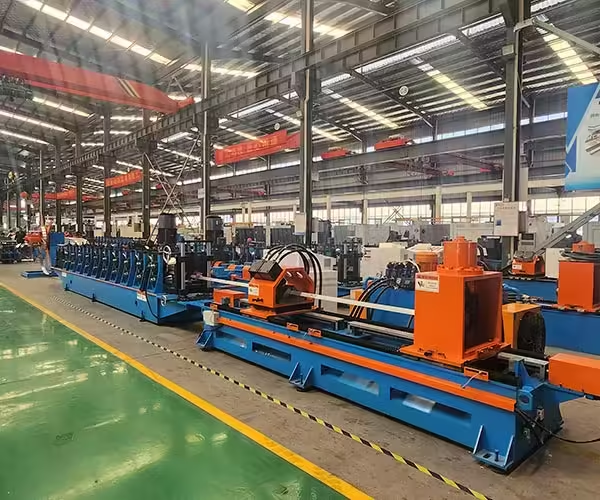
A steel formwork production line is a group of connected machines used to manufacture metal formwork components for concrete construction. These components create temporary molds that support fresh concrete until it develops sufficient strength.
The exact equipment configuration depends on the panel design, material thickness, rib arrangement, connection method, hole pattern, and production target.
Main Products
A production line may manufacture:
- Flat steel formwork panels
- U-shaped formwork panels
- Corner panels
- Ribbed panels
- End plates
- Connecting components
- Customized formwork profiles
- Supporting structural parts
Not every line produces all these products. The buyer should define the required product family before requesting a quotation.
Main Manufacturing Processes
Typical production stages include:
- Coil or sheet loading
- Leveling
- Servo feeding
- Hole punching
- Length cutting
- Roll forming
- Edge bending
- Rib positioning
- Welding
- Straightening
- Surface preparation
- Coating or painting
- Inspection
- Stacking and packaging
A complete steel formwork production line should be designed as a coordinated process rather than a collection of unrelated machines.
Semi-Automatic vs Fully Automatic Production Lines
The difference between semi-automatic and fully automatic equipment is not always absolute. A line may automate feeding and forming while still requiring manual welding, inspection, or material transfer.
Buyers should therefore examine the automation level of every production stage.
| Comparison factor | Semi-automatic line | Fully automatic line |
|---|---|---|
| Initial investment | Generally lower | Generally higher |
| Labor requirement | Higher | Lower for repetitive handling |
| Production volume | Small to medium | Medium to high |
| Product flexibility | Often easier for varied orders | Best for standardized product families |
| Process consistency | More dependent on operators | More controlled by programmed systems |
| Changeover | May require manual adjustment | May use stored recipes and automatic positioning |
| Data collection | Usually limited | Can include production and fault records |
| Factory layout | Relatively flexible | Requires carefully planned material flow |
| Maintenance | Simpler equipment structure | More sensors and control systems |
| Best application | Mixed or developing production | Stable, repeated industrial production |
The better configuration is the one that fits the factory’s orders, operators, maintenance resources, and financial plan.
How a Semi-Automatic Steel Formwork Line Works
A semi-automatic line combines powered machinery with manual loading, positioning, transfer, or inspection. Operators remain closely involved in moving components between processes.
This configuration can provide useful production capability without the cost of full line integration.
Manual Material Transfer
Panels may be transferred between forming, punching, welding, and inspection stations using operators, carts, cranes, or forklifts.
Manual transfer creates flexibility but can increase waiting time and the risk of surface damage.
Independent Machine Controls
Each machine may have its own operating panel. The punching, forming, cutting, and welding processes are controlled separately rather than through one central production system.
Operator-Based Adjustments
Operators may manually adjust guides, stops, roll clearances, welding fixtures, and cutting positions.
Advantage for Varied Orders
Manual adjustment can be useful when product designs change frequently. Experienced operators can adapt the process without reprogramming a complete automated line.
How a Fully Automatic Steel Formwork Production Line Works
A fully automatic line connects major processes through synchronized controls and automated material handling. Product data can be entered or selected through a central control interface.
Material then moves through the planned manufacturing sequence with reduced manual intervention.
Centralized Control
A programmable control system coordinates feeding, punching, forming, cutting, conveying, welding, and stacking.
The operator can monitor production status, alarms, quantities, and selected machine parameters.
Automated Material Handling
Conveyors, transfer units, robots, or positioning mechanisms move panels between production stages.
This reduces repetitive lifting and helps maintain a predictable production rhythm.
Production Recipe Storage
The control system may store parameters for different formwork specifications. Saved recipes can reduce setup time and manual data entry.
Traceable Production Data
Depending on the line configuration, the system may record output, equipment status, downtime, energy use, alarms, and product batches. Buyers should confirm exactly which information is available.
Which Production Stages Should Be Automated?
Full automation does not always mean that every factory process requires a robot. The most valuable automation normally targets repetitive, labor-intensive, or accuracy-sensitive tasks.
Coil Loading and Feeding
A powered uncoiler and leveling system can feed material continuously into the line. Automatic control helps maintain stable strip tension and position.
Servo Punching
A servo feeder positions the material according to a programmed hole pattern. This can improve the repeatability of holes, slots, and notches.
Roll Forming
Roll forming continuously bends the steel into the required panel or profile shape. Automatic speed and drive coordination support stable production.
Cutting
A programmed cutting system separates products according to their required length. The cutting position should be coordinated with punching references.
Robotic Welding
Robotic welding may be used when ribs, frames, or other components have repeatable positions and joint designs.
When Robotic Welding Is Suitable
Robotic welding is most effective when products are standardized, fixtures are accurate, and component preparation is consistent. It may deliver less value when every panel has a different welding layout.
Automatic Stacking
Stacking equipment can collect and organize finished panels. It reduces manual handling and helps prevent production congestion at the end of the line.
Material Requirements for Steel Formwork Production
A steel formwork production line should be designed according to the actual metal specification. Strip thickness alone does not provide enough information.
Material grade, yield strength, surface condition, width, and thickness tolerance all affect the equipment design.
Carbon Steel
Carbon steel is commonly used because it offers a practical balance of strength, formability, availability, and cost.
The supplier needs the specific grade and mechanical properties to calculate forming and punching requirements.
High-Strength Steel
High-strength material may support lighter or more efficient product designs, depending on engineering requirements. However, it can increase forming loads and springback.
The machine may require stronger shafts, frames, bearings, drives, and roll tooling.
Galvanized or Coated Steel
Coated material may be selected when additional corrosion protection is required. Tooling, guides, and material-handling equipment should minimize coating scratches.
Material Thickness
Thicker material requires greater punching, forming, cutting, and welding capacity. Very thin material may be more sensitive to waves, distortion, and handling damage.
Submit a Complete Material Schedule
The buyer should provide every important material grade and thickness combination, including the products expected to represent most production volume.
Product Design and Tooling Requirements
Machine design begins with the finished formwork component. The supplier should receive approved drawings rather than approximate dimensions or reference photos.
Panel Width and Depth
Panel dimensions determine roll positions, machine width, material requirements, and handling systems.
Edge Geometry
Edges may include returns, flanges, hooks, channels, or other connection features. Complex edges generally require more forming stages.
Hole Patterns
Holes and slots may support panel connections, alignment, lifting, or accessories. Their size, spacing, and orientation should be shown clearly on the drawing.
Reinforcing Ribs
Ribs increase panel rigidity and may be formed separately before being welded to the main panel.
Welding Fixture Design
Fixtures must hold the panel and ribs in the correct position during welding. Poor fixture accuracy can lead to dimensional variation even when the forming equipment is precise.
Roll Forming vs Press Brake Forming
Steel formwork components may be shaped through continuous roll forming or individual press brake operations.
Each method serves different production conditions.
| Selection factor | Roll forming | Press brake forming |
|---|---|---|
| Production method | Continuous | Individual bending cycles |
| Best volume | Medium to high | Low to medium |
| Product length | Efficient for long profiles | Limited by machine and handling |
| Repeatability | High with stable tooling | Depends more on setup and operator |
| Tooling investment | Higher initial tooling requirement | Lower for simple profiles |
| Product flexibility | Best for defined profile families | Flexible for varied bends |
| Production speed | High for repeated profiles | Slower for multiple bend operations |
| Integration | Easy to connect with feeding and cutting | Usually a separate process |
A factory may use both methods. Roll forming can handle repeated panels, while a press brake supports prototypes, special components, and low-volume accessories.
Punching Before or After Forming
Punching location affects die access, hole position, forming behavior, and production flow.
Pre-Punching
Pre-punching creates holes while the metal remains flat. The strip is easier to support and position.
Servo pre-punching is suitable for repeated holes and several programmed product lengths.
Post-Punching
Post-punching creates holes after the panel or profile is formed. This may help position features relative to the final geometry.
Special fixtures may be necessary to prevent deformation.
Choosing the Correct Method
The decision should consider:
- Hole location
- Bend-line distance
- Profile shape
- Required tolerance
- Material thickness
- Production speed
- Die accessibility
Hole Deformation Risk
Holes located too close to a bend may deform during roll forming. The product and tooling design should be reviewed before the machine is manufactured.
Welding Automation and Production Capacity
Welding is frequently one of the most important capacity factors in steel formwork manufacturing. A high-speed forming machine may create more panels than the welding section can process.
Buyers should calculate the total weld length and cycle time for each product.
Manual Welding
Manual welding provides flexibility for different panel designs and small production quantities.
Its speed and consistency depend heavily on operator skill, fixture quality, and production management.
Dedicated Automatic Welding
Dedicated welding equipment follows a programmed path or fixed joint position. It can be efficient for stable products with repeatable weld layouts.
Robotic Welding
Industrial robots can process several seams and component positions when suitable fixtures and programs are available.
Welding Distortion
Heat input can cause panels to bend or twist. Welding sequence, fixture design, heat control, and straightening requirements should be evaluated as part of the production line.
Real Production Capacity vs Maximum Machine Speed
Production capacity should be calculated from qualified finished panels rather than the speed of one machine.
Punching, forming, welding, transfers, inspection, changeovers, and maintenance all affect daily output.
Cycle Time
Cycle time is the total time required to manufacture one finished component or batch.
For a complete steel formwork production line, the slowest essential process usually determines overall output.
Operating Efficiency
Factories should allow for:
- Coil changes
- Machine setup
- Product changeovers
- Welding adjustments
- Maintenance
- Quality inspections
- Material delays
- Operator breaks
- Unplanned downtime
Product Yield
Scrap, trial pieces, welding defects, dimensional rejects, and surface damage reduce saleable output.
Capacity Formula
A simplified calculation is:
Saleable output = Theoretical production rate × Available operating time × Efficiency × Product yield
A realistic capacity estimate should use actual product drawings and production processes.
Semi-Automatic vs Automatic Line Cost Comparison
The lowest purchase price does not always produce the lowest manufacturing cost.
A complete comparison should consider investment, labor, output, scrap, maintenance, and expected equipment utilization.
Initial Equipment Cost
Semi-automatic equipment usually requires a lower initial investment because it contains fewer automated handling and control systems.
A fully automatic line may include additional conveyors, robots, sensors, safety systems, and centralized controls.
Labor Cost
Automatic equipment can reduce repetitive loading, positioning, welding, and stacking tasks.
However, skilled technicians are still needed for setup, maintenance, troubleshooting, programming, and quality management.
Maintenance Cost
A complex line includes more electrical, hydraulic, pneumatic, and control components.
The buyer should evaluate access to replacement parts and technical support.
Scrap and Rework
Improved feeding, positioning, and process control may reduce errors. The financial value depends on material cost and current defect levels.
Payback Should Use Real Factory Data
Calculate the payback period using actual labor rates, production volume, operating hours, product value, and expected equipment utilization. Avoid relying on a general payback promise.
How to Choose the Right Automation Level
The appropriate automation level depends on both current production and realistic future demand.
Choose a Semi-Automatic Line When:
- Order quantities are relatively small
- Product designs change frequently
- Initial investment is limited
- Labor is readily available
- Operators have strong fabrication skills
- The factory is entering the market gradually
- Manual processes provide useful flexibility
Choose a Fully Automatic Line When:
- Production volume is consistently high
- Products are standardized
- Labor availability is limited
- Repeatability is a high priority
- Several processes can be integrated
- Production data is required
- The factory has technical maintenance resources
Consider Modular Automation
A modular steel formwork production line allows the factory to automate selected processes first and add other systems later.
Plan Interfaces in Advance
If future automation is expected, confirm that the initial machines include suitable control, communication, layout, and material-transfer interfaces.
Information Required for a Machine Quotation
A detailed project specification helps the equipment supplier prepare an accurate line configuration.
Product Information
Provide:
- Finished panel drawings
- Profile cross-sections
- Panel dimensions
- Rib and frame designs
- Hole patterns
- Welding locations
- Finished-product tolerances
- Required surface condition
Material Information
Provide:
- Material grade
- Yield and tensile strength
- Thickness range
- Sheet or strip width
- Coil dimensions
- Maximum coil weight
- Coating or surface condition
Production Information
Provide:
- Products per shift
- Shifts per day
- Annual production target
- Main product types
- Average batch quantity
- Frequency of changeovers
- Required level of automation
Factory Information
Provide:
- Available floor area
- Building height
- Power supply
- Compressed air availability
- Crane and forklift capacity
- Material-flow plan
- Number of available operators
You can review Jinbolida’s steel formwork production line solutions when planning the main equipment and process layout.
Factory Acceptance Test Checklist
Factory acceptance testing should evaluate the complete production process before shipment.
Testing only individual machine movement does not prove that the line can produce qualified formwork panels.
Verify Major Processes
The test should include:
- Material feeding
- Leveling
- Punching
- Forming
- Cutting
- Component positioning
- Welding, when included
- Product transfer
- Stacking
- Safety systems
Inspect Finished Products
Measure:
- Panel width and length
- Edge dimensions
- Hole positions
- Flatness
- Straightness
- Diagonal dimensions
- Rib location
- Welding quality
- Surface condition
Test Continuous Production
The line should produce multiple components continuously. This helps reveal feeding drift, heat accumulation, transfer delays, and repeatability issues.
Test Product Changes
If the line supports several panel sizes, the supplier should demonstrate the agreed adjustment or tooling-change process.
Record Acceptance Data
Record material specifications, machine settings, operating speed, finished measurements, changeover time, and any corrective actions.
Common Steel Formwork Equipment Buying Mistakes
Several purchasing mistakes can reduce productivity or create unexpected costs.
Automating an Unstable Process
Automation repeats the programmed process. If product drawings, welding methods, or material standards change constantly, the automated line may require frequent modification.
Comparing Only Total Price
Different quotations may include different machines, dies, fixtures, conveyors, robots, software, installation services, and spare parts.
Ignoring Welding Capacity
A fast forming line cannot reach its potential if the welding section becomes a bottleneck.
Failing to Plan Material Flow
Poorly arranged loading, transfer, inspection, and stacking areas can reduce the output of otherwise capable equipment.
Underestimating Maintenance Skills
Automatic lines require personnel who can inspect sensors, drives, controls, hydraulic systems, and communication faults.
Skipping Complete-Line Testing
Individual machines may operate correctly but fail to work efficiently when connected.
Conclusion
Choosing between a semi-automatic and fully automatic steel formwork production line requires a careful analysis of production volume, product variety, labor, factory layout, maintenance capability, and investment objectives.
Semi-automatic equipment offers flexibility and a lower initial cost. Fully automatic equipment can improve process coordination, repeatability, data collection, and labor efficiency when production is sufficiently standardized.
Before purchasing, define the complete product family, material range, welding process, production target, and acceptance requirements. Compare every quotation according to its complete equipment scope rather than total price alone.
Manufacturers can explore Jinbolida’s complete range of industrial production equipment and review its existing guide to optimizing structural steel fabrication. For a production-line proposal based on your panel drawings and capacity target, submit the project details through the contact page.
FAQ
What does a steel formwork production line manufacture?
It manufactures reusable steel panels, ribs, corners, channels, and related components used to create molds for concrete construction.
Is a fully automatic line always better?
No. Full automation is valuable for high-volume, standardized production. A semi-automatic line may be more economical and flexible for varied or smaller orders.
How many workers does the production line require?
Labor requirements depend on the automation level, product design, material handling, welding method, inspection process, and shift organization.
Can one production line make different panel sizes?
It may be possible through adjustable tooling, replaceable roll sets, programmable punching, and flexible cutting systems. The exact range must be confirmed from product drawings.
Is robotic welding suitable for every panel?
No. Robotic welding is most suitable for repeatable joint positions and standardized components. Highly customized panels may still require manual or flexible welding.
What determines production capacity?
Capacity depends on forming speed, punching cycles, cutting, welding time, material transfer, changeovers, operating efficiency, and product yield.
Can galvanized steel be used?
Yes, if the equipment and tooling are designed for the specified galvanized material. Surface protection and welding requirements should be evaluated.
What information is needed for a quotation?
Provide finished-product drawings, material specifications, production targets, automation requirements, factory conditions, and required testing standards.
How should a production line be tested?
Test the complete production cycle using representative material. Inspect dimensions, holes, forming quality, welding, surface condition, speed, and process repeatability.
Can a semi-automatic line be upgraded later?
Some systems can be upgraded with servo feeding, automatic transfer, robotic welding, data monitoring, or stacking equipment. Future interfaces should be planned during the initial design.
If you enjoyed this article on Jinbolida’s smart manufacturing and digital factory expertise, follow us for more insights and updates:
- 📘 Facebook: Stay tuned for our latest smart production line projects → Facebook
- 📱 WhatsApp: Contact us anytime for custom production solutions → Chat Now
- ▶️ YouTube: Watch our automated line demos and real-world applications → YouTube
Let’s keep innovating and shaping the future of smart manufacturing — together!
 English
  Arabic
  Russian
  Spanish
  French