
Steel Processing for Cold Mill Applications: Key Steps and Equipment Insights
/ Steel Processing for Cold Mill Applications: Key Steps and Equipment Insights
Precision, surface quality, and mechanical performance are critical in modern steel production. Unlike hot rolling, steel processing for cold mill applications produces steel sheets with extremely tight thickness tolerances, superior flatness, and enhanced mechanical properties.
From automotive panels to appliance bodies and high-precision packaging steel, cold-rolled steel is indispensable. Its production involves highly controlled processes that transform hot-rolled coils into sheets ready for industrial use.
According to the World Steel Association, cold-rolled steel accounts for over 20% of global flat steel production, reflecting its high value in precision applications.This article explores all key steps, machinery, and concepts that make cold mill processing efficient, precise, and reliable.
Table of Contents
Key Takeaways
- Comprehensive overview of steel processing for cold mill applications
- Step-by-step breakdown from coil preparation to final packaging
- Detailed explanation of all relevant equipment: leveling machines, cold mills, annealing lines, skin-pass mills
- Conceptual analysis: reduction ratios, work hardening, surface finish, ductility
- Data-supported comparisons of cold vs. hot mill processing
- Expert opinions and industrial benchmarks
- FAQ section with conversational, Google-search-friendly questions
Step 1: Coil Preparation
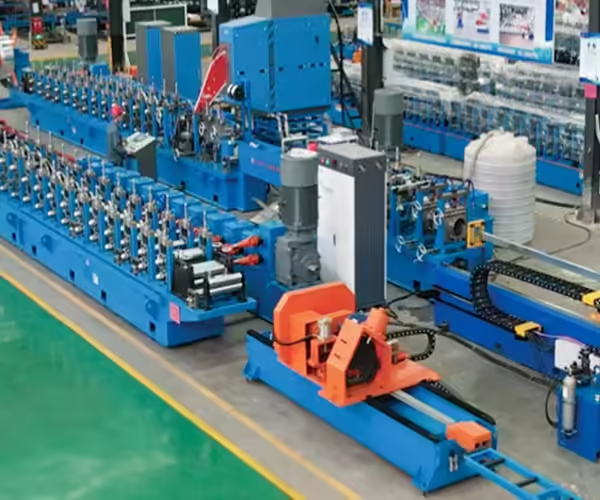
Uncoiling and Leveling
Steel coils are uncoiled and flattened to remove curvature and stresses.
Equipment Used: Coil leveling machines, uncoilers.
Concept: Coil Memory
Coil memory is the steel’s tendency to retain the curved shape from coiling. Proper leveling ensures smooth feed into the cold mill, preventing misalignment, wrinkling, or roll damage.
Data Insight
- Residual stress reduction after leveling can exceed 60%, improving downstream roll life and sheet uniformity.
Edge Trimming
Edges are trimmed using high-speed slitting or precision trimming machines.
Ensures smooth coil entry and prevents defective edges during rolling.
Concept: Edge Quality
High edge quality directly improves:
- Surface finish
- Roll lifespan
- Dimensional accuracy of final sheets
Step 2: Cold Rolling

Pass Scheduling
Steel is reduced in thickness through multiple passes in tandem or reversing mills.
The number of passes and reduction per pass are carefully calculated.
Concept: Reduction Ratio
Reduction ratio = (Initial thickness − Final thickness) / Initial thickness
High reduction ratios improve strength but risk excessive work hardening.
Data Example
- Mild steel (0.2% carbon): typical reduction per pass ~15–20%
- Final thickness precision: ±0.01–0.03 mm
Cold Mill Equipment
Tandem Cold Mills
- Multiple rolling stands in sequence for high throughput
- Capable of producing 2–6 mm sheets at 200–300 m/min
- Ideal for automotive-grade steels
Reversing Cold Mills
- Single stand with reversible rolling direction
- Flexible for specialty products
- Allows controlled reduction for thickness-sensitive applications
Lubrication in Cold Rolling
Lubricants reduce friction between rolls and steel.
They also dissipate heat and prevent scratches.
Concept: Lubrication Film
A thin, uniform film ensures consistent thickness and protects both rolls and steel surface.
Step 3: Annealing
Purpose of Annealing
Cold rolling increases hardness and reduces ductility. Annealing restores ductility and relieves internal stresses.
Types of Annealing
- Batch Annealing: Slow, uniform heating; ideal for small-batch or specialty steels
- Continuous Annealing: High throughput; precise temperature control for automotive or appliance steel
Data Insight
Continuous annealing lines can achieve 0.1–0.3% thickness variation while restoring 95% of ductility lost during cold rolling.
Annealing Equipment
- Batch furnaces for medium production
- Continuous annealing lines with high-precision heating zones
- Integrated cooling sections for controlled microstructure formation
Expert Quote:
“Proper annealing is the most critical step in cold mill processing. It balances strength, ductility, and surface quality.” – John Matthews, Metallurgical Engineer
Step 4: Temper Rolling (Skin-Pass)
Purpose
- Improves surface smoothness
- Adjusts mechanical properties
- Reduces residual stresses
Concept: Skin-Pass
A light rolling (~1–2%) ensures flatness and prepares steel for final coating or finishing.
Equipment
- Skin-pass mills with adjustable roller pressure
- Often integrated after annealing lines for continuous processing
Step 5: Surface Finishing
Cleaning and Pickling
Acid pickling removes oxides and mill scale.
Ensures high adhesion for painting or galvanizing.
Concept: Surface Quality
Surface smoothness is essential for automotive panels and decorative steel.
Coating and Galvanizing
Cold-rolled steel sheets may be coated with zinc, chrome, or paint for corrosion resistance.
Cold mill processing ensures a uniform, smooth surface for coating adherence.
Step 6: Slitting, Cutting, and Packaging


Slitting
Coils are slit to width specifications using rotary slitters or shear lines.
Precision prevents customer complaints and downstream forming issues.
Cut-to-Length Shearing
Sheets are cut to exact lengths for stamping or fabrication.
Tolerance typically ±0.5 mm.
Packaging
- Wrapping with protective film
- Steel banding to maintain coil integrity
- Minimizes transport damage and preserves surface finish
Step 7: Quality Control
Thickness and Flatness Measurements
- Laser or X-ray gauges monitor real-time thickness
- Flatness measured using roller tables or sensors
Surface Inspection
- Visual inspection for scratches, pits, or scale
- Automated camera systems detect defects at high speeds
Data Benchmark
Top-tier cold mill lines achieve >99% defect-free output for automotive-grade sheets.
Step 8: Process Optimization and Troubleshooting
Common Challenges
- Coil misalignment
- Surface scratches
- Thickness variations
- Work hardening-induced cracking
Optimization Strategies
- Adjust lubrication type and flow
- Fine-tune roll gap and tension
- Use predictive maintenance on mill equipment
- Monitor reduction ratios and pass schedule carefully
Expert Tip:
“Predictive control systems can reduce thickness variability by up to 40% in modern cold mills.” – Dr. Maria Chen, Process Engineer
Step 9: Cold Mill Process Comparison Table
To better understand the function of each step and piece of equipment, a comparison table of key process parameters is provided below:
| Step | Equipment | Key Parameters | Purpose | Notes |
|---|---|---|---|---|
| Coil Prep | Leveling Machine | Residual stress <40% | Remove coil memory | Ensures smooth feed |
| Edge Trimming | Slitting Machine | Edge width ±0.5 mm | Smooth coil edges | Prevents roll damage |
| Cold Rolling | Tandem/Reversing Mill | Thickness 0.2–6 mm, speed 200–300 m/min | Reduce thickness | High precision & uniformity |
| Annealing | Batch/Continuous Furnace | Temp 600–700°C, dwell time varies | Restore ductility | Relieves stress |
| Skin-Pass | Skin-Pass Mill | 1–2% reduction | Improve flatness & surface | Prepares for coating |
| Surface Finish | Pickling/Coating Line | Surface roughness Ra <0.2 µm | Scale removal & coating prep | Essential for automotive/appliance |
| Slitting & Shearing | Rotary Slitter / Shear | Width ±0.5 mm | Final size prep | Customer specification |
Comparison: Cold Mill vs. Hot Mill Processing
| Feature | Cold Mill | Hot Mill |
|---|---|---|
| Surface Finish | High-quality, smooth | Rough, oxidized |
| Thickness Tolerance | ±0.01–0.03 mm | ±0.1–0.5 mm |
| Strength | Increased due to work hardening | Lower |
| Thickness Range | 0.2–6 mm | >6 mm |
| Typical Applications | Automotive, appliance, packaging | Structural, heavy plate |
Step 10: Emerging Technologies in Cold Mill Applications
AI and Automation
- Real-time thickness control via machine learning
- Predictive maintenance reduces downtime
- Automatic defect detection for surface quality
High-Precision Rollers
- Enhanced roll coatings reduce wear
- Nanotextured rollers improve friction control
- Reduce defects by 20–30%
Sustainability
- Water recycling in lubricating systems
- Energy-efficient furnaces
- Reduced chemical waste in pickling
Conclusion
Steel processing for cold mill applications is a complex, multi-step operation involving precise equipment, careful planning, and skilled execution. From coil preparation and rolling to annealing, skin-passing, surface finishing, and final packaging, each step plays a crucial role in achieving high-quality, dimensionally accurate, and mechanically reliable steel sheets.
Modern cold mills integrate advanced technology, predictive control, and process expertise to meet the rigorous demands of automotive, appliance, and industrial steel users. Understanding these key steps, equipment, and process innovations ensures manufacturers produce steel that consistently meets tight tolerances, excellent surface quality, and superior performance.
FAQ
1. Why is cold rolling preferred for certain steels?
It produces superior surface finish, tighter tolerances, and increased strength through work hardening.
2. What equipment is essential for cold mill applications?
Leveling machines, tandem/reversing mills, annealing lines, skin-pass mills, pickling lines, and slitting/shearing equipment.
3. How does annealing affect steel properties?
It restores ductility, relieves internal stress, and prepares steel for forming or coating.
4. What is the difference between tandem and reversing mills?
Tandem mills are fast and high-volume; reversing mills allow precise control for specialty products.
5. How is surface quality maintained in cold mills?
Lubrication, proper roll alignment, skin-pass rolling, and pickling remove scale and scratches.
6. Can cold mill processing improve mechanical properties?
Yes—work hardening, temper rolling, and annealing optimize strength, ductility, and uniformity.
If you enjoyed this article on Jinbolida’s smart manufacturing and digital factory expertise, follow us for more insights and updates:
- 📘 Facebook: Stay tuned for our latest smart production line projects → Facebook
- 📱 WhatsApp: Contact us anytime for custom production solutions → Chat Now
- ▶️ YouTube: Watch our automated line demos and real-world applications → YouTube
Let’s keep innovating and shaping the future of smart manufacturing — together! 🚀
 English
  Arabic
  Russian
  Spanish
  French