
Bracket for PV System Trends: What Buyers and Manufacturers Should Watch in 2026
/ Bracket for PV System Trends: What Buyers and Manufacturers Should Watch in 2026
Table of Contents
A photovoltaic mounting structure may look simple, but it has to carry modules securely through years of wind, snow, temperature changes, moisture, and mechanical stress. As solar projects expand into more demanding environments, the bracket for PV system is evolving from a basic metal support into a precision-engineered component.
This article explains the trends shaping bracket design, production, material selection, and procurement in 2026. It is intended for solar project developers, mounting-system suppliers, metal fabricators, production-line investors, and buyers comparing different photovoltaic support solutions.
Key takeaways:
- Lightweight profiles are reducing material consumption without removing essential structural capacity.
- Bifacial modules, larger panels, and solar trackers are changing bracket dimensions and connection designs.
- Galvanized steel, aluminum, and coated high-strength steel serve different project environments.
- Automated roll forming and inline punching are improving profile consistency and manufacturing speed.
- Modular systems are becoming more attractive because they simplify transportation and installation.
- Buyers are paying more attention to wind load, snow load, corrosion resistance, and traceable quality records.
- Manufacturing flexibility is becoming an important competitive advantage as project specifications diversify.
- The lowest bracket price does not always produce the lowest lifetime project cost.
Why Bracket for PV System Design Is Changing
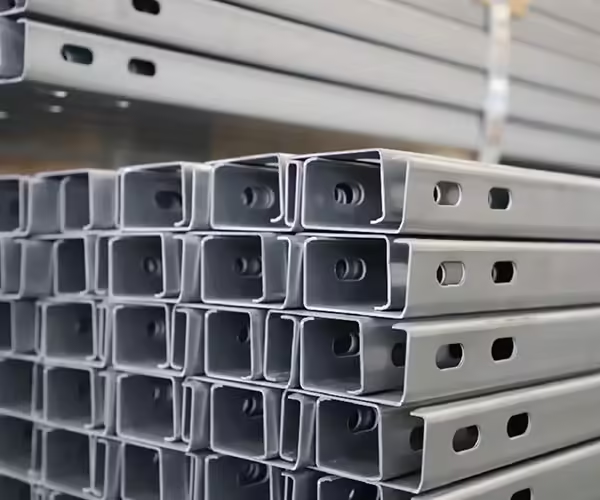
Global solar deployment continues to increase. The International Energy Agency expects solar PV to represent nearly 80% of worldwide renewable capacity expansion between 2025 and 2030, creating demand not only for modules but also for reliable mounting components and efficient manufacturing capacity (IEA renewable electricity outlook).
At the same time, modules are becoming larger, projects are being built in more complex locations, and installers are expected to finish work faster. These changes place new requirements on every bracket for PV system, from the cross-section of a rail to the position of its mounting holes.
Larger Solar Modules
Larger modules can reduce the number of panels and electrical connections needed for a given project capacity. However, their dimensions may increase bending moments and place different forces on clamps, rails, posts, and fasteners.
Bracket manufacturers therefore need to confirm module dimensions, clamping zones, design loads, and attachment locations before finalizing a profile. Simply enlarging an older bracket is rarely the most efficient engineering solution.
Faster Project Installation
Labor availability and installation time have become significant project considerations. A mounting system with fewer parts, pre-punched connections, and repeatable positioning can reduce work at the project site.
This trend favors standardized slots, tool-friendly fasteners, modular rails, and components that are easy to identify. Manufacturing accuracy is especially important because small hole-position errors can accumulate across a long array.
More Challenging Installation Environments
Solar arrays are increasingly installed on industrial roofs, agricultural land, carports, water-adjacent sites, and locations exposed to snow, salt, sand, or high winds. The same bracket design cannot be assumed to perform equally well in all these conditions.
Site-specific structural calculations remain necessary. The U.S. Department of Energy also emphasizes the role of fastened joints—including bolts, clips, and brackets—in maintaining PV system resilience during severe weather (DOE severe-weather PV design guidance).
Leading Bracket for PV System Trends in 2026
1. Lightweight, High-Strength Profiles
Reducing bracket weight can lower raw-material use, freight costs, and manual handling requirements. The goal, however, is not simply to use thinner metal; it is to place material where it contributes most effectively to stiffness and load resistance.
Optimized C, U, and custom channel profiles may use reinforcing ribs, folded edges, or carefully controlled section geometry. A suitable design should be supported by structural calculations, production tolerances, and project-specific load requirements.
Profile Optimization
Profile optimization adjusts the shape, thickness, and reinforcement features of a metal section to achieve a required performance level. It can help reduce unnecessary mass while maintaining appropriate mechanical capacity.
Reliable optimization requires accurate forming equipment. Uncontrolled springback, twisting, or dimensional variation can weaken connections and make field assembly more difficult.
2. Greater Use of Modular Bracket Systems
Modular mounting structures use standardized components that can be combined for different array lengths, module formats, or site layouts. This approach can reduce the number of unique parts in inventory and make replacement components easier to manage.
For buyers, modularity may also shorten installation time. For manufacturers, however, it increases the importance of consistent hole patterns, connector compatibility, and repeatable profile dimensions.
Interchangeable Components
An interchangeable component can be used across more than one product configuration without extensive reworking. Examples include standardized splice plates, clamps, connectors, and slotted support profiles.
Interchangeability should be verified rather than assumed. Material grade, coating thickness, fastener type, and allowable load may still differ between systems that look similar.
3. Brackets Designed for Bifacial Modules
Bifacial solar modules produce electricity from light reaching both the front and rear surfaces. Their mounting structures should therefore minimize unnecessary rear-side shading while maintaining secure clamping and suitable clearance.
This is encouraging the use of narrower rails, optimized torque tubes, repositioned supports, and reduced obstruction behind the module. The exact design depends on array height, ground reflectivity, row spacing, and tracker or fixed-tilt configuration.
Rear-Side Shading Control
Rear-side shading occurs when rails, beams, cables, or other components block reflected light from reaching a bifacial module. Even structurally small components can affect the uniformity of rear irradiance.
Bracket selection should consequently consider both mechanical performance and energy yield. A structural change should never be made only to reduce shading without checking the resulting load path.
4. Advanced Corrosion Protection
A bracket for PV system may remain outdoors for decades, making corrosion resistance a purchasing priority. Current solutions include hot-dip galvanizing, pre-galvanized steel, zinc-aluminum-magnesium coatings, anodized aluminum, and project-specific protective finishes.
The correct choice depends on exposure conditions, base-metal compatibility, fabrication method, cut-edge behavior, and required service life. Coastal, industrial, and high-humidity sites normally require more detailed corrosion evaluation than mild inland locations.
Coating Continuity
Coating continuity describes whether protective coverage remains consistent across surfaces, bends, holes, edges, and connection areas. Damage during punching, cutting, transport, or installation may create localized corrosion risks.
Buyers should ask how exposed edges are treated and how coating quality is inspected. A coating name alone does not define the durability of the completed part.
5. Automated Roll Forming and Inline Punching
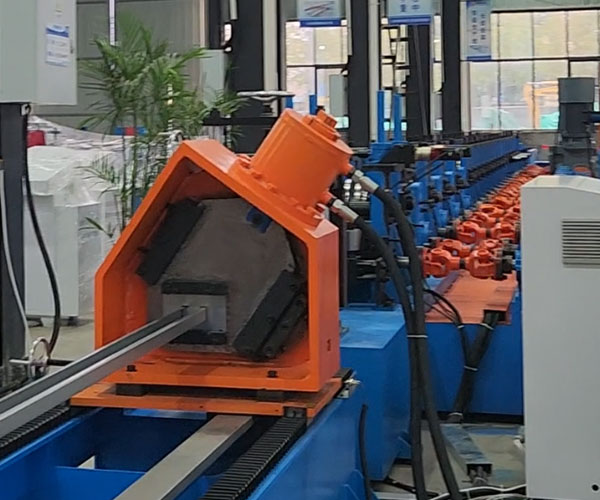
Automation is one of the most important production trends behind modern photovoltaic mounting components. A coordinated line can feed metal coil, level material, punch slots, roll-form the profile, cut it to length, and record production information.
Manufacturers planning new capacity can explore Jinbolida’s solar photovoltaic bracket forming machines for C-shaped, U-shaped, and customized mounting profiles. Projects requiring frequent holes, slots, or connection features may also benefit from dedicated solar photovoltaic rack punching equipment.
Inline Punching
Inline punching places the hole-making process within the forming line. It can reduce material transfers, manual handling, and work-in-progress inventory when a product has stable, repeatable patterns.
The system must synchronize feeding length, punching position, and cutting accurately. Buyers can compare the two production approaches in Jinbolida’s guide to inline versus separate solar bracket punching systems.
Flexible Tooling
Flexible tooling helps a production line accommodate multiple lengths, slot patterns, or related profile sizes. Servo-controlled feeding and programmable operations make smaller batches easier to manage.
The practical level of flexibility depends on the profile geometry. Some product changes may need only a software recipe, while others require roll-tool, punching-die, spacer, or guide adjustments.
6. Digital Quality Control and Traceability
More buyers now expect measurable evidence of production quality rather than a general statement that a bracket is “high quality.” Useful records may include coil batch information, material certificates, dimensional inspection results, coating data, and production timestamps.
Digital traceability makes it easier to investigate deviations and connect finished components with their source materials. It also supports repeat orders when customers need identical profiles months later.
Dimensional Inspection
Dimensional inspection verifies features such as width, height, thickness, hole spacing, straightness, twist, and cut length. These dimensions affect whether the bracket can connect smoothly with modules, rails, posts, and fasteners.
Inspection frequency should reflect production speed and the critical nature of each dimension. First-piece inspection alone may not detect variation that develops later because of tool wear or coil changes.
7. Manufacturing for More Than One Mounting Application
A modern production line may need to supply rooftop arrays, fixed ground mounts, carports, agricultural installations, or tracker components. Each application creates a different combination of weight, load, corrosion, and assembly requirements.
Manufacturing flexibility can protect an investment when customer demand changes. Jinbolida’s article on C versus U solar mounting profiles provides a useful starting point for factories comparing common section types.
Material Comparison for PV Brackets
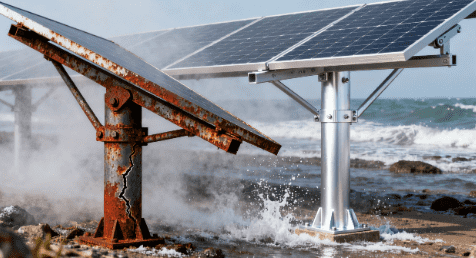
Material choice should be based on structural calculations, environmental exposure, manufacturing requirements, supply conditions, and total project cost. The following table provides a general comparison rather than a substitute for engineering verification.
| Material option | Main advantages | Important limitations | Typical applications |
|---|---|---|---|
| Hot-dip galvanized steel | High strength, familiar fabrication methods, robust protective layer | Heavier than aluminum; cut or welded areas need attention | Ground mounts, posts, heavy-duty frames |
| Pre-galvanized steel | Efficient for roll forming and volume production | Coating specifications and cut-edge protection must be checked | C channels, U channels, rooftop rails |
| Zn-Al-Mg coated steel | Strong corrosion performance with potential material efficiency | Availability, forming behavior, and coating requirements vary | Lightweight profiles and exposed installations |
| Aluminum alloy | Low weight and natural corrosion resistance | Higher material cost in some markets; galvanic contact must be managed | Rooftop rails, clamps, lightweight structures |
| Stainless steel | Strong corrosion resistance for suitable grades | Higher cost and different forming/tooling requirements | Fasteners, clips, highly corrosive locations |
Steel or Aluminum: Which Is Better?
Steel generally provides high strength and stiffness at a competitive material cost. It is often preferred for ground-mounted structures, long spans, and heavily loaded components.
Aluminum is lighter and can simplify rooftop handling while offering good corrosion resistance. The better option depends on the complete system—not just price per kilogram.
Fixed Brackets or Tracking Structures?
Fixed mounting systems use a set orientation and contain fewer moving components. They are usually simpler to install and maintain, making them suitable for many rooftops and fixed ground arrays.
Tracking systems rotate modules to follow the sun and may improve energy collection under suitable conditions. They also introduce moving connections, drive components, torque tubes, and more complex load cases, so component selection and manufacturing accuracy become especially important.
How Modern Manufacturing Supports Bracket Trends
Roll Forming for Consistent Profiles
Roll forming gradually shapes coiled metal through a sequence of forming stations. It is well suited to long sections with consistent cross-sections and can support high-volume bracket production.
A production-line buyer should evaluate forming speed, station design, shaft and roller quality, expected tolerances, changeover procedure, and after-sales support. Jinbolida’s overview of a PV panel bracket production line explains how feeding, punching, forming, and cutting processes work together.
Servo Feeding for Hole Accuracy
Servo feeding controls how far the strip advances before punching or cutting. Accurate feeding helps maintain repeatable hole spacing and reduces alignment problems during installation.
Performance should be evaluated under real production conditions. Coil behavior, line acceleration, slippage, tooling clearance, and control settings may all influence final accuracy.
Automated Cutting and Stacking
Automated cutting can produce programmed lengths without repeatedly stopping the complete line. Stacking or discharge systems then organize finished profiles for inspection and packaging.
These systems become more valuable as production volume increases. They can reduce manual handling, but the factory still needs safe procedures for sharp edges, long profiles, and heavy bundles.
What Buyers Should Check Before Ordering
Confirm the Project Load Conditions
Ask for design criteria covering wind, snow, dead load, seismic conditions where applicable, module size, array geometry, and support spacing. A bracket should be assessed as part of the complete mounting structure rather than as an isolated piece of metal.
Do not select a component solely because it worked on another project. Local building rules, terrain, roof structure, foundation design, and environmental conditions may be different.
Review Standards and Certifications Carefully
In North American applications, UL 2703 addresses mounting systems, mounting devices, clamping or retention devices, and grounding or bonding components used with flat-plate PV modules (UL mounting-system certification overview). Requirements vary by country and project, so buyers should confirm the exact applicable standard with the designer and local authority.
IEC 61215 relates to the design qualification and type approval of terrestrial PV modules rather than acting as a universal certification for every mounting bracket. Its scope can be reviewed through the IEC 61215-1 standard page. This distinction helps buyers avoid requesting irrelevant or incorrectly described certificates.
Ask for Material and Coating Documentation
A quotation should identify the base material, grade, thickness, coating type, coating mass or thickness where applicable, and dimensional tolerances. Material certificates and inspection records can provide greater confidence than marketing descriptions alone.
Also clarify whether quoted thickness refers to the base metal or the coated finished material. This small detail can affect both structural calculations and price comparisons.
Test Assembly Before Mass Production
A sample assembly can reveal interference, incorrect slot positions, clamp incompatibility, or difficult installation sequences. It is considerably less expensive to correct these problems before full production begins.
For a customized bracket for PV system, buyers should approve drawings, critical dimensions, hole patterns, and test samples in writing. Any later design revision should be controlled through a documented change process.
Bracket Purchasing Comparison: Lowest Price vs Total Value
| Purchasing factor | Lowest-price approach | Total-value approach |
| Material | Selects the cheapest quoted option | Confirms grade, thickness, traceability, and suitability |
| Coating | Compares coating names only | Reviews exposure conditions and complete coating specification |
| Tolerance | Accepts general tolerance statements | Identifies critical dimensions and inspection methods |
| Installation | Focuses on component price | Considers labor, alignment, fasteners, and assembly time |
| Packaging | Minimizes packaging expense | Prevents bending, coating damage, and mixed components |
| Supplier capability | Reviews the quotation only | Evaluates equipment, quality control, capacity, and support |
| Lifetime cost | Measures initial purchase cost | Considers maintenance, replacement risk, and project downtime |
A low unit price may be attractive when thousands of brackets are required. However, small dimensional errors or coating failures can create costs that exceed the original saving.
The most useful comparison therefore combines component cost with installation efficiency, logistics, expected durability, quality records, and supplier responsiveness.
How to Choose a Bracket Production Solution
Define the Product Family
Start with drawings or samples for every intended profile. Record material grade, strip thickness, finished dimensions, hole patterns, required lengths, annual output, and acceptable tolerances.
This information allows the equipment supplier to determine roll-station design, punching capacity, line speed, motor power, and changeover requirements. An unclear product range usually leads to an unclear machine proposal.
Compare Dedicated and Flexible Lines
A dedicated line is optimized for one stable product and can offer efficient high-volume output. It may be the right choice when order quantities are large and the profile rarely changes.
A flexible line handles more product variants but may require additional tooling and longer changeovers. Jinbolida’s guide to PV bracket factory solutions can help investors connect equipment selection with factory layout and production goals.
Calculate Real Output
Nominal line speed is only one part of productivity. Actual output also depends on punching frequency, cut length, coil change time, tooling adjustment, inspection, packaging, and unplanned downtime.
Ask equipment suppliers to calculate output using a representative bracket drawing. This produces a more meaningful comparison than a maximum speed measured without punching or cutting.
FAQ About Bracket for PV System Trends
What is the biggest PV bracket trend in 2026?
The strongest overall trend is the combination of lighter structural profiles and more automated production. Buyers want to reduce material and installation costs, while manufacturers need to maintain accurate dimensions and repeatable connection features.
How do I choose the right bracket for a solar project?
Begin with module dimensions, mounting method, roof or ground conditions, wind and snow loads, corrosion exposure, and applicable local codes. Then compare materials, profiles, fasteners, testing documentation, installation time, and supplier manufacturing capability.
Is a thicker solar bracket always stronger?
Not necessarily. Strength and stiffness depend on material grade, cross-sectional shape, support spacing, connection design, and load direction as well as thickness.
A thinner optimized profile may outperform a poorly designed thicker section in a specific application. Structural calculations and testing are more reliable than thickness comparisons alone.
What is the best material for PV mounting brackets near the coast?
There is no universal best material for every coastal project. Marine exposure may require a suitable aluminum or stainless-steel grade, an enhanced coated-steel system, compatible fasteners, and careful control of galvanic corrosion.
An engineer should evaluate distance from the coast, salt exposure, drainage, service-life target, and maintenance plan before the material is specified.
Can one roll forming machine produce both C and U brackets?
Some adjustable or combination lines can produce related C and U profiles, but capability depends on the difference between the sections. Major changes in width, depth, edge design, or thickness may require separate roller sets or dedicated equipment.
Provide exact drawings to the machine supplier before assuming that one tooling set can produce every profile.
Should bracket holes be punched before or after roll forming?
Pre-punching is efficient for repeatable patterns and can be integrated with servo feeding. Post-punching may be useful for some geometries or products where the forming process could affect hole shape and position.
The correct sequence depends on profile design, material, tolerance, production speed, and tooling arrangement.
How can I verify the quality of a PV bracket supplier?
Request material certificates, coating records, dimensional inspection reports, load-test information where required, equipment details, and sample products. Buyers should also confirm how nonconforming components are identified and how production batches are traced.
Are lightweight brackets safe for high-wind projects?
They can be, provided that the complete structure has been engineered and verified for the project conditions. “Lightweight” should result from optimized geometry and suitable materials, not from uncontrolled thickness reduction.
What information is needed to quote a PV bracket forming line?
A supplier normally needs bracket drawings, section dimensions, hole details, raw-material specifications, thickness range, product lengths, tolerance requirements, desired speed, electrical standard, and expected annual capacity. Sample parts are also useful when drawings do not fully describe the product.
Will modular brackets reduce installation costs?
Modular systems can reduce installation time when they use repeatable components, clear positioning, and compatible connections. Savings depend on the site layout, packaging, installer training, fastening method, and whether the components arrive in the correct sequence.
Preparing for the Next Generation of PV Mounting
The bracket for PV system is becoming lighter, more modular, more application-specific, and more precisely manufactured. These developments reflect a broader change in the solar industry: mounting components are now evaluated for installation efficiency, traceable quality, durability, and energy-system compatibility—not only for their purchase price.
For project buyers, the best strategy is to compare complete technical specifications and lifetime value. For manufacturers, success will increasingly depend on flexible roll forming, accurate punching, controlled materials, and production data that customers can verify.
Businesses preparing to expand bracket production can review Jinbolida’s solar photovoltaic bracket forming equipment or explore its detailed article on how PV bracket factories operate at industrial scale. Matching the production process to future profile, material, and quality requirements is the foundation for building a competitive photovoltaic mounting product line.
If you enjoyed this article on Jinbolida’s smart manufacturing and digital factory expertise, follow us for more insights and updates:
- 📘 Facebook: Stay tuned for our latest smart production line projects → Facebook
- 📱 WhatsApp: Contact us anytime for custom production solutions → Chat Now
- ▶️ YouTube: Watch our automated line demos and real-world applications → YouTube
Let’s keep innovating and shaping the future of smart manufacturing — together!
 English
  Arabic
  Russian
  Spanish
  French