
Máquina de soporte de montaje fotovoltaico para perfiles personalizados, C, U y C
Introducción
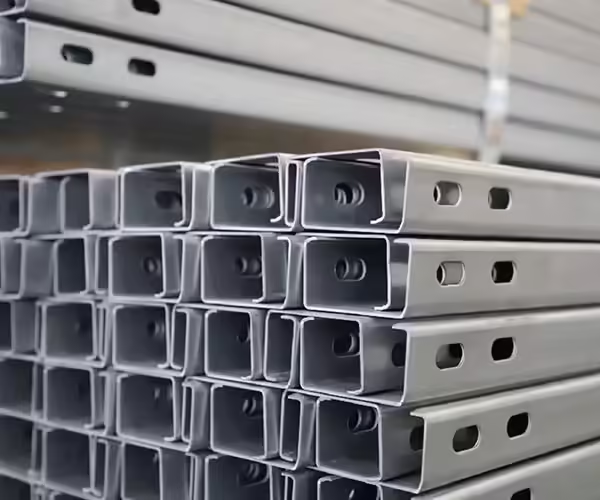
A PV mounting bracket machine is rarely selected simply by choosing between a C-channel and a U-channel. The finished profile determines the roll tooling, forming sequence, punching arrangement, cutting method, drive requirements, changeover strategy, production speed, and even the layout of the complete manufacturing line.
This becomes increasingly important when a factory needs to manufacture more than one photovoltaic support profile. A dedicated production line optimized for one C-channel can be highly efficient, but it may not be the best configuration for a manufacturer that frequently switches between U-channels, slotted rails, lipped profiles, ground-mount supports, or customer-specific sections.
The U.S. Department of Energy describes photovoltaic racking systems as the support structures used to hold PV modules on roofs or in fields and notes that ground-mounted racking commonly uses protected or galvanized steel. Because these profiles become part of the structural mounting system, their geometry, connection features, hole positions, and repeatability must be considered from the beginning of equipment design.
For manufacturers evaluating new equipos de fabricación de soportes fotovoltaicos, the most useful approach is therefore to start with the finished C, U, or custom profile and work backward to the required forming and punching system.
Conclusiones clave
- C-channel, U-channel, and customized PV mounting profiles can require significantly different roll tooling and forming sequences.
- One machine can sometimes manufacture several sizes or related profiles, but this does not automatically mean it can produce every C and U design.
- Profile geometry, material thickness, bend positions, lips, ribs, holes, and slots should be evaluated together.
- Dedicated production lines generally favor stable high-volume products, while adjustable or changeable tooling can support a broader product mix.
- Punching strategy may change according to the number of punched faces and the relationship between holes and finished bends.
- Real machine selection should be based on drawings, product mix, output requirements, changeover frequency, and acceptance criteria.
Why Profile Geometry Comes Before Machine Selection
A common RFQ begins with a question such as: “Can you provide a PV mounting bracket machine for C-channel and U-channel production?”
From an engineering perspective, this is only the starting point.
Two profiles described as C-channels may have different web widths, flange heights, return lips, ribs, slots, hole patterns, thicknesses, and materials. These differences affect how the metal must be gradually bent through the roll forming stations.
The same applies to U-shaped products. A simple open U-channel does not require the same forming sequence as a deeper section containing reinforced edges, longitudinal features, or complex punching.
For this reason, a machine supplier needs the actual finished profile drawing before determining the roller design, shaft configuration, station quantity, motor power, punching arrangement, and cutting tooling.
Jinbolida’s existing solar mounting bracket C vs U profile guide explains the structural differences between these two common profile families. For equipment selection, however, the next question is more specific: how do those profile differences change the machine itself?
How a PV Mounting Bracket Machine Forms the Profile
Roll forming gradually converts coiled metal into the required cross-section through a sequence of roller stations. Instead of creating the full shape in a single operation, each station introduces part of the required bend.
For a relatively simple profile, the forming path may be straightforward. As the number of bends, return lips, ribs, or asymmetric features increases, the forming sequence generally requires more careful control.
The objective is not merely to make the metal resemble the drawing. The line must repeatedly control the final width, height, angles, straightness, twist, cut length, and connection features while protecting the surface condition of the material.
El más amplio Máquina perfiladora para estructuras solares concept is particularly suitable for repeat manufacturing because the profile can be continuously produced from coil once the forming sequence and tooling have been correctly developed.
The exact production arrangement can also integrate decoiling, leveling, servo feeding, punching, forming, cutting, unloading, and digital control, depending on the bracket design and required automation.
C-Channel PV Mounting Bracket Machine Configuration
C-channel profiles are widely associated with photovoltaic support manufacturing, but the term covers a large range of possible cross-sections.
A basic C-profile normally contains a web and two flanges. Many solar support designs add return lips, slots, repeated mounting holes, or dimensional variations to suit a particular mounting structure.
These features influence the PV mounting bracket machine in several ways.
The roller set must control the formation of the web, flanges, and any return edges without creating excessive twist or distortion. If the profile contains lips, their forming sequence needs to be coordinated with the main flange bends. If several widths or depths are required, the equipment designer must determine whether adjustment is practical or whether separate tooling is more appropriate.
For manufacturers specifically producing this profile family, Jinbolida’s Máquina formadora de rollos de acero con canal C para soportes solares fotovoltaicos is a useful reference for the current equipment configuration. Its published specification lists production speed up to 45 m/min, ±1 mm precision, and a C-channel range with web height of 30–60 mm and base width of 50–160 mm.
Those numbers should not be treated as universal specifications for every C-profile project. Actual operating speed and achievable production output still depend on the customer’s material, hole pattern, cutting requirements, profile geometry, and complete line cycle.
The important point is that C-channel equipment can be designed around a defined working range rather than one single fixed dimension.
U-Channel PV Mounting Bracket Machine Configuration
U-channels may appear simpler because they do not always include return lips, but the machine still needs to be designed around the exact finished geometry.
A U-profile can vary in web dimension, side height, steel thickness, punched features, and connection method. Some products are used as rails or structural support members, while others may form part of a larger ground-mounted or rooftop system.
For a machine dedicated to U-channel production, the roll tooling focuses on controlling the gradual formation of the two sides relative to the web. Straightness and angular consistency become important because variation across a long profile can affect downstream assembly.
La corriente de Jinbolida Máquina formadora de acero con canal en U para soportes fotovoltaicos solares lists production speed up to 45 m/min and ±1 mm precision for its specified product range. The published U-shaped steel range is 41×21 mm to 41×82 mm.
Again, these figures describe the existing product configuration rather than every possible U-profile. A new project should be evaluated from its own drawing and material conditions.
This distinction matters because buyers sometimes assume that an existing U-channel machine can automatically manufacture any section with a U-shaped appearance. In practice, major changes in width, depth, thickness, or additional forming features can require different tooling or machine adjustments.
C-Channel vs U-Channel Machine Requirements
The differences can be summarized more clearly from an equipment perspective.
| Machine Factor | Perfiles de canal C | Perfiles de canal U | Por qué es importante |
|---|---|---|---|
| Sección transversal | May include flanges and return lips | Usually open section with two sides | Affects forming sequence |
| Complejidad de herramientas | Can increase with lips and reinforced features | Often simpler for basic open sections | Influences roller design |
| Width/depth adjustment | Possible within a designed range | Possible within a designed range | Determines flexibility |
| Patrones de agujeros | Web, flange, or multiple surfaces | Commonly web and side surfaces | Affects punching system |
| Profile support during cutting | Depends on final geometry | Depends on U depth and wall geometry | Influences cutting die |
| Cambio | May require width/lip/tool adjustments | May require width/depth adjustments | Affects downtime |
| Typical machine strategy | Dedicated or adjustable line | Dedicated or adjustable line | Depende de la combinación de productos |
| Customization potential | Alto | Alto | Must be confirmed from drawings |
The correct conclusion is not that one profile is easier or better. The equipment requirements depend on the exact section that needs to be manufactured.
Can One PV Mounting Bracket Machine Produce Both C and U Profiles?
It may be possible, but this question should never be answered with a simple yes or no before the drawings are reviewed.
If the C and U profiles share similar dimensions and forming logic, interchangeable tooling or a specially designed machine may support both product families. In other cases, the cross-sections differ too much for one roller arrangement to switch economically between them.
The most important issue is the degree of change.
Changing only the web width is very different from changing:
- the number of bends;
- return lip geometry;
- profile depth;
- grosor del material;
- patrón de agujeros;
- number of punched faces;
- cutting shape;
- rib or embossment geometry.
If a factory produces a small number of high-volume C and U products, separate dedicated lines may provide better production stability and reduce frequent setup.
If the factory handles lower-volume project work and many specifications, flexibility may become more valuable.
El existente photovoltaic solar bracket machine buying checklist discusses this broader distinction between single-profile and multi-profile production and is useful when evaluating whether dedicated or flexible equipment better matches the expected production model.
Herramientas dedicadas versus herramientas ajustables
This is one of the most important decisions for a multi-profile factory.
Dedicated tooling is designed around a defined product or narrow product family. Once commissioned, it can offer a stable setup because operators are not frequently changing the forming geometry.
This approach is attractive when a factory has predictable demand for one or several standardized photovoltaic profiles.
Adjustable tooling takes a different approach. Selected roller positions or machine sections can be repositioned to accommodate dimensional changes within the designed range. This may reduce the need to replace complete roller sets when moving between related profile sizes.
However, “adjustable” should never be interpreted as “universal.”
Every adjustable system has a defined working envelope. A machine capable of changing from one C-channel width to another may still be unable to transform into a very different U-profile or custom rail without replacing tooling.
When reviewing a quotation, buyers should therefore ask exactly what changes automatically, what changes manually, what requires a roller replacement, and how long a validated product changeover should take.
Changeover Time Can Matter More Than Maximum Speed
A multi-profile factory should not evaluate productivity only while the machine is running.
If a production line frequently switches between specifications, changeover can consume a meaningful portion of available production time. Adjusting rollers, replacing dies, changing punching tools, loading new PLC programs, checking the first piece, and confirming finished dimensions all contribute to the total changeover period.
This becomes especially important when batch sizes are small.
A line that reaches a high maximum forming speed but requires lengthy setup between every profile can produce less qualified output over a complete shift than a line designed for more efficient changeovers.
The correct calculation should therefore consider:
production quantity per batch, number of profile changes per shift, expected setup time, first-article inspection time, and normal production speed after the line has been validated.
Jinbolida diseño de línea de la máquina formadora de soportes solares provides additional context because the productivity of a PV bracket factory is influenced by the complete material and equipment flow, not only by the central roll former.
Custom Profiles Need a Different Evaluation Process
Customized PV mounting profiles are where generic machine quotations become especially unreliable.
A custom profile may contain a lipped edge, asymmetrical geometry, additional reinforcing ribs, special slots, multiple hole groups, embossed features, or dimensions that do not match standard C- or U-channel tooling.
The first engineering question is whether the profile remains suitable for continuous roll forming.
Many open steel sections can be roll formed efficiently, but the forming method and equipment configuration should be confirmed from the actual geometry and material.
The second question is whether one dedicated roller set is required or whether the custom product belongs to an existing profile family that can share part of the machine configuration.
The third question concerns secondary operations. A visually simple custom profile can become a much more demanding production project when it contains multiple punching operations or holes on several surfaces.
For this reason, a customized PV mounting bracket machine should be quoted from a complete manufacturing specification rather than only a CAD cross-section.
What Counts as a Custom PV Mounting Profile?
“Custom profile” does not necessarily mean a completely unusual shape.
In photovoltaic manufacturing, customization may involve relatively small dimensional or functional changes such as a different flange height, additional return lip, unique slot arrangement, reinforced web, customer-specific hole pitch, or another connection detail.
A manufacturer may therefore produce products that all belong to the same basic channel family while still requiring different tooling or control programs.
Other custom sections can be much more distinct, including:
- lipped solar channels;
- slotted mounting rails;
- ground-mount support profiles;
- tracker-related channels;
- purlin-style components;
- asymmetric open profiles;
- reinforced support sections.
Whether these products can share one machine depends on their geometry and production requirements rather than the commercial product name.
Punching Requirements Change the Machine Configuration
Profile geometry cannot be separated from hole geometry.
PV brackets often require round holes, elongated slots, connection holes, notches, or repeated patterns. These features may be located on the web, flange, side wall, or several surfaces of the finished section.
A simple C-channel with one repeated web pattern can require a very different punching system from a custom profile containing holes on three surfaces.
This affects machine selection because punching may occur before roll forming, after forming, or in a separate operation.
Pre-punching can simplify access because the strip remains flat. Post-punching can be useful when hole position needs to reference the final profile geometry. Complex applications may justify separate or multi-station punching equipment.
Projects with significant hole-processing requirements can be evaluated alongside Jinbolida’s Equipos de perforación de bastidores para sistemas solares fotovoltaicos rather than assuming that every punching task should be integrated into the roll former itself.
This distinction is particularly important for manufacturers planning a complete equipment matrix rather than one isolated machine.
Connector Parts Should Not Be Treated Like Long Profiles
Photovoltaic mounting systems also contain short connector parts that may not be suitable for the same production process as continuous C- or U-channel rails.
These components can require punching, cutting, and forming in shorter cycles.
Jinbolida Máquina perforadora de conectores de soporte para sistemas solares fotovoltaicos is designed for automatic punching, cutting, and forming of photovoltaic connection components including C-shaped, U-shaped, and triangular parts.
Its current product specification lists a 3–5 second processing cycle per piece and ±0.5 mm punching positioning accuracy.
This is a useful example of why a photovoltaic bracket factory should not try to force every component through the same machine concept.
Long structural rails are naturally suited to continuous roll forming. Short connector components can be better suited to an integrated stamping, punching, cutting, or forming process.
A complete manufacturing plan should identify each component family and assign the correct equipment process to it.
Pre-Punching vs Post-Punching for Different Profiles
The choice between pre-punching and post-punching becomes more important as profile variety increases.
For a relatively simple U-channel with repeated web holes, pre-punching may provide straightforward access to the flat strip. The holes can be produced before the material passes through the roll forming stations.
For a C-channel with return lips or complex connection features, engineers must evaluate how the subsequent bends may influence the relationship between the pre-punched features and the final profile.
A custom profile can present an entirely different situation. If holes need to reference several finished surfaces, post-forming or dedicated secondary punching may be more suitable.
The correct punching strategy therefore should be determined for each product rather than copied from another profile running on the same factory line.
Material Range Must Be Defined for Every Profile
Machine flexibility is not only about shape.
The same PV mounting bracket machine may also be expected to process different material grades, thicknesses, or coatings. These changes influence forming force, roller design, springback behavior, drive requirements, and surface protection.
A machine designed around one thin material should not automatically be assumed to perform identically at a much greater thickness.
Similarly, tooling developed around a certain mechanical property range should be verified when a substantially different steel grade is introduced.
For photovoltaic support manufacturing, galvanized or coated steel is common because the finished racking structure must operate outdoors. The DOE’s overview of diseño de sistemas solares fotovoltaicos notes that PV arrays require stable, durable mounting structures capable of facing wind, rain, hail, and corrosion over long service periods.
The machine supplier does not determine the structural design requirement of the solar installation, but the manufacturing equipment must be capable of processing the material specified by the bracket designer without unnecessarily damaging its surface or producing inconsistent geometry.
Why Coating Protection Matters During Roll Forming
When galvanized or otherwise coated strip passes through multiple roller stations, tooling condition and roller contact deserve attention.
Surface scratches may not affect the cross-sectional dimensions of the bracket, but they can reduce the quality of the finished product and create additional inspection or handling problems.
Good roll tooling should therefore be manufactured, finished, aligned, and maintained for the specified material.
Cleanliness also matters. Metal particles or debris trapped between the strip and rollers can mark the surface during continuous production.
For a factory switching between material types, cleaning and setup procedures should form part of the changeover plan.
This is another reason why a flexible machine should be evaluated according to complete production practice rather than only its theoretical profile range.
How Many Roll Forming Stations Are Needed?
There is no useful universal station number for every PV mounting bracket machine.
Station count depends on the total amount of forming, number of bends, material properties, thickness, desired line speed, profile dimensions, and required dimensional stability.
A relatively simple open profile may require fewer forming steps than a lipped, reinforced, or highly asymmetric custom profile.
Trying to reduce station quantity without considering forming progression can create abrupt deformation between passes. Conversely, adding stations without an engineering reason does not automatically improve quality.
The better evaluation is to ask how the supplier developed the forming sequence for the actual product.
For a new custom profile, the supplier should be able to explain the intended forming progression, identify critical bends, and define how the finished profile will be verified during commissioning.
Production Speed Should Be Calculated by Profile
A multi-profile PV mounting bracket machine does not necessarily deliver the same practical output for every product.
A simple profile with limited punching can move through the line differently from a product with dense slots or multiple stop-and-punch operations. A shorter profile may also require more frequent cutting than a longer rail.
This is why machine buyers should avoid asking for one generic speed without defining the product.
Jinbolida’s current C-channel and U-channel product pages both list forming speeds up to 45 meters per minute for the corresponding machine configurations. However, practical output should still be calculated from the complete production cycle rather than the forming speed alone.
For each major profile, the supplier should ideally evaluate:
- effective forming speed;
- ciclu de punct;
- longitud terminada;
- ciclo de corte;
- unloading method;
- required changeover;
- expected qualified pieces per hour.
This provides a more useful production benchmark than comparing maximum m/min values alone.
Fixed Line, Adjustable Line, or Multiple Dedicated Lines?
There are three broad strategies for a factory producing several photovoltaic support profiles.
| Production Strategy | Mejor ajuste | Ventaja principal | Limitación principal |
| Dedicated line | Stable, high-volume product | Consistent setup and high repeatability | Lower flexibility |
| Adjustable line | Related profiles with dimensional variation | Faster switching within designed range | Cannot cover unlimited geometries |
| Interchangeable tooling line | Varias familias perfiladas | Wider product flexibility | More tooling and changeover work |
| Múltiples líneas dedicadas | High volumes across several major products | Parallel production and reduced changeovers | Greater factory space and equipment investment |
The correct choice depends heavily on product mix.
If one C-profile represents most annual production, it may make little sense to interrupt that line repeatedly for small custom batches. A second flexible machine could be more practical.
Conversely, a factory with moderate demand spread across several related profiles may benefit from adjustable or changeable tooling rather than maintaining multiple dedicated lines.
There is no universal “most advanced” solution. The best configuration is the one that matches the actual production model.
How Factory Layout Changes With Profile Variety
A flexible machine strategy also changes the surrounding factory requirements.
More product variety usually means more tooling storage, more frequent material changes, additional inspection references, and greater need for organized finished-product handling.
If punching dies, roller sets, cutting tools, or guide components must be changed, they need to be stored close enough to the line for practical setup while remaining protected and clearly identified.
Raw materials should also be managed according to grade, thickness, width, and coating.
The complete line may include a decoiler, loading equipment, leveling and feeding, punching, roll forming, cutting, run-out handling, and PLC control. More automated configurations can add stacking and production-data functions.
El existente solar support bracket forming machine line layout guide can therefore be used together with the machine specification when planning a new photovoltaic bracket manufacturing area.
Quality Control Must Be Profile-Specific
A machine capable of changing between products also needs a quality-control method capable of changing with them.
The important dimensions for one C-channel may not be the same as those for a U-channel or custom rail.
Inspection should be based on the approved drawing and may include:
- finished cross-sectional dimensions;
- flange angle;
- profile width and depth;
- ticălos;
- girar;
- espaciarea găurii;
- slot location;
- hole-to-edge relationship;
- longitud de corte;
- condiția finală;
- coating condition.
The first product after a tooling or specification change should receive particular attention.
Production should not continue at full batch volume simply because the material passes through the machine without obstruction. The new setup should first be confirmed against the required finished dimensions.
This is especially important for flexible equipment because repeatability after changeover is part of the machine’s practical value.
When a Custom Profile Deserves Its Own Production Line
Not every product should be forced into an existing flexible line.
A custom profile may deserve a dedicated machine when it has a significantly different cross-section, requires specialized punching, runs at high annual volume, uses a different material range, or creates long changeover times on the main production line.
Dedicated equipment can also be useful when the custom product becomes strategically important and must be produced independently from other orders.
The decision should therefore consider annual output and scheduling, not only whether the profile can technically pass through an existing machine.
A profile that is technically possible but operationally disruptive may still justify separate equipment.
This distinction between technical feasibility and production practicality is important in factory expansion planning.
What Information Should Be Sent for a Multi-Profile Machine RFQ?
The quality of the machine proposal depends directly on the information supplied.
For a PV mounting bracket machine intended to manufacture C, U, and custom profiles, do not send only one representative drawing.
Provide every major profile expected to run on the equipment.
A useful RFQ package should include:
| Artículo de solicitud de cotización | Information Required | Por qué es importante |
| Dibujos de perfil | Complete cross-sections | Defines forming sequence |
| Gama de productos | C, U and custom profiles | Determines tooling strategy |
| Dimensional range | Min/max width and depth | Defines adjustment limits |
| Material | Grado y recubrimiento | Influences forming design |
| Espesor | Rango para cada perfil | Influences force and tooling |
| Dibujos de agujeros | Shape, spacing and punched faces | Determines punching equipment |
| Longitudes terminadas | Min/max/common lengths | Influences cutting and output |
| Volumen de producción | Annual/monthly requirement by profile | Supports line strategy |
| Tamaño del lote | Ejecución de producción típica | Determina la importancia del cambio |
| Change frequency | Profiles per shift/week | Supports flexibility evaluation |
| Critical tolerances | Drawing-specific | Defines acceptance requirements |
| Factory utilities | Power and available area | Influences line design |
| Objetivo de automatización | Required handling/control level | Defines complete configuration |
The percentage of annual volume represented by each profile is particularly valuable.
A supplier can design a more practical production strategy when it understands which profile is the main product and which ones are occasional custom orders.
How to Compare Two PV Mounting Bracket Machine Proposals
Two quotations can both state that the equipment produces C-channel and U-channel profiles while describing very different levels of flexibility.
The buyer should ask each supplier to explain exactly how each planned product is produced.
For every profile, confirm:
What roller set is used? Which sections are adjustable? Does any tooling need replacement? How is the punching program changed? Are punching dies shared? Does the cutting die change? How long is the expected changeover? What dimensions require manual adjustment? What reference is used for setup? How is the first article inspected?
This transforms a general equipment comparison into a product-by-product manufacturing comparison.
The buyer should also request sample production or a factory acceptance test based on agreed drawings when practical.
A machine should not be considered successfully flexible merely because it can physically produce two different cross-sections. It should be able to change between the agreed products with acceptable setup time, repeatability, and finished quality.
Building a Complete PV Bracket Equipment Matrix
A growing photovoltaic support factory may eventually require more than one machine family.
A practical equipment matrix could include continuous roll forming lines for long structural channels, dedicated punching equipment for complex hole patterns, integrated equipment for connector components, and auxiliary systems for material feeding, cutting, handling, and stacking.
This approach makes equipment selection more modular.
Instead of asking one machine to process every possible bracket, each component is assigned to the manufacturing method that best fits its geometry and volume.
Jinbolida solar photovoltaic bracket forming machine range includes equipment for C-channel and U-channel production, while its separate punching equipment category supports projects requiring dedicated hole-processing configurations.
For manufacturers planning a broader PV support factory, this equipment-family approach can provide a clearer path for capacity expansion.
Common Mistakes When Choosing a Multi-Profile PV Mounting Bracket Machine
One common mistake is using only commercial product names in the RFQ. “C-channel,” “U-channel,” and “solar rail” are not precise manufacturing specifications. The actual drawings are required.
Another mistake is assuming that a machine described as adjustable can produce unlimited dimensions. Adjustment always occurs within a designed range.
Buyers may also underestimate punching complexity. A forming machine that can switch between two cross-sections may still require completely different punching tooling for each product.
Changeover time is another frequently overlooked issue. A technically flexible machine can become inefficient when every small batch requires lengthy manual adjustments and repeated trial production.
Finally, some equipment comparisons focus too heavily on maximum line speed. For a mixed-profile factory, effective output over a complete shift may be more important than the highest speed achieved on one simple product.
How to Choose the Right Configuration
Start by grouping planned products into profile families.
If several C-channels differ mainly in width or depth, evaluate whether one adjustable C-channel machine can cover the range.
Do the same for U-channels.
Then separate genuinely different custom profiles and determine whether they can share tooling or require independent roller sets.
After the forming groups are established, evaluate punching. Products with similar cross-sections may still require very different hole-processing systems.
Next, calculate production demand. High-volume profiles deserve priority when determining whether equipment should be dedicated or flexible.
Finally, define how every changeover and product will be tested.
This process makes the equipment decision much more reliable than choosing a machine first and trying to fit all future products into it afterward.
Conclusión
Selecting a PV mounting bracket machine for C-channel, U-channel, and custom profiles requires more than comparing profile names or maximum production speed.
Each finished section changes the forming sequence, roller design, punching strategy, cutting tooling, dimensional control, and changeover requirements. A machine that is highly effective for one standardized C-channel may not be the most practical solution for a factory producing many custom rails, while a flexible line may not offer the same production efficiency as dedicated equipment for a stable high-volume product.
The best equipment strategy begins with the complete profile portfolio.
Manufacturers should provide accurate drawings, material specifications, hole patterns, production quantities, batch sizes, changeover requirements, and critical tolerances before machine design begins. These details allow the supplier to determine whether the factory needs a dedicated C-channel line, a U-channel line, adjustable tooling, interchangeable roller sets, separate punching equipment, or a combination of several systems.
For photovoltaic manufacturers developing broader production capability, Jinbolida’s PV bracket manufacturing solutions combine forming, punching, cutting, connector processing, and customized production-line engineering around the actual components to be manufactured.
Preguntas frecuentes
Can one PV mounting bracket machine make both C-channel and U-channel profiles?
Yes, in some projects, but feasibility depends on the exact cross-sections. Related profiles may be produced using adjustable or interchangeable tooling, while significantly different C and U designs can require separate roller sets or dedicated lines. The supplier should review all finished drawings before confirming the machine configuration.
What is the best machine for producing several solar bracket sizes?
The best configuration depends on how much the profiles differ and how often production changes between sizes. Adjustable equipment can be practical for related dimensions, while interchangeable tooling may be required for larger geometry changes. High-volume standardized profiles may be better suited to dedicated production lines.
Can a PV mounting bracket machine produce custom profiles?
Custom open profiles can often be evaluated for roll forming, but the supplier needs the full cross-sectional drawing, material grade, thickness, hole pattern, finished length, and production target. Complex geometry may require dedicated tooling, additional forming stations, specialized punching, or a separate production line.
Does changing from C-channel to U-channel require new punching tools?
Not necessarily in every case, but it frequently requires a separate evaluation. Even when two profiles have similar dimensions, their hole positions, punched faces, slots, or connection features may differ. Forming flexibility does not automatically mean the same punching dies and programs can serve every product.
What drawings should I send before requesting a PV mounting bracket machine quotation?
Send dimensioned finished-profile drawings for every major C, U, and custom section, together with hole and slot drawings, material grade, thickness, coating, product lengths, expected output, batch size, profile change frequency, and critical tolerances. This allows the supplier to design tooling and calculate realistic production capacity.
 Spanish
  English
  Arabic
  Russian
  French