
Photovoltaic Bracket Roll Forming Machine: Pre-Punching vs Post-Punching
19FAQ
Introduction
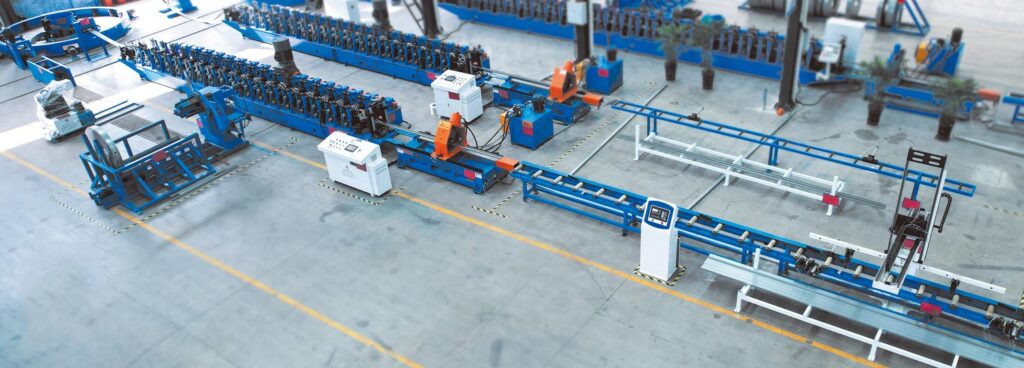
Punching is one of the most important decisions in the design of a photovoltaic bracket roll forming machine. Solar mounting profiles usually require mounting holes, elongated slots, connection holes, positioning features, or repeated hole patterns. These features must correspond accurately with the finished profile because they directly affect how brackets, rails, connectors, fasteners, and other structural components are assembled.
The key question is not simply whether a production line needs punching equipment. Manufacturers also need to determine where punching should occur in relation to roll forming. In a pre-punching configuration, holes and slots are produced while the strip is still flat or before most of the profile has been formed. In a post-punching configuration, punching takes place after the material has reached its finished or near-finished cross-section.
Neither approach is universally better. The correct choice depends on profile geometry, hole position, material behavior, required production rate, tooling complexity, dimensional requirements, and the relationship between punched features and the final formed section.
For manufacturers planning new photovoltaic bracket manufacturing equipment, understanding this difference early can prevent unnecessary tooling changes and help establish a more stable production process.
Key Takeaways
- Pre-punching generally offers simpler tooling and easier access because the material is still flat.
- Post-punching can improve control when hole position must be referenced directly to the finished profile geometry.
- Holes located close to bends require particular attention because forming can influence their final shape or position.
- Production speed depends on the complete punching, feeding, forming, and cutting cycle rather than the roll former alone.
- The best production line should be selected from the actual bracket drawing, material specification, hole layout, tolerance requirements, and planned production volume.
Why Punching Position Matters in PV Bracket Production
Photovoltaic mounting structures include many different metal components. Depending on the system design, these may include C-channels, U-channels, mounting rails, strut channels, ground-mount posts, connectors, purlins, and customized structural profiles.
The U.S. Department of Energy describes PV racking systems as the structures used to support photovoltaic modules on roofs or in fields and notes that ground-mounted racking commonly uses steel with protective coatings or galvanization. This makes dimensional consistency in structural profile manufacturing especially important because the finished components must be compatible with the broader mounting system. The DOE’s overview of solar photovoltaic manufacturing and racking systems provides useful background on how these structural components fit into photovoltaic installations.
On a roll forming line, punching affects far more than the appearance of the finished bracket. Hole location influences assembly, component interchangeability, fastener alignment, and subsequent installation. When repetitive holes or slots are involved, a small indexing inconsistency can be repeated throughout a production batch.
This is why the punching process should be considered during line design rather than added as an afterthought. Jinbolida’s solar photovoltaic bracket forming machine solutions can be configured around different profile requirements, while dedicated solar photovoltaic rack punching equipment addresses projects where hole patterns, multiple punching positions, or separate stamping operations require greater attention.
What Is Pre-Punching in a Photovoltaic Bracket Roll Forming Machine?
Pre-punching means that holes, slots, notches, or other features are produced before the strip passes through most or all of the roll forming stations.
In a typical coil-fed production concept, the material is decoiled and guided into a feeding or leveling section. The punching system processes the flat strip according to programmed positions, after which the material enters the roll forming section and gradually develops into the required profile.
One major advantage is accessibility. A flat strip can be supported relatively easily, and the punch and die can approach the material without interference from flanges, lips, ribs, or other three-dimensional features. This can simplify tooling design, particularly when several holes need to be produced across the width of the strip.
Pre-punching can therefore be highly effective for long production runs involving stable profiles and repeatable hole patterns. It is especially practical when punched features are located on relatively flat areas of the finished profile and remain sufficiently separated from heavily formed zones.
However, the finished hole position is influenced by everything that happens afterward. Material passes through multiple forming stations and undergoes gradual bending. Depending on the geometry, some local movement, deformation, or dimensional change may occur during this process.
For that reason, a pre-punching layout should not be evaluated only by the accuracy of the punching press. Engineers also need to understand how the strip behaves during forming.
What Is Post-Punching?
Post-punching moves the punching operation to a point where the profile has already been formed or substantially formed.
The principal advantage is that hole position can be referenced more directly to the finished geometry. Instead of predicting how a hole in flat strip will behave during forming, the production system processes the profile after the critical bends and dimensions have already been established.
This approach can be valuable when holes need to correspond closely with finished edges, flanges, connection surfaces, or multiple faces of the bracket. It may also reduce certain concerns associated with deformation of previously punched holes near bending areas.
The tradeoff is tooling complexity.
A finished C-channel, U-channel, strut, or other structural section is three-dimensional. The punching die must therefore accommodate the shape of the profile and provide sufficient support during the punching stroke. Tool access can become more difficult, especially when features are required on opposing faces or in confined areas.
Post-punching can also affect line cycle design. Depending on the equipment configuration, the profile may need to stop for punching, or the manufacturer may need a more sophisticated moving or synchronized punching arrangement to maintain continuous output.
Pre-Punching vs Post-Punching: Practical Comparison
The best choice becomes clearer when both methods are compared according to actual manufacturing requirements rather than treating one process as inherently superior.
| Comparison Factor | Pre-Punching | Post-Punching |
|---|---|---|
| Material condition during punching | Flat or partially formed strip | Finished or near-finished profile |
| Tool access | Generally easier | More dependent on profile geometry |
| Die design | Often simpler | May require profile-specific support |
| Multiple holes across strip width | Relatively convenient | Can require several punching directions |
| Hole behavior during forming | Must account for subsequent forming | Hole is produced after critical forming |
| Holes near bends | Requires careful evaluation | Can offer better control in some designs |
| Reference to finished profile | Requires process compensation where necessary | Can reference finished geometry more directly |
| Line integration | Well suited to many coil-fed lines | Integration can be mechanically more complex |
| Changeover considerations | Punch tooling and profile tooling must remain coordinated | Finished-profile tooling may be more profile-specific |
| Best suited to | Stable, repeatable patterns on suitable profile areas | Critical finished-position features and complex geometries |
This table should be treated as a selection framework rather than a fixed rule. Some photovoltaic bracket production lines may also use a combination of punching positions when the product contains several different feature types.
How Roll Forming Can Affect Pre-Punched Holes
Roll forming does not produce the finished profile in one bending operation. The strip passes through a sequence of roller stations that gradually changes its cross-section.
When a hole is located far from major bending zones, its geometry may remain relatively stable. When a hole or slot sits near a bend line, embossment, rib, flange transition, or heavily worked section, the forming sequence requires greater attention.
The concern is not simply whether the hole remains visible. Manufacturers need to evaluate whether its final location, orientation, edge condition, and relationship to surrounding geometry remain suitable for assembly.
Long slots deserve particular attention because they have directional geometry. If the surrounding material experiences significant deformation during forming, the finished relationship between the slot and the profile can differ from what would be expected from the flat-strip drawing alone.
Good production-line engineering therefore starts with the finished part drawing and works backward to determine the appropriate flat-strip layout, punching position, forming sequence, and tooling configuration.
This is one reason why manufacturers should provide the machine supplier with actual profile drawings rather than only a general description such as “solar C-channel” or “PV mounting rail.”
When Pre-Punching Is Usually the Better Choice
Pre-punching is often appropriate when production is centered on repeatable profiles with relatively straightforward hole layouts.
For example, a long C-channel may contain a recurring series of holes along its web. If those holes are positioned away from critical bends and remain stable through forming, punching the flat strip can provide a relatively straightforward production arrangement.
Flat-strip punching also makes it easier to install multiple punching tools across different positions. Depending on the design, round holes, elongated slots, notches, or other features can be arranged into a dedicated tooling system before the material enters the forming section.
This configuration can also simplify maintenance because the punching area remains comparatively accessible. Operators can inspect tooling, remove scrap, check die condition, and make certain adjustments without working inside a finished profile.
However, the final decision still needs validation with the actual material and profile design. Material grade, thickness, coating, bend positions, and forming sequence can all affect the result.
When Post-Punching Makes More Sense
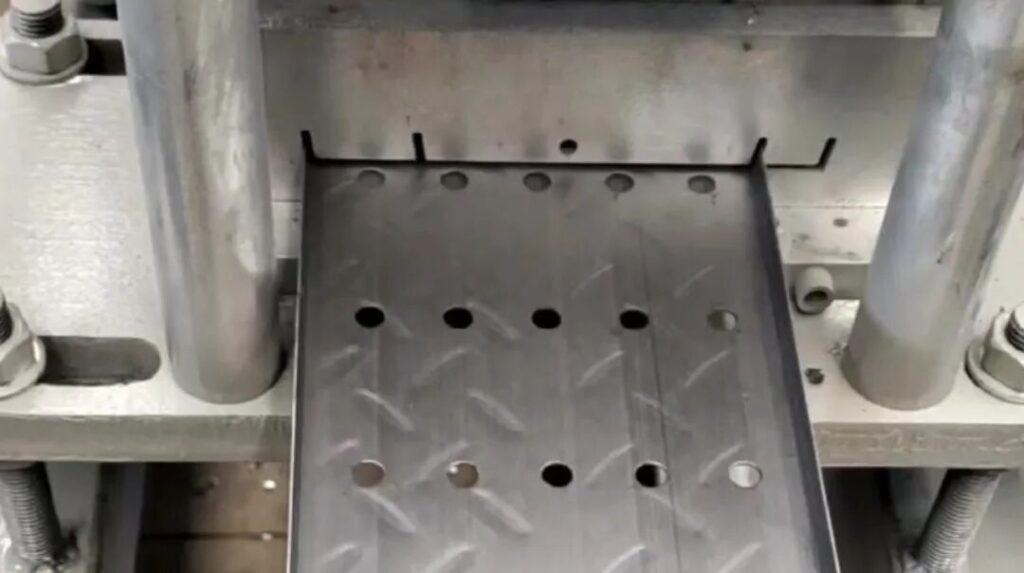
Post-punching becomes attractive when the final relationship between the hole and the formed section is especially important.
Consider a photovoltaic support component where mounting holes must align with a finished flange or where connection holes appear on several faces. In such cases, referencing the already formed profile may simplify certain dimensional relationships.
It can also be useful when pre-punched features would sit close to severe bending zones. Instead of attempting to compensate for the effects of forming, the manufacturer can create the feature after the geometry has been established.
The limitation is that a finished profile must be properly supported during punching. Without appropriate support, punching forces can distort thin-walled sections or affect surface quality. Tooling therefore has to match the specific profile.
As profile complexity increases, this becomes an important commercial consideration. A machine intended to manufacture many significantly different sections may require more post-punching tooling changes than a dedicated line producing one stable profile family.
Punching Speed Is Not the Same as Roll Forming Speed
A common mistake during machine selection is to focus heavily on the maximum forming speed while paying insufficient attention to punching frequency.
For a plain profile without holes, the forming section may be able to operate continuously at a relatively high line speed. Once repeated holes and slots are introduced, however, the complete production cycle becomes more important than the theoretical speed of the roll former.
A profile with only a few widely spaced holes places different demands on the punching system than a profile containing dense repeated patterns. A product requiring punching on several faces introduces another level of complexity.
Manufacturers should therefore evaluate output using the actual product drawing. The relevant question is not simply, “How many meters per minute can the machine run?” It is whether the complete line can produce the required finished profile consistently at the required output.
This includes feeding, positioning, punching, forming, cutting, unloading, and any additional handling operations.
The relationship among these sections is covered in more detail in Jinbolida’s guide to solar support bracket forming machine line layout, where individual equipment sections are considered as parts of a complete production system rather than isolated machines.
C-Channel and U-Channel Profiles Need Different Punching Analysis


The same punching configuration should not automatically be applied to every solar support profile.
C-channel and U-channel components may appear similar in a product catalog, but differences in flange geometry, lip design, width, depth, bend position, and connection method can change the manufacturing requirements.
A basic U-channel with web holes may be relatively straightforward. A lipped C-channel with slots near several bends may require much more careful coordination between punching and forming. Customized solar rails or strut profiles can introduce additional ribs, return edges, embossments, or multiple connection faces.
For this reason, profile geometry should be reviewed together with punching requirements. The existing Jinbolida comparison of C and U solar mounting bracket roll forming profiles explains how profile selection affects production-line configuration and provides useful context before deciding on the punching strategy.
The broader lesson is that a photovoltaic bracket roll forming machine should be designed around the finished component rather than around a generic machine specification.
How to Control Hole Position Accuracy
Reliable hole positioning begins before the punching stroke occurs.
The feeding system must move the strip or profile consistently. Punching commands must correspond to the correct programmed locations, and the control system must coordinate punching with material movement. Tooling condition must also remain stable throughout production.
For pre-punching, engineers additionally need to consider the relationship between flat-strip coordinates and finished-profile coordinates. If forming changes this relationship, the punching program or tooling layout may need appropriate compensation during machine commissioning.
For post-punching, support and positioning of the finished profile become particularly important. The profile needs to enter the punching area consistently so that the finished cross-section provides a repeatable reference.
Quality inspection should therefore evaluate the finished part rather than only checking the punching station. A hole can be correctly punched in the flat strip but still fail to meet the required finished relationship after forming.
First-article inspection should include the dimensions that matter to assembly: finished profile dimensions, hole spacing, hole-to-edge relationships, slot orientation, cut length, and the relationship between punched features and bends.
How Tooling Design Changes Between the Two Methods
Tooling cost and maintenance can influence the most practical production strategy.
Pre-punching often allows a relatively conventional punch-and-die arrangement because the strip is accessible from both sides. Tooling can be designed around the flat pattern and the required combination of holes.
Post-punching must accommodate the finished section. Dies may require shaped supports, internal backing, side punching arrangements, or other profile-specific mechanisms.
This does not mean post-punching is inherently inefficient. For the right product, the improvement in process control can justify the additional tooling complexity. The important point is that manufacturers should include tooling strategy in the initial machine evaluation.
This becomes particularly important for factories serving several customers. A factory producing one high-volume bracket may favor dedicated tooling optimized for that product. A contract manufacturer handling many different profiles may place greater value on flexible tooling and efficient changeover.
Should Punching and Roll Forming Be Integrated?
For many solar bracket factories, integrating punching and forming into one coordinated line can reduce intermediate material handling and make production management easier.
Integration does not necessarily mean every operation must share one mechanical machine body. It means that feeding, punching, forming, cutting, and control are engineered to work as one production system.
A well-planned integrated line can manage product length, hole pattern, batch quantity, and other production information through a coordinated control strategy. It can also reduce the need to move semi-finished components between separate workstations.
Separate punching remains useful in certain cases. A factory may already operate independent punching equipment, may manufacture low-volume customized connectors, or may need a flexible secondary operation for products that do not justify dedicated inline tooling.
Jinbolida’s product range therefore separates photovoltaic rack punching equipment from the broader forming-machine category, allowing production systems to be planned according to actual product and factory requirements rather than assuming a single configuration for every application.
What Information Should Be Provided Before Machine Design?
The quality of the machine proposal depends heavily on the quality of the information provided by the manufacturer.
A simple photograph of a bracket is usually insufficient for evaluating punching position. The machine designer needs to understand the complete geometry and production requirement.
The most useful starting point is a dimensioned finished-profile drawing showing the cross-section, overall length, hole dimensions, slot dimensions, hole spacing, bend positions, and relevant dimensional requirements. Material grade, coil thickness, coating condition, planned product range, expected batch sizes, and required production volume should also be defined.
If several profiles are expected to run on the same photovoltaic bracket roll forming machine, each profile should be evaluated separately. Changing width or depth is very different from changing the entire cross-section, hole arrangement, or number of punched faces.
Providing this information before quotation allows the supplier to determine whether pre-punching, post-punching, separate punching, or a combined production concept is more appropriate.
How to Choose Between Pre-Punching and Post-Punching
The final decision should begin with the finished bracket rather than with a preferred machine configuration.
If holes are located in stable areas of the profile, the patterns are highly repetitive, and access to the flat strip simplifies tooling, pre-punching can be a highly practical solution. When features must reference finished geometry closely, occur near complex forming areas, or require operations on several finished faces, post-punching deserves stronger consideration.
Production volume matters as well. Dedicated high-volume manufacturing can justify specialized tooling optimized around a stable bracket design. Factories producing a wider mix of components may value flexibility differently.
The important point is that punching strategy, roll forming strategy, tooling, feeding, control, and inspection should be evaluated together.
A photovoltaic bracket roll forming machine is not simply a sequence of rollers. It is a coordinated manufacturing system whose performance depends on how well the individual processes match the finished solar support component.
Common Mistakes When Specifying a PV Bracket Production Line
One common mistake is supplying only the cross-sectional drawing without the complete hole pattern. The profile may appear straightforward from the cross-section alone, while the actual punching requirements make the production line significantly more complex.
Another mistake is selecting a machine according to maximum line speed without calculating how frequently the finished product must be punched. A high nominal forming speed offers limited benefit when the punching cycle becomes the controlling operation.
Manufacturers can also underestimate changeover requirements. A line capable of forming several dimensions does not automatically mean that the same punching tools can process every hole layout.
Finally, dimensional requirements should be discussed before tooling is finalized. Applying unnecessarily restrictive tolerances to every dimension can increase machine and tooling complexity, while failing to identify genuinely critical assembly dimensions can create problems during production.
A better approach is to identify which dimensions affect component assembly, structural interfaces, fastener positions, and interchangeability, then build the manufacturing and inspection plan around those requirements.
Conclusion
Choosing between pre-punching and post-punching is an engineering decision that can influence tooling complexity, production efficiency, dimensional control, changeover, and long-term manufacturing stability.
Pre-punching offers excellent accessibility and can simplify tooling for many repetitive solar support profiles. Post-punching can provide advantages when critical holes need to reference the final formed geometry or when pre-punched features would be affected by complex bending.
The correct configuration therefore depends on the actual photovoltaic bracket rather than a general rule.
Before specifying a photovoltaic bracket roll forming machine, manufacturers should provide complete profile drawings, hole patterns, material information, product variants, and production requirements. Evaluating these factors together makes it possible to design a production line that balances punching accuracy, forming stability, automation, and practical factory output.
For manufacturers developing new solar mounting structure capacity, Jinbolida’s solar photovoltaic bracket manufacturing solutions cover roll forming, punching, profile processing, and integrated production configurations for different bracket designs.
FAQ
Should photovoltaic bracket holes be punched before or after roll forming?
Both methods are used. Pre-punching is often suitable when holes are positioned on stable areas of the profile and flat-strip access simplifies tooling. Post-punching may be preferable when hole location must reference finished geometry closely or when forming could affect features near bends.
Can pre-punched holes move during roll forming?
Their final relationship to the finished profile can be influenced by the forming process, particularly when holes or slots are close to bends or heavily formed areas. The finished component should therefore be validated during tooling development and commissioning rather than relying only on flat-strip dimensions.
Is post-punching always more accurate?
No. Accuracy depends on the complete production system, including feeding, positioning, tooling, profile support, control, and inspection. Post-punching can offer advantages for certain finished-profile references, but properly engineered pre-punching can also provide reliable repeatability for suitable bracket designs.
Can one photovoltaic bracket roll forming machine use both punching methods?
A customized line can incorporate different processing concepts if the product requirements justify them. However, adding multiple punching stages increases equipment and control complexity, so the configuration should be based on actual drawings, production volume, and the range of profiles to be manufactured.
What information is needed to select the punching system for a PV bracket line?
The supplier should receive dimensioned finished-profile drawings, complete hole and slot patterns, material grade, thickness, coating information, required product lengths, expected profile variants, production volume, and critical dimensional requirements. These details make it possible to evaluate tooling and line configuration correctly.
 English
  Arabic
  Russian
  Spanish
  French