
PV Bracket Punching Machine for Multi-Side Hole Patterns
Table of Contents
Introduction
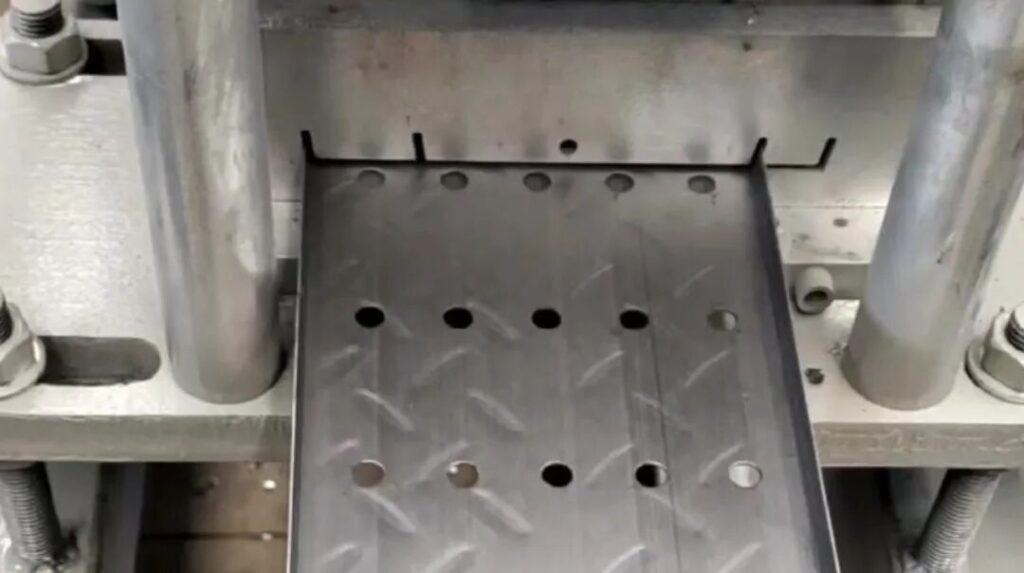
A PV bracket punching machine becomes more difficult to configure when the finished support profile contains more than one simple row of holes. Photovoltaic C-channels, U-channels, mounting rails, posts, and connectors can require round holes, elongated slots, locating holes, and connection features on the web, flanges, or several faces of the same profile.
In these applications, selecting a punching machine only by tonnage is not enough. Manufacturers also need to consider how many different hole types are required, which surfaces must be processed, how often the pattern changes, and whether several operations can be completed in one coordinated production flow.
The U.S. Department of Energy identifies racking and tracking structures as manufactured products within the broader solar manufacturing value chain. For PV support manufacturers, consistent hole processing is an important part of producing these structural components repeatedly.
Key Takeaways
- Multi-side PV brackets may require several independent punching positions.
- More punching stations are useful only when the product drawing actually requires them.
- Servo feeding helps coordinate repeated hole spacing and product length.
- Hole accuracy should be checked on the finished bracket, not only at the punching station.
- The correct machine should be selected from the profile drawing, hole layout, material and target output.
Why Multi-Side Hole Patterns Are More Difficult
A simple photovoltaic bracket may contain only repeated holes along the center of a flat web. That type of product can often be processed with a relatively straightforward punching configuration.
Complex C-shaped profiles are different.
One product may require several hole types on the central web and additional holes on both side surfaces. Another may combine round holes, elongated slots, and project-specific mounting features along a long profile.
The difficulty is not simply the total number of holes. Each punching direction requires suitable tooling access, part support, positioning and scrap removal.
This is where multi-station solar photovoltaic rack punching equipment becomes relevant.
Instead of repeatedly changing one die to perform different operations, separate stations can be assigned to different hole types or profile surfaces.
How Many Punching Stations Does a PV Bracket Need?
There is no universal answer.
A machine with more stations is not automatically better. The correct number should follow the actual hole drawing.
| Product Requirement | Possible Equipment Direction |
|---|---|
| One repeated hole type | Simple punching configuration |
| Several hole types on one face | Multi-tool or multi-station punching |
| Web plus side holes | Multi-side punching arrangement |
| Several hole types on three faces | Higher-station configuration |
| Frequently changing custom patterns | Flexible tooling and programmable feeding |
| Stable high-volume profile | Dedicated station layout |
For example, Jinbolida’s Nine-Station Punching Machine is designed for C-shaped steel requiring processing on three sides and several hole types.
This type of machine makes sense when the product genuinely contains that level of complexity. A simple bracket with only one or two repeated holes does not need the same station configuration.
Multi-Station Punching vs Repeated Die Changes
One advantage of multi-station punching is that different operations can remain assigned to dedicated tooling.
Consider a C-profile requiring three different hole shapes.
With a simple machine, the factory may need to change dies or process the material through several separate production steps. This increases setup and material handling.
A multi-station system can distribute these operations across several units and coordinate them through the feeding and control system.
For stable production, this can reduce repeated tooling changes and make complex patterns easier to reproduce.
However, manufacturers should still compare this advantage against batch size.
If the product changes every few pieces, highly dedicated tooling may provide less value than it does in long repetitive production.
Why Servo Feeding Matters for Hole Position
Punching accuracy depends partly on how consistently the material reaches each programmed position.
Servo feeding is therefore important for PV brackets containing repeated pitch dimensions.
The control system moves the material according to the programmed distance, stops or coordinates with the punching cycle, and then advances to the next position.
However, servo accuracy alone does not guarantee a qualified finished bracket.
Tool alignment, material guidance, die condition, profile support and the relationship between punching and subsequent roll forming also influence the final result.
The site’s detailed guide to hydraulic punching machines for PV brackets covers servo feeding, die clearance, punching accuracy and tooling in greater technical depth.
For this article, the main takeaway is simpler: feeding, tooling and profile geometry must be evaluated together.
Should Multi-Side Holes Be Punched Before or After Forming?
Pre-punching is often attractive because the strip remains flat.
Tool access is easier, and several holes can be arranged across the strip before it enters the roll forming section.
For many photovoltaic channels, this creates an efficient production flow.
The limitation appears when holes are close to bend lines or when their finished position needs to reference the formed profile very closely.
Post-punching creates holes after the section has been formed or substantially formed. This can improve the relationship with finished geometry in some applications, but the three-dimensional profile is more difficult to support and access.
The existing Photovoltaic Bracket Roll Forming Machine: Pre-Punching vs Post-Punching guide explains this choice in detail.
For multi-side profiles, it is also possible that different features require different processing strategies.
C-Channel Profiles Often Need More Punching Analysis

C-shaped photovoltaic profiles can contain a central web, side flanges and return lips.
Once the profile becomes three-dimensional, those surfaces create different punching directions.
This is one reason C-channel projects should be evaluated together with the complete hole layout rather than only the cross-section.
Jinbolida’s Solar Photovoltaic Bracket C-Channel Steel Roll Forming Machine represents the forming side of this production process, while dedicated punching equipment can handle more complex hole requirements.
For factories producing C-channel in high volume, forming and punching capacity should be calculated together.
A fast roll forming machine provides limited benefit if the punching cycle becomes the main bottleneck.
Punching Speed Should Be Calculated From the Product
Machine punching frequency is useful, but it does not directly equal finished bracket output.
A profile requiring three punching operations has a different cycle from a profile requiring twelve.
Product length, feeding distance and the number of punched faces also influence the result.
A better calculation starts with the finished drawing:
- Count the required hole groups.
- Determine how many can be produced in one stroke.
- Calculate feeding movements between positions.
- Add punching and material-positioning time.
- Include cutting and downstream handling.
The resulting cycle provides a much better estimate of practical output.
For a complete capacity method, the site’s solar bracket production line capacity calculation explains why punching, cutting, product length and downtime should be considered together.
What Should Be Checked Before Ordering a PV Bracket Punching Machine?
The machine supplier should receive more than a photograph or a simple statement that “three-side punching is required.”
The most useful RFQ information includes:
| Information | What to Provide |
| Profile drawing | Finished cross-section |
| Hole drawing | Hole and slot dimensions |
| Punching faces | Web, side or multiple surfaces |
| Material | Grade and coating |
| Thickness | Minimum and maximum |
| Product length | Typical production lengths |
| Hole pitch | Repeated spacing requirements |
| Product volume | Pieces or tons per shift |
| Product variants | Different planned hole patterns |
| Accuracy requirement | Critical finished dimensions |
This allows the supplier to determine whether three-station, six-station, nine-station or another customized configuration is more appropriate.
Avoid Selecting the Machine by Station Count Alone
“More stations” sounds attractive in a quotation, but unused stations do not automatically improve production.
Extra tooling increases machine complexity, setup, maintenance and investment.
The correct objective is to provide enough punching capacity for the actual product family.
A manufacturer producing one stable three-side C-channel with several hole types may benefit greatly from a Nine-Station Punching Machine.
Another manufacturer producing simpler profiles may obtain better efficiency from a lower-station configuration.
Machine selection should therefore follow the hole matrix rather than a preference for the largest machine.
Conclusion
A PV bracket punching machine for multi-side hole patterns should be selected from the finished component rather than from tonnage or station count alone.
The most important factors are hole type, punching surface, profile geometry, material, feeding distance, production volume and the relationship between punching and roll forming.
Multi-station systems are particularly useful when a bracket contains several stable hole patterns across different faces because separate tooling can reduce repeated die changes and create a more coordinated production process.
For simpler profiles, a smaller punching configuration may be more practical.
Manufacturers should therefore provide complete cross-sectional and hole drawings before equipment is selected. Jinbolida’s photovoltaic rack punching equipment includes different station configurations that can be matched to the actual C-channel, U-channel or customized photovoltaic bracket being manufactured.
FAQ
What is a multi-station PV bracket punching machine?
A multi-station punching machine uses several punching units or tooling positions to process different hole types or surfaces. It is useful when photovoltaic brackets contain complex repeated patterns that would otherwise require frequent die changes or several separate processing steps.
How many punching stations are needed for a solar bracket?
The number depends on the hole drawing. A simple one-face profile may need only a basic configuration, while C-shaped steel with several hole types on three surfaces can justify a higher-station machine. Buyers should not choose station quantity before the complete profile and hole layout are reviewed.
Can a PV bracket punching machine process holes on three sides?
Yes, equipment can be configured for multi-side processing when the profile and tooling permit it. Jinbolida’s nine-station configuration, for example, is designed for three-side processing of C-shaped steel with several hole types.
What should I send before requesting a punching machine quotation?
Provide the finished profile drawing, complete hole and slot layout, material grade, thickness, product length, punching surfaces, required output, planned product variations and critical dimensional requirements. These details allow the supplier to determine the station quantity, tooling and feeding configuration.
 English
  Arabic
  Russian
  Spanish
  French