
Как выбрать линию по производству фотоэлектрических кронштейнов
Оглавление
Линия по производству фотоэлектрических кронштейнов не должна выбираться только по скорости машины или уровню автоматизации. правильная конфигурация зависит от того, какие кронштейны вам нужно изготовить, спецификации стали или алюминия, рисунка отверстий, допусков на размеры, объема производства, ассортимента продукции и способа перемещения материала по вашей фабрике.
Это различие имеет значение, поскольку в фотоэлектрических системах крепления могут использоваться различные рельсы, каналы, стойки, раскосы и компоненты соединения в зависимости от конструкции установки. Как поясняется в этом обзоре системы фотоэлектрического монтажа, монтажные конструкции образуют механическую опору между фотоэлектрическими модулями и крышей, землей или другой опорной конструкцией.
Для производителя кронштейнов такое разнообразие напрямую приводит к различным производственным требованиям.
Фабрика больших объемов производства одного профиля С-канала может извлечь выгоду из высокоинтегрированной линии с автоматизированной штамповкой, формовкой, резкой и штабелированием. Производитель, поставляющий несколько систем кронштейнов меньшими партиями, может вместо этого нуждаться в более быстрой замене и более гибкой оснастке.
Поэтому наиболее эффективный способ выбора оборудования - работать назад от готового кронштейна, а не вперед из каталога машин.
Что делает линия по производству фотоэлектрических кронштейнов?
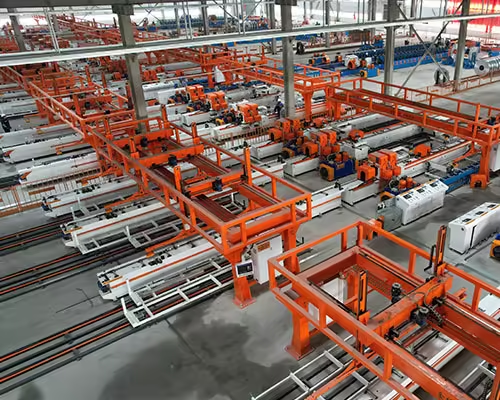
Линия по производству фотоэлектрических кронштейнов преобразует металлические катушки или подготовленную полосу в профили и компоненты, используемые в солнечных монтажных конструкциях.
В зависимости от товара полная линейка может сочетаться
- Загрузка катушки
- Разгружать
- Выравнивание
- Сервопитание
- Штамповка
- Выемка
- Формирование рулона
- Измерение длины
- Резка
- Разгрузка
- Поворот
- Штабелирование
- Мониторинг производства
Джинболида решения для производственных линий фотоэлектрических кронштейнов может интегрировать несколько из этих процессов в скоординированную производственную систему.
Для длинных конструкционных профилей, таких как каналы C и U-каналы, профилирование рулонов обычно является центральным процессом. Более короткие соединители и пластины могут потребовать различного оборудования для штамповки, резки или формования.
Вот почему производители, планирующие построить полноценный завод по производству компонентов для солнечного монтажа, должны оценить как профилеобразующее оборудование, так и фотоэлектрическое оборудование для штамповки стоек вместо того, чтобы относиться к каждому компоненту так, как если бы он производился одной и той же машиной.
Начните с чертежа готового профиля
Важнейшим документом при выборе производственной линии фотоэлектрических кронштейнов обычно является чертеж готового изделия.
Он говорит производителю машины гораздо больше, чем общее утверждение, такое как
“Нам нужна машина для солнечных кронштейнов.”
Полезный чертеж должен определять такие параметры, как
| Информация о продукте | Почему это важно |
|---|---|
| Форма профиля | Определяет оснастку валков и последовательность формования |
| Ширина и высота профиля | Определяет геометрию машины |
| Толщина материала | Влияния, формирующие силу и оснастку |
| Размеры отверстия | Определяет пробивные инструменты |
| Расстояние между отверстиями | Влияет на кормление и позиционирование |
| Слот-шаблон | Влияет на конфигурацию штамповки |
| Длина | Влияет на резку и обработку на выходе |
| Допуск размеров | Влияет на требования к управлению линией |
| Требование прямолинейности | Влияет на формирование и коррекцию |
| Состояние поверхности | Влияет на конструкцию роликов и манипуляций |
Производитель, поставляющий только один профиль, должен отправить этот чертеж.
Производитель, производящий десять или двадцать спецификаций, должен подготовить полную матрицу продукта до начала настройки машины.
Это позволяет определить, могут ли эти продукты реально использовать одну формирующую линию или их следует разделить на специальное и гибкое оборудование.
Определите материал перед выбором машины
Два кронштейна со схожими размерами могут вести себя по-разному при формовании, если их материалы имеют разные механические свойства.
Важная материальная информация включает в себя
- Стальной марки
- Предел текучести
- Прочность на разрыв
- Диапазон толщины
- Ширина полосы
- Вес катушки
- Внутренний диаметр катушки
- Внешний диаметр катушки
- Оцинкованное или другое покрытие
- Требования к защите поверхности
Формообразуемость материала особенно важна при холодной штамповке.
Международная организация по стандартизации поддерживает стандарты, касающиеся стали, используемой для холодной штамповки Например, ИСО 13887 покрывает холодновосстановленный стальной лист более высокого предела текучести с улучшенной формуемостью, при этом ИСО 20805 относится к некоторым горячекатаным стальным листам в рулонах, предназначенных для холодной штамповки.
Эти стандарты не означают, что каждая солнечная скоба должна использовать эти конкретные марки. Они иллюстрируют важный инженерный принцип: прочность и формуемость материала необходимо учитывать вместе при разработке процесса формования.
Материал с более высокой прочностью может потребовать различных радиусов формования, конструкции станции, мощности привода и компенсации пружинения по сравнению с более мягким материалом.
Поэтому в RFQ следует указывать фактический материал, а не просто писать “galvanized steel.”
Определите, какие профили кронштейна вам необходимо создать
Solar mounting structures can contain a wide range of profiles and connectors.
Общие примеры включают:
- C-channel brackets
- U-канальные опоры
- Каналы стойки
- Z profiles
- Монтажные рельсы
- Наземные столбы
- Перлинс
- Брекет-члены
- Разъемные пластины
- Clamps
- Базовые пластины
- Tracker components
Джинболида солнечный фотоэлектрический кронштейн формируя машинный ряд covers equipment for multiple photovoltaic profile applications.
The correct machine architecture depends on how similar those profiles are.
Profiles with similar dimensions may sometimes share tooling or use adjustable roll stations. Products with substantially different geometry may require tooling replacement or separate forming machines.
This creates one of the most important purchasing decisions in a PV bracket factory:
Should you optimize for maximum output or maximum flexibility?
Выделенная линия против гибкой многопрофильной линии
There is no universally better option.
A dedicated line is typically optimized around a limited range of products, while a flexible line sacrifices some simplicity in exchange for the ability to process more specifications.
| Производственная ситуация | Более подходящее направление |
| One profile, very high volume | Dedicated production line |
| Several similar C/U profiles | Adjustable or interchangeable solution |
| Frequent small batches | Flexible production configuration |
| Long campaigns with few changes | High-output dedicated line |
| Contract manufacturing | Flexible multi-profile capability |
| Rapidly changing product portfolio | Future-expandable tooling strategy |
A common purchasing mistake is asking:
“How many profiles can this machine produce?”
A better question is:
“How long does a complete changeover take between the profiles we actually sell?”
Those two questions are not equivalent.
A line may technically produce many sizes, but if tooling changes and recalibration take several hours, it may not suit a factory processing frequent small batches.
Оцените штамповку перед профилированием рулона
Hole processing is one of the most important parts of photovoltaic bracket manufacturing.
Solar brackets may contain:
- Круглые отверстия
- Slotted holes
- Elongated mounting slots
- Repeated hole patterns
- Соединительные отверстия
- Выемки
- End features
The number, shape and spacing of these features influence punching equipment selection.
Before choosing a line, determine:
- How many hole patterns are required?
- Are the patterns fixed or variable?
- Does every product use the same punching sequence?
- How frequently will product specifications change?
- What positional tolerance is required?
- Is high-speed repetitive punching required?
- Should punching be integrated into the forming line?
Джинболида предоставляет специальные оборудование для перфорации стоек солнечных фотоэлектрических панелей as well as systems in which punching can be coordinated with feeding, forming and cutting.
The correct decision should follow the product mix rather than assuming integrated punching is always superior.
Предварительная или последующая штамповка?
The punching position within the manufacturing sequence can affect both equipment layout and dimensional control.
Предварительная штамповка
In a pre-punching arrangement, holes and slots are produced while the material is still flat or before the profile is fully formed.
Potential advantages include:
- Easier access to the material
- Simpler punching tooling in some applications
- Efficient repetitive hole processing
- Easier integration with servo feeding
However, the designer must understand how the subsequent forming process influences the final location of those features.
После перфорации
Post-punching processes features after part or all of the profile has been formed.
This may be useful where the finished geometry provides a more appropriate dimensional reference, but tooling access can become more complicated.
There is no single correct answer for every bracket.
Hole pattern, profile geometry, accuracy requirement, speed and tooling cost should all be evaluated before selecting the sequence.
Не выбирайте линию только по максимальной скорости
Machine speed is one of the most frequently misunderstood specifications in equipment purchasing.
Suppose a forming machine is rated at 40 m/min.
That does not automatically mean the factory will continuously produce saleable brackets at 40 m/min.
Actual output can also be limited by:
- Цикл перфорации
- Ускорение и замедление
- Метод резки
- Длина продукта
- Tooling change
- Изменение катушки
- Материальная загрузка
- Operator intervention
- Штабелирование
- Упаковка
- Проверка качества
- Обслуживание
- Downstream bottlenecks
For this reason, the more useful metric is often finished parts per hour or finished meters per shift under the actual production recipe.
Jinbolida’s existing guide to PV bracket factory workflow discusses how receiving, coil preparation, punching, forming, inspection and downstream handling need to work as a connected process.
A fast roll former surrounded by slow material handling can still create a low-output factory.
Рассчитайте необходимую мощность на основе реального спроса
Before requesting equipment speed, calculate your required output.
A simplified production estimate can start with:
Annual demand ÷ working days ÷ shifts ÷ effective production hours
For example, imagine a factory needs to produce:
- 6,000,000 meters per year
- 300 production days
- 2 shifts per day
- 8 hours per shift
The theoretical average requirement is:
6,000,000 ÷ 300 ÷ 2 ÷ 8 = 1,250 meters per hour
But this calculation assumes 100% utilization.
Real factories experience downtime from:
- Замена катушки
- Изменения инструмента
- Чистка
- Обслуживание
- Проверка качества
- Material shortages
- Production scheduling
- Переключение продукта
Therefore, capacity planning needs a realistic utilization allowance rather than simply matching theoretical annual demand to rated machine speed.
Сопоставьте систему резки с продуктом
Cutting is another area where buyers often focus on the forming machine but overlook the effect of the downstream process.
The cutting method influences:
- Время цикла
- Точность длины
- Конечное условие
- Шум
- Tool maintenance
- Line continuity
Depending on the application, a system may use hydraulic cutting, tracking cutting, saw cutting or other configurations.
For high-throughput production, cutting should be coordinated with line speed so it does not repeatedly force the forming process to stop.
For lower-volume or frequently changing products, a simpler system may sometimes be economically more appropriate.
The correct selection depends on the required production cycle and cut quality rather than the name of the cutting technology alone.
Рассмотрите возможность защиты поверхности оцинкованных профилей
Many photovoltaic mounting profiles use coated steel because the final bracket is expected to operate outdoors.
That creates an additional manufacturing requirement: forming and handling should minimize unnecessary surface damage.
Важные соображения включают
- Roller surface condition
- Чистота оснастки
- Выравнивание направляющих
- Contact pressure
- Burrs
- Material dragging
- Metal chips
- Метод штабелирования
- Transport between processes
A machine can produce dimensionally correct profiles while still creating commercial problems if the surface is heavily scratched during forming or unloading.
Surface requirements should therefore be included in the project specification from the beginning.
Думайте за пределами рулона. Бывший
An efficient photovoltaic bracket production line is more than a roll forming machine.
A complete manufacturing system may require coordinated equipment before and after forming.
A typical flow could be:
Coil Storage → Decoiling → Leveling → Feeding → Punching → Roll Forming → Cutting → Unloading → Stacking → Inspection → Packaging
The exact configuration should depend on the product.
Jinbolida’s guide to солнечная опорная скоба формируя схему линии машины explains why equipment position, coil-loading space, maintenance access, punching capacity and downstream handling should be planned together.
This becomes increasingly important as automation rises.
Automating one process while leaving the next process manual can simply move the bottleneck further downstream.
Выберите правильный уровень автоматизации
More automation does not automatically mean a better investment.
The right level depends on:
- Labor availability
- Стоимость труда
- Объем продукта
- Number of SKUs
- Размер партии
- Required traceability
- Factory management system
- Частота переключения
- Product handling requirements
- Investment budget
Consider three simplified scenarios.
Сценарий 1: Стандартный продукт большого объема
The factory manufactures a small number of bracket profiles continuously.
A more integrated line can be attractive because repetitive handling and operator intervention can be reduced.
Сценарий 2: Множество продуктов малой партии
The manufacturer serves multiple customers and changes specifications frequently.
Fast adjustment and flexible tooling may create more value than maximum automation.
Сценарий 3: Быстрое расширение мощностей
The manufacturer already has equipment but needs substantially higher output.
The correct solution may not be replacing every machine.
Instead, the bottleneck should first be identified. Punching, forming, coil handling or stacking may be restricting capacity.
This is why factory-level analysis is often more useful than comparing machines individually.
Оцените макет завода перед заказом
Equipment dimensions alone are not enough for layout planning.
Allow space for:
- Coil delivery
- Доступ к крану или вилочному погрузчику
- Загрузка катушки
- Tooling storage
- Электрические шкафы
- Operator movement
- Обслуживание
- Finished profile discharge
- Инспекция
- Штабелирование
- Упаковка
- Экстренный доступ
- Future expansion
Long photovoltaic profiles also need sufficient discharge length.
A line that physically fits between two walls may still be impractical if there is no room to replace tooling or remove finished material.
The factory drawing should therefore be shared with the equipment supplier before final configuration.
Понимайте точность как полную систему
Customers commonly ask for “high precision,” but precision needs to be translated into measurable requirements.
Relevant dimensions may include:
- Ширина профиля
- Высота профиля
- Flange dimension
- Диаметр отверстия
- Положение отверстия
- Длина слота
- Допуск длины
- Прямолинейность
- Твист
- Cross-sectional angle
Each of these can be affected by different processes.
For example, a hole-position issue may originate from feeding or punching rather than roll forming.
A length problem may relate to measurement or cutting.
Profile twist may relate to tooling, material variation or forming balance.
The equipment specification should therefore define which dimensions matter and how they will be inspected.
Рассмотрим изменение материала, а не только номинальную толщину
A drawing may specify material thickness of 2.0 mm, but real coil material always has permitted manufacturing variation.
The same applies to mechanical properties.
This is one reason the production line should be engineered for a realistic material range rather than one perfect theoretical value.
ISO’s Steel Technical Committee covers standardization relating to cast, wrought and cold-formed steel, illustrating how material specifications and delivery conditions form an important part of industrial processing.
For equipment projects, buyers should provide the applicable material standard or actual mill certificate whenever possible.
That gives the equipment engineer more useful information than a generic steel description.
Планируйте изменение, прежде чем оно вам понадобится
Photovoltaic mounting products can change as customer projects, structural designs and market requirements evolve.
Therefore, manufacturers should consider future products before finalizing machine tooling.
Просить:
- Can width be adjusted?
- Can forming stations be repositioned?
- How is tooling replaced?
- How long does replacement take?
- Which parts are product-specific?
- Are recipes stored in the control system?
- What requires manual adjustment?
- Could future tooling be added?
If your production includes C-channel and U-channel variants, reviewing Jinbolida’s solar photovoltaic bracket forming machine solutions can help illustrate the range of profile-processing equipment that may be involved.
The objective is not to buy an unnecessarily complicated machine.
It is to avoid discovering after installation that every new profile requires major equipment modification.
Оцените общую себестоимость производства, а не только цену машины
The lowest quotation does not always create the lowest manufacturing cost.
A production-line investment should consider:
- Initial equipment price
- Инструментарий
- Установка
- Shipping
- Требования оператора
- Потребление энергии
- Обслуживание
- Запасные части
- Changeover downtime
- Обломки
- Tool life
- Product quality
- Пропускная способность
- Future expansion
Imagine two lines.
Line A costs less but requires two additional operators and 90 minutes of product changeover.
Line B costs more but requires fewer operators and changes products in 20 minutes.
Which is cheaper?
The answer depends on your actual production schedule.
A manufacturer producing one profile for several weeks may gain little from rapid changeover.
A contract manufacturer changing products three times per shift could obtain significant value from it.
The correct economic comparison therefore needs to reflect the production model.
Распространенные ошибки при покупке линии по производству фотоэлектрических кронштейнов
Выбор по цене перед определением продукта
Different machine quotations may represent completely different technical configurations.
The finished profile and production requirement should be defined first.
Запрашивать только для максимальной скорости
Rated speed is not the same as effective factory output.
Evaluate the complete manufacturing cycle.
Игнорирование пробивной способности
A fast roll forming machine cannot compensate for a punching process that cannot keep pace.
Недооценка переключения
Flexibility should be measured in actual changeover steps and time.
Игнорирование обработки нисходящего потока
Manual unloading and stacking can become a bottleneck when upstream equipment is automated.
Предоставление неполной информации о материалах
Material grade and mechanical properties can influence forming behavior.
Проектирование машины перед заводской компоновкой
Machine access, coil loading and product discharge must be considered before equipment is finalized.
Покупка автоматизации без производственной причины
Automation should solve a measurable labor, quality, throughput or traceability requirement.
Информация, которую необходимо подготовить перед запросом предложения
A professional RFQ should contain enough information for the supplier to design the line around the real product.
Prepare the following:
| Category | Информация, которую необходимо предоставить |
| Профиль | 2D/3D drawings |
| Материал | Grade and standard |
| Толщина | Минимальный и максимальный |
| Катушка | Width, ID, OD and weight |
| Шаблон отверстия | Drawing and tolerance |
| Длина продукта | Минимальный и максимальный |
| Выход | Pieces/hour or meters/year |
| Смесь продуктов | SKUs and batch quantities |
| Переключение | Required frequency |
| Поверхность | Coating and finish |
| Автоматизация | Desired level |
| Фабрика | Layout and available area |
| Коммунальные услуги | Voltage, frequency and air |
| Качество | Критические допуски |
| Expansion | Expected future products |
The more complete this information is, the easier it becomes to compare equipment proposals on an equal basis.
Как сравнить два предложения производственной линии
When two suppliers submit quotations, do not compare only the final price.
Use a technical comparison table.
| Evaluation Area | Questions to Ask |
| Формирование | How many forming stations and why? |
| Инструментарий | What material and treatment are used? |
| Штамповка | What cycle and positioning method are used? |
| Резка | Does cutting interrupt production? |
| Скорость | Is it forming speed or effective output? |
| Переключение | What steps and time are required? |
| Контроль | Which parameters are recipe-controlled? |
| Обработка | Is unloading automatic or manual? |
| Точность | Which tolerances are guaranteed? |
| Установка | What commissioning support is included? |
| Запасные части | What critical parts are recommended? |
| Expansion | Can future profiles be added? |
This converts the buying process from a price comparison into an engineering comparison.
Когда полностью интегрированная линия имеет смысл?
A highly integrated line becomes particularly attractive when:
- Product demand is stable
- Объем производства высокий
- Processes are repetitive
- Labor reduction is important
- Material transfer creates bottlenecks
- Product traceability is required
- Finished profiles can be automatically handled
In these conditions, integrating loading, forming, cutting and stacking can reduce unnecessary work between separate machines.
Джинболида photovoltaic support equipment guide provides additional discussion of when integrated equipment makes sense and when separate machines may provide greater flexibility.
Когда отдельные машины лучше?
Separate machines can still be appropriate.
They may make sense when:
- Production volume is moderate
- Разнообразие продукции очень высокое
- Different processes serve multiple product families
- The manufacturer already owns usable equipment
- Capital investment needs to be phased
- Batch production changes frequently
The key principle is simple:
Integration should remove a real production bottleneck, not merely make a production line look more advanced.
Практический процесс отбора
A reliable photovoltaic bracket production line selection process can be summarized in nine steps:
- Collect all finished bracket drawings.
- Group similar and different profile families.
- Define the actual material specification.
- Map all punching, forming and cutting operations.
- Calculate required annual and hourly output.
- Determine acceptable changeover time.
- Define the appropriate automation level.
- Check factory layout and material flow.
- Compare suppliers using measurable technical criteria.
Following this order dramatically reduces the risk of selecting equipment before the manufacturing problem has been properly defined.
Часто задаваемые вопросы
Какие машины необходимы для изготовления фотоэлектрических кронштейнов?
The exact equipment depends on the bracket design. A production system may include a decoiler, leveler, feeder, punching machine, roll forming machine, cutting unit, unloading system and stacking equipment. Connector components may require additional punching or forming equipment.
Может ли одна профилегибочная машина производить различные размеры солнечных кронштейнов
Yes, some machines can produce multiple sizes through adjustable or interchangeable tooling. However, the number of possible profiles does not alone determine flexibility. Buyers should also evaluate the actual changeover procedure and time.
Какая информация необходима для цитирования линии по производству фотоэлектрических кронштейнов?
The most important information includes profile drawings, material grade, thickness, coil dimensions, hole patterns, product lengths, required output, production mix and desired automation level.
Следует ли интегрировать штамповку с профилегибочной машиной?
It can be, but integration is not always the best solution. The decision depends on hole patterns, production volume, cycle time, product variety and factory workflow.
Что определяет скорость производственной линии солнечных кронштейнов?
Effective speed can be limited by feeding, punching, roll forming, cutting, coil replacement, changeover, unloading and stacking. The slowest process in the production sequence often determines actual output.
Всегда ли полностью автоматическая линия фотоэлектрических кронштейнов лучше?
No. High automation is especially valuable for repetitive, high-volume production. Smaller batches and frequent specification changes may benefit more from flexible equipment.
Почему сорт материала важен для профилирования валков?
Different yield strength, tensile strength and formability can change springback and forming behavior. These differences can affect tooling design, forming sequence and machine requirements.
Как мне сравнить две цитаты на фотоэлектрических кронштейнах?
Compare the complete technical scope: forming stations, tooling, punching, cutting, effective production speed, changeover, automation, accuracy, downstream handling, service and future expansion—not only the purchase price.
Заключение
Choosing a photovoltaic bracket production line starts with the finished product, not the machine.
Profile geometry, steel properties, hole patterns, production volume, changeover frequency, automation requirements and factory layout all influence the correct configuration. A line designed for a high-volume C-channel manufacturer may be completely different from equipment designed for a contract manufacturer producing many solar bracket specifications.
The most useful purchasing process is therefore to define products and production targets first, identify the processes required to manufacture them, and then determine how those processes should be connected.
Manufacturers planning new photovoltaic bracket capacity can review Jinbolida’s солнечные фотоэлектрические машины для формирования кронштейнов, фотоэлектрическое оборудование для штамповки стоек and existing PV bracket factory workflow guide for additional production-line planning information.
For a customized production line proposal, prepare your profile drawing, material specification, hole pattern, required capacity and available factory layout, then свяжитесь с Джинболидой to discuss a configuration based on your actual manufacturing requirements.
 Russian
  English
  Arabic
  Spanish
  French